

Details
Description
Jules René Hervé "View of L'Arc de Triomphe" Paris -Original Oil Painting
French Impressionist - Oil Painting on board - …
Read more
Jules René Hervé "View of L'Arc de Triomphe" Paris -Original Oil Painting
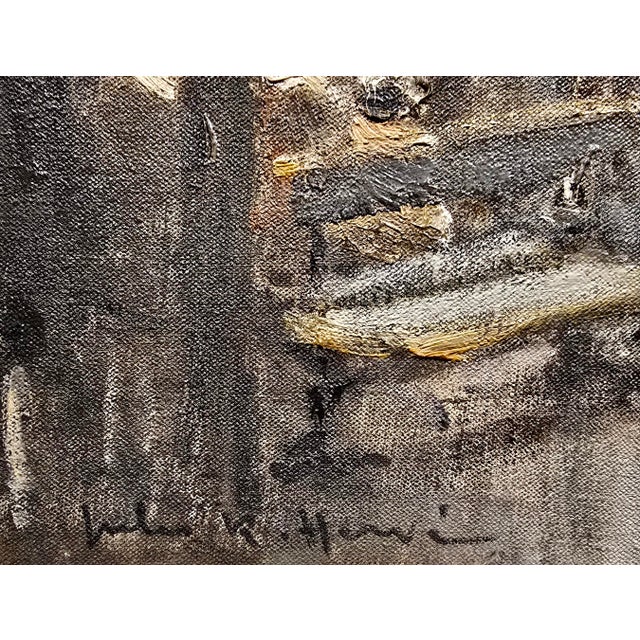
French Impressionist - Oil Painting on board - Signed -circa 1940s/50s
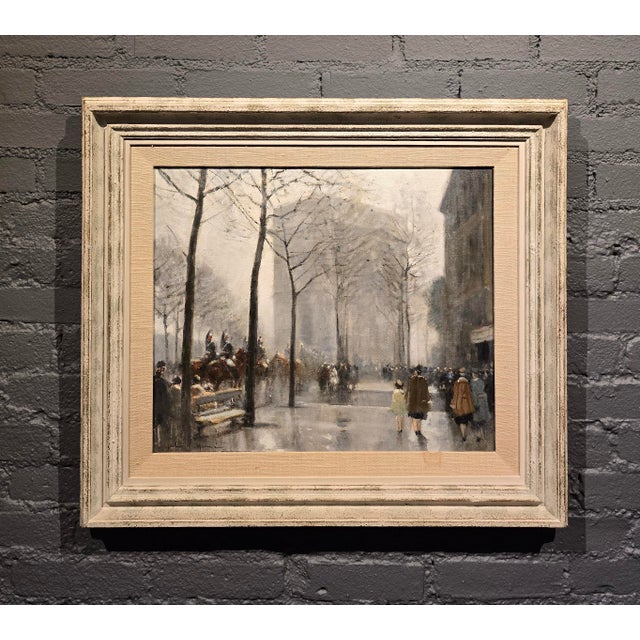
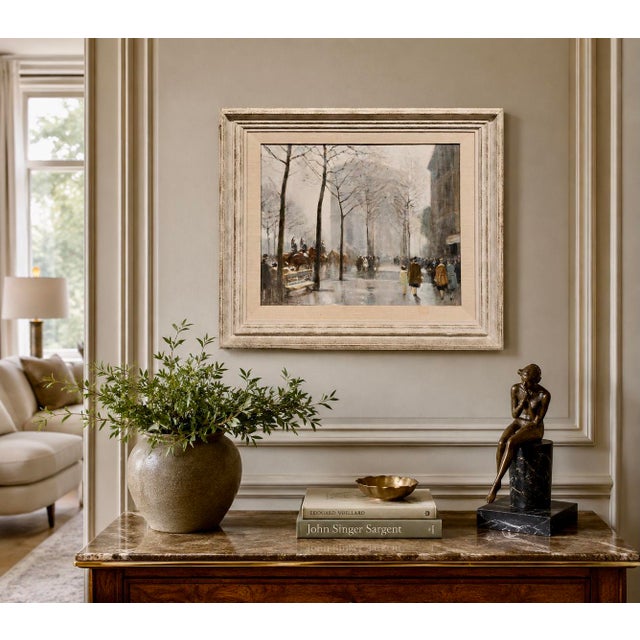
Board Size 18x22" - Frame size 26x30x2
Description:
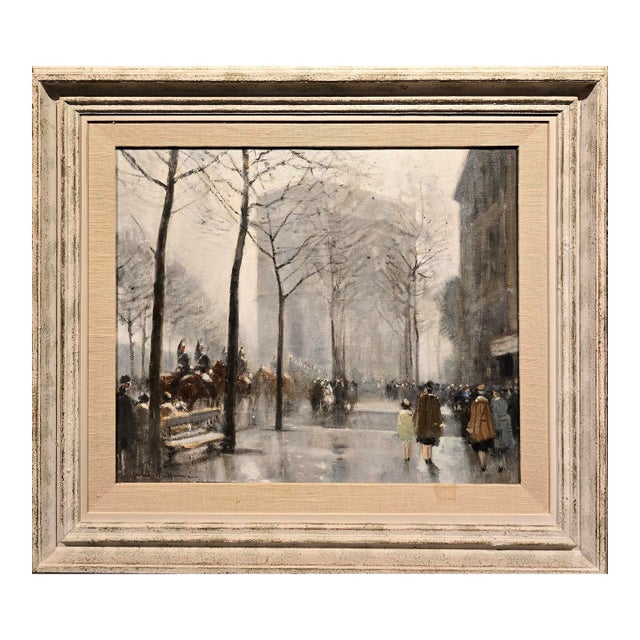
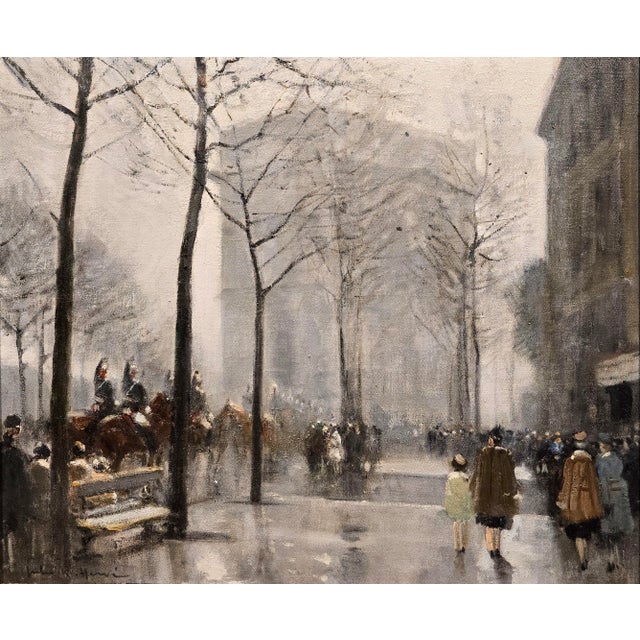
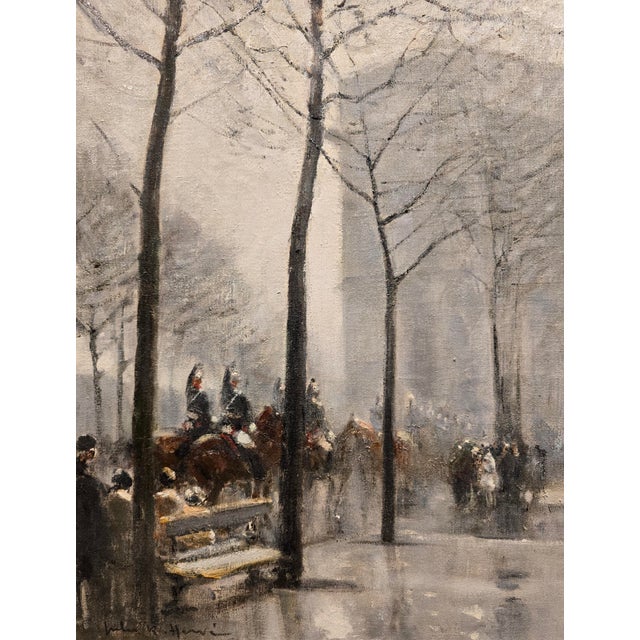
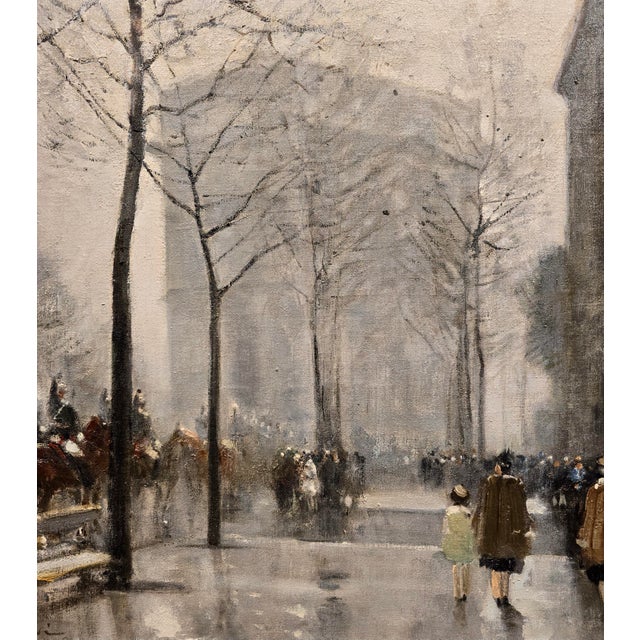
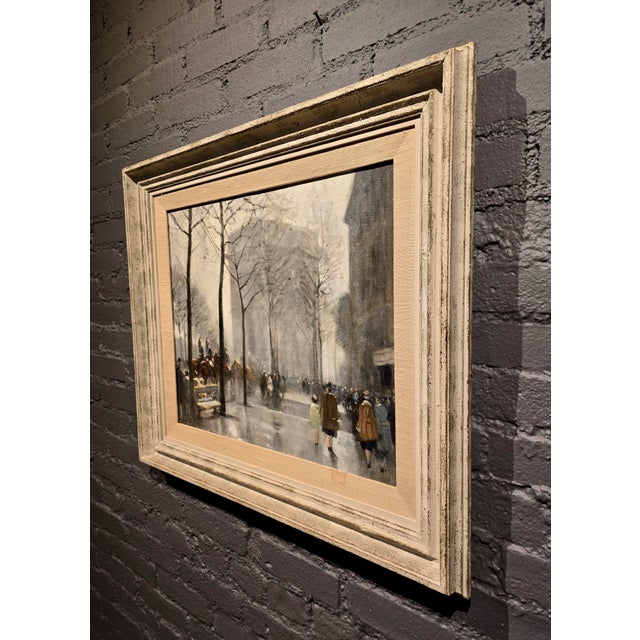
This Post-Impressionist street scene by French master Jules René Hervé captures a atmospheric, rain-slicked day on a grand Parisian boulevard, looking toward the ghostly silhouette of the Arc de Triomphe.
Atmospheric Perspective and Light
The painting relies heavily on a muted, monochromatic color palette dominated by slate grays, soft creams, and cool whites. A heavy mist or winter rain blurs the colossal architecture in the background, transforming the historic monument into a pale, towering form that anchors the composition. The sky hangs low and dense, diffusing the daylight across the entire scene.
The Wet Ground Reflection
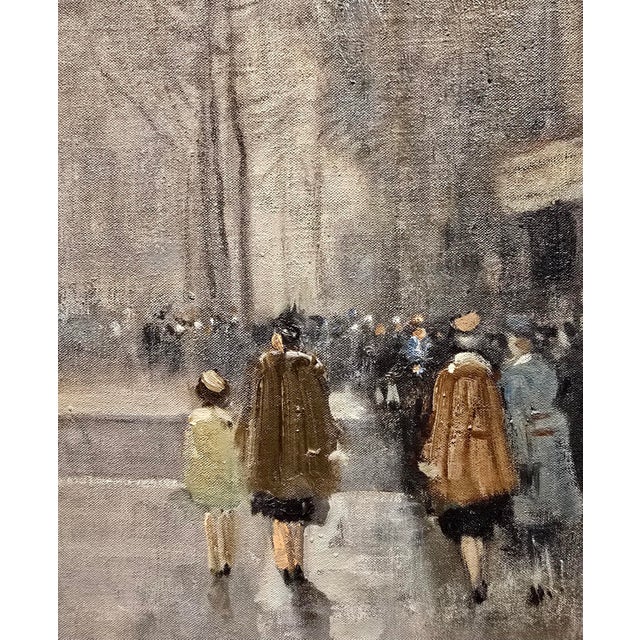
One of the most technically striking elements is the treatment of the wide boulevard. The wet asphalt acts like a mirror, catching fluid, vertical strokes of white and light gray to mimic the reflective sheen of fresh puddles and rainwater. This glossy effect stretches from the foreground deep into the background, providing a luminous surface that contrasts with the dark forms of the pedestrians.
Figures and Movement
Hervé populates the urban landscape with elegant figures captured in motion:
The Elegantly Dressed Pedestrians: On the right, a cluster of figures—including a young child in a light-colored coat and a woman in a rich brown cloak—walk away from the viewer. Their heavy clothing and distinct hats convey a sense of a brisk, chilly season.
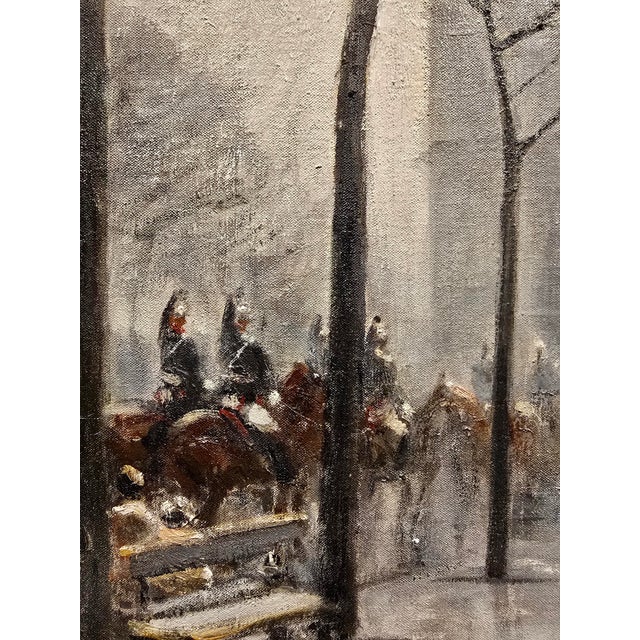
The Mounted Guards: On the left side of the boulevard, under the shelter of bare, spindly winter trees, a regiment of Republican Guards sits astride horses. Their dark uniforms and tiny details of red plumage on their helmets offer subtle punctures of color in an otherwise neutral scene.
The Street Elements: An empty, dark-slatted public bench sits silently on the left walkway, reinforcing the damp, quiet mood of the day.
Style and Brushwork
The artwork showcases a beautiful balance between realism and impressionistic freedom. The trees are rendered with swift, calligraphic dark lines that branch out into delicate twigs, framing the wide perspective. Figures are built using loose, confident brushstrokes rather than sharp lines, emphasizing their movement and the fleeting nature of modern city life.
Artist Biography
Jules René Hervé (1887–1981) was an acclaimed French Post-Impressionist master renowned for his luminous, highly poetic depictions of Parisian city life and idyllic rural scenes. Active across eight decades, he effectively bridged the gap between traditional 19th-century academic art and the fluid, light-centric brushwork of the Impressionists, cementing his status as one of the definitive visual chroniclers of modern France.
Early Life and Academic Foundations
Hervé was born in Langres, a historic fortified town in eastern France. Showing an innate passion and a natural predisposition for drawing and painting from a young age, he began his formal artistic journey in evening classes at his hometown school, the Diderot College.
Determined to pursue a career in fine art, he moved to Paris in 1908. There, he enrolled at the prestigious École Nationale Supérieure des Arts Décoratifs and later at the revered École des Beaux-Arts. During his formative academic years, he studied under established masters Fernand Cormon and Jules Adler, who instilled in him a rigorous foundation in classical composition, draftsmanship, and structured oil painting techniques.
Institutional Acclaim and Teaching Career
Hervé’s career advanced rapidly following his academic training:
Salon Debut (1910): He exhibited his work for the first time at the famous Salon des Artistes Français, immediately capturing the attention of the Parisian art scene.
Prestige and Medals: In 1914, at only 27 years old, he was awarded the Médaille d'Argent (Silver Medal). He followed this achievement with a coveted Médaille d'Or (Gold Medal) in 1925 at the Salon, and another Gold Medal at the 1937 World’s Fair (Exposition Internationale).
Vice-Presidency: His lasting institutional influence led to his election as Vice-President of the Salon des Artistes Français.
Educating Generations: Alongside his creative output, Hervé dedicated over three decades (1911 to 1943) to teaching painting to younger generations of artists in Paris, a tenure only briefly paused for his active military service during World War I.
Style, Subject Matter, and Technique
Hervé worked largely independent of passing 20th-century trends, choosing instead to refine and perfect a deeply emotional, sensitive continuation of classical French art. His oeuvre splits beautifully into two main themes:
The City of Light: His urban scenes capture busy Parisian boulevards, street markets, the Luxembourg Gardens, and rain-streaked quays along the Seine River. He masterfully populated these cityscapes with fashionable strollers, classic vehicles, and playing children, emphasizing the atmospheric and emotional spirit of everyday urban life.
The French Countryside: Hervé was equally celebrated for his serene landscapes, rural genre scenes, country workers, and rhythmic religious processions throughout small-town France.
The Shimmering Touch: His artistic hallmark relies on rapid, deliberate dabs of thick paint that catch the light. Like a musician arranging harmonies, Hervé played with contrasting soft grays, misty blues, and unexpected pops of warm color to beautifully mimic light dancing across wet asphalt or open river water.
Later Years and Legacy
In the latter portion of his life, Hervé retired from public positions and institutional duties, retreating into private life to focus solely on his canvas work until his passing in 1981.
Today, his observational paintings are highly valued by fine art collectors globally and are preserved in permanent public collections worldwide. His works hang in major institutional galleries, including the Petit Palais in Paris, the fine art museums of Dijon, Langres, Annecy, and Saint-Étienne, as well as the Art Institute of Chicago and the Museum of Casablanca.
See less
- Dimensions
- 30ʺW × 2ʺD × 26ʺH
- Styles
- French
- Impressionist
- Frame Type
- Framed
- Art Subjects
- Cityscape
- Period
- 1940s
- Country of Origin
- France
- Item Type
- Vintage, Antique or Pre-owned
- Materials
- Oil Paint
- Wood
- Condition
- Good Condition, Original Condition Unaltered, Some Imperfections
- Color
- Slate Gray
- Condition Notes
- Excellent - Minor wear consistent with age and history Excellent - Minor wear consistent with age and history less
Questions about the item?
Returns & Cancellations
Return Policy - All sales are final 48 hours after delivery, unless otherwise specified in the description of the product.
Cancellation Policy - Prior to shipping or local pickup, buyers may cancel an order for up to 48 hours, unless otherwise specified.
Related Collections
- Ed Ruscha Paintings
- Photorealism Canvas Paintings
- Ralph Lauren Paintings
- Photorealism Paintings in New York
- Silk Velvet Paintings
- Herman Miller Paintings
- Louise Nevelson Paintings
- Richard Serra Paintings
- Jaanika Peerna Paintings
- Jo Baskerville Paintings
- Jean-Paul Barray Paintings
- Hans Andersen Paintings
- Johannes Andersen Paintings
- Peter Behrens Paintings
- Raphael Paintings
- Photorealism Paintings in Los Angeles
- Carl-Axel Acking Paintings
- Joseph Stella Paintings
- Karl-Erik Ekselius Paintings
- Pedro Friedeberg Paintings
- Piet Hein Eek Paintings
- Black Photorealism Paintings
- Cassina Paintings
- James McCray Paintings
- Lawson-Fenning Paintings