

Details
Description
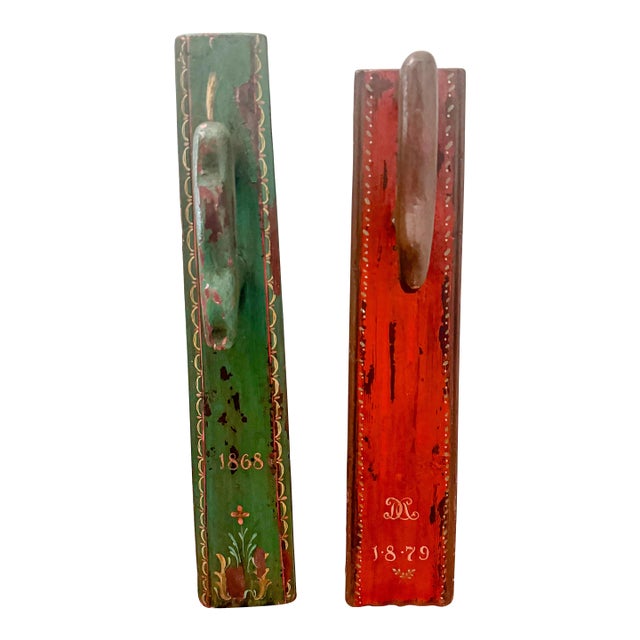
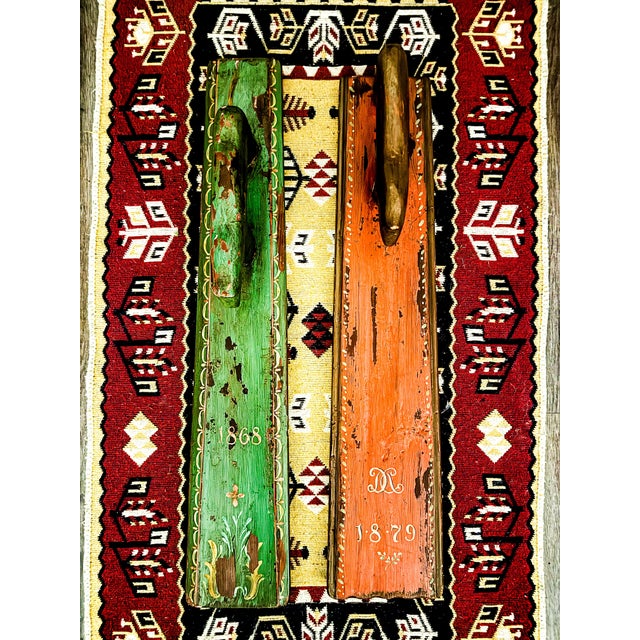
Museum-Quality Pair of 19th-Century Norwegian Mangle Boards (Dated 1868 & 1879) An extraordinary, generationally linked pair of 19th-century Norwegian courtship …
Read more
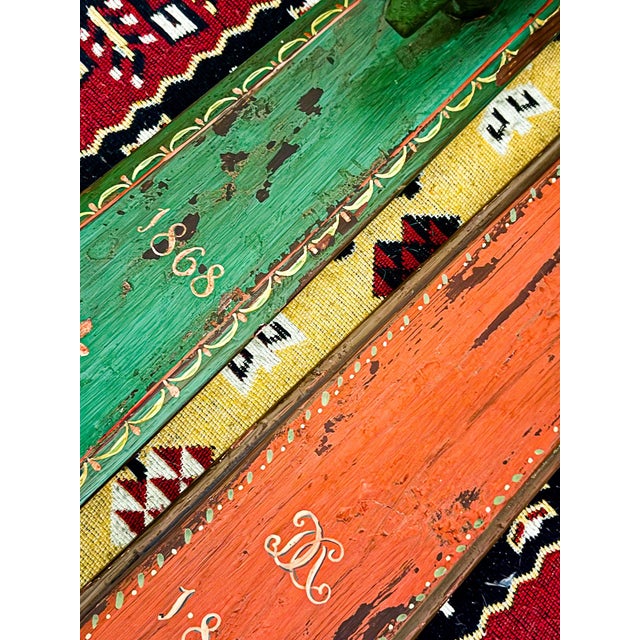
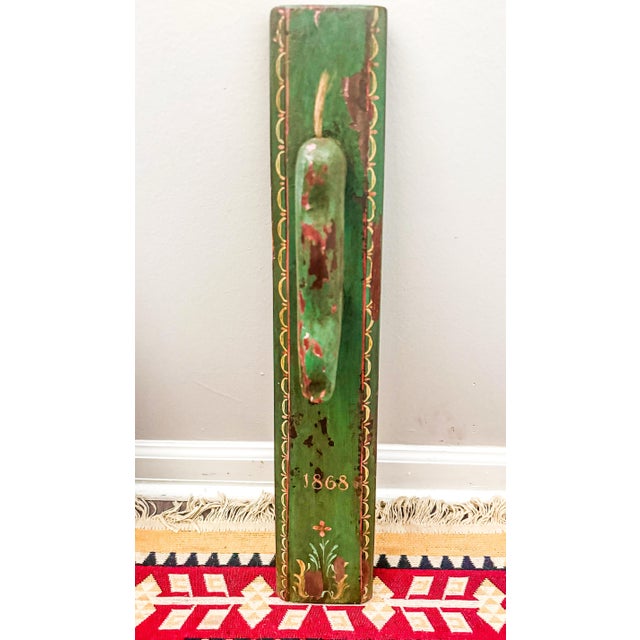
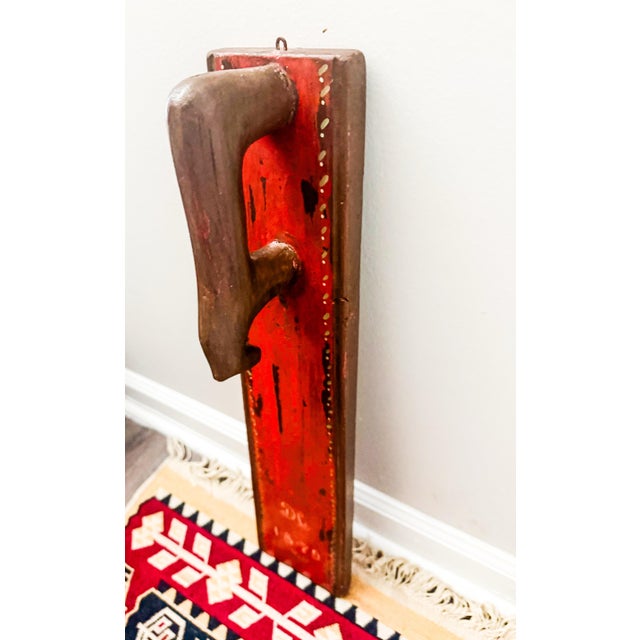
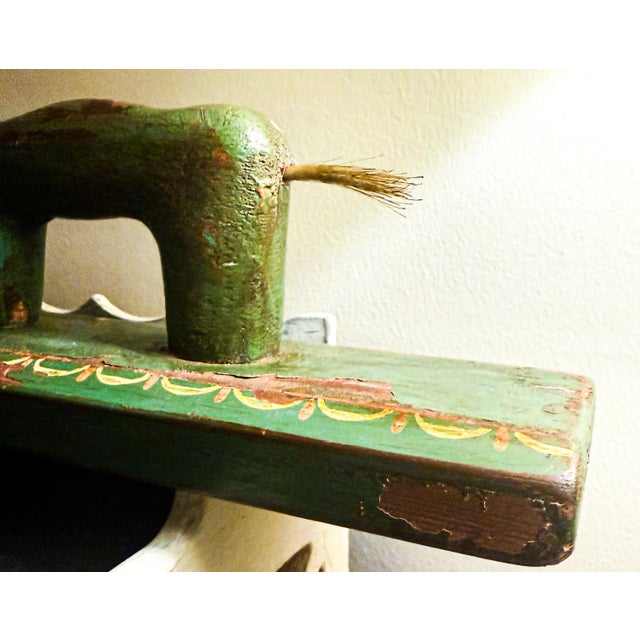
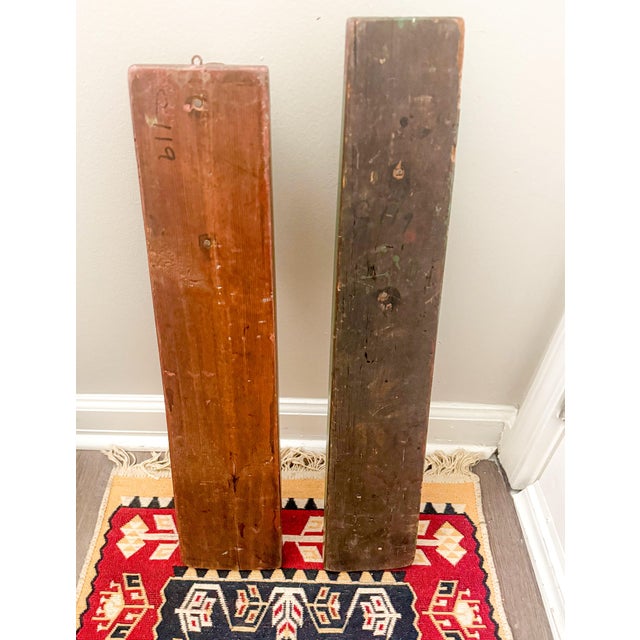
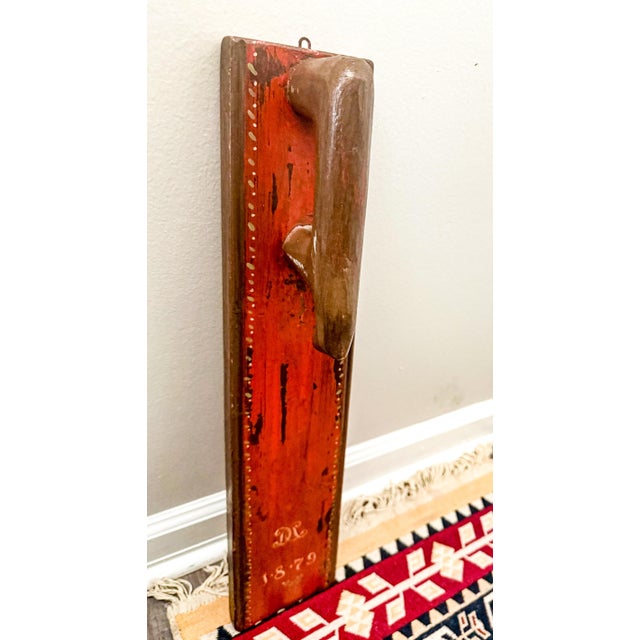
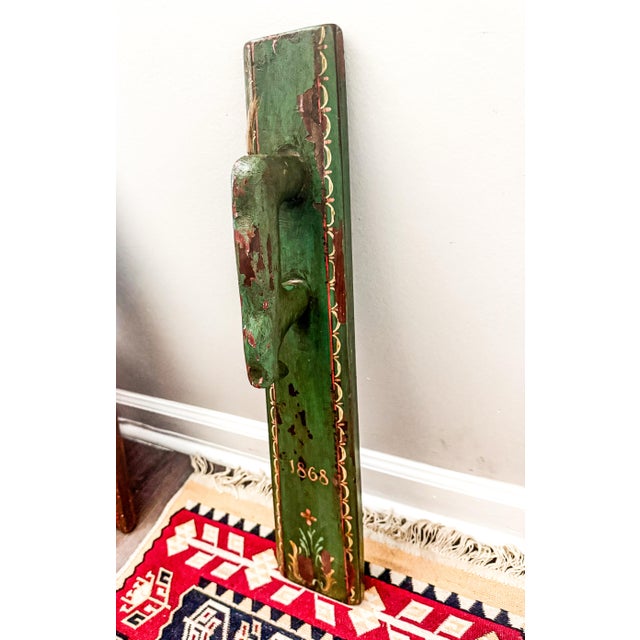
Museum-Quality Pair of 19th-Century Norwegian Mangle Boards (Dated 1868 & 1879) An extraordinary, generationally linked pair of 19th-century Norwegian courtship mangle boards (mangletre), sourced from a single Scandinavian family collection. Carved by hopeful suitors as formal marriage proposals, these vibrant folk-art pieces feature traditional straight-line silhouettes, classic carved horse handles, and stunningly preserved painted borders in rich forest green and cinnabar red. The true crown jewel of this collection is the 1868 green board, which incredibly retains its ultra-rare original organic horsehair tail. The 1879 red board showcases elite presentation calligraphy with the bridal monogram "DK" and a time-capsule "1·8·79" regional date stamp. Kept together for over 150 years as prized family heirlooms, these boards show minimal wear to their brilliant original pigments. This museum-quality pair offers an exceptional investment opportunity for discerning collectors of European folk art and high-end rustic antiquities. Perfect for hanging as a captivating wall gallery installation.
Deep dive:
Belonging to two early 19th-century Scandinavian daughters from the same family, this set of sisters' mangle boards—known as a mangletre in Norway or a mangelbräda in Sweden—carries deep cultural significance as traditional courtship tokens. These unique household artifacts date back centuries, with roots widely tied to coastal Northern Europe and Scandinavia.
The Courtship mangle boards served a dual purpose as both a domestic laundry tool and a love token.The Proposal: A young man would spend winter months hand-carving or painting a board to showcase his skill, patience, and readiness for marriage. He would then leave the finished board outside his chosen bride's home.The Answer: If the woman brought the board inside, she accepted his marriage proposal. If she left it outside, it was a rejection. Tradition dictated that a rejected board could never be reused; the suitor had to start completely from scratch for his next prospect.
The Inscriptions: Boards accepted as engagement or wedding gifts were prominently carved or painted with the bride's initials and the date. This custom explains the specific markings of 1868 and 1879 seen on these pieces. As rural folk art blossomed across Scandinavia in the 18th and 19th centuries, mangle boards evolved from plain tools into vibrant displays of personal craftsmanship.Folk
Painting: These boards display stylized floral patterns reminiscent of traditional Norwegian Rosemaling or Swedish Dala art. These painted borders and botanical flourishes represent growth, vitality, and prosperity for the future household.The Horse Handle: The stylized, upright handles visible on these pieces are classic horse motifs. In Norse tradition and rural Scandinavian culture, the horse represents strength, protection, loyalty, and virility—all highly regarded attributes to offer in a marriage.
Utilitarian function when used for housework, these boards operated as primitive manual irons to smooth out stiff textiles like handwoven linen sheets. Damp fabric was wrapped tightly around a separate wooden roller, similar to a rolling pin. The user would grip the handle on top of the board, using the completely flat, unpainted underside to press and roll back and forth with heavy downward pressure. Exceptionally ornate or highly painted pieces, much like these, were often hung proudly on the farmhouse wall as family heirlooms rather than heavily used, minimizing wear to the paint.Why the Tail MattersThe green board still has its original horsehair, which is a phenomenal detail. A real horsehair tail dramatically elevates the historical authenticity and collector value of the piece.The Crown Jewel of the Craft: Incorporating real horsehair into the carved horse handle was a premium design element. It transitioned the object from a standard carved block into a three-dimensional work of folk art.The Ultimate Devotion: Since these were courtship gifts, adding actual hair required an extra layer of time, effort, and material resourcefulness from the suitor. It was a direct display of his dedication to the woman he hoped to marry.Rarity & Survival: Finding a piece from 1868 that still retains its organic horsehair tail is exceptionally rare. Organic elements like hair, leather strings, and hemp tassels are typically the first things to rot, fall out, or get eaten by pests over 150+ years of storage.The Meaning of the MonogramThe inclusion of the monogram "DK" directly over the date 1·8·79 confirms that the red board was an accepted wedding or engagement gift.The Bride's Surname: In 19th-century rural Scandinavia, the "K" most likely stands for a patronymic surname ending in Knutsdatter (daughter of Knut) or Kristiansdatter (daughter of Kristian), rather than a family name passed down by a father.The Presentation Calligraphy: The lettering features a highly formal, looping cursive flourish. Suitors who did not possess elegant handwriting skills would often pay a skilled local church scribe, schoolmaster, or recognized regional folk artist to paint the official monogram and date. This ensured the final gift looked prestigious when hung on the bride's parlor wall.An "1879" Time Capsule: The punctuation formatted as 1·8·79, with dots separating the digits, is a distinct regional stylistic preference common in rural European folk art of the late 1800s.Pairing of the Two BoardsFinding a green board dated 1868 paired directly alongside a red board dated 1879 tells a beautiful generational story. It is highly common for family heirlooms to be kept together like this. The 1868 board may have belonged to the bride's mother or an older sister, with the 1879 board created eleven years later for "DK" when she reached marriageable age.Regional Origin: Norwegian vs. SwedishBased on key visual details, these pieces point strongly toward a Norwegian origin rather than Swedish, though they exhibit excellent characteristics of 19th-century Scandinavian folk art. The visual layout and specific design details provide strong clues to support this origin:1. The Silhouette and Handle PlacementThe Norwegian Style: In Norway, mangle boards (mangletre) traditionally feature long, completely straight, narrow rectangular bodies. The horse handle is strictly aligned along the central vertical axis, leaving open painted lanes on either side.The Swedish Contrast: Swedish boards often feature a widening or slightly flared tail at the far end, resembling a cricket bat, or a wider surface decorated with geometric chip carving instead of mostly flat paint layers.2. The Color Palette and "Rosemaling" InfluenceThe Base Colors: The deep forest green and rich cinnabar red bases are the hallmark background shades of classic Norwegian Rosemaling.The Green Board (1868): The bottom of the green board features a delicate root system growing upward into a multi-tiered orange flower. This is a localized variation of the Telemark or Hallingdal style of Norwegian painting. The fine gold S-curves framing the outer borders mimic the flowing scrolls found on 19th-century Norwegian dowry chests.The Red Board (1879): The perimeter consists of rhythmic white dots and delicate gold line-work. This creates an ornamental frame popular among rural artisans in western and central Norway during the late 1800s.3. The Natural Horsehair TailWhile Swedish makers occasionally added organic horsehair to carved horse handles, this hyper-realistic treatment is most famously documented on premium West-Norwegian pieces. Suitors in these mountain and coastal communities took immense pride in sourcing actual hair from their best livestock to complete the bridal gift.Ultimately, these boards represent highly preserved examples of late-19th-century Norwegian folk painting. The combination of the narrow profile, central horse handle, and botanical calligraphic embellishments strongly anchors them to a Norwegian heritage.
See less
- Dimensions
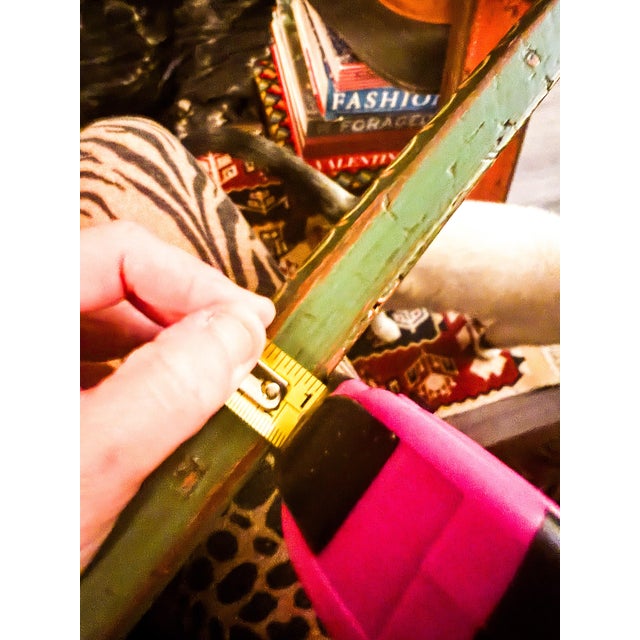
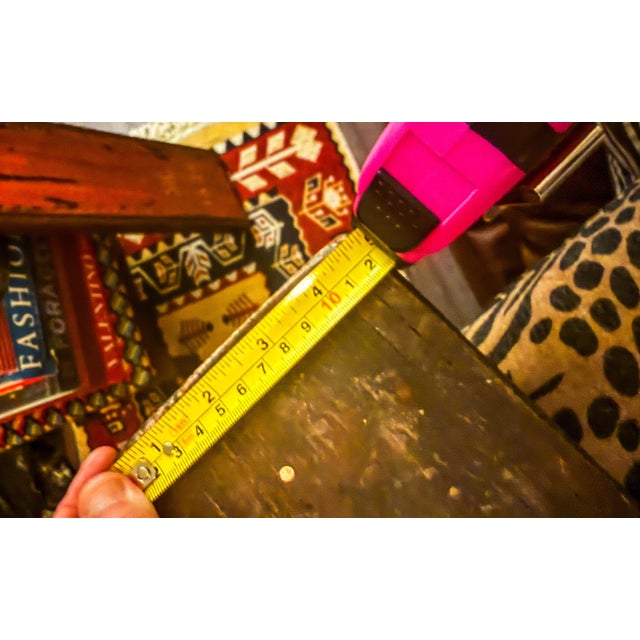
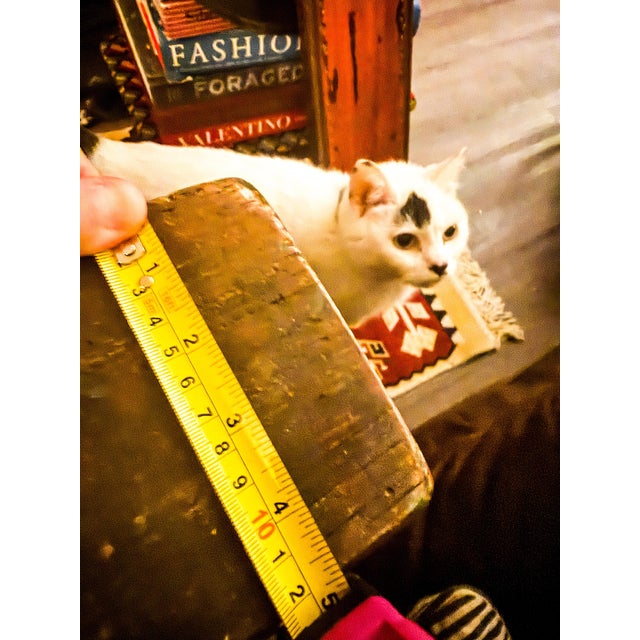
- 5ʺW × 1ʺD × 25.5ʺH
- Styles
- Folk Art
- Rustic European
- Period
- Early 19th Century
- Country of Origin
- Norway
- Item Type
- Vintage, Antique or Pre-owned
- Materials
- Textile
- Wood
- Condition
- Good Condition, Original Condition Unaltered, Some Imperfections
- Color
- Red
- Condition Notes
- I have the measurements for the green in the description but the red measures: 24”H x 1” D x 5”W. … moreI have the measurements for the green in the description but the red measures: 24”H x 1” D x 5”W. They are perfectly preloved and in great condition for their age. This museum-quality pair offers an instant, beautifully balanced gallery installation for upscale rustic, Scandinavian modern, or eclectic historic projects. The 25-inch vertical profile makes them exceptionally versatile for styling narrow entryways, framing a fireplace, or flanking a piece of fine art. We welcome all inquiries regarding trade pricing, hold requests for active client pitches, or additional high-resolution photography. We pack and ship with white-glove care, ensuring the delicate, ultra-rare 1868 horsehair detail is fully protected in transit. The photos really captured these beautifully. less
Questions about the item?
Returns & Cancellations
Return Policy - All sales are final 48 hours after delivery, unless otherwise specified in the description of the product.
Cancellation Policy - Prior to shipping or local pickup, buyers may cancel an order for up to 48 hours, unless otherwise specified.
Related Collections
- Helmut Friedrich Schäffenacker Sculptural Wall Objects
- Antique Copper Finish Sculptural Wall Objects
- Medium-Density Fibreboard Sculptural Wall Objects
- Dada Sculptural Wall Objects
- Maison Jansen Sculptural Wall Objects
- Ralph Lauren Sculptural Wall Objects
- Asian Sculptural Wall Objects
- Greg Copeland Sculptural Wall Objects
- Mid-Century Modern Sculptural Wall Objects
- Curtis Jere Sculptural Wall Objects
- Plaster Sculptural Wall Objects
- Brutalist Sculptural Wall Objects
- Japanese Sculptural Wall Objects
- Sarreid Ltd. Sculptural Wall Objects
- Wenge Sculptural Wall Objects
- Arteriors Home Sculptural Wall Objects
- Silverplate Sculptural Wall Objects
- Stainless Steel Sculptural Wall Objects
- Platinum Sculptural Wall Objects
- The American School Sculptural Wall Objects