

Details
Description
Robert Watson-Human Figures on a Surreal California Beach- Mid-Century Oil Painting
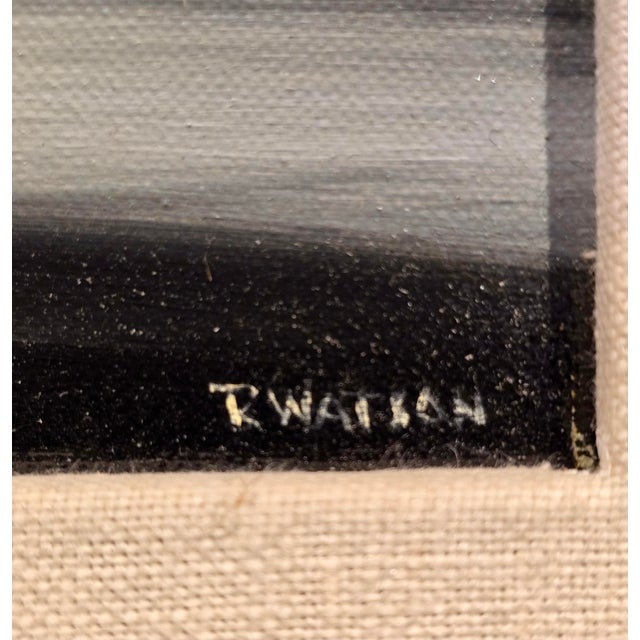
American Surrealist - Oil painting on Canvas - Signed
…
Read more
Robert Watson-Human Figures on a Surreal California Beach- Mid-Century Oil Painting
American Surrealist - Oil painting on Canvas - Signed
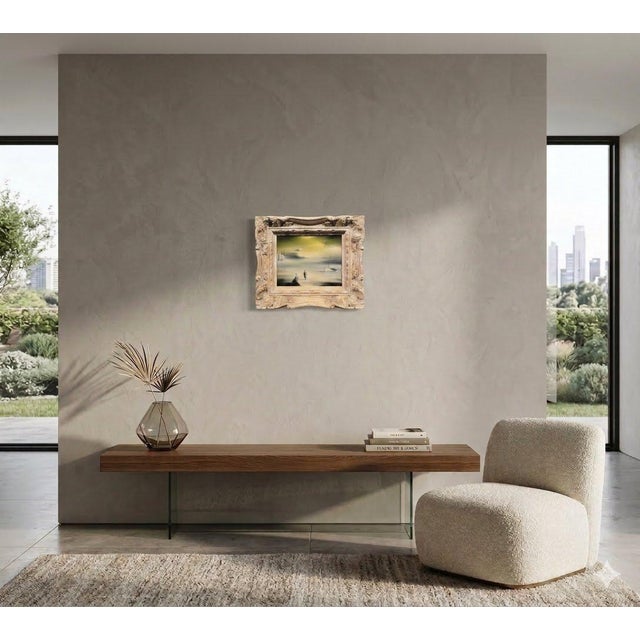
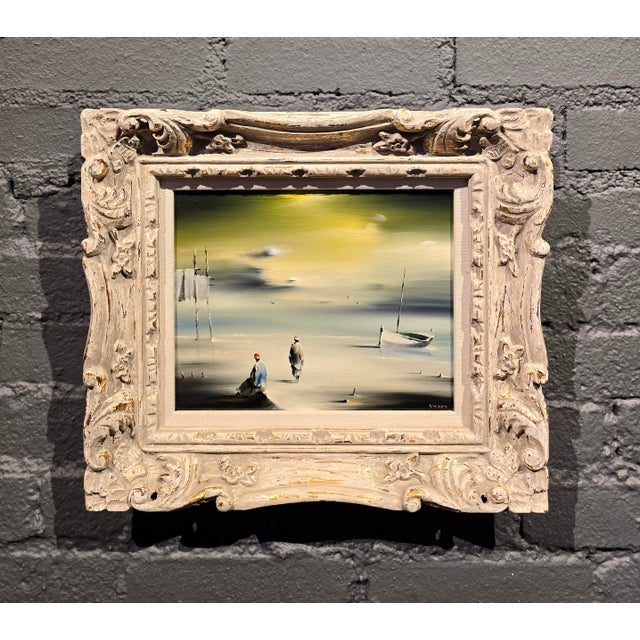
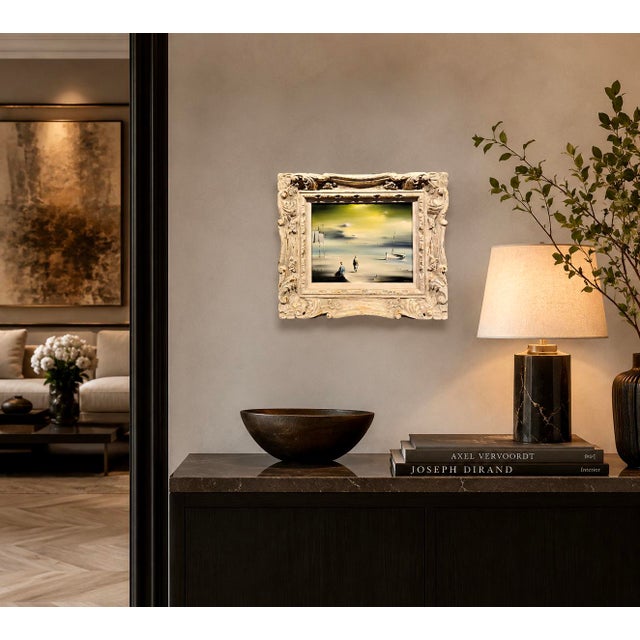
Canvas size 8x10 - Frame size- 14x16x2"
Description
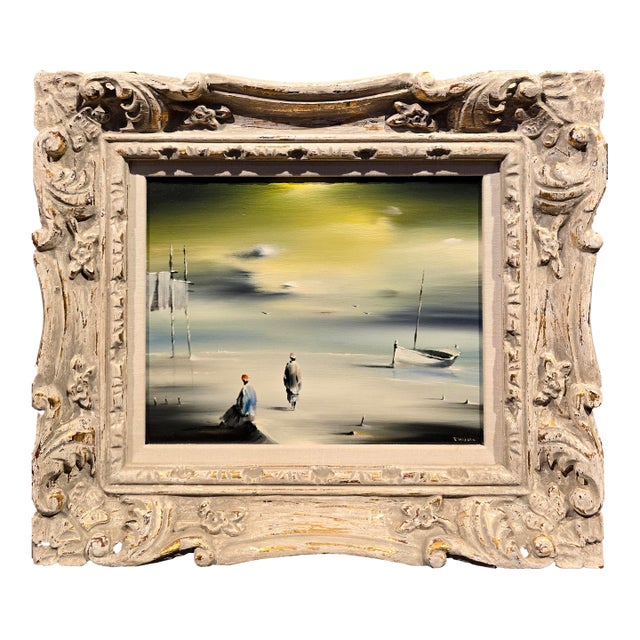
This artwork is an original oil painting by the renowned American mid-century surrealist Robert Watson (1923–2004). It showcases his signature blend of vast, haunting landscapes and isolated human elements.
Composition and Subject Matter
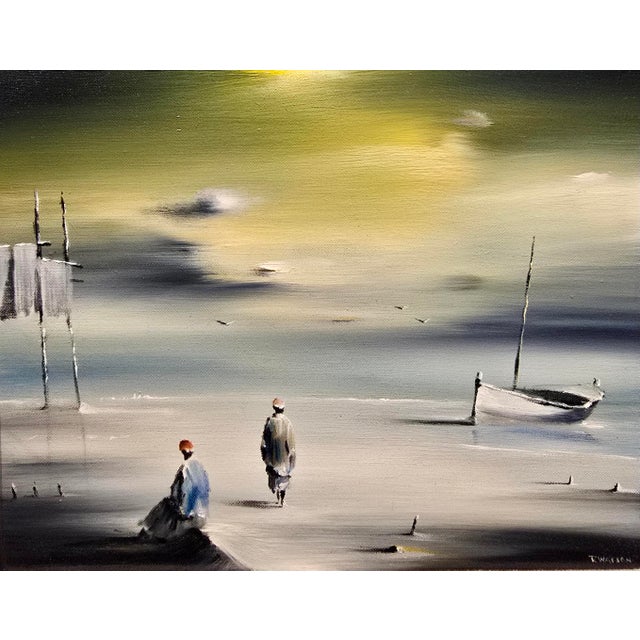
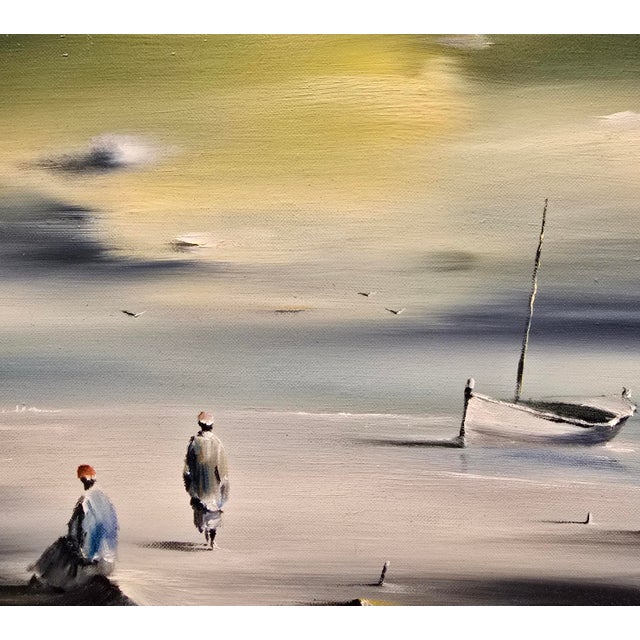
The composition is structured around an expansive, dreamlike beach or tidal flat under an overarching sky. The scene contains several meticulously arranged elements:
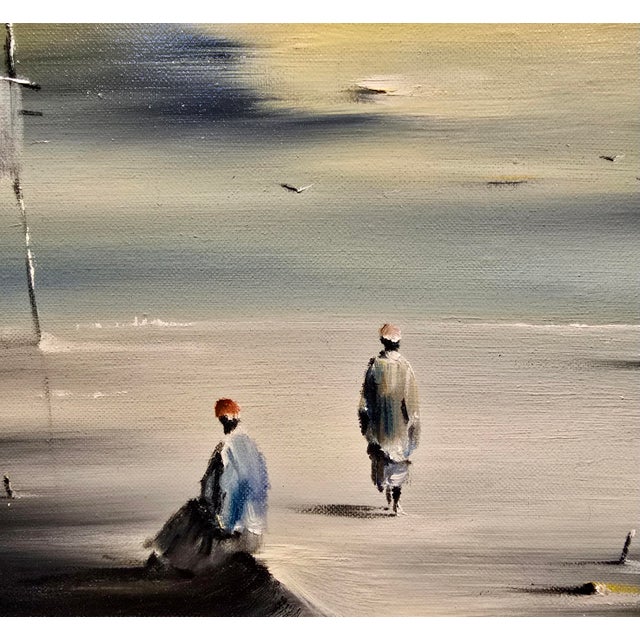
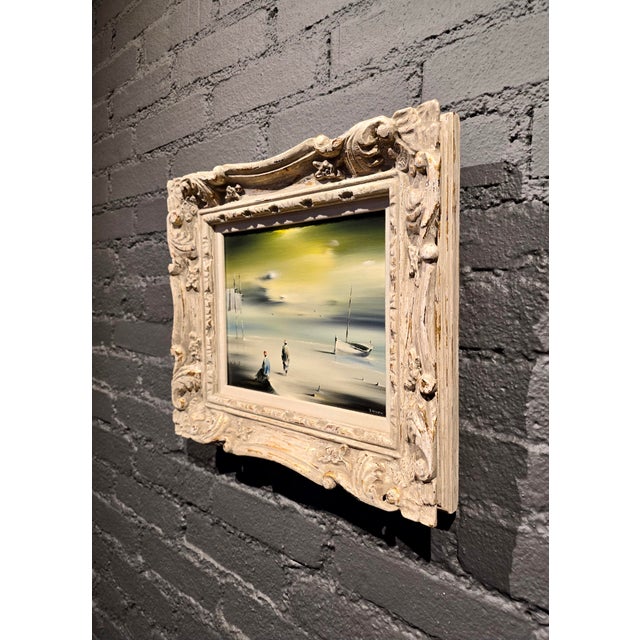
The Figures: Two figures stand near the lower-left foreground. True to Watson's standard motif, their backs are turned to the viewer, shrouding them in anonymity. One figure is seated or crouching near a dark outcropping, dressed in blue, while the second stands a few paces away in long, flowing grey attire, gazing out toward the horizon.
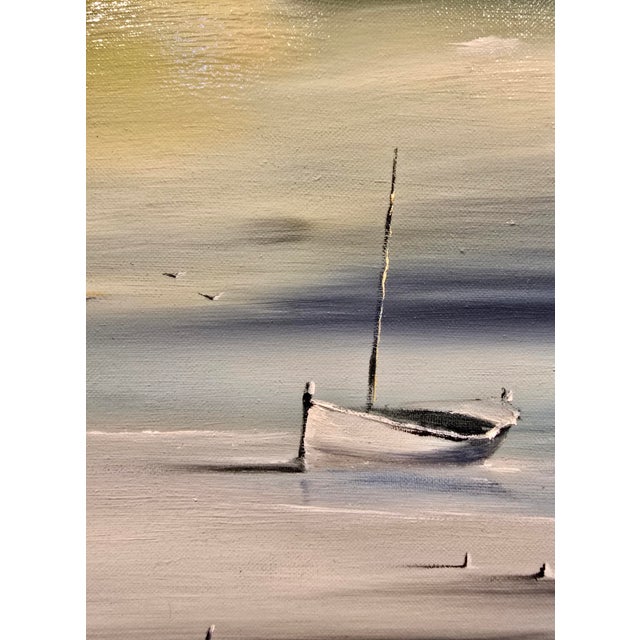
The Maritime Elements: To the right, a solitary white rowboat or dory sits beached on the smooth sand, casting a soft reflection beneath it. On the far left, narrow wooden poles rise from the ground, supporting a pair of white cloths or rectangular sails that catch a nonexistent wind.
The Horizon: Tiny black specks resembling birds dot the center line, drawing the viewer's eye across the immense, flat expanse where land subtly dissolves into sky.
Color Palette and Technique
The palette is dominated by a dramatic, atmospheric transition of light.
The Sky: The upper portion features a striking banner of sulfuric, yellowish-green light cutting through heavy, dark grey clouds. This creates an eerie twilight or post-storm glow.
The Ground: The sands are rendered in a silky, desaturated grey-blue and off-white hue.
Technique: Watson utilizes a highly refined, tender blending technique. The colors bleed seamlessly into one another, mimicking a soft fog or blurred vision. Despite the hazy, misty atmosphere, the finish is exceptionally smooth and precise.
Framing and Presentation
The canvas is set within a wide, ornately carved rococo or baroque-style wooden frame with a heavily distressed, off-white and cream finish. The frame's deep flourishes and vintage wear contrast beautifully with the stark, minimalist surrealism of the painting itself.
Artist Biography: Robert Watson (1923–2004)
Robert Watson was a prominent mid-century American painter and illustrator celebrated for his distinctive contribution to California Surrealism.
Early Life and Education
Born in Martinez, California, in 1923, Watson spent his childhood in a large home overlooking the San Francisco Bay. Art historians often attribute the vast, lonely vistas of his paintings to his early memories of looking out across these expansive waters. Following high school and a deployment in the U.S. Army, he pursued his education at the University of California and the University of Wisconsin. Looking to formalize his artistic style, he traveled to New York and later spent eight weeks studying closely under the influential realist painter and art technique authority Frederic Taubes.
Artistic Style and Motifs
Watson developed a singular style focused entirely on a "mysterious world" of vast plateaus, desolate shorelines, and ancient, towering architectural ruins that merge into hazy skies. Nearly all of his paintings prominently feature his hallmark motif: solitary, shrouded figures with their backs completely turned to the audience. This thematic repetition captures a powerful, melancholic mood of existential isolation and timelessness. Hollywood icon Vincent Price, an avid art collector and admirer of Watson's work, once wrote a widely circulated biography celebrating the haunting, cinematic depth of Watson's quiet, desolate landscapes.
Career Success and Pop Culture Impact
Watson achieved significant commercial and critical success relatively early in his career. His first one-man show was hosted at the prestigious Gump’s Gallery in San Francisco in 1947. By 1950, his artwork was featured in a major solo exhibition at the California Palace of the Legion of Honor. [1]
Beyond traditional art institutions, Watson made an impact on science fiction pop culture. In 1953, his surrealist imagery caught the attention of author Ray Bradbury, resulting in Watson providing the iconic cover illustration for the second edition of The Martian Chronicles.
Later Years and Legacy
Watson lived and worked out of Berkeley, California, during the height of his career in the 1950s and 1960s, later spending a brief period in Westport, Connecticut, before returning to the West Coast. To honor his lifetime achievement, the Weinstein Gallery in San Francisco organized a massive 50-year retrospective exhibition of his work in May 1997. Watson passed away in Poway, California, in 2004 at the age of 81. Today, his paintings remain highly collectible pieces of post-war American surrealism.
See less
- Dimensions
- 16ʺW × 2ʺD × 14ʺH
- Styles
- American
- Surrealism
- Frame Type
- Framed
- Art Subjects
- Seascape
- Artist
- Robert Watson
- Period
- 1950s
- Country of Origin
- United States
- Item Type
- Vintage, Antique or Pre-owned
- Materials
- Canvas
- Condition
- Good Condition, Original Condition Unaltered, Some Imperfections
- Color
- Sky Blue
- Condition Notes
- Robert Watson-Human Figures on a Surreal California Beach- Mid-Century Oil Painting American Surrealist - Oil painting on Canvas - Signed … moreRobert Watson-Human Figures on a Surreal California Beach- Mid-Century Oil Painting American Surrealist - Oil painting on Canvas - Signed Canvas size 8x10 - Frame size- 14x16x2" Description This artwork is an original oil painting by the renowned American mid-century surrealist Robert Watson (1923–2004). It showcases his signature blend of vast, haunting landscapes and isolated human elements. Composition and Subject Matter The composition is structured around an expansive, dreamlike beach or tidal flat under an overarching sky. The scene contains several meticulously arranged elements: The Figures: Two figures stand near the lower-left foreground. True to Watson's standard motif, their backs are turned to the viewer, shrouding them in anonymity. One figure is seated or crouching near a dark outcropping, dressed in blue, while the second stands a few paces away in long, flowing grey attire, gazing out toward the horizon. The Maritime Elements: To the right, a solitary white rowboat or dory sits beached on the smooth sand, casting a soft reflection beneath it. On the far left, narrow wooden poles rise from the ground, supporting a pair of white cloths or rectangular sails that catch a nonexistent wind. The Horizon: Tiny black specks resembling birds dot the center line, drawing the viewer's eye across the immense, flat expanse where land subtly dissolves into sky. Color Palette and Technique The palette is dominated by a dramatic, atmospheric transition of light. The Sky: The upper portion features a striking banner of sulfuric, yellowish-green light cutting through heavy, dark grey clouds. This creates an eerie twilight or post-storm glow. The Ground: The sands are rendered in a silky, desaturated grey-blue and off-white hue. Technique: Watson utilizes a highly refined, tender blending technique. The colors bleed seamlessly into one another, mimicking a soft fog or blurred vision. Despite the hazy, misty atmosphere, the finish is exceptionally smooth and precise. Framing and Presentation The canvas is set within a wide, ornately carved rococo or baroque-style wooden frame with a heavily distressed, off-white and cream finish. The frame's deep flourishes and vintage wear contrast beautifully with the stark, minimalist surrealism of the painting itself. Artist Biography: Robert Watson (1923–2004) Robert Watson was a prominent mid-century American painter and illustrator celebrated for his distinctive contribution to California Surrealism. Early Life and Education Born in Martinez, California, in 1923, Watson spent his childhood in a large home overlooking the San Francisco Bay. Art historians often attribute the vast, lonely vistas of his paintings to his early memories of looking out across these expansive waters. Following high school and a deployment in the U.S. Army, he pursued his education at the University of California and the University of Wisconsin. Looking to formalize his artistic style, he traveled to New York and later spent eight weeks studying closely under the influential realist painter and art technique authority Frederic Taubes. Artistic Style and Motifs Watson developed a singular style focused entirely on a "mysterious world" of vast plateaus, desolate shorelines, and ancient, towering architectural ruins that merge into hazy skies. Nearly all of his paintings prominently feature his hallmark motif: solitary, shrouded figures with their backs completely turned to the audience. This thematic repetition captures a powerful, melancholic mood of existential isolation and timelessness. Hollywood icon Vincent Price, an avid art collector and admirer of Watson's work, once wrote a widely circulated biography celebrating the haunting, cinematic depth of Watson's quiet, desolate landscapes. Career Success and Pop Culture Impact Watson achieved significant commercial and critical success relatively early in his career. His first one-man show was hosted at the prestigious Gump’s Gallery in San Francisco in 1947. By 1950, his artwork was featured in a major solo exhibition at the California Palace of the Legion of Honor. [1] Beyond traditional art institutions, Watson made an impact on science fiction pop culture. In 1953, his surrealist imagery caught the attention of author Ray Bradbury, resulting in Watson providing the iconic cover illustration for the second edition of The Martian Chronicles. Later Years and Legacy Watson lived and worked out of Berkeley, California, during the height of his career in the 1950s and 1960s, later spending a brief period in Westport, Connecticut, before returning to the West Coast. To honor his lifetime achievement, the Weinstein Gallery in San Francisco organized a massive 50-year retrospective exhibition of his work in May 1997. Watson passed away in Poway, California, in 2004 at the age of 81. Today, his paintings remain highly collectible pieces of post-war American surrealism. less
Questions about the item?
Returns & Cancellations
Return Policy - All sales are final 48 hours after delivery, unless otherwise specified in the description of the product.
Cancellation Policy - Prior to shipping or local pickup, buyers may cancel an order for up to 48 hours, unless otherwise specified.
Related Collections
- Ed Ruscha Paintings
- Ralph Lauren Paintings
- Photorealism Canvas Paintings
- Photorealism Paintings in New York
- Karen Offutt Paintings
- Richard Serra Paintings
- Mark Lewis Art Paintings
- Mark Lewis Paintings
- FM Mobler Paintings
- Jo Baskerville Paintings
- Silk Velvet Paintings
- Louise Nevelson Paintings
- Jeff Slemmons Paintings
- Vienna Secession Paintings
- Photorealism Paintings in Los Angeles
- Michelle Arnold Paine Paintings
- Black Photorealism Paintings
- BDDW Paintings
- Lee Reynolds Paintings
- Mid-Century Modern Paintings
- Abstract Paintings
- Nautical Paintings
- Velvet Paintings
- Landscape Paintings
- 19th Century Oil Paintings