



Details
Description
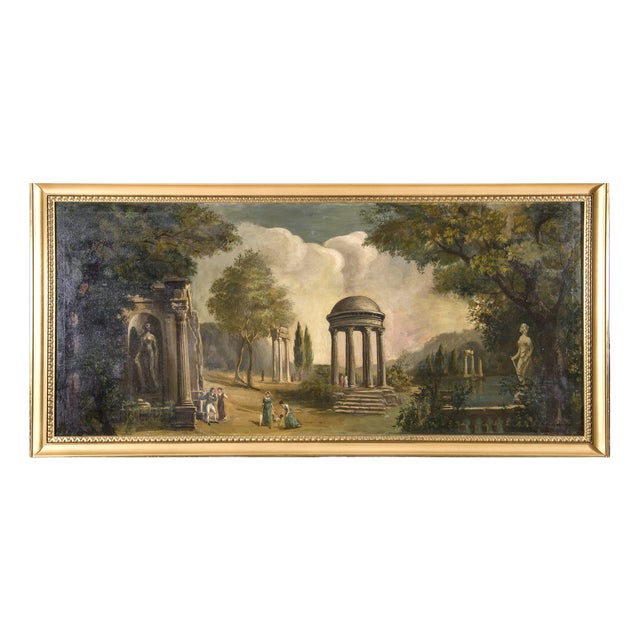
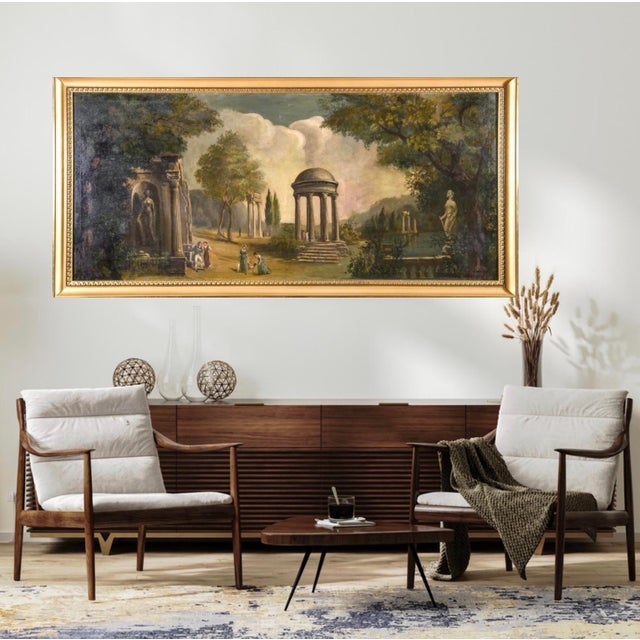
XIX Century Italian Grand Tour Landscape Painting Credited to Anton Sminck Pitlo
This wonderful not signed classical landscape, attributed to …
Read more
XIX Century Italian Grand Tour Landscape Painting Credited to Anton Sminck Pitlo
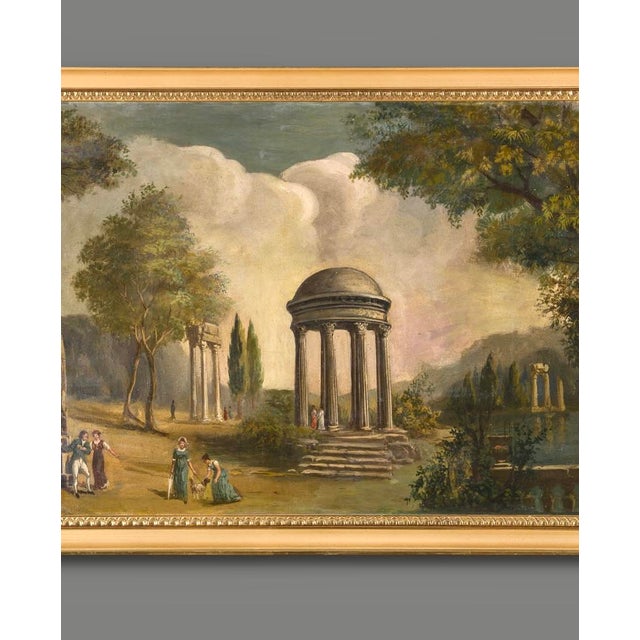
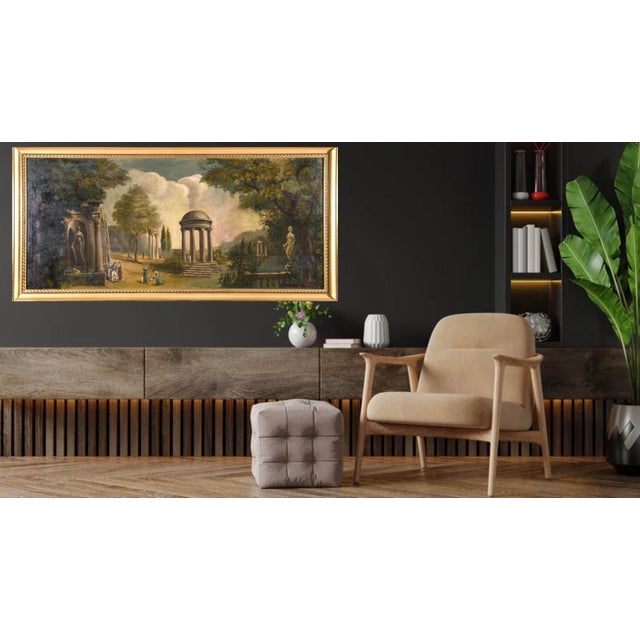
This wonderful not signed classical landscape, attributed to Anton Sminck Pitloo (1790–1837), serves as an architectural capriccio—a fantasy composition that combines real and imagined classical ruins into a single scene.
Pitloo was the founder of The School of Posillipo, this Neapolitan landscape movement, which transitioned from rigid realistic rendering to a Romantic approach.
The work demonstrates Pitloo's characteristic sensitivity to light, using it to create depth and a "lyrical" atmosphere.
His technique is known for being rapid and luminous, often captured en plein air(outdoors) to record fleeting naturalistic data before being refined in the studio.
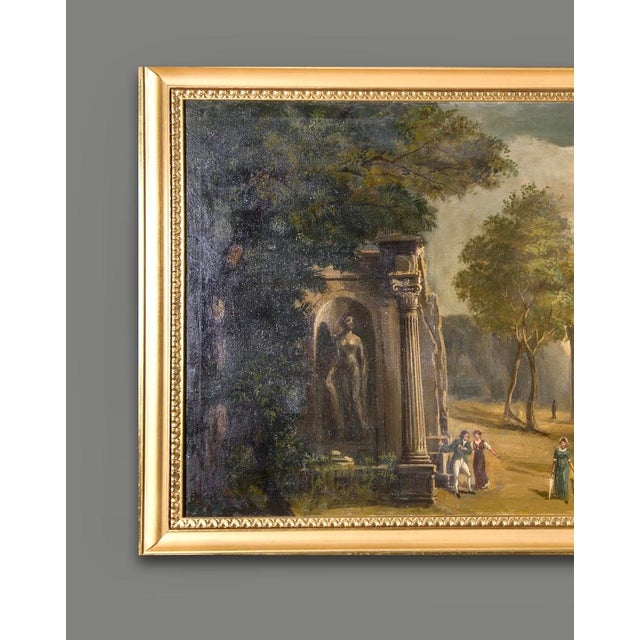
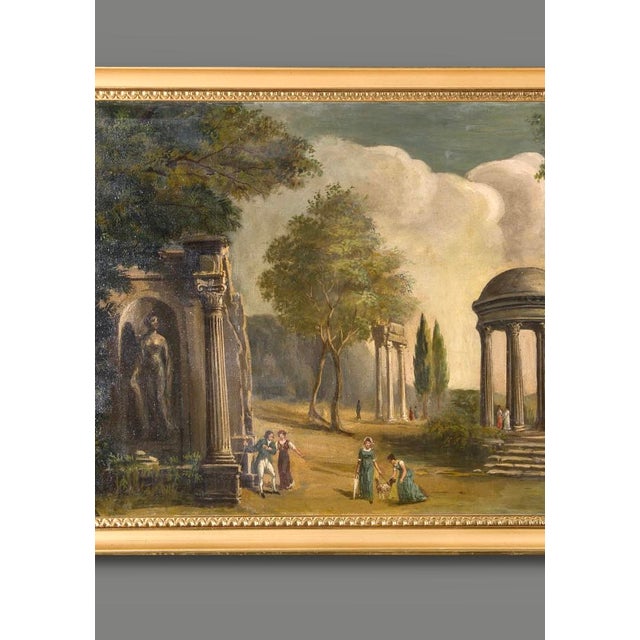
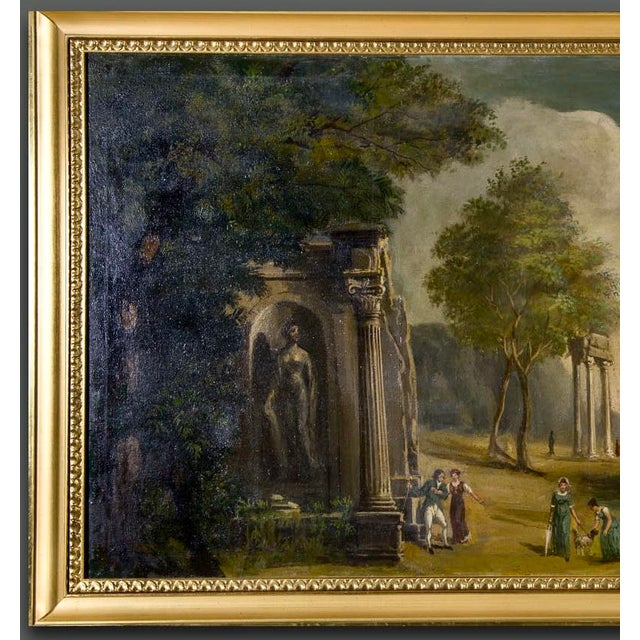
Features contemporary figures—known as staffage—which provide scale and human narrative to the monumental architecture.Dominated by various classical ruins, including a central circular tholos temple and ruined archways, which are common motifs in Pitloo's work.
Following 18th-century landscape traditions, roughly half the canvas is dedicated to the sky, using cloud formations to direct the eye and enhance the scene's depth.
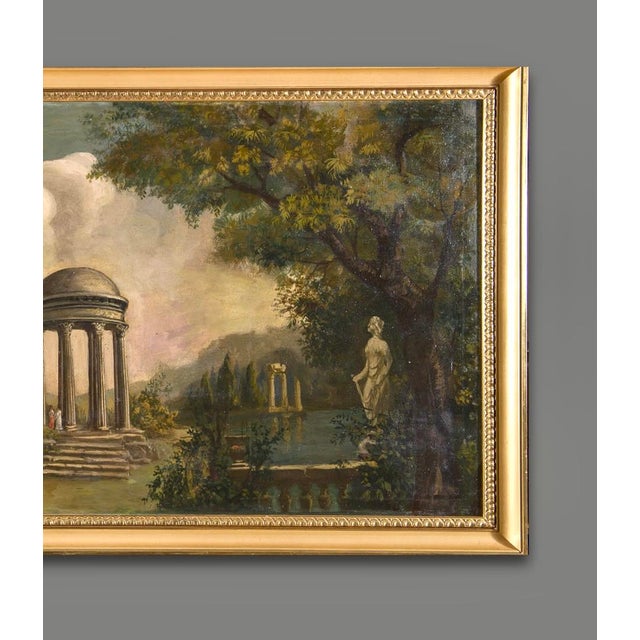
The painting prominently displays an ancient circular temple and fragmented columns, echoing the artist's frequent interest in the archaeological sites of Italy, such as those in Rome and Paestum. Large, detailed trees act as a repoussoir (framing device) on either side, a technical choice used to push the viewer’s eye toward the luminous center of the landscape.
This artwork, never before on the market, comes from an important Italian private collection and is beautified by an impressive original frame in gilded wood, in very good condition.
Antonie or Anton Sminck Pitloo ( 1790– 1837) was a Dutch painter.
His surname was originally Pitlo, but he added the extra "o" because he was often mistaken for an Italian while resident in Italy.
In Italian he is also known as Antonio van Pitloo.
Pitloo was born in Arnhem. He started studying painting first at Paris and then at Rome, where there was already an international artistic colony, in 1811.
He took advantage of a scholarship offered by Louis Bonaparte, the King of Holland. In 1815, after the fall of Bonaparte, the scholarship payments ceased.
He was then invited to Naples by the Russian diplomat and art connoisseur Count Grigory Vladimirovich Orloff (1777 – 22 June 1826).
In 1816, Pitloo won, in a public competition, the post of professor of landscape at the Neapolitan Academy.
Lord Napier lauded him as a landscape painter:
"His manner is not very careful or scholastic, but full of sensibility.
His pencil is always true to general effects, whether his canvass represents the prospect basking in the mid-day brightness of the Italian sky, or the waves flashing in the train of the level sun, or the fields refreshed and steaming in the dawn; every color finds its counterpart on his palette, and no aerial magic is so evanescent as to elude his subtle imitation: although not so perfect in the delineation of particular objects, he could touch the different kinds of foliage with sufficient exactness; his foregrounds were managed with taste; and his figures, being prudently removed to some distance from the eye, formed an agreeable adjunct to the inanimate scene."
In 1820 he married Giulia Mori and thus became a citizen of the Kingdom of the Two Sicilies.
He became a lecturer at the Art Institute of Art at Naples where he specialized in pastoral painting.
Around 1826 he was living in Vicoletto del Vasto 15, with Carl Götzloff, Giacinto Gigante and Teodoro Duclere. Gabriele Smargiassiwas his pupil and successor at the academy.
His paintings have been compared to precursors of Impressionism, some sixty years before this was invented.
Dimensions are frame included This piece is attributed to the mentioned designer/maker. It has no attribution mark and no
official proof of authenticity,
however it is well documented in design history. I take full responsibility for any authenticity
issues arising from misattribution
See less
- Dimensions
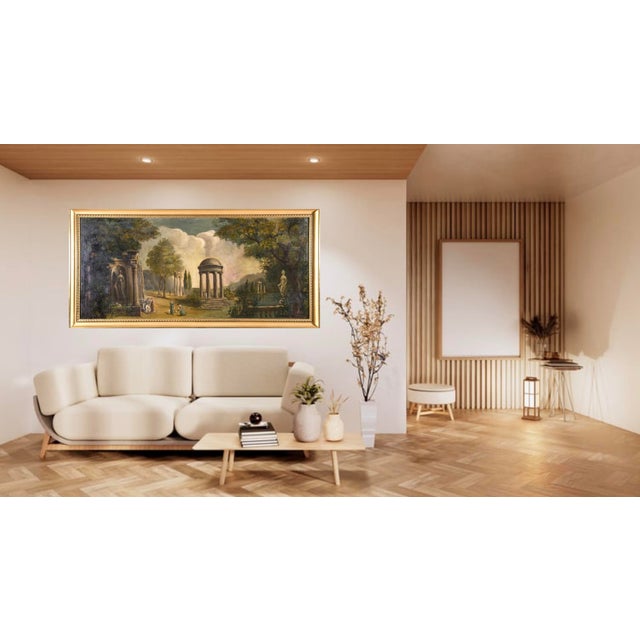
- 76.38ʺW × 2.76ʺD × 37.01ʺH
- Period
- 19th Century
- Country of Origin
- Italy
- Item Type
- Vintage, Antique or Pre-owned
- Condition
- Good Condition, Unknown, Some Imperfections
- Color
- Condition Notes
- Patina Consistent with Age and Use Patina Consistent with Age and Use less
Returns & Cancellations
Return Policy - All sales are final 48 hours after delivery, unless otherwise specified in the description of the product.
Cancellation Policy - Prior to shipping or local pickup, buyers may cancel an order for up to 48 hours, unless otherwise specified.
Related Collections
- Photorealism Canvas Paintings
- Ed Ruscha Paintings
- Richard Serra Paintings
- Photorealism Paintings in New York
- Louise Nevelson Paintings
- Karen Offutt Paintings
- Jo Baskerville Paintings
- Nicola Simbari Paintings
- Herman Miller Paintings
- BDDW Paintings
- James McCray Paintings
- Leroy Neiman Paintings
- Jaanika Peerna Paintings
- Vienna Secession Paintings
- Johannes Andersen Paintings
- Pedro Friedeberg Paintings
- Peter Behrens Paintings
- Piet Hein Eek Paintings
- Raphael Paintings
- Jeff Slemmons Paintings
- Photorealism Paintings in Los Angeles
- Milton Avery Paintings
- Karl-Erik Ekselius Paintings
- Hans Andersen Paintings
- Jean-Paul Barray Paintings