

Details
Description
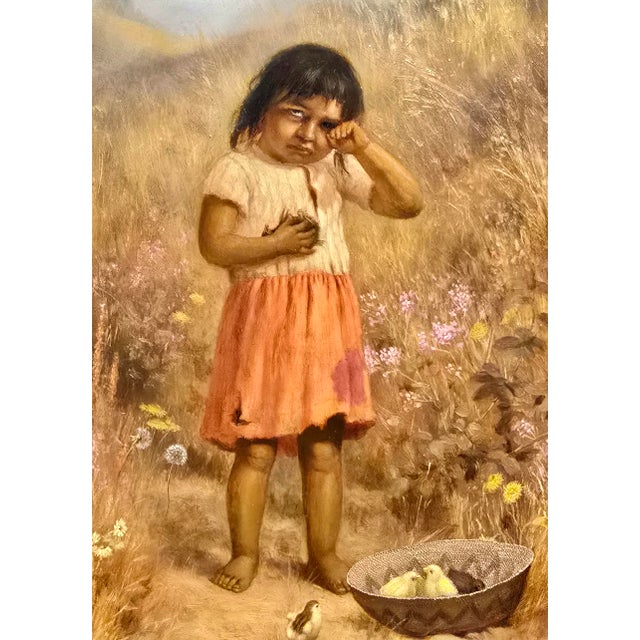
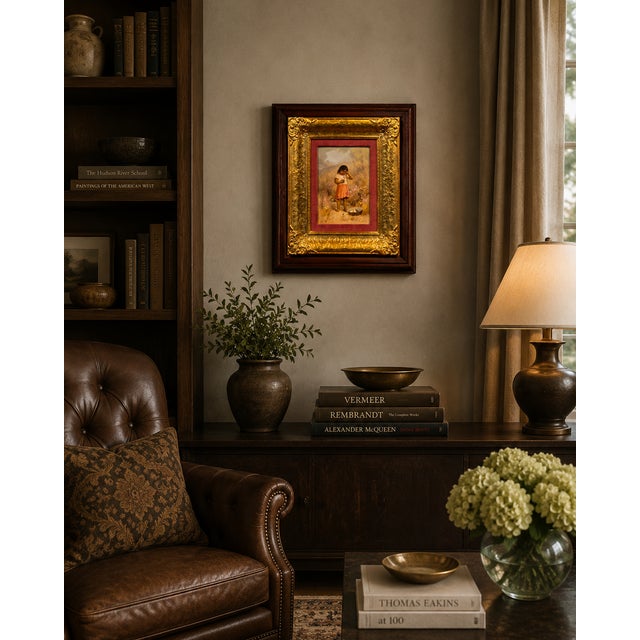
Alice Coutts –Young Native American Pomo Girl w/her Chicks-19th c. Oil painting
South Western Art - Oil painting on board- …
Read more
Alice Coutts –Young Native American Pomo Girl w/her Chicks-19th c. Oil painting
South Western Art - Oil painting on board- Signed - circa 1895s
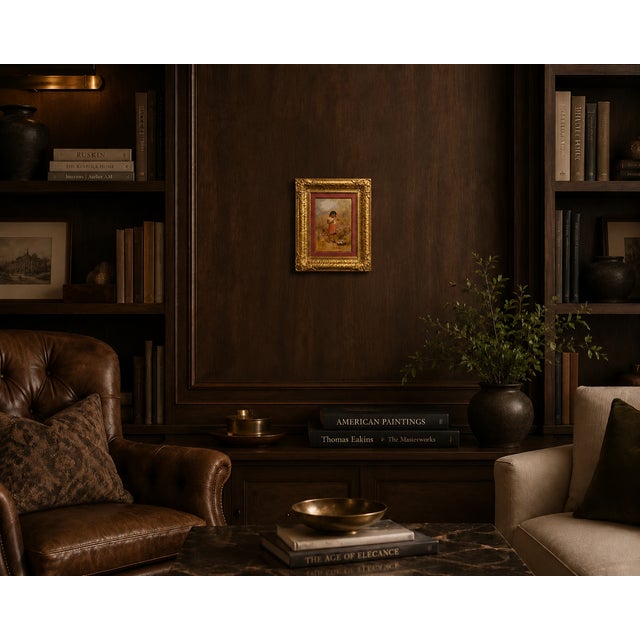
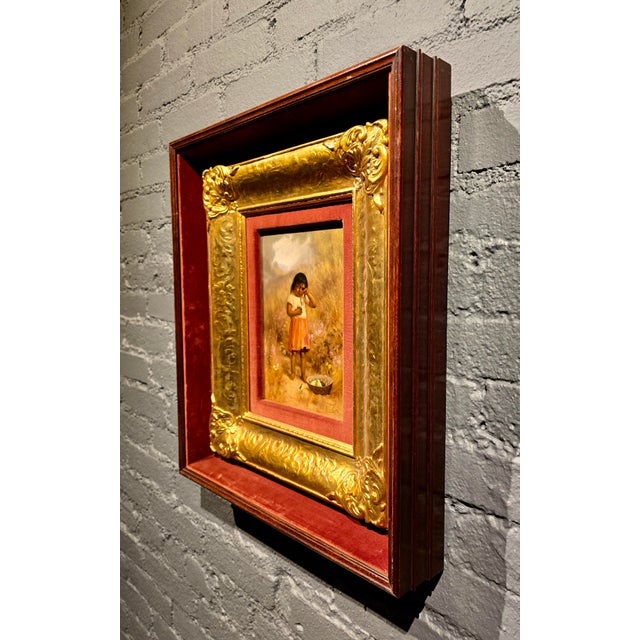
board size 10x7" - Frame size 20x17"
Overview
This poignant, masterfully executed oil on panel painting by renowned early California impressionist Alice Grey Hobbs Bolton Coutts represents a premium addition to any collection of Western Americana, Native American portraiture, or turn-of-the-century genre art. Celebrated for her tender, emotionally resonant depictions of local Pomo Indian children, Coutts delivers an exceptional masterpiece of narrative art.
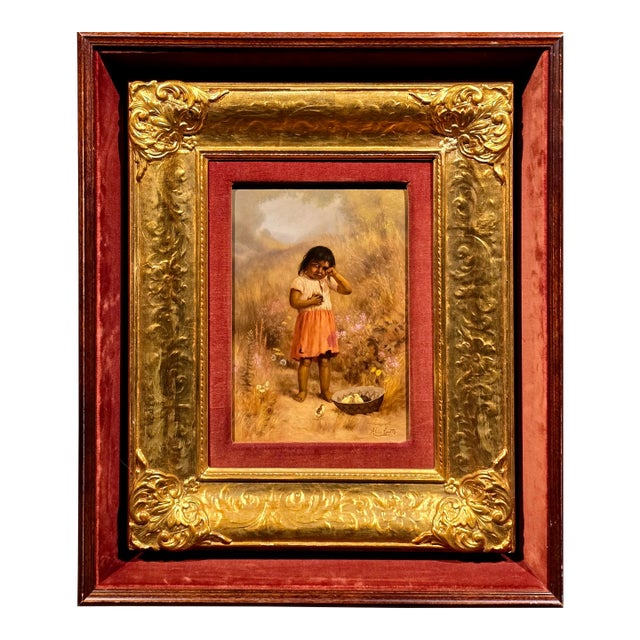
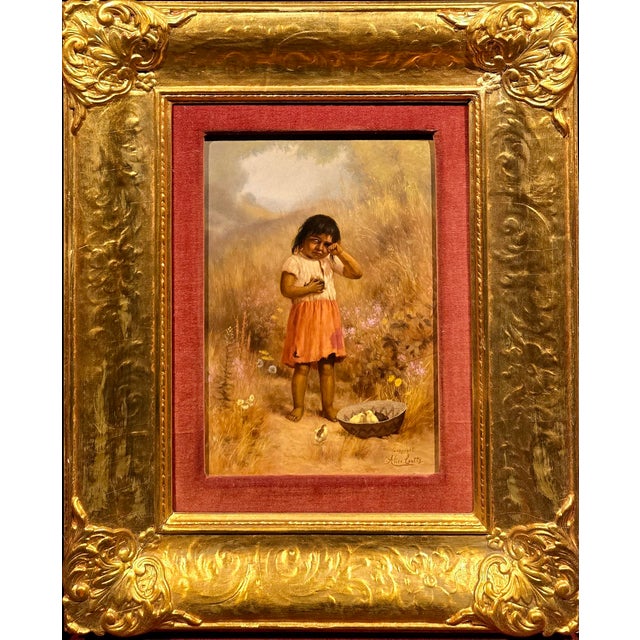
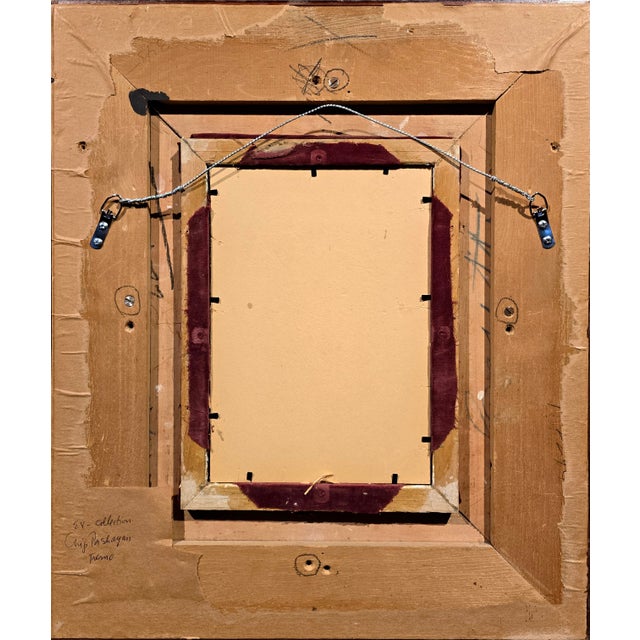
The piece is presented in its original, extraordinarily grand presentation formatting: a deep-set crimson velvet liner nestled within a heavily carved, ornate Baroque giltwood frame, further preserved inside a thick hardwood shadowbox outer frame.
Item Details & Specifications
Creator: Alice Grey Hobbs Bolton Coutts (British/American, 1879–1973)
Title: Untitled (Sorrow / The First Loss)
Period: Late 19th Century (Circa 1895–1905)
Medium: Oil on Panel / Board
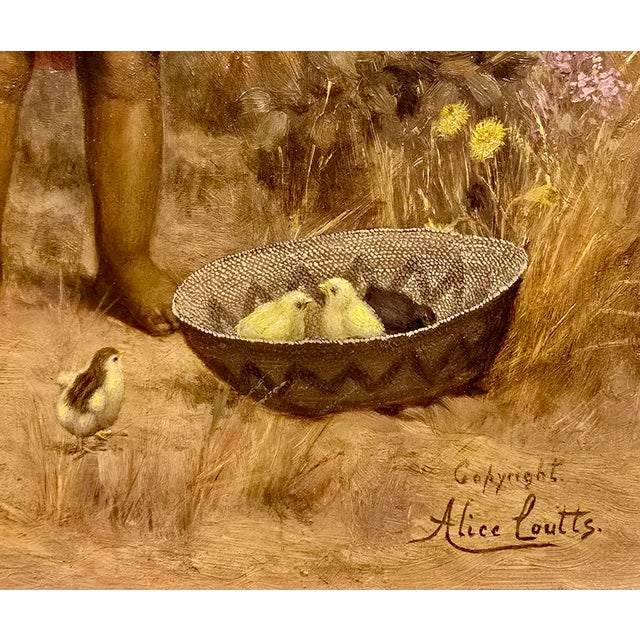
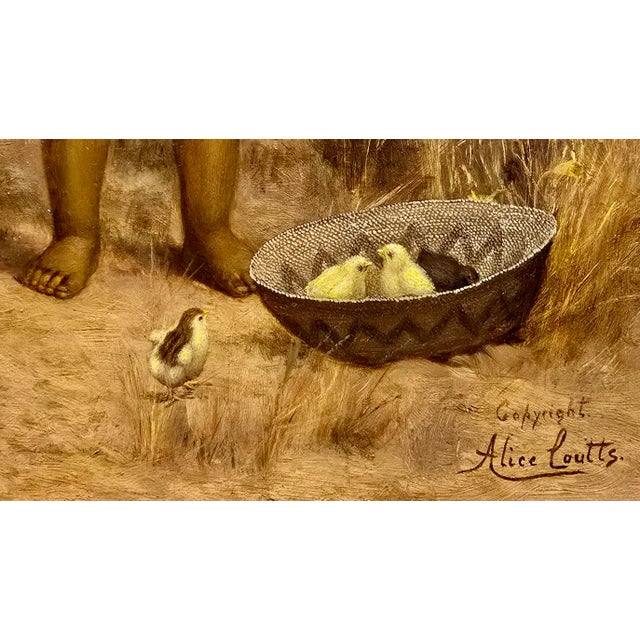
Signature: Signed lower right "Alice Coutts"
Condition: Excellent vintage condition. The oil painting exhibits beautiful color saturation and steady stabilization, with very light, age-appropriate wear to the gilt frame and outer wood shadowbox.
Styles: Early California Impressionism, American Western Art, Genre Scene Portraiture.
Narrative & Compositional Analysis
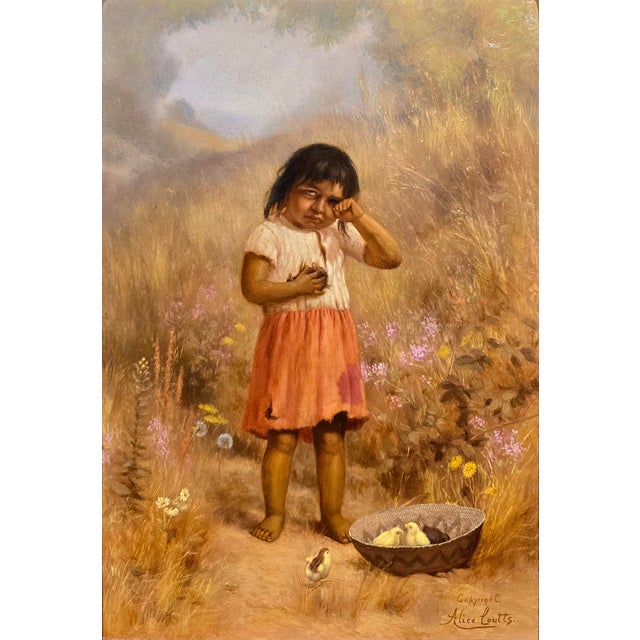
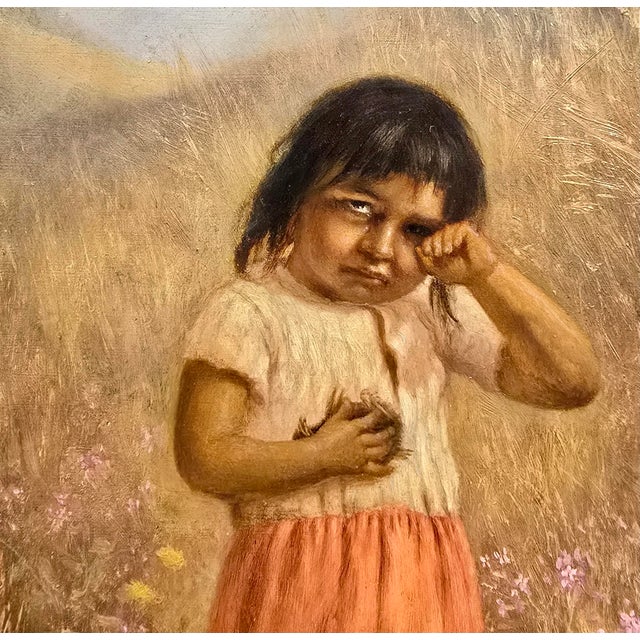
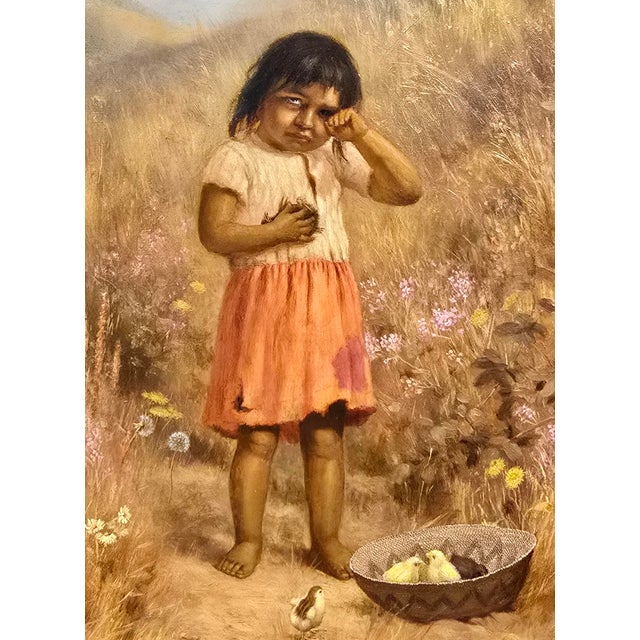
The painting explores a deeply moving, universal theme: a child’s innocent, firsthand encounter with grief. Standing barefoot on a sun-dappled dirt path, a young Pomo Native American girl is overcome with sorrow. With her left hand, she wipes away a tear from her crying eye. Her right hand is held tenderly against her chest, gently cradling a small, lifeless chick.
At her feet sits a dark, woven basket overflowing with active, lively black and yellow chicks. Nearby, a single stray chick stands on the path looking up at her, casting a bittersweet contrast between the vibrance of life and the quiet mystery of death. Coutts uses a stunning, atmospheric palette dominated by golden grasses, wild lavender flora, and muted earth tones, prioritizing emotional realism over stark ethnographic documentation.
Biography: Alice Grey Hobbs Bolton Coutts (1879–1973)
Alice Grey Hobbs Bolton Coutts was an internationally educated early California Impressionist and genre painter. She is most celebrated for her poignant, deeply empathetic portraiture of Native American children. Alongside contemporaries like her mentor Grace Carpenter Hudson, Coutts belongs to an elite group of early 20th-century female artists who bucked social norms to chronicle indigenous communities firsthand in the American West.1. A Globetrotting EducationBorn in Surrey, England, in 1879, Alice was the daughter of Charles and Maria Hobbs. During her childhood, the family immigrated to Melbourne, Australia, where she demonstrated an early, prodigious talent for drawing and composition, winning several regional art contests. Recognizing her skills, she traveled to Europe as a teenager to receive a rigorous classical foundation. She was accepted into the world-famous Académie Julian in Paris, studying under the master academic painter Jules Lefebvre. Here, she mastered anatomy, light modeling, and the delicate rendering of human emotion that defines her later Western portraiture.2. Romance, Tragedy, and the 1906 EarthquakeWhile studying abroad, she met the prominent British-born painter Gordon Coutts, an art instructor from Sydney. Against her parents' strict wishes and without their approval, Alice eloped with Gordon, marrying him in San Francisco in 1904. The artistic couple immediately embarked on an ambitious, year-long world tour, gathering inspiration across Europe and North Africa. In 1906, they officially settled in San Francisco. Only months later, the catastrophic 1906 San Francisco Earthquake and Fire tore through the city, destroying their home and studio. Tragically, Alice’s earliest portfolio of European paintings, which was on exhibition at the historic Mark Hopkins Institute, was completely incinerated in the blaze. Undeterred, the couple relocated across the bay to the affluent hills of Piedmont/Oakland, rebuilding their studios. 3. Fieldwork with Indigenous TribesDuring her most prolific era (roughly 1905–1918), Alice committed herself entirely to painting regional subjects directly from real-life observation. She sought out Grace Carpenter Hudson in Ukiah, California, whose world-famous "papoose" paintings heavily influenced Alice's style. To achieve unmatched accuracy and emotional authenticity, Alice traveled extensively into rugged territories, camping for long stretches with the Hopi of Northern Arizona and living directly alongside the Pomo Indians of Northern California. Unlike ethnographic painters who treated indigenous subjects as clinical specimens, Alice focused entirely on universal childhood narratives—showing children playing with puppies, listening to seashells, or crying over small mishaps. Her technical skill was so high that her unsigned works were frequently confused with Hudson's.4. Peak Commercial SuccessBy 1910, Alice was a major force in the California art scene. Her painting The Jockey was selected as the cover art for Sunset Magazine in 1910, cementing her status. She exhibited regularly with the San Francisco Art Association and achieved massive commercial heights through highly publicized solo exhibitions at the historic Gump's Department Store luxury gallery in 1910 and 1911.5. Later Years and LegacyFollowing a turbulent personal life, Alice and Gordon Coutts divorced in 1918. She remained in her beloved Piedmont, California, where she spent the remainder of her life expanding her repertoire to include sweeping California landscapes, coastal seascapes, and vibrant floral still lifes.She passed away in Piedmont in 1973. Today, her works reside in elite private estates and Western institutions, including the Irvine Museum and the Smithsonian Institution's permanent art registries. Her paintings are highly prized for their deep tenderness, technical mastery, and their rare, empathetic window into early 20th-century Native American childhood.
See less
- Dimensions
- 17ʺW × 1.5ʺD × 20ʺH
- Styles
- American
- Southwestern
- Frame Type
- Framed
- Art Subjects
- Portrait
- Period
- Late 19th Century
- Country of Origin
- United States
- Item Type
- Vintage, Antique or Pre-owned
- Materials
- Oil Paint
- Wood
- Condition
- Good Condition, Original Condition Unaltered, Some Imperfections
- Color
- Copper
- Condition Notes
- Excellent - Minor wear consistent with age and history Excellent - Minor wear consistent with age and history less
Questions about the item?
Returns & Cancellations
Return Policy - All sales are final 48 hours after delivery, unless otherwise specified in the description of the product.
Cancellation Policy - Prior to shipping or local pickup, buyers may cancel an order for up to 48 hours, unless otherwise specified.
Related Collections
- Photorealism Canvas Paintings
- Ed Ruscha Paintings
- Photorealism Paintings in New York
- Richard Serra Paintings
- Jo Baskerville Paintings
- Louise Nevelson Paintings
- Karen Offutt Paintings
- Nicola Simbari Paintings
- Herman Miller Paintings
- BDDW Paintings
- Jaanika Peerna Paintings
- Leroy Neiman Paintings
- Jeff Slemmons Paintings
- Vienna Secession Paintings
- Johannes Andersen Paintings
- Pedro Friedeberg Paintings
- Peter Behrens Paintings
- Piet Hein Eek Paintings
- Raphael Paintings
- Carl-Axel Acking Paintings
- Karl-Erik Ekselius Paintings
- Hans Andersen Paintings
- Jean-Paul Barray Paintings
- Cassina Paintings
- Soicher Marin Paintings