

Details
Description
MEASUREMENTS:
Height: 20 cm; Width: 14 cm; Depth: 13.3 cm; Weight: 0.520 kg
Item :
Splendid and extremely rare ceramic …
Read more
MEASUREMENTS:
Height: 20 cm; Width: 14 cm; Depth: 13.3 cm; Weight: 0.520 kg
Item :
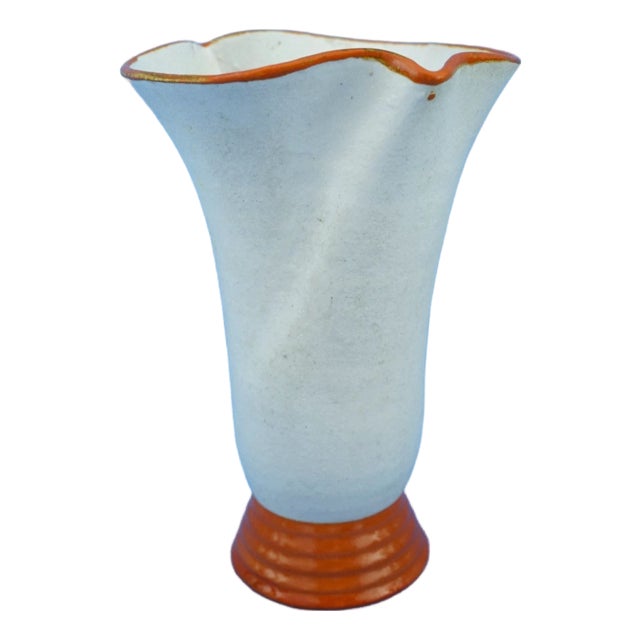
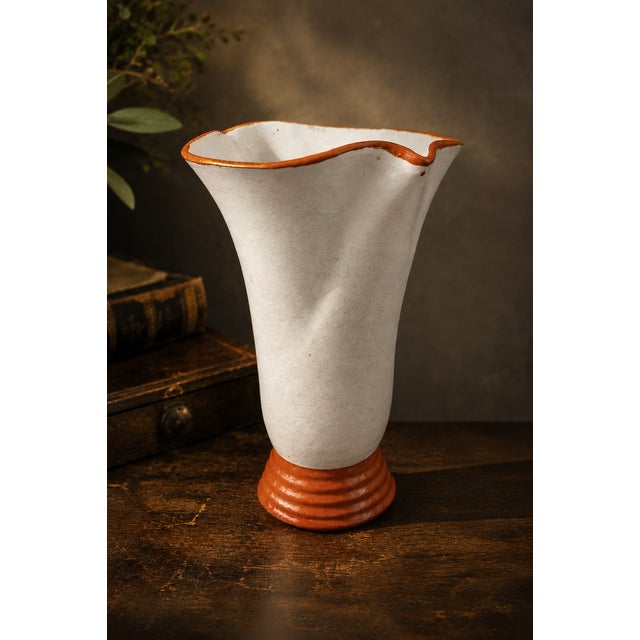
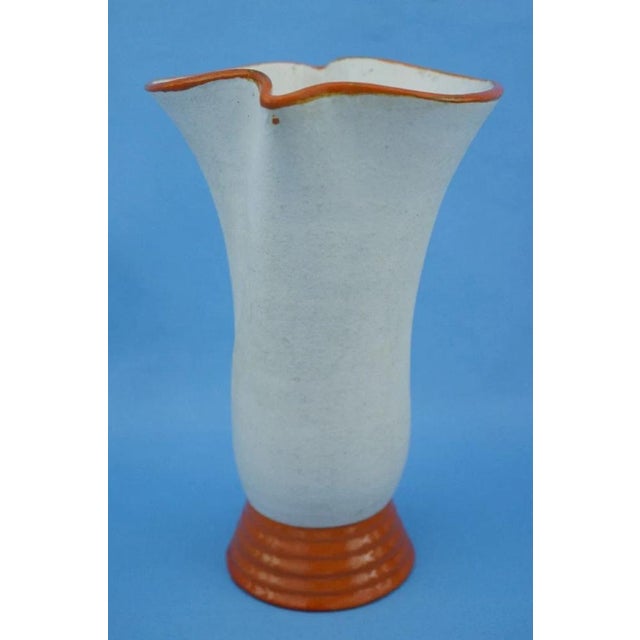
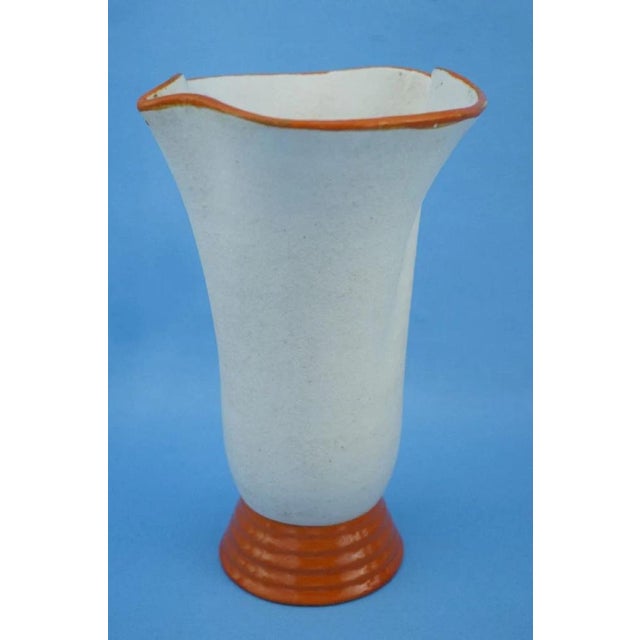
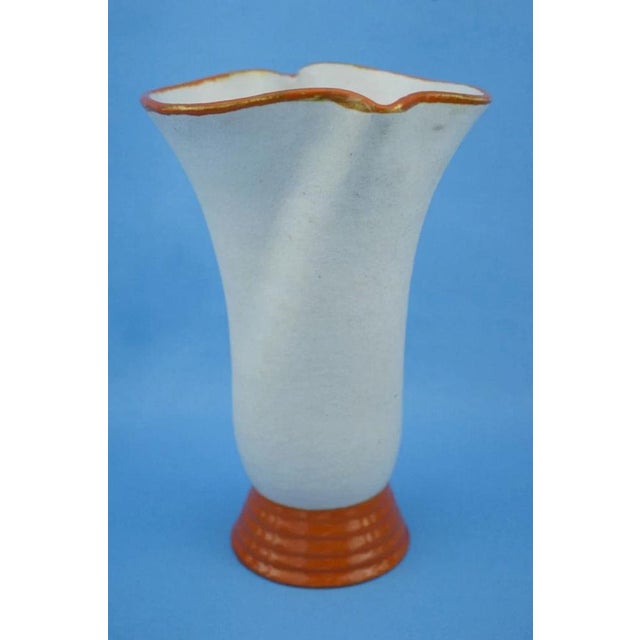
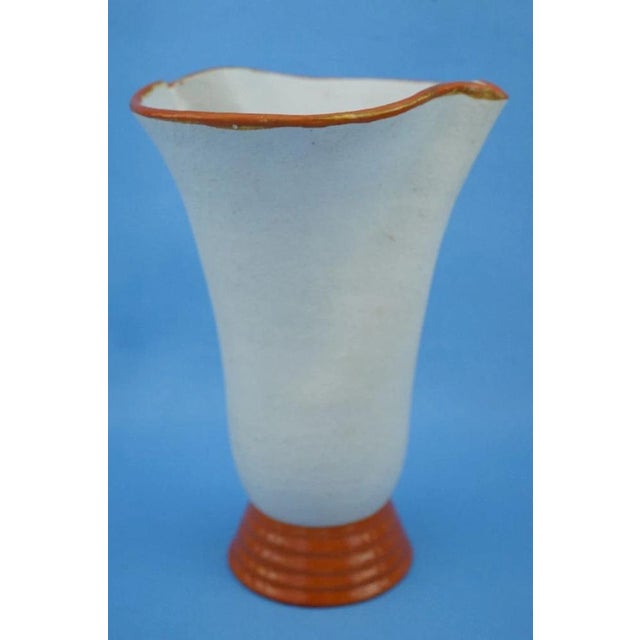
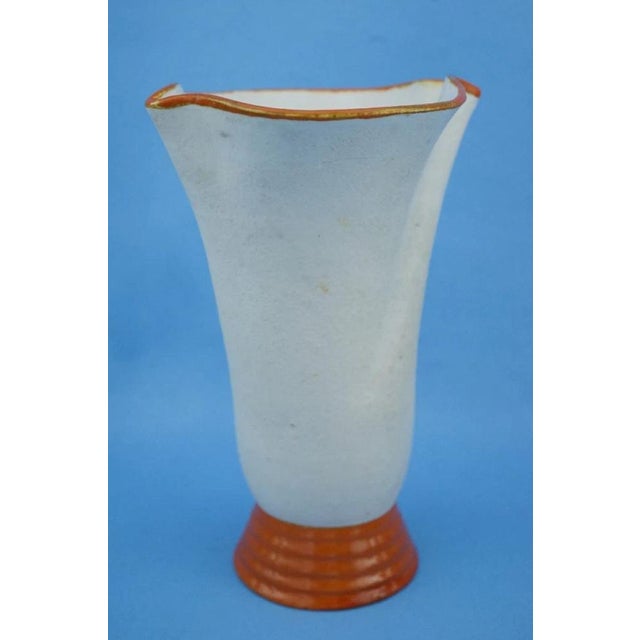
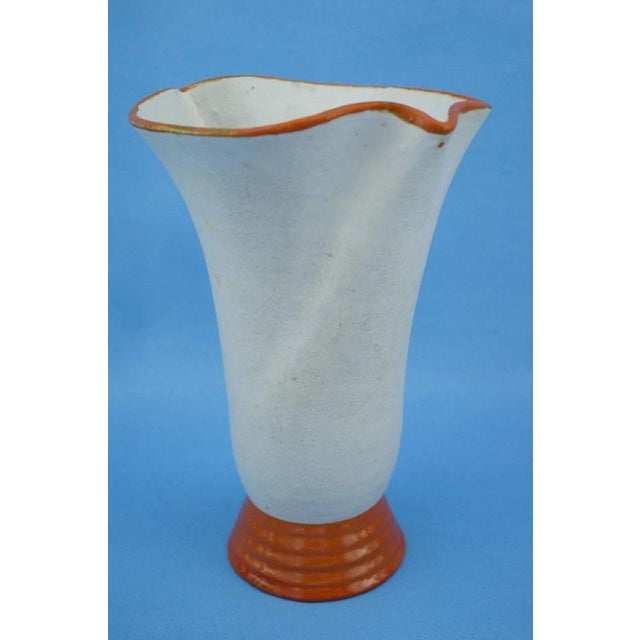
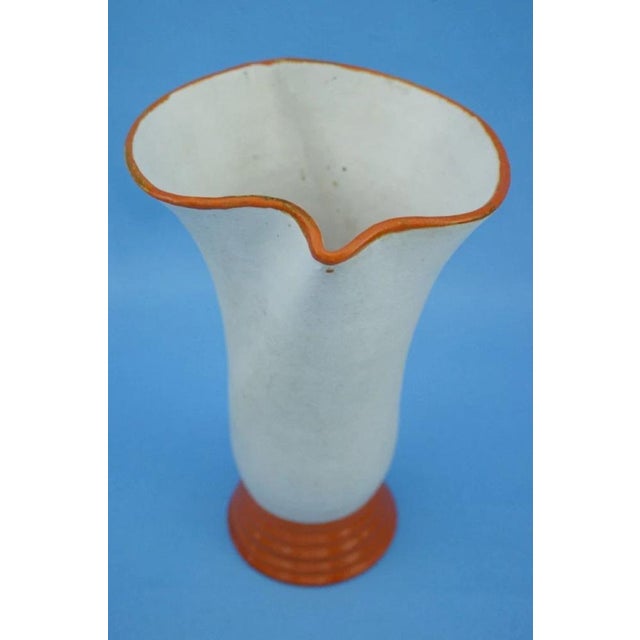
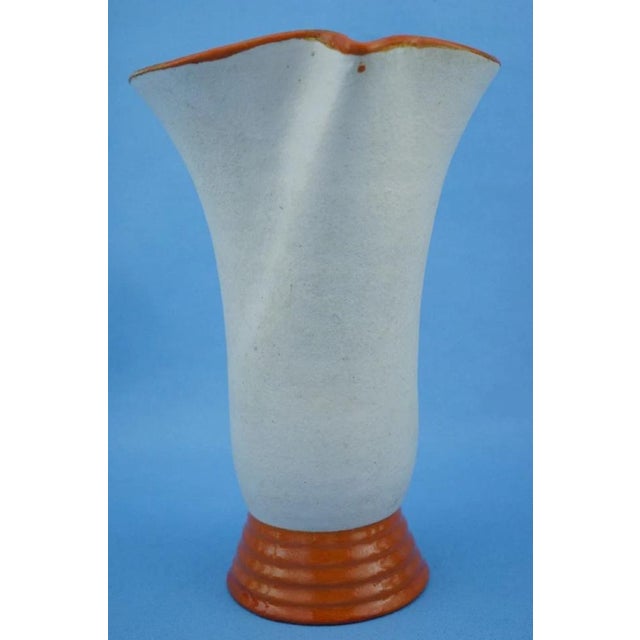
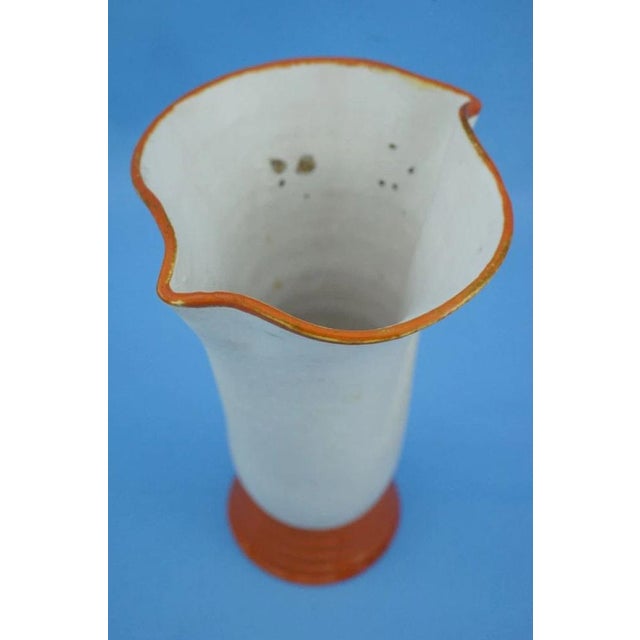
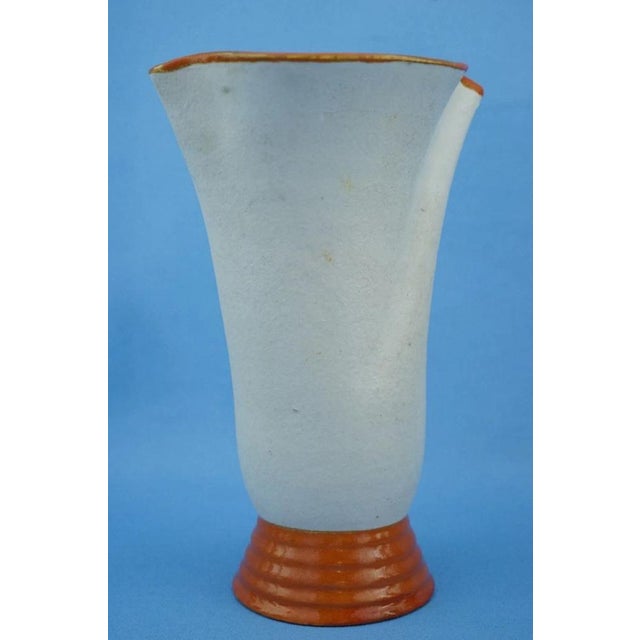
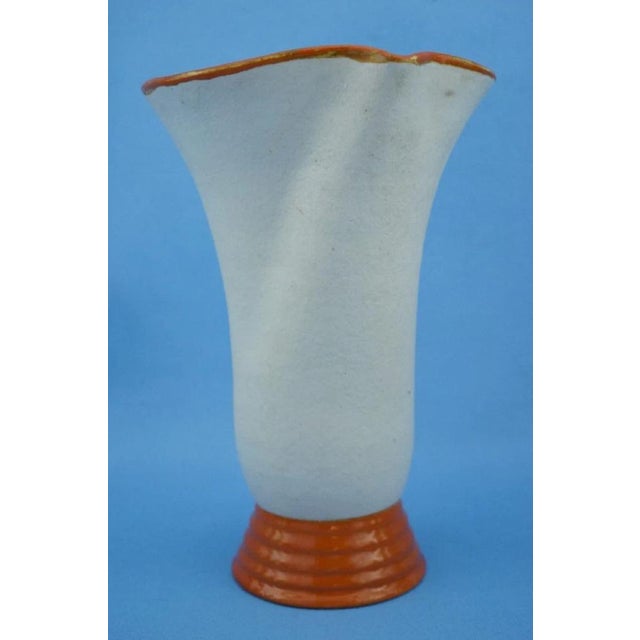
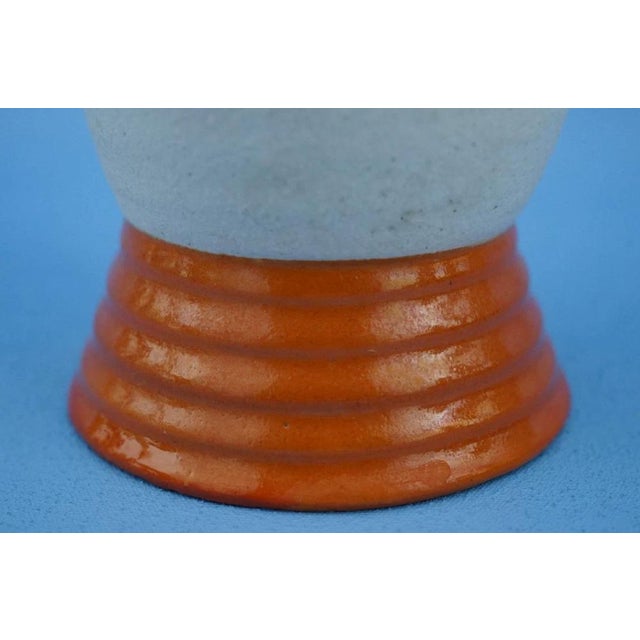
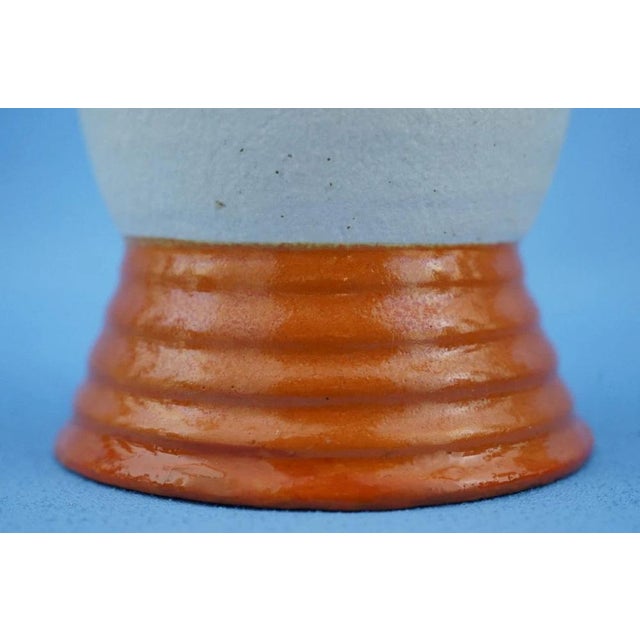
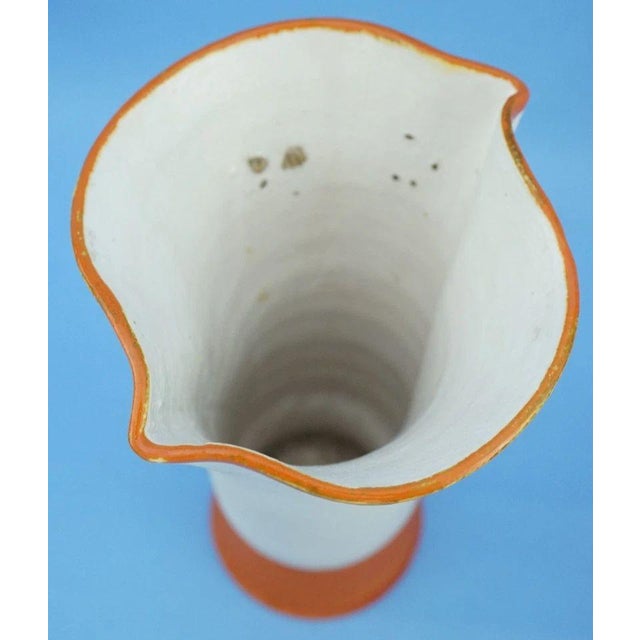
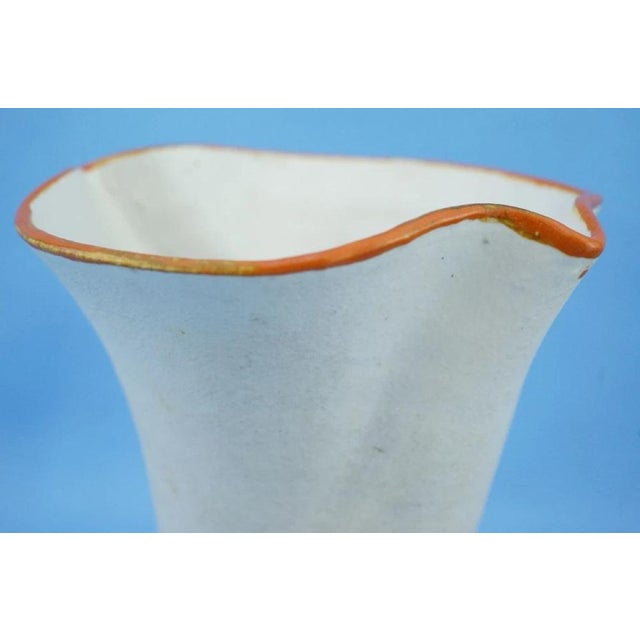
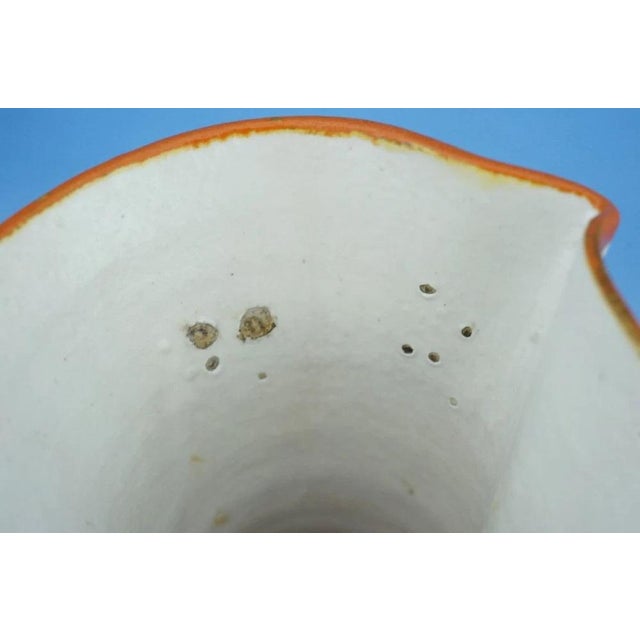
Splendid and extremely rare ceramic vase, entirely hand-crafted on a wheel, featuring a refined tulip shape with a stem articulated by two transverse folds culminating in the two asymmetrical spouts of the slightly flared mouth. The ceramic body is coated in an ivory white glaze with a satin and matte finish, masterfully acid-etched to achieve a sophisticated "orange peel" effect, making the surface pleasantly rough and vibrant to the touch. In perfect chromatic contrast, the rounded edge of the flared edge and the truncated cone base, punctuated by raised circular rings, are decorated in a vibrant shade of orange, a signature color of the Art Deco repertoire. Under the base is one of the earliest and oldest marks of the Albisola-based "La Fenice" factory, placing the piece among the very first and most exclusive artistic production of the company. The work is attributed to Manlio Trucco, founder and leading exponent of the factory. The exceptionality of the sculptural form and the technical complexity of the surface finish clearly differ from the artist's standard production, elevating this piece to an extremely rare piece of great collector's interest.
Information on the artist and/or manufacturer:
Manlio Trucco (1884-1974) was a celebrated Italian painter and ceramist. After studying in Genoa at the Ligurian Academy of Fine Arts under Luigi De Servi, he moved to Paris, where he fully absorbed the nascent Art Deco trend. In 1921, he returned to Italy, to Albisola Capo, joining the "La Casa dell'Arte" factory, owned by Angelo and Giulio Barile and Giuseppe Agnino. Here, he introduced the third-fire firing technique for metallic reflections to the Albisola workshops for the first time, a technique that would later be studied by great twentieth-century masters, including Lucio Fontana himself. In 1922, together with Cornelio Geranzani, he founded the "La Fenice" factory, attracting figures of the calibre of Adelina Zandrino, Mario Labò, Francesco Messina and Arturo Martini, with whom he began an exceptionally fruitful artistic partnership. The factory immediately achieved international prestige by participating in the 1st Biennial of Decorative Arts in Monza (1923), the Exhibition of the Society of Fine Arts (1924) and the famous International Exhibition in Paris (1925). While in his large monumental production Trucco often maintained the traditional blue colours on a white background typical of the ancient Savona style, in his production of earthenware for everyday use and furnishings he re-elaborated the themes of Art Deco, fusing them with styles drawn from European popular art, particularly Russian and Hungarian. Famous for his "interpenetrating swallows" motifs, presented in Monza in 1923, his decorative style evolved from the late 1920s toward geometric palmettes, stylized floral symmetries, and elegant zoomorphic figures. His artist residence in Albisola Capo, designed in 1936 by architect Mario Labò and engineer Fabris, was donated by Trucco himself to the Municipality to become a museum center for Ligurian artists. The "Manlio Trucco" Civic Museum of Contemporary Art, listed in the General Catalogue of Cultural Heritage, today preserves the history of Ligurian majolica from the 15th century to the present day, including the famous 17th- and 18th-century apothecary jars and, in the garden, the monumental sculpture "Battaglia" by Agenore Fabbri. In the last photo, we've included additional historical information on the manufacture for those who wish to delve deeper, including many of the trademarks used, including ours, one of the oldest.
Final Considerations on the Object:
The vase's distinctive design, characterized by a curved, asymmetrical cartoccio-shaped mouth, a slender, geometrically twisted stem, and a base of concentric orange rings, perfectly embodies the transition between the sinuous lines of late Art Nouveau and the geometric decomposition of Ligurian Futurism of the 1920s and 1930s. Our vase (Form number 784) is of exceptional interest to collectors because, despite its monochrome, minimalist ceramic body, it entrusts its expressive power entirely to its complex, Futurist-inspired plastic structure. The stark contrast with the bright orange edges and concentric circles (a hue symbolic of the Riviera's historic avant-garde movements) makes the work a perfect manifesto of Albisola's great twentieth-century period. This piece has an attribution mark,
I am sure that it is completely authentic and take full responsibility for any authenticity
issues arising from misattribution
See less
- Dimensions
- 5.51ʺW × 5.12ʺD × 7.87ʺH
- Period
- 1920s
- Country of Origin
- Italy
- Item Type
- Vintage, Antique or Pre-owned
- Materials
- Ceramic
- Condition
- Good Condition, Original Condition Unaltered, Some Imperfections
- Color
- Gold
Returns & Cancellations
Return Policy - All sales are final 48 hours after delivery, unless otherwise specified in the description of the product.
Cancellation Policy - Prior to shipping or local pickup, buyers may cancel an order for up to 48 hours, unless otherwise specified.
Related Collections
- Clarice Cliff Vases
- Dorothy Draper Vases
- Franco Bucci Vases
- Gesso Vases
- Kähler Keramik Vases
- Liz Marsh Vases
- The American School Vases
- Ralph Lauren Home Vases
- Vases in Panama City, FL
- Cristalleries De Sevres Vases
- Southeast Asia Vases
- Karl Springer Vases
- Louis Dage Vases
- From Vienna Vases
- Bimini Glass Vases
- Libbey Glass Co. Vases
- Workaday Handmade Vases
- St. Louis Crystal Vases
- Lenox Vases
- Blenko Vases
- Swung Vases
- Fenton Art Glass Company Vases
- Viking Glass Company Vases
- Haeger Vases
- Rosenthal Vases