



Details
Description
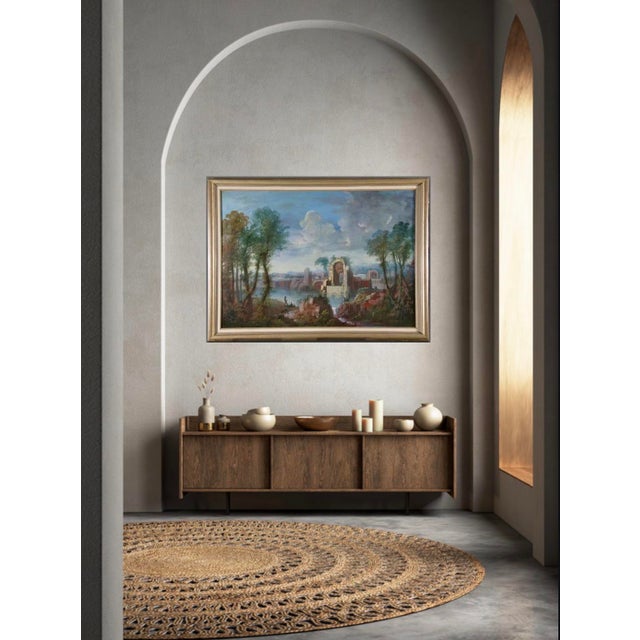
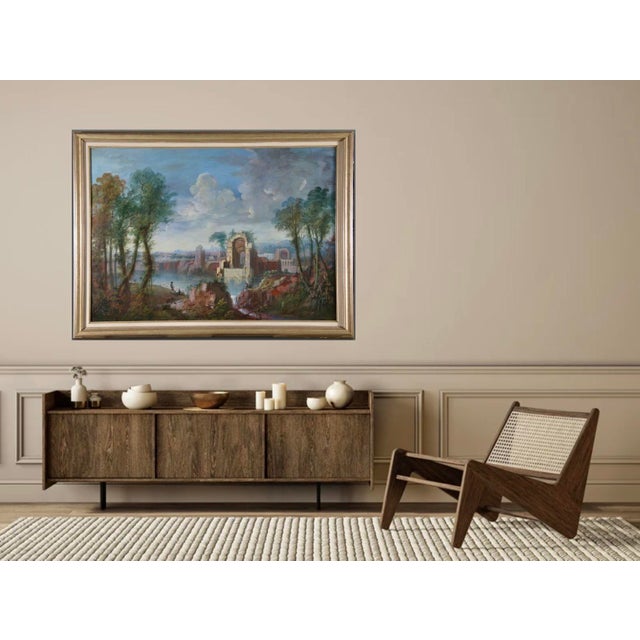
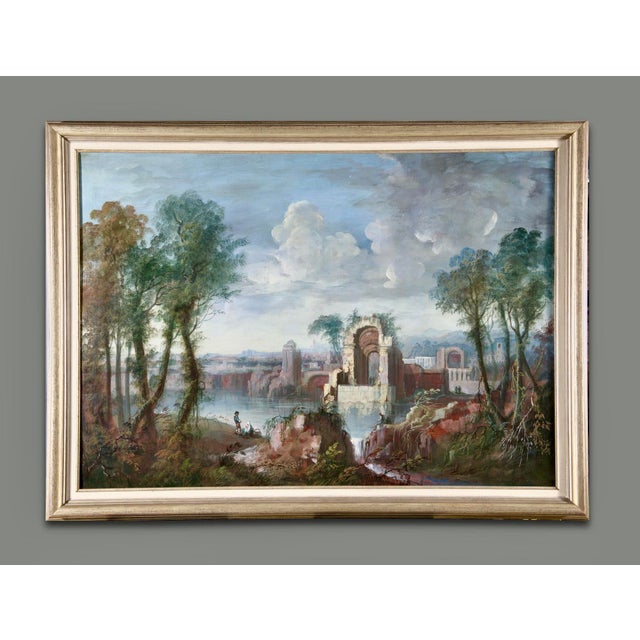
Maria Luigia Raggi 18th Century Italian Capriccio Landscape Painting
This as usual not signed wonderful capriccio, is an important hallmark …
Read more
Maria Luigia Raggi 18th Century Italian Capriccio Landscape Painting
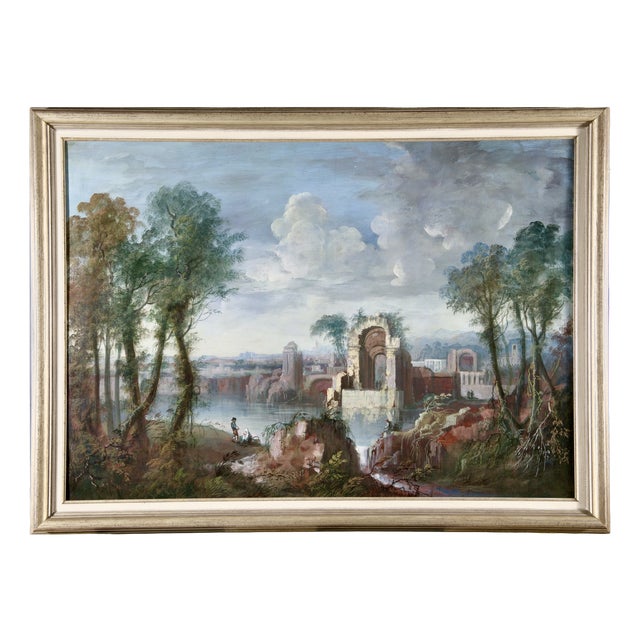
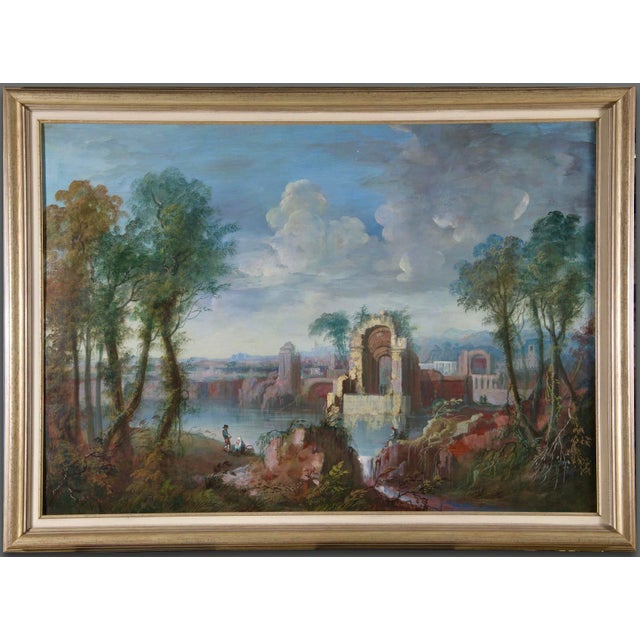
This as usual not signed wonderful capriccio, is an important hallmark work credited to Maria Luigia Raggi (1742–1813), a Genoese artist known for her atmospheric, idealized landscapes and her ability to produce the soft, matte finishes seen in the sky and foliage.
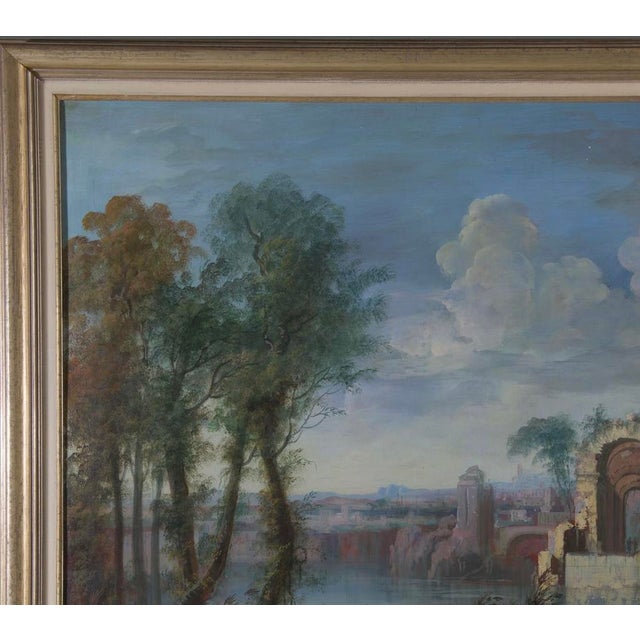
Her technique involves delicate, minute brushstrokes and a luminous, light-toned palette.
The painting follows a classic veduta arrangement:"Staffage" figures—peasants engaged in everyday activities—are placed on the banks to provide scale and narrative life.
The focal point is a massive, crumbling Roman archway, partially reclaimed by nature.
This structure acts as a monumental anchor, typical of Raggi’s fascination with ancient ruins.
A serene, hazy body of water leads the eye toward distant, faintly rendered hills and further architectural silhouettes under a dramatic, billowing cloudscape.
This is an imaginary landscape rather than a topographic record.
It blends real Roman architectural motifs with invented settings to create a nostalgic, "Arcadian" atmosphere popular among 18th-century Grand Tour collectors.
The use of a "late Rococo" aesthetic results in a lyrical, dreamlike quality.
The soft lighting and lush greenery frame the central ruins, emphasizing themes of time’s passage and nature’s triumph over man-made structures
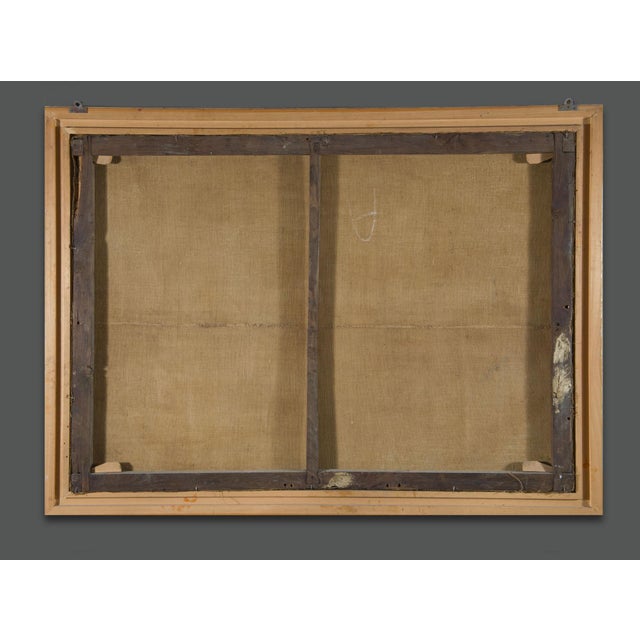
This artwork, never before on the market, comes from an important Italian private collection and is beautified by an impressive frame in natural wood, in almost perfect condition.
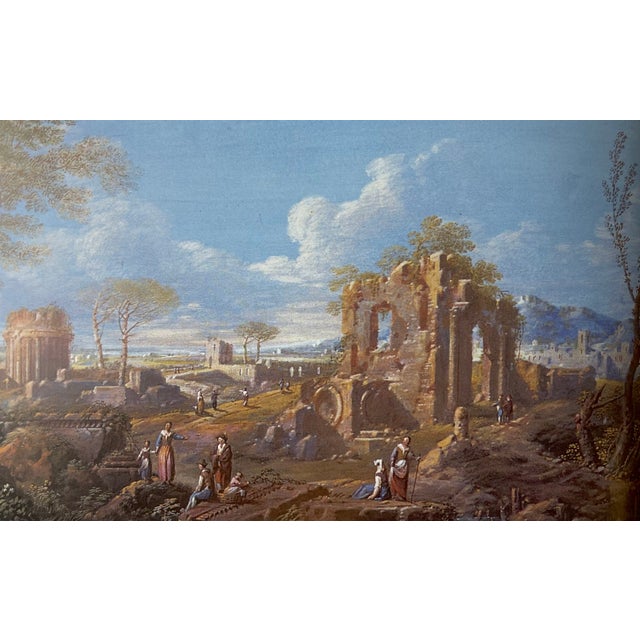
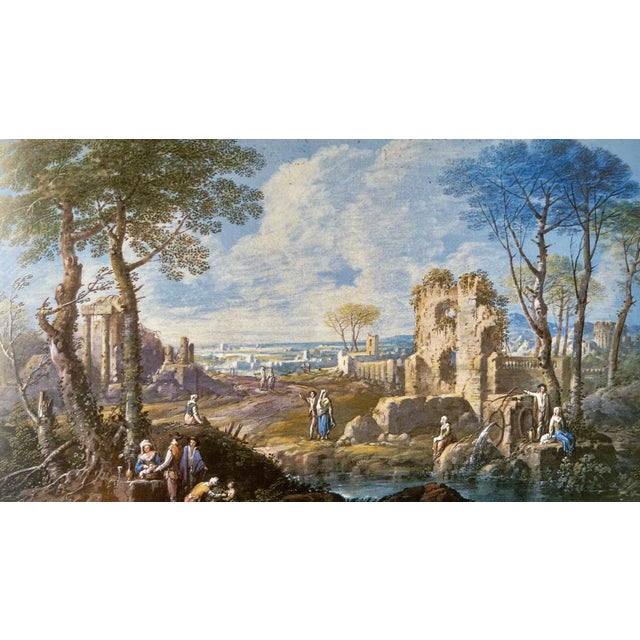
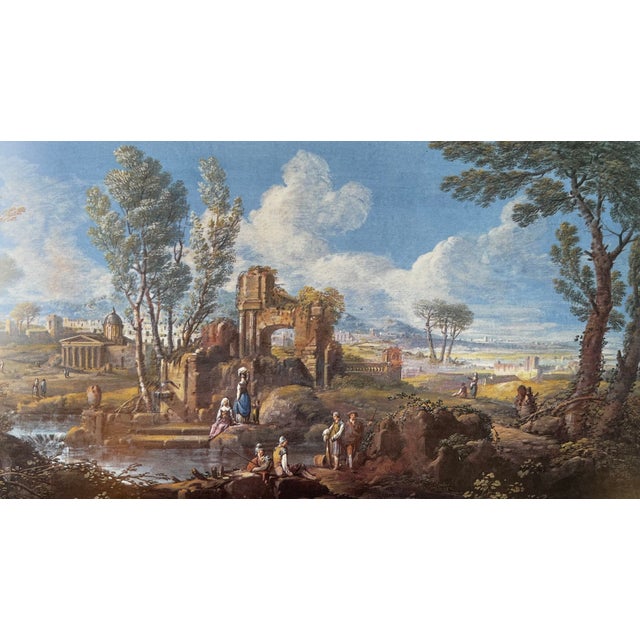
In the last three photographs published, you will find 3 works by Maria Luigia Raggi, preserved in Rome at the Pinacoteca of the prestigious Capitoline Museums, which clearly demonstrate the complete accuracy of the attribution to this great artist.
Thanks to the invaluable and meticulous historical and art-historical research carried out by Dr Consuelo Lollobrigida, the life and work of Maria Luigia Raggi – born in Genoa as Battina Ignazia Raggi (1742–1813), a cloistered nun – have been reconstructed; she has finally been identified as the artist behind numerous previously anonymous landscapes.
Maria Luigia Raggi was a painter and a cloistered nun belonging to one of the most illustrious families of the Genoese aristocracy
Through this seminal work, the artist—who belonged to one of the most illustrious families of the Genoese aristocracy—emerges as a complex figure who, despite the constraints of monastic life, managed to express her creative freedom by painting tempera works and capriccios of rare grace and elegance.
Her works did not seek to depict real places, but aimed to ‘convey emotions’, combining myth and nature in visions rich in suggestion and imagination.
Despite the rigidity of her vow of cloistered life, Raggi managed to become part of the fabric of late 18th-century figurative culture, emerging as a rare female figure active in the landscape genre, which at the time was practised almost exclusively by men.
Sources record a significant stay in Rome in 1781, a period during which our work may have been produced, and in which the painter came into contact with a cosmopolitan and intellectual milieu under the guidance of her mentor and relative, Ferdinando Raggi.
Her artistic output is distinguished by her ability to blend the classical models of Lorrain and Dughet with a pre-Romantic sensibility, populating Arcadian scenes and ruins with a serene naturalness.
Thanks to meticulous archival research, Raggi has been rescued from historiographical oblivion and rightfully placed within the international landscape painting scene of the 18th century.
Ultimately, this marks the rediscovery of an independent female voice capable of transforming the confines of a convent cell into a space for refined aesthetic experimentation.
Her painting is described as ‘light and muted’, characterised by an ability to visually expand spaces and backgrounds.
Her works are populated by gentle, serene figures who gesticulate and converse naturally amongst the ruins, as if that world were their usual stage.
Nature is depicted in a lush and alluring manner, with the use of vibrant greens and soft brushstrokes to render shrubs and bushes.
The compositions adhere to principles of variety and aesthetic appeal, featuring ponds, streams, seascapes, mountains, groves and monuments.
These elements form fantastical scenes that capture the eye, typical of the ‘Capriccio’ and ‘Picturesque’ genres.
His paintings reflect the classical themes of Arcadian literature, such as flower-filled meadows, cool woods and grazing flocks, evoking a lost era and an escape from everyday reality.
Her artistic vision is seen as straddling the classical ideal of Arcadia and the emerging Romantic aesthetic of the sublime, revealing a sensibility that anticipates modernity.
In short, Raggi’s landscapes are not mere views, but visions brimming with imagination and evocative power, where the ruins of antiquity serve as a pretext for staging a magical and harmonious world
Dimensions are frame included This piece is attributed to the mentioned designer/maker. It has no attribution mark and no
official proof of authenticity,
however it is well documented in design history. I take full responsibility for any authenticity
issues arising from misattribution
See less
- Dimensions
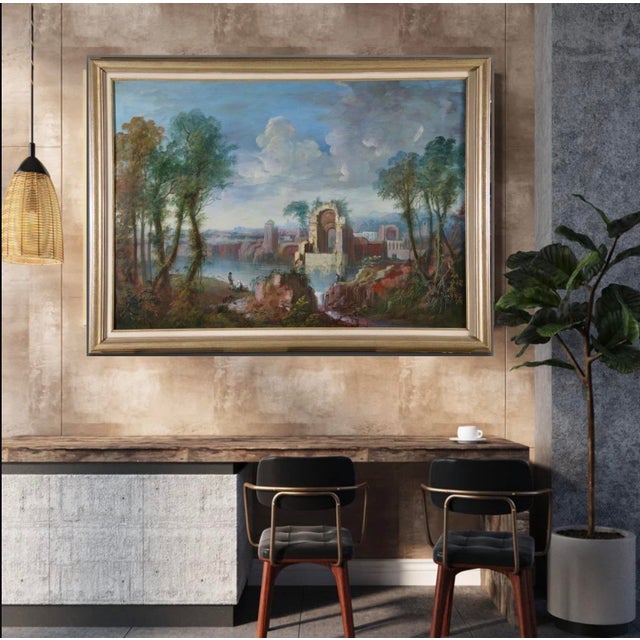
- 60.24ʺW × 2.76ʺD × 44.88ʺH
- Art Subjects
- Figure
- Period
- 18th Century
- Country of Origin
- Italy
- Item Type
- Vintage, Antique or Pre-owned
- Condition
- Good Condition, Unknown, Some Imperfections
- Color
- Condition Notes
- Patina Consistent with Age and Use Patina Consistent with Age and Use less
Returns & Cancellations
Return Policy - All sales are final 48 hours after delivery, unless otherwise specified in the description of the product.
Cancellation Policy - Prior to shipping or local pickup, buyers may cancel an order for up to 48 hours, unless otherwise specified.
Related Collections
- Photorealism Canvas Paintings
- Photorealism Paintings in New York
- Ed Ruscha Paintings
- Richard Serra Paintings
- Herman Miller Paintings
- Jo Baskerville Paintings
- Louise Nevelson Paintings
- Karen Offutt Paintings
- Nicola Simbari Paintings
- BDDW Paintings
- James McCray Paintings
- Jaanika Peerna Paintings
- Leroy Neiman Paintings
- Black Photorealism Paintings
- Jeff Slemmons Paintings
- Gold-filled Paintings
- Milton Avery Paintings
- Soicher Marin Paintings
- Vienna Secession Paintings
- Johannes Andersen Paintings
- Pedro Friedeberg Paintings
- Peter Behrens Paintings
- Piet Hein Eek Paintings
- Raphael Paintings
- Photorealism Paintings in Los Angeles