

Details
Description
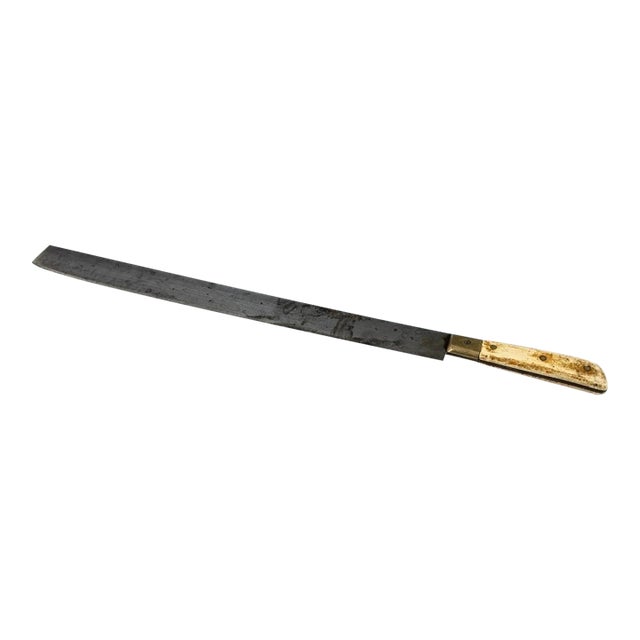
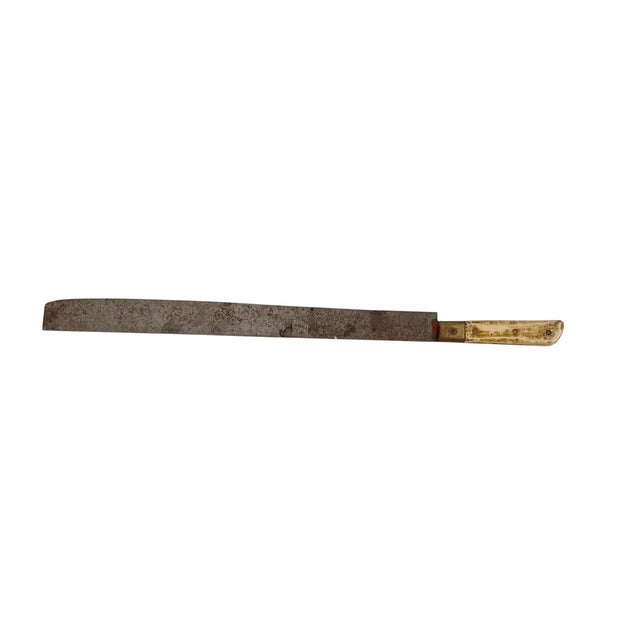
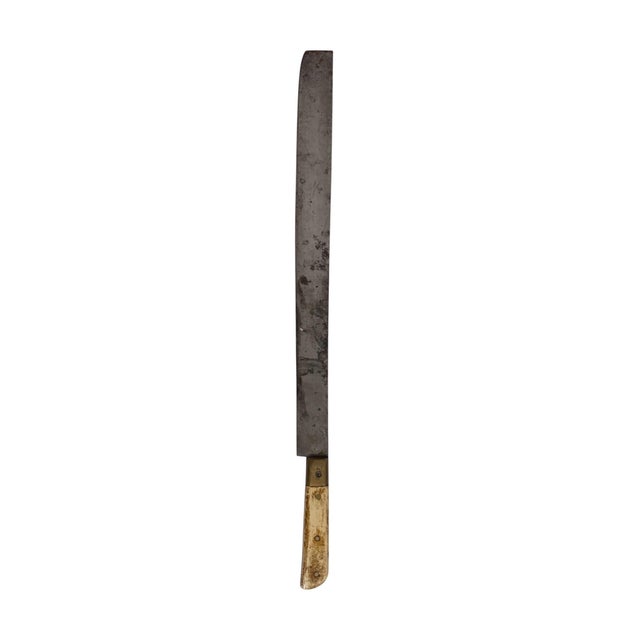
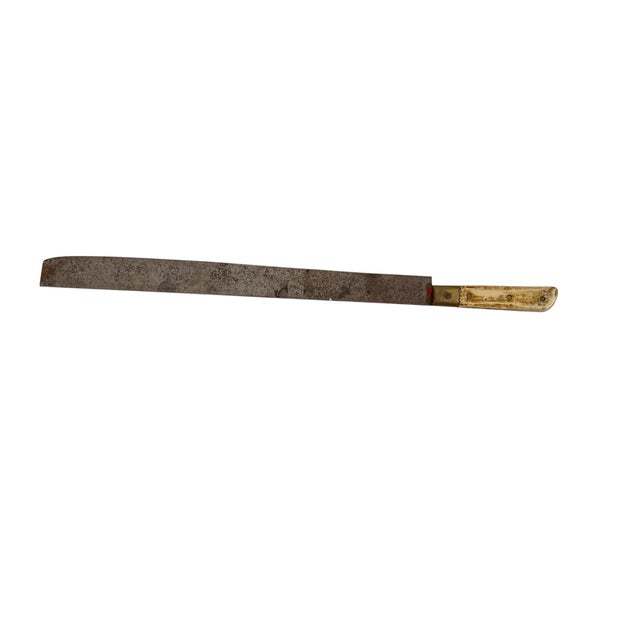
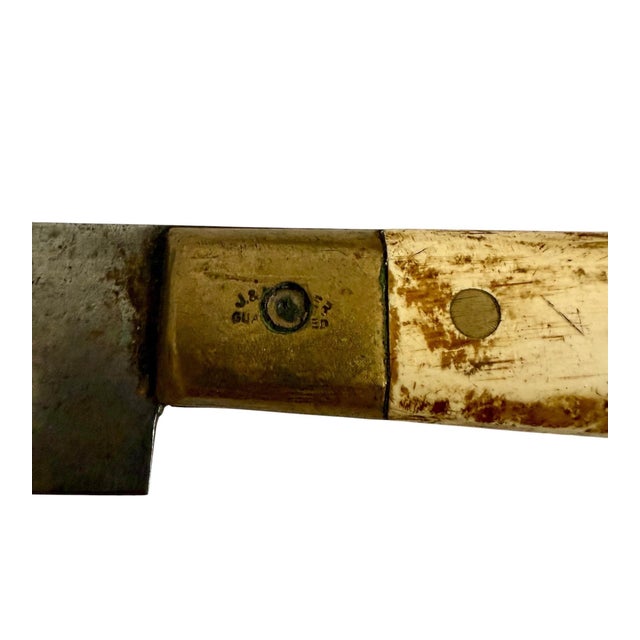
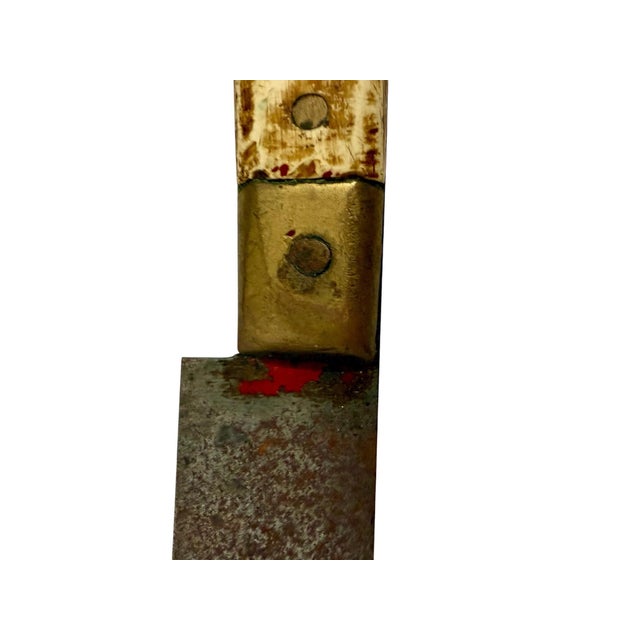
A LARGE ANTIQUE CHALIF (KOSHER SLAUGHTERING KNIFE)
Lower East Side New York City
c. 1920
Horn handle and long steel …
Read more
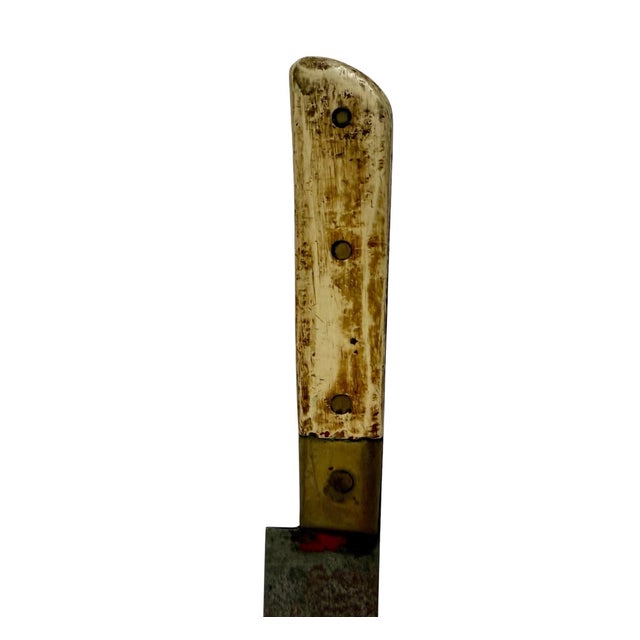
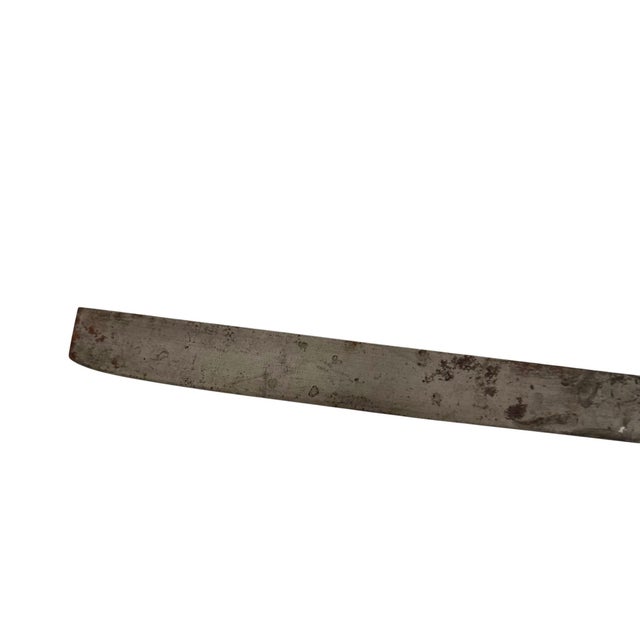
A LARGE ANTIQUE CHALIF (KOSHER SLAUGHTERING KNIFE)
Lower East Side New York City
c. 1920
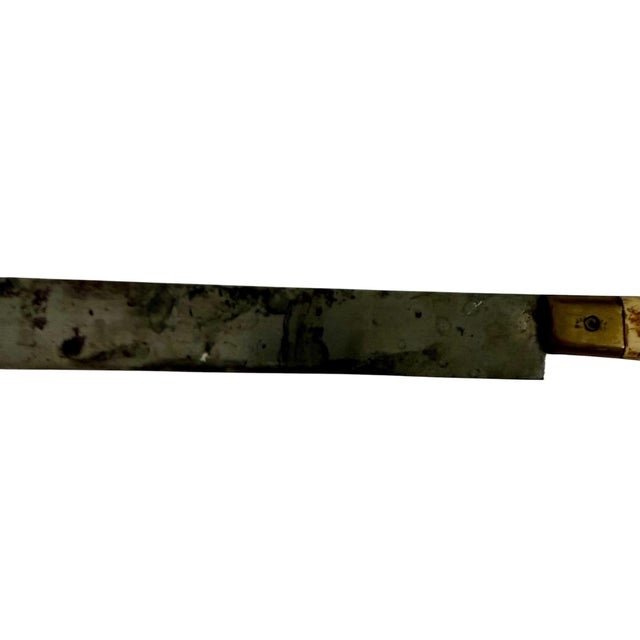
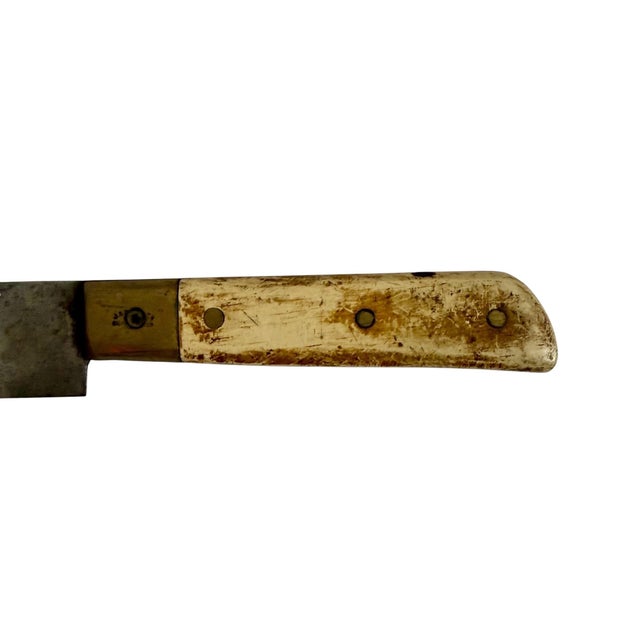
Horn handle and long steel blade
This is being sold as a Judaica museum artifact. I do not know about its usability.
"J. & D. Miller" shechita knives are highly regarded, hand-forged, rust-resistant, and extraordinarily sharp, traditionally used for Jewish kosher slaughter (chalafim) by shochtim (ritual slaughterers). Produced in New York City's Lower East Side, they are historic, high-quality instruments often found in use decades later.
Manufactured by Eastern European Russian immigrants, the brothers Joseph Miller (1887-1972) and David Miller (about 1883-1943) at 25 Canal Street, known as some of the "best and most beautiful" in the world. These knives were meticulously handmade for the specific task of shechita (ritual slaughter).
The shop produced different types of blades, including gasos halef (large rectangular knife for cattle) and ofos halef (small rectangular knife for poultry) as well as Mohel knives for Bris Milah, ritual circumcision.
The brothers were born in Western Russia, near Minsk. As young boys, they were sent as apprentices to an uncle, who had a factory where knives were manufactured. Escaping the military conscription, Joseph escaped Russia, followed by his brother several years later. By 1909 the brothers both resided in the Lower East Side of New York, and Joseph's first shop on Canal Street was founded where he manufactured various knives and tools for cutting fur, felt, leather, and cloth as well as Jewish ritual knives. Each one of their products was marked "J. & D. Miller N.Y. Guaranteed".
Due to their durable nature, authentic Miller knives are still sought after by practitioners today, often found through specialized vintage dealers.
The knife, known as the chalif, is the most important tool of the shochet. The chalif must be handmade and kept exquisitely sharp. In industrial kosher plants, a bell rings every three minutes reminding shochtim to check their knives. If a nick the size of a hairsbreadth is discovered, all animals killed since the last inspection are deemed not kosher. There are different knives for different animals. For chickens, the blade is about five inches long. A lamb, eight to 12. A full-sized cow would need at least an 18-inch blade. The same goes for a bull. A buffalo could exceed 19 inches. The Smithsonian museum has their shop sign. This 1920s free-standing, wood–framed oilcloth window sign from the knife shop of Russian–immigrants Joseph and David Miller in the Lower East Side of New York City uses four implements and a legend in Yiddish to advertise their commercial offerings.
The sign reads:
Do iz Millers a brentsh [Here are Miller's forgings]
Di Miller halafim un mohel messer [The Miller ritual slaughter blades and circumcision knives]
zaynen di beste un sheynste [are the best and most beautiful]
in der gantser velt [in the whole world]
garantirt keyn mol nit tsu rosten [Guaranteed never to rust]
Jewish ceremonial art, also known as Judaica refers to an array of objects used by Jews for ritual purposes. Both for synagogue and for home, because enhancing a mitzvah by performing it with an especially beautiful object is considered a praiseworthy way of honoring God's commandments, Judaism has a long tradition of commissioning ritual objects from craftsmen and artists.
Judaism has a set of classical early rabbinic commentaries on the Hebrew Bible; these commentary collections are known as the midrash literature (Hebrew midrashim). Midrash Mechilta has this teaching on a biblical verse:
"This is my God and I will glorify Him" (Exodus 15:2)
Is it possible for a human being to add glory to his Creator? What this really means is: I shall glorify God in the way that I perform commandments. I shall prepare a beautiful lulav, beautiful sukkah, beautiful fringes (tzitzit), and beautiful tefilin."
Other Midrash teachings (e.g. Song of Songs Rabbah 1.15) offer the same idea. This idea is expanded upon in the Babylonian Talmud (e.g. Tractate Bava Kama 9b). This teaching was understood by succeeding generations as a duty, when possible, to make beautiful items used in Jewish life and worship, both physical and textual
Kiddush cup: Kiddush, literally, "sanctification," is a blessing recited over wine or grape juice to sanctify the Shabbat and Jewish holidays. Kiddush cups are highly decorated, and are generally made of china, porcelain, silver, pewter and nickel. The close of the Jewish Shabbat is marked by the brief prayer ceremony of Havdalah, which usually takes place in the home. Part of the ceremony requires sniffing a sweet-smelling spice or plant. In Jewish communities around the Mediterranean, a sprig of a sweet-smelling shrub was customarily used, in Northern Europe by the twelfth century there are literary references of the use of a specially designed spice box or or spice tower container. The oldest surviving spice boxes for Havdalah date to the mid-sixteenth century. The Jewish Museum (New York) has a German example c. 1550 thought to originate in Frankfurt am Main. The menorah (or hanukkiah) used on the Jewish holiday of Hanukkah is perhaps the most widely produced article of Judaic ceremonial art. The Lindo lamp is a particularly fine example by an 18th-century silversmith. Contemporary Israel artists often design menorahs, such as the gold-plated brass menorah with 35 moveable branches designed by Israeli artist Yaacov Agam. A silver Chanukah menorah by Ze'ev Raban from the 1930s is in the Judaica Collection of the North Carolina Museum of Art.
To protect the ethrog during the Sukkot holiday, it is traditionally wrapped in silky flax fibers and stored in a special box, often made from silver. In modern times, the etrog is also commonly wrapped in synthetic netting, and placed in cardboard boxes. Wooden boxes are increasingly popular as well.
The tradition of artistically embellished haggadah, the Jewish Hebrew text that sets forth the order of the Passover Seder, dates back to the Middle Ages. The Sarajevo Haggadah of 1350 is a celebrated example. Major contemporary artists have produced notable haggadahs, such as the Arthur Szyk Hagadah. See also the facsimile edition of the even earlier Barcelona Haggadah of 1340.
Museums with notable collections of Jewish ceremonial art include the British Library, the Israel Museum, Jerusalem, as well as the Tel Aviv museum of art, the Jewish Museum (London), the Musée d'Art et d'Histoire du Judaïsme in Paris, the Jewish Museum in Prague, the North Carolina Museum of Art, the Jewish Museum (New York), the Musée Lorraine in Nancy, the Musée alsacien in Strasbourg and the Contemporary Jewish Museum of San Francisco. The Museum of Jewish Heritage in Battery City Park, New York City also holds a sizable collection. Another way to see good antique, rare, Judaica is through the art marketplace, There are many examples of Russian, German Polish, Austro Hungarian and Sephardic works available as well as contemporary Israeli and American. The leading auction houses. Sotheby's, Bonhams-New York, J. Greenstein, Skinner's and Kestenbaum's routinely hold regular auctions each year.
See less
Questions about the item?
Returns & Cancellations
Return Policy - All sales are final 48 hours after delivery, unless otherwise specified in the description of the product.
Cancellation Policy - Prior to shipping or local pickup, buyers may cancel an order for up to 48 hours, unless otherwise specified.