

Details
Description
Jack Levine
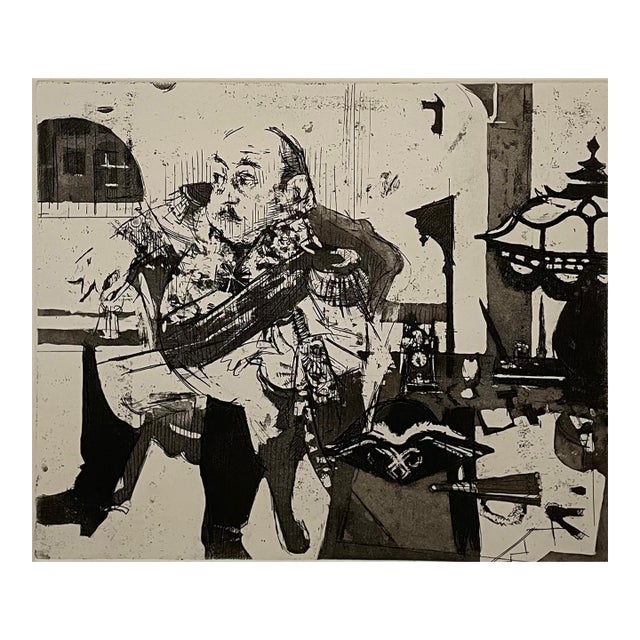
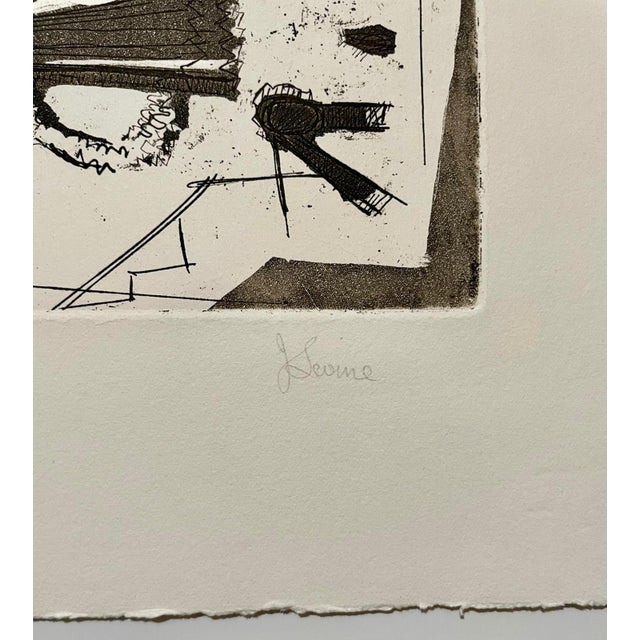
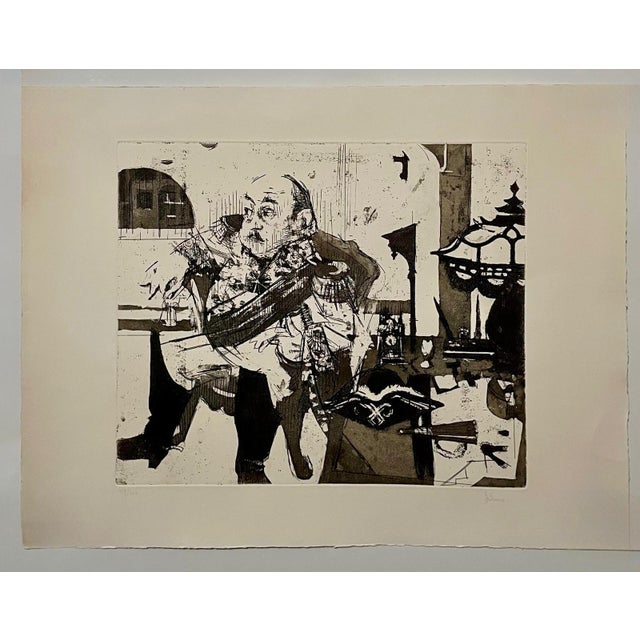
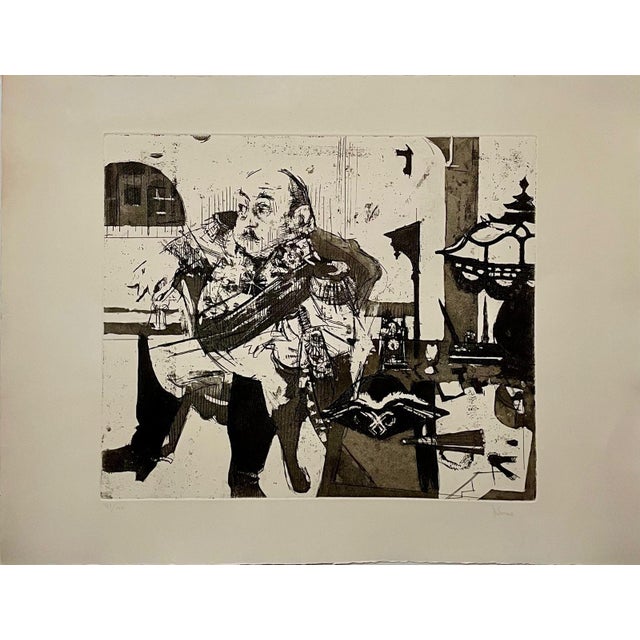
Etching and aquatint print on paper titled The Spanish General by Jack Levine (American; 1915-2010). Hand signed and …
Read more
Jack Levine
Etching and aquatint print on paper titled The Spanish General by Jack Levine (American; 1915-2010). Hand signed and numbered 89/100 lower edge.
Born to Lithuanian Jewish parents, Levine grew up in the South End of Boston, where he observed a street life composed of European immigrants and a prevalence of poverty and societal ills, subjects which would inform his work. He first studied drawing with Harold K. Zimmerman from 1924-1931. At Harvard University from 1929 to 1933, Levine and classmate Hyman Bloom studied with Denman Ross. As an adolescent, Levine was already, by his own account, "a formidable draftsman". In 1932 Ross included Levine's drawings in an exhibition at the Fogg Art Museum at Harvard, and three years later bequeathed twenty drawings by Levine to the museum's collection. Levine's early work was most influenced by Bloom, Chaim Soutine, Georges Rouault, and Oskar Kokoschka. Along with Bloom and Karl Zerbe, he became associated with the style known as Boston Expressionism.
In 1935, shortly after its formation, Levine joined the WPA’s Federal Art Project, where he was employed intermittently until 1939. In 1937, while with the WPA, Levine painted The Feast of Pure Reason, the work that catapulted him to fame. The painting, which depicted a politician, a policeman, and a “gentleman” of wealth, was interpreted by the press as an indictment of police corruption and its connection to wealth and organized crime gangsters.
Born to Lithuanian Jewish parents, Levine grew up in the South End of Boston, where he observed a street life composed of European immigrants and a prevalence of poverty and societal ills, subjects which would inform his work. He first studied drawing with Harold K. Zimmerman from 1924-1931. At Harvard University from 1929 to 1933, Levine and classmate Hyman Bloom studied with Denman Ross. As an adolescent, Levine was already, by his own account, "a formidable draftsman". In 1932 Ross included Levine's drawings in an exhibition at the Fogg Art Museum at Harvard, and three years later bequeathed twenty drawings by Levine to the museum's collection. Levine worked in oil painting, gouache, watercolor, drawing, lithograph and etching prints. Levine's early work was most influenced by Bloom, German expressionist artists, such as George Grosz and Oskar Kokoschka, Chaim Soutine and Georges Rouault. Along with Bloom and Karl Zerbe, he became associated with the style known as Boston Expressionism. He was included in the show “American Modernism – Paintings from the Dr. and Mrs. Mark S. Kauffman Collection,” along with 30 leading masters of American modernism, which captured the essence of a revolutionary era in American art. As the 20th century began, American painters became increasingly involved in avant-garde developments in Europe. Different styles from international sources developed concurrently, making the years between the World Wars a dynamic period of artistic exchange and cathartic change. Faced with the fast-moving, machine-driven technology of the 20th century, American artists began to explore different ways of representing the world: through the influences of Cubism, structurally fracturing the picture plane into angular prisms, and through the expressionist application of bold, unnaturalistic color. Collectively, these first American modernist experiments with abstraction were to change the direction of the art world. Artists included were Stuart Davis, Lyonel Feininger, William Gropper, Robert Gwathmey, Jack Levine, William Meyerowitz, Abraham Rattner, Ben Shahn, Moses and Raphael Soyer, Konrad Cramer, Charles Sheeler, Abraham Walkowitz, and Max Weber. The exhibition also showed at the John and Mable Ringling Museum of Art, Sarasota and the Butler Institute of American Art, Youngstown, Ohio.
The Brooklyn Museum, the Detroit Institute of Arts, the Hirshhorn Museum and Sculpture Garden (Washington, DC), the Honolulu Museum of Art, the Metropolitan Museum of Art, the Museum of Modern Art (New York City), the Philadelphia Museum of Art, The Phillips Collection (Washington, DC), the Walker Art Center (Minneapolis, Minnesota), and the Whitney Museum of American Art (New York City) are among the institutions holding works by Jack Levine.
See less
- Dimensions
- 26ʺW × 1ʺD × 20ʺH
- Styles
- Realism
- Art Subjects
- Figure
- Frame Type
- Unframed
- Artist
- Jack Levine
- Designer
- Jack Levine
- Period
- Late 19th Century
- Country of Origin
- United States
- Item Type
- Vintage, Antique or Pre-owned
- Materials
- Aquatint
- Etching
- Paper
- Condition
- Good Condition, Original Condition Unaltered, Some Imperfections
- Color
- Black
- Condition Notes
- Good Good less
Questions about the item?
Returns & Cancellations
Return Policy - All sales are final 48 hours after delivery, unless otherwise specified in the description of the product.
Cancellation Policy - Prior to shipping or local pickup, buyers may cancel an order for up to 48 hours, unless otherwise specified.
Related Collections
- George Barbier Original Prints
- Gustave Baumann Original Prints
- Robert Kipniss Original Prints
- Rattan Original Prints
- Silver Finish Original Prints
- Dye Transfer Original Prints
- Louis XIII Original Prints
- Johannes Kip Original Prints
- Medium-Density Fibreboard Original Prints
- Botanical Prints
- Framed Prints
- Bird Prints
- Woodblock Prints
- Screen Prints
- Japanese Woodblock Prints
- Thomas McKnight Original Prints
- Frank Stella Original Prints
- Teak Original Prints
- Chaim Gross Original Prints