

Details
Description
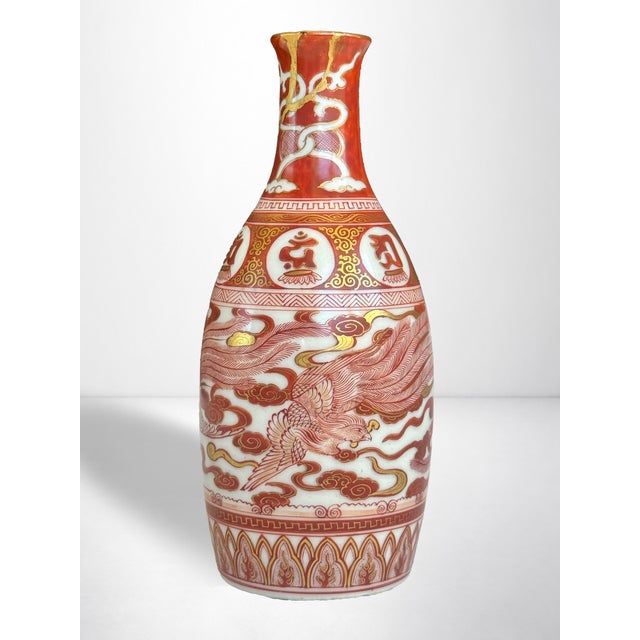
An extraordinary example of Japanese aka-e Kutani porcelain, this tokkuri (sake bottle). The style is Kinrande (金襴手 - "Gold Brocade …
Read more
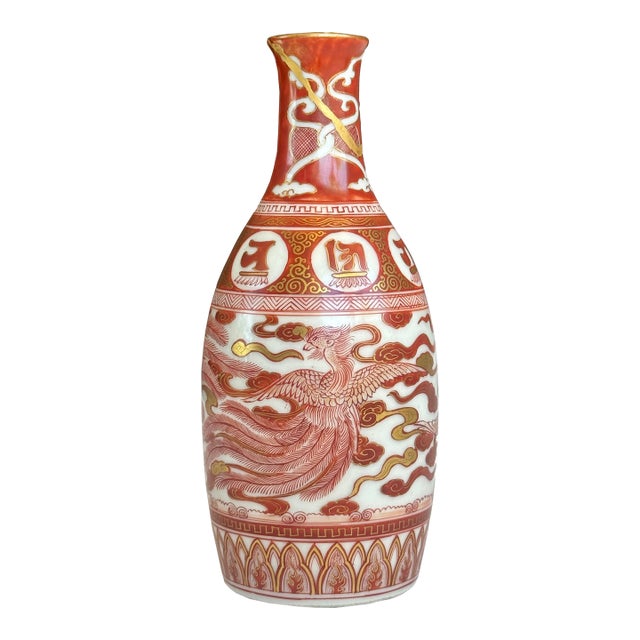
An extraordinary example of Japanese aka-e Kutani porcelain, this tokkuri (sake bottle). The style is Kinrande (金襴手 - "Gold Brocade Style") and Aka-e (赤絵 - Red overglaze line-work), and it is representative of the pinnacle of the iron red and gold decorative tradition first developed around 1830 by master craftsman Iidaya Hachiroemon.
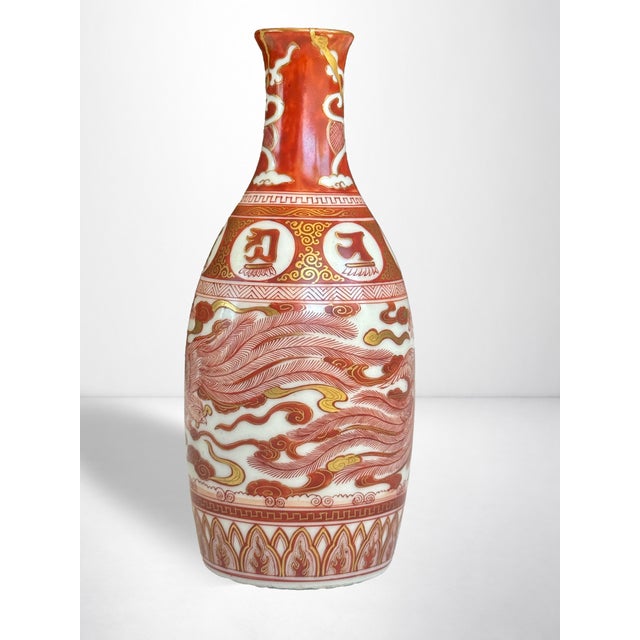
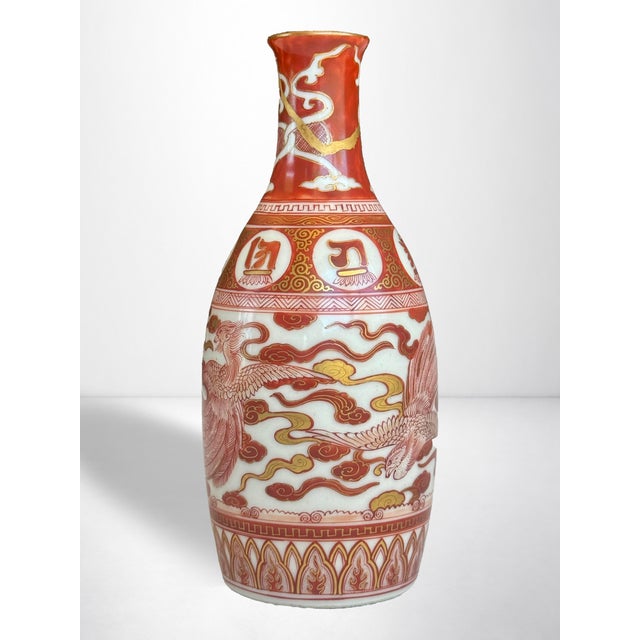
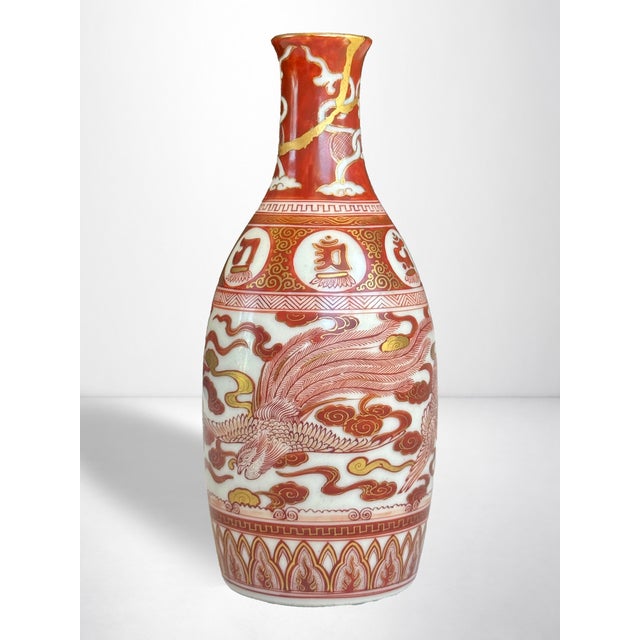
The body is painted with a magnificent ho-oh (phoenix) in flight amid swirling clouds, rendered in hundreds of individually brushed iron red lines of extraordinary fineness and control. The wing feathers, body scales, and tail plumes are each articulated with a master's hand. This is not production work but the output of a highly skilled individual painter. In Japanese culture, the phoenix appears exclusively during times of profound peace, virtue, and prosperity.
The shoulder bears a band of circular medallions each containing a Sanskrit bija (seed syllable) on a lotus throne, outlined in gold. This series of characters is the Mantra of Light. It is traditionally chanted to clear negative karma, dissolve illusions, and bring ultimate peace. By painting this sequence in a unbroken circle around the neck, the early Meiji artisan created a spiritual "gate." As sake was poured, it was symbolically purified and blessed by the divine light of Dainichi Nyorai. Full translation provided below.
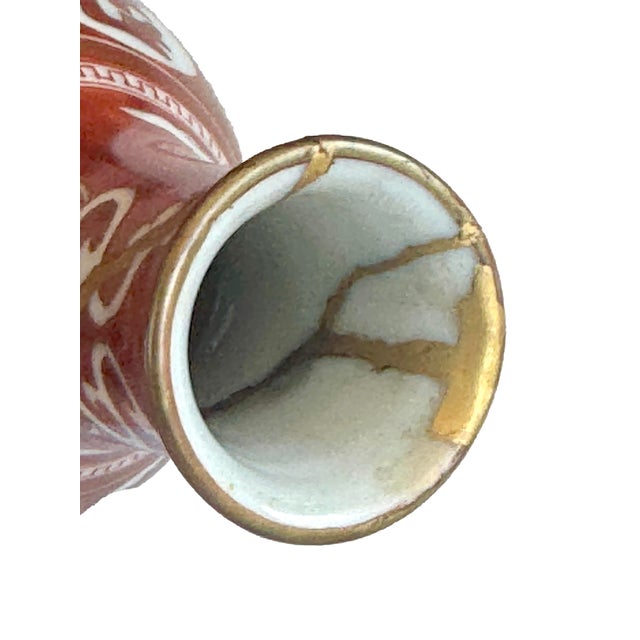
The neck and rim were repaired using the Japanese art of kintsugi — mending with gold lacquer, transforming damage into beauty. The repair is smooth, well-executed, and aged to warm antique gold. Rather than hiding the damage, Kintsugi elevates the fracture into a highlight of the bottle's long history, emphasizing the Buddhist philosophy of Wabi-Sabi (finding beauty in impermanence and imperfection).
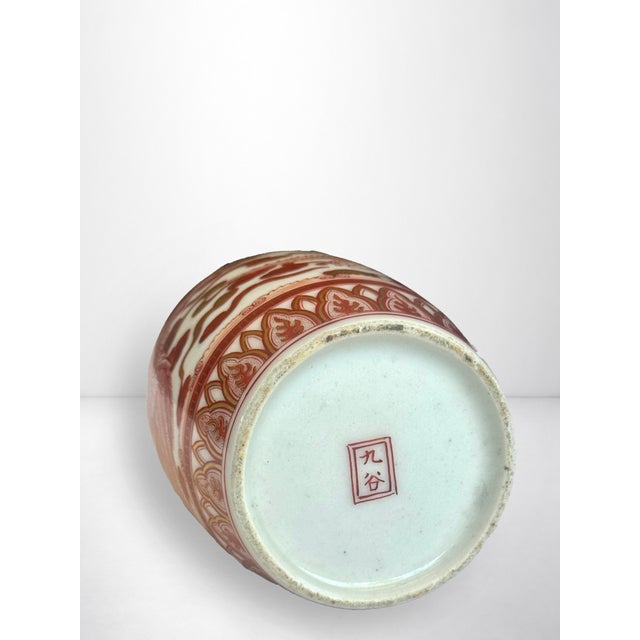
The bottle is marked on the bottom with a crisp, square, double-bordered red seal painted by a calligrapher reading 九谷 (Kutani). The bottom radical of the 谷 (valley) character is executed as two fluid, upward-slanting calligraphic dashes that do not completely seal the box. This specific orthographic choice is highly characteristic of the transitional calligraphy used in the late Edo period (Bakumatsu era) and early Meiji era, cementing an early production date before the late-Meiji export boom introduced standardized stamps.
Height: just under 6.5". Condition: kintsugi repair to neck and rim; body excellent, no chips or cracks.
Translation of the Six Medallions
The artisan selected a specific, highly auspicious six-syllable sequence from the 23-syllable Mantra of Light. Read clockwise around the neck, they form the core of a protective mandala. Every syllable is resting on a hand-painted lotus throne, signifying divine birth and purity.
Medallion 1: Oṃ (オン)Visual: The character with the horizontal curve and a single crescent/dot on top. Meaning: The cosmic, primordial sound of the universe. It initiates the mantra, awakening the mind to divine presence.
Medallion 2: A (ア)Visual: The clean, open character resembling a stylized backward 'F'. Meaning: Represents Dainichi Nyorai (Mahavairocana), the Supreme Primordial Buddha of Infinite Light. It symbolizes the unoriginated nature of all things.
Medallion 3: Mo (モ)Visual: The broad character with a heavy left curve and a straight right vertical wall. Meaning: Part of Amogha, signifying the infallible, unobstructed power of Buddhist compassion.
Medallion 4: Gha (ガ)Visual: The complex character with a prominent central loop and a flag-like tail on the right. Meaning: Completes Amogha, reinforcing that the Buddha's blessings never fail to reach those in need.
Medallion 5: Vai (ベイ)Visual: The blocky, dense character with an enclosed central petal shape. Meaning: Part of Vairocanā, invoking the boundless, all-illuminating light that dispels inner darkness and confusion.
Medallion 6: Ro (ロ)Visual: The highly symmetrical character with three tiered vertical segments, topped by a crescent and dot. Meaning: Completes the name of the Cosmic Buddha, signaling that the divine light reaches all corners of existence.
See less
- Dimensions
- 2.5ʺW × 2.5ʺD × 6ʺH
- Styles
- Japanese
- Period
- Mid 19th Century
- Country of Origin
- Japan
- Item Type
- Vintage, Antique or Pre-owned
- Materials
- Porcelain
- Condition
- Good Condition, Restored, Some Imperfections
- Color
- Red
- Condition Notes
- Kintsugi repair to neck and rim; body excellent, no chips or cracks. Kintsugi repair to neck and rim; body excellent, no chips or cracks. less
Questions about the item?
Returns & Cancellations
Return Policy - All sales are final 48 hours after delivery, unless otherwise specified in the description of the product.
Cancellation Policy - Prior to shipping or local pickup, buyers may cancel an order for up to 48 hours, unless otherwise specified.
Related Collections
- Roger Capron Bottles and Jars and Jugs
- Ralph Lauren Bottles and Jars and Jugs
- Gold-Plate Bottles and Jars and Jugs
- Medieval Bottles and Jars and Jugs
- Cherry Wood Bottles and Jars and Jugs
- Borosilicate Glass Bottles and Jars and Jugs
- Acrylic Bottles and Jars and Jugs
- Bottles and Jars and Jugs in Lexington, KY
- Khaki Bottles and Jars and Jugs
- Port 68 Bottles and Jars and Jugs
- Crocks
- Wicker Bottles and Jars and Jugs
- Apothecary Jars
- Cookie Jars
- Japanese Bottles and Jars and Jugs
- 1800s Perfume Bottles
- Candy Jars
- Antique Water Jugs
- Murano Glass Bottles and Jars and Jugs
- Apothecary Bottles
- 1950s Perfume Bottles
- Portieux Vallerysthal Bottles and Jars and Jugs
- Deruta Bottles and Jars and Jugs
- Mottahedeh Bottles and Jars and Jugs
- Lead Bottles and Jars and Jugs