

Details
Description
A Fine Chinese Export Porcelain Tea Bowl and Saucer
Kangxi Period,
Early 18th Century
This finely potted Chinese export porcelain …
Read more
A Fine Chinese Export Porcelain Tea Bowl and Saucer
Kangxi Period,
Early 18th Century
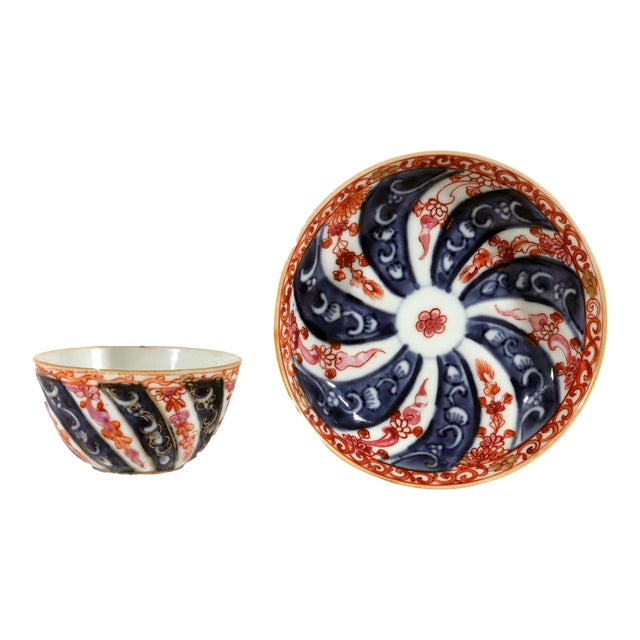
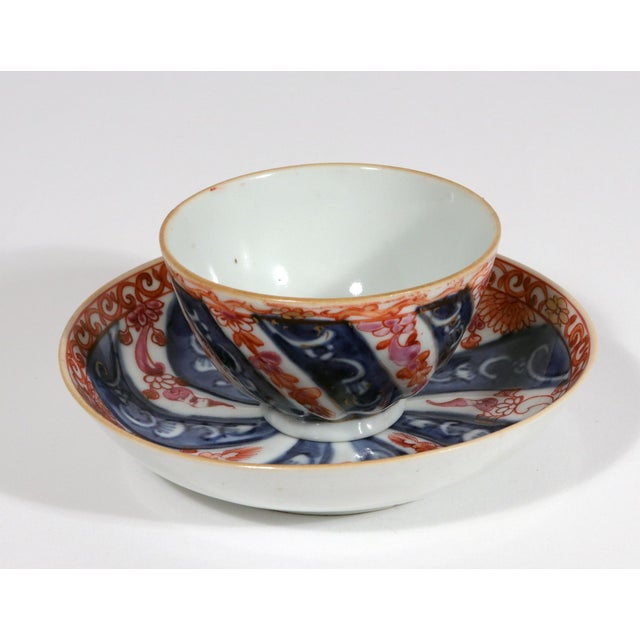
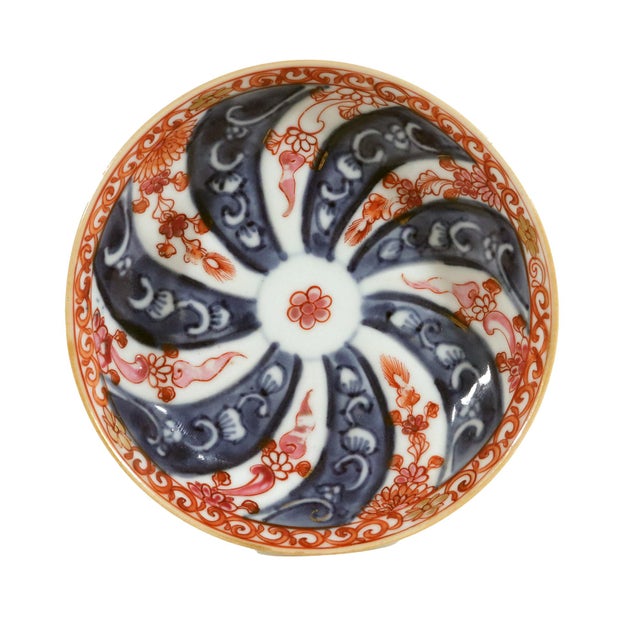
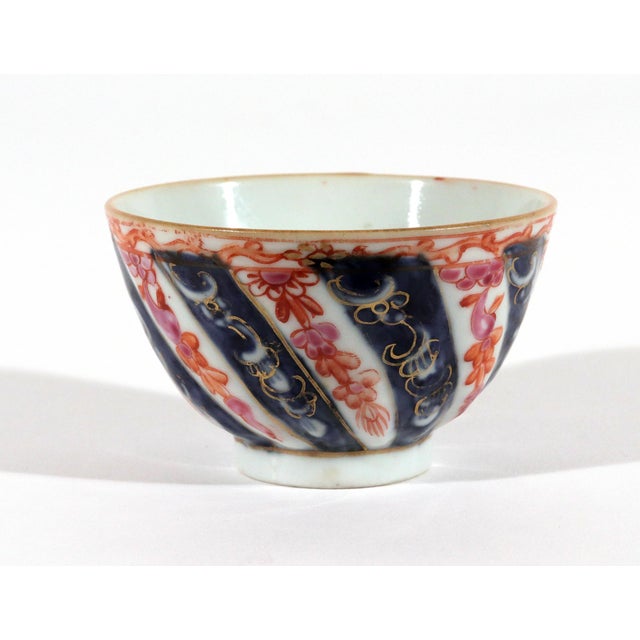
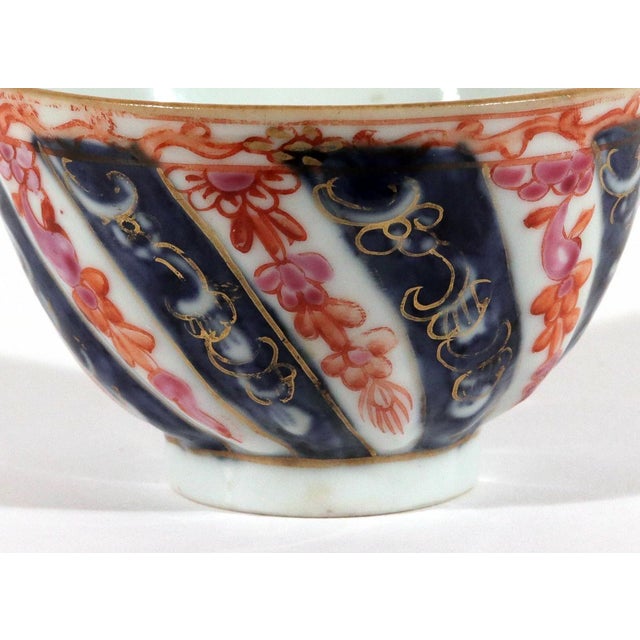
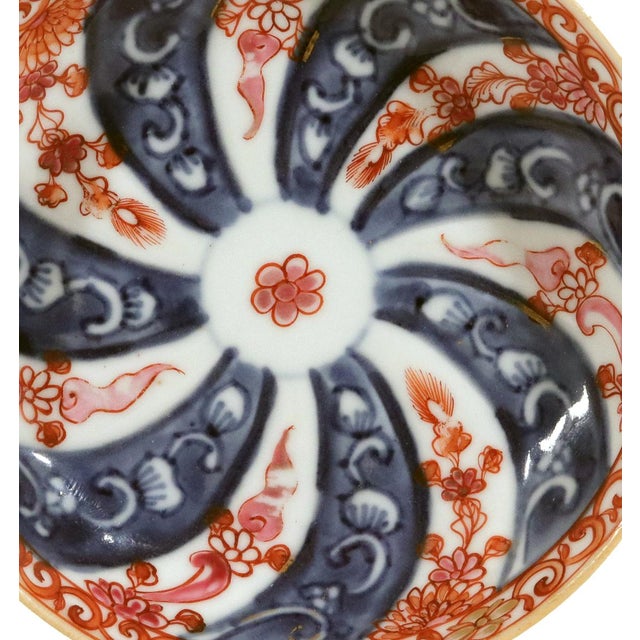
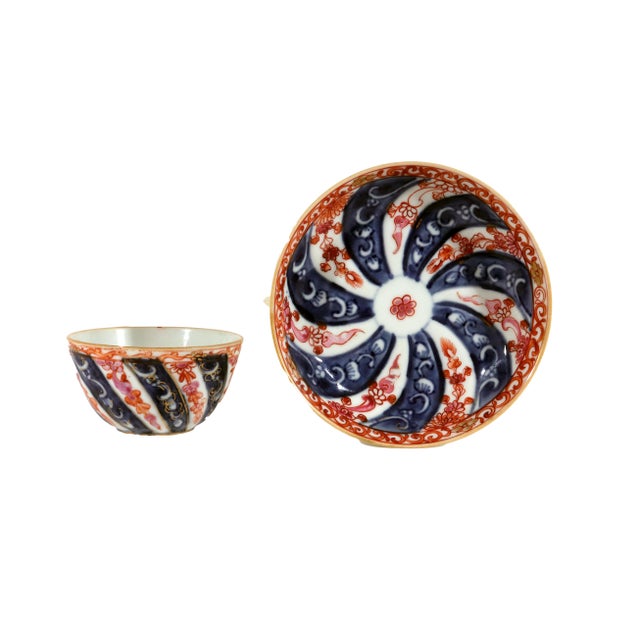
This finely potted Chinese export porcelain tea bowl and saucer is decorated in a striking polychrome spiral or "pinwheel" design — a pattern later celebrated in England under the name "Queen Charlotte" when adopted by the Worcester factory. Executed in a characteristically bold variation of the Chinese Imari palette, the decoration is organised around a series of broad radiating lobes of deep underglaze cobalt blue, each panel enriched with sinuous white-reserve scrollwork of exceptional precision.
Between the blue lobes, delicate iron-red enamel reserves carry flowering branches and wisp-like floral tendrils rendered in a warm, slightly orange-toned red. Small accents of soft pink enamel — a distinctive hallmark of later Qianlong export production — punctuate the interstices with stylised blossoms, lending the design a lightness that counterbalances the boldness of the cobalt ground.
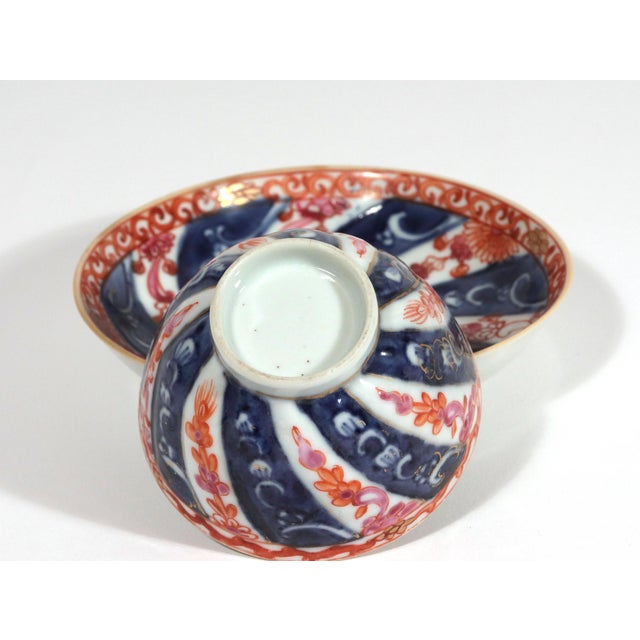
On the saucer, the composition radiates outward from a central pink flowerhead and terminates in a scrolling iron-red and pink border of considerable vivacity. The tea bowl follows the same decorative programme on its exterior, the lobed panels wrapping the gently flared sides with assured confidence. The handleless form of the bowl and the characteristic shallow well and steeply raised rim of the saucer are precisely those shapes produced for the Western tea-drinking market, reflecting the Jingdezhen potters' close familiarity with European taste and usage. The translucent, high-fired porcelain body exhibits the fine potting and luminous glaze surface for which this period of export production is admired.
DIMENSIONS
– Saucer: 4¼ inches (10.80 cm) diameter
– Tea Bowl: 2¾ inches (6.99 cm) diameter × 1¾ inches (4.45 cm) high
CONDITION
The tea bowl and saucer are in good antique condition. The underglaze cobalt blue retains its characteristic depth and intensity, while the iron-red enamels remain vibrant and crisp. The pink enamel accents are well-preserved. Both pieces are free of chips, cracks, or restoration.
PROVENANCE
Private Collection, New York.
HISTORICAL CONTEXT
The spiralling pinwheel or radiating-lobe design seen on this tea bowl and saucer belongs to a family of Chinese Imari patterns produced at Jingdezhen throughout the early 18th century. The combination of underglaze blue, overglaze iron-red, and enamel colours — here with the addition of a delicate pink — represents a sophisticated Chinese interpretation of the earlier Japanese Imari palette that had captivated European collectors since the late seventeenth century. By the middle decades of the eighteenth century, Chinese potters had thoroughly absorbed this aesthetic and were producing export wares of great refinement in this manner, often adapting the compositions to suit the decorative preferences of their Western clientele.
The term "Queen Charlotte" pattern, by which this design is widely known in the English ceramic literature, properly belongs to the Worcester factory's version of the motif. When King George III and Queen Charlotte visited the Worcester porcelain manufactory in August 1788, the factory's swirling Imari-inspired pattern was renamed in royal honour, cementing its fashionable status. Worcester had itself drawn on Chinese and Japanese Imari precedents for the design, so this Chinese export example occupies a fascinating position in that web of influence: it represents the source tradition from which the Worcester pattern ultimately derives, and which continued to be produced at Jingdezhen in parallel with — and likely in ignorance of — its English namesake. Together, such pieces illuminate the complex circularity of taste that characterised the global porcelain trade of the eighteenth century.
SELECTED BIBLIOGRAPHY
Howard, David S., and John Ayers. China for the West: Chinese Porcelain and Other Decorative Arts for Export Illustrated from the Mottahedeh Collection. 2 vols. London and New York: Sotheby Parke Bernet, 1978.
Jörg, Christiaan J. A. Porcelain and the Dutch China Trade. The Hague: Martinus Nijhoff, 1982.
Mudge, Jean McClure. Chinese Export Porcelain for the American Trade, 1785–1835. Newark: University of Delaware Press, 1962.
Hervouët, François, and Yves Bruneau. La Porcelaine des Compagnies des Indes à décor occidental. Paris: Flammarion, 1986.
Brongniart, Alexandre, and Denis Riocreux. Description méthodique du musée céramique de la Manufacture royale de porcelaine de Sèvres. Paris, 1845. [For comparative Imari palette analysis.]
Sandon, Henry. Flight and Barr Worcester Porcelain, 1783–1840. Woodbridge: Antique Collectors' Club, 1978. [For the Worcester 'Queen Charlotte' pattern in English ceramic context.]
(Ref: NY11123)
See less
- Dimensions
- 4.5ʺW × 4.5ʺD × 2ʺH
- Styles
- Chinese
- Period
- Early 18th Century
- Country of Origin
- China
- Item Type
- Vintage, Antique or Pre-owned
- Materials
- Porcelain
- Condition
- Good Condition, Original Condition Unaltered, Some Imperfections
- Color
- Blue
- Condition Notes
- Good condition Good condition less
Questions about the item?
Returns & Cancellations
Return Policy - All sales are final 48 hours after delivery, unless otherwise specified in the description of the product.
Cancellation Policy - Prior to shipping or local pickup, buyers may cancel an order for up to 48 hours, unless otherwise specified.