

Details
Description
A little history lesson first ...
Czech glass artist Josef Hospodka (1923–1989) was one of the key figures of post-war …
Read more
A little history lesson first ...
Czech glass artist Josef Hospodka (1923–1989) was one of the key figures of post-war Bohemian glass, closely associated with the Chribská glassworks. Known for his expressive, organic forms and richly colored glass, he helped define a more sculptural, artistic direction for Czech glass in the mid-20th century.
The story begins in Chřibská, a small town in northern Bohemia, near the German border. Glassmaking there dates back to the early 15th century, which makes it one of the oldest continuous glassmaking regions in Europe. For hundreds of years, local families produced window glass, bottles, and simple tableware.
By the 19th century, the factory had grown into a respected workshop supplying decorative glass to Austria and Germany. Then, after World War II, the Czechoslovak government nationalized most of the country’s glassworks. The Chřibská factory became part of a network of state-owned enterprises that aimed to rebuild and modernize Czech design.
Although the company’s name changed several times, the glassmakers of Chřibská kept their focus on quality. In the mid-20th century, that focus led to a new and exciting direction.
The transformation of Chribska Glass began with one man — Josef Hospodka. Born in 1923, he studied sculpture and design at the Academy of Arts, Architecture and Design in Prague. After graduating, he joined the Chribska glassworks, where his creativity and technical knowledge soon made an impact.
Hospodka believed that glass should move beyond utility. He wanted each object to feel alive, with curves that reflected light and color in unpredictable ways. His designs broke away from traditional symmetry and introduced free-flowing, organic forms.
Because he worked directly with the glassmakers, Hospodka developed new techniques that allowed molten glass to stretch, twist, and fold without losing control. The result was a distinctive style filled with movement, contrast, and emotion.
Under his influence, Chribska Glass entered a new golden age during the 1950s and 1960s. The workshop produced decorative pieces that stood alongside international names such as Murano and Whitefriars. Yet, it kept its own unmistakable identity.
Hospodka’s work extended beyond Chribska. He taught at the School of Applied Arts in Prague and influenced a generation of Czech designers. His emphasis on creativity and emotion shaped the entire Czech glass movement of the 20th century.
While many glassworks focused on functional tableware, Hospodka treated glass as art. His pieces blurred the boundary between sculpture and design. He once said that glass “should not hide its own light,” and that philosophy guided every design he created.
Hospodka’s career continued until his death in 1989, by which time his influence had spread internationally. Collectors now view his Chribska period as his most iconic era.
And now on to this piece ...
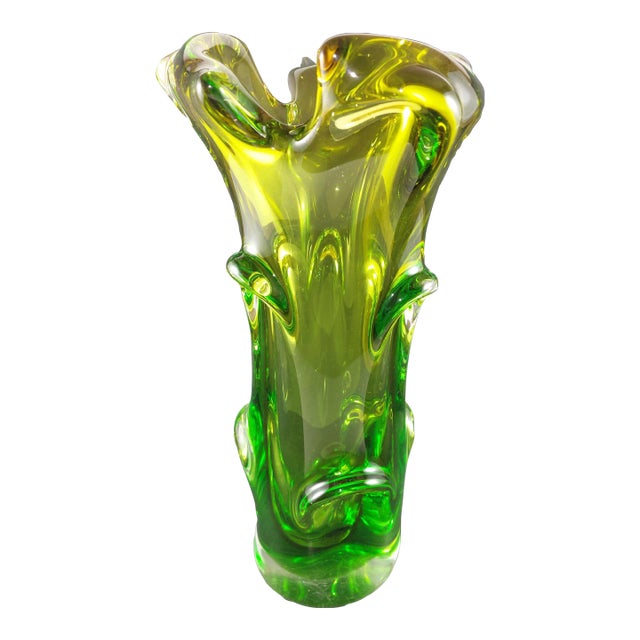
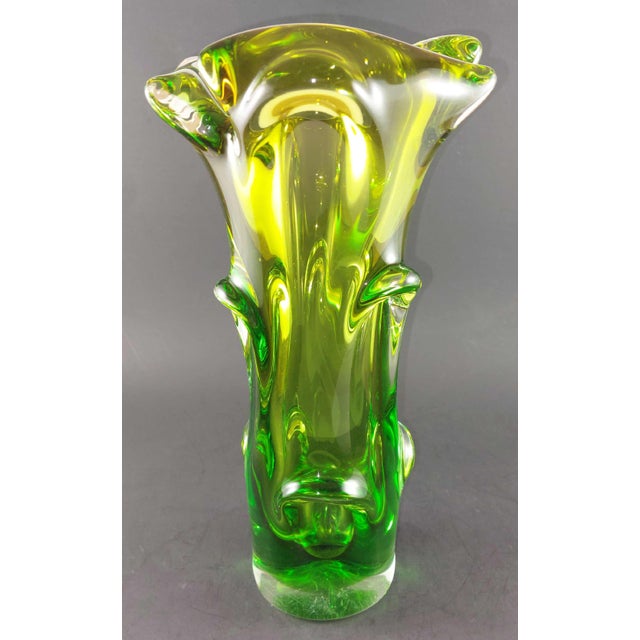
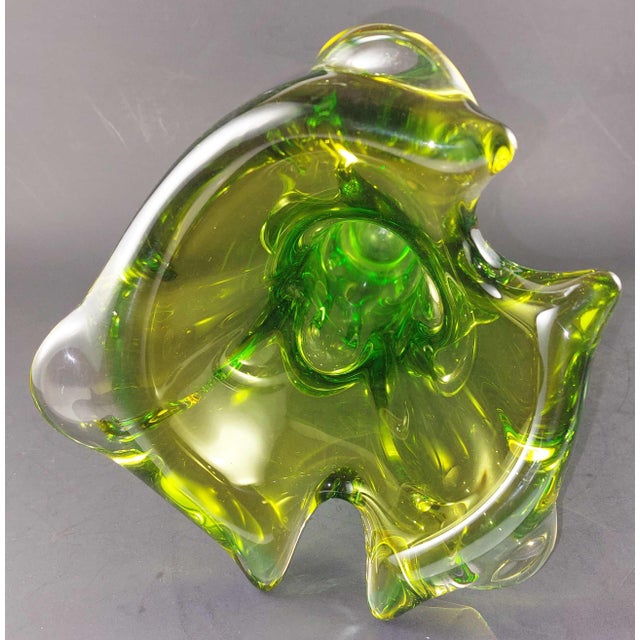
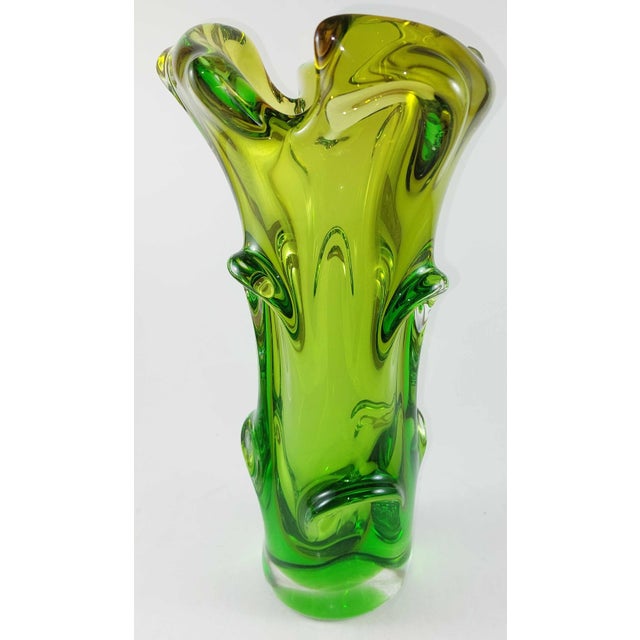
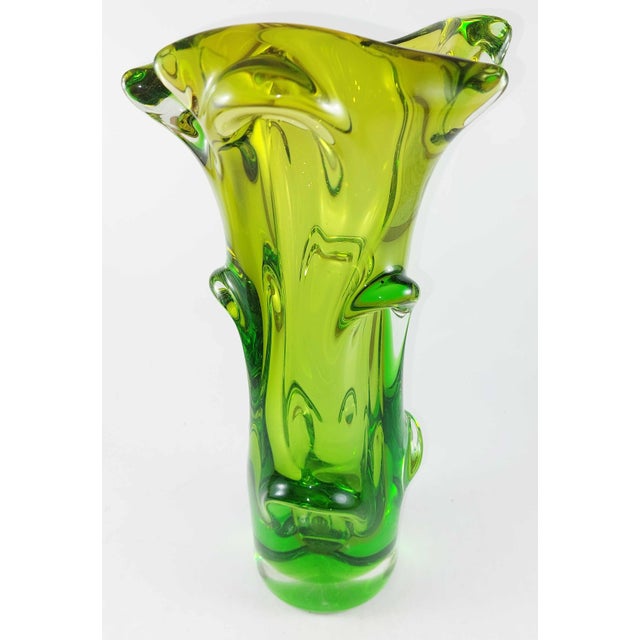
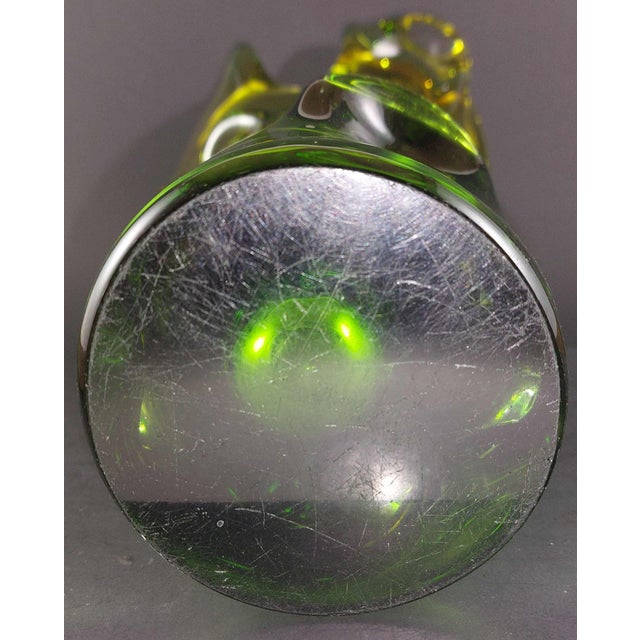
Offered here is a stunningly beautiful art glass 1960s Josef Hospodka vase. When standing in the light, the colors are incredible and difficult to describe. I've included photos against both a black and a white background to help you judge the colors for yourself. The very bottom is totally flat and clear. From there, it quickly graduates upward to a deep and vibrant emerald green. Proceeding upward, there is a slow and subtle ombre transition to a more chartreuse green. Near the top, as it continues to change, there are hints of yellow which are only visible in a certain reflective light.
The form is as equally difficult to describe as the color. No hard edges or corners. Very soft and perpetually flowing, almost like waves of green sea water. It's pleasing to run fingers over it. Hard to get an exact measurement because of the free-form top rim, but it stands about 12" tall. Bottom diameter is easy to measure at 3 1/2". Top diameter, not so easy to measure. At the widest point, I get 6 3/4".
No chips, cracks, or unusual wear. Best of all, no hard water stains! A few surface scratches on the exterior bottom from sliding around on tables for 70 years or so. Absolutely lovely.
If you are a collector of Josef Hospodka art glass pieces, or you're just looking for a beautiful accent piece for your room, you've just found what you're looking for. Will be wrapped with care and shipped with GOBS of packing material.
See less
- Dimensions
- 3.5ʺW × 3.5ʺD × 12ʺH
- Styles
- Mid-Century Modern
- Period
- 1960s
- Country of Origin
- Czechia
- Item Type
- Vintage, Antique or Pre-owned
- Materials
- Glass
- Condition
- Good Condition, Original Condition Unaltered, Some Imperfections
- Color
- Green
- Condition Notes
- No chips, cracks, or unusual wear. Best of all, no hard water stains! A few surface scratches on the exterior … moreNo chips, cracks, or unusual wear. Best of all, no hard water stains! A few surface scratches on the exterior bottom from sliding around on tables for 70 years or so. Absolutely lovely. less
Questions about the item?
Returns & Cancellations
Return Policy - All sales are final 48 hours after delivery, unless otherwise specified in the description of the product.
Cancellation Policy - Prior to shipping or local pickup, buyers may cancel an order for up to 48 hours, unless otherwise specified.
Related Collections
- Clarice Cliff Vases
- Franco Bucci Vases
- Dorothy Draper Vases
- St. Louis Crystal Vases
- Arcore Ceramica Vases
- Poltronova Vases
- Surface Ceramics Vases
- Graphite Vases
- Bimini Glass Vases
- Libbey Glass Co. Vases
- Raymor Import Vases
- Workaday Handmade Vases
- Liz Marsh Vases
- Karl Springer Vases
- Southeast Asia Vases
- The American School Vases
- From Vienna Vases
- Lenox Vases
- Blenko Vases
- Swung Vases
- Fenton Art Glass Company Vases
- Haeger Vases
- Viking Glass Company Vases
- Italian Vases
- Orrefors Vases