







Details
Description
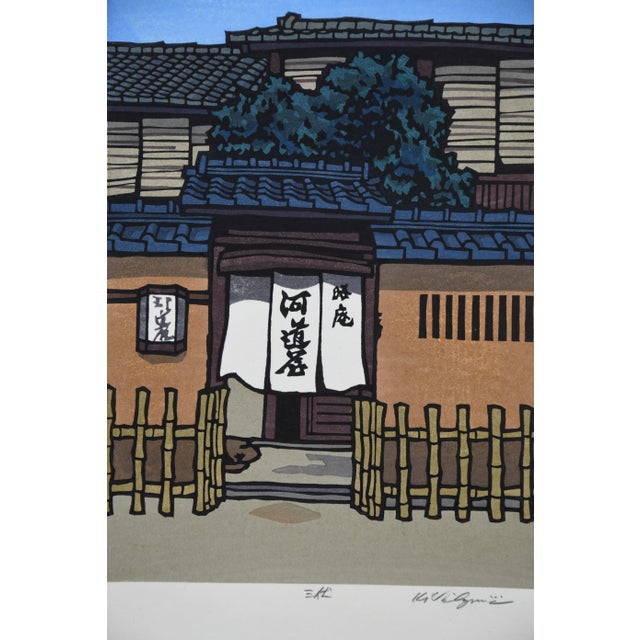
Sanpuku (三伏) — katsuyuki nishijima, sōsaku-hanga woodblock print, kyoto, c. 1990s
a masterwork of composed stillness, sanpuku presents the entrance …
Read more
Sanpuku (三伏) — katsuyuki nishijima, sōsaku-hanga woodblock print, kyoto, c. 1990s
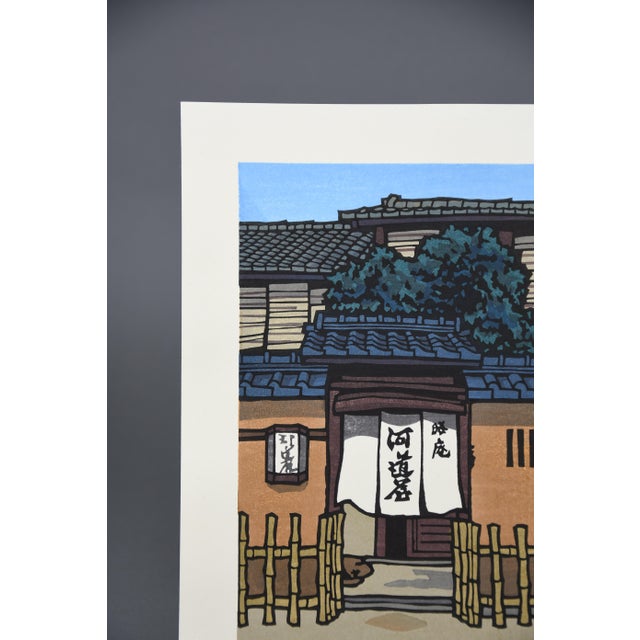
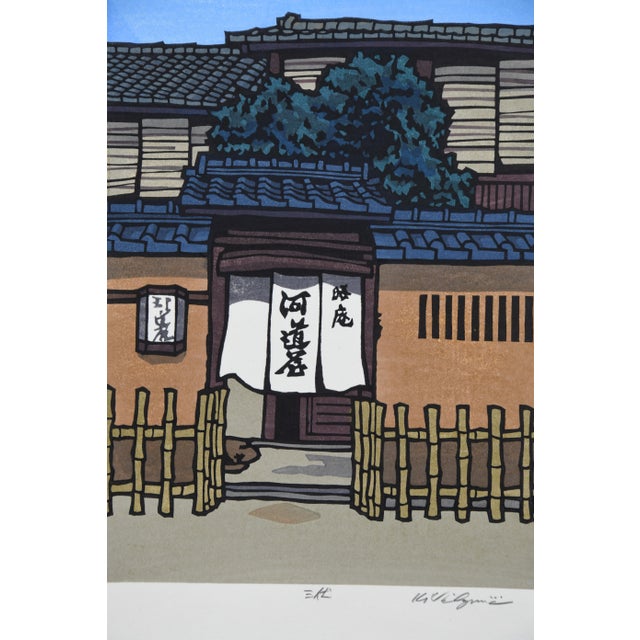
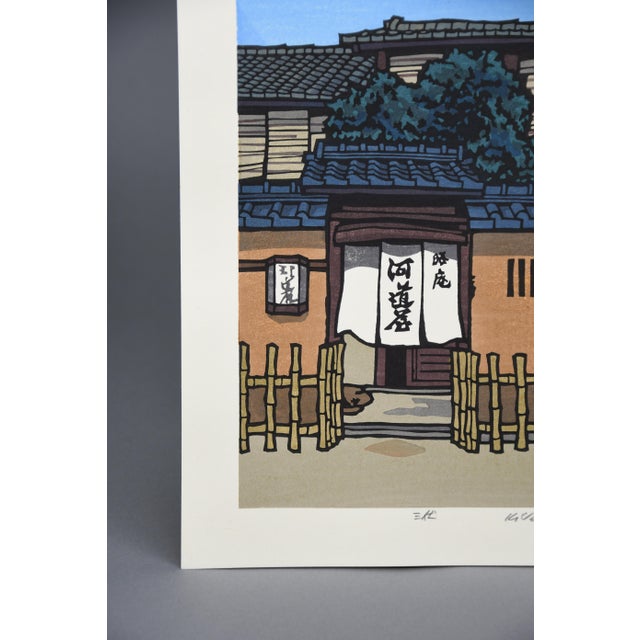
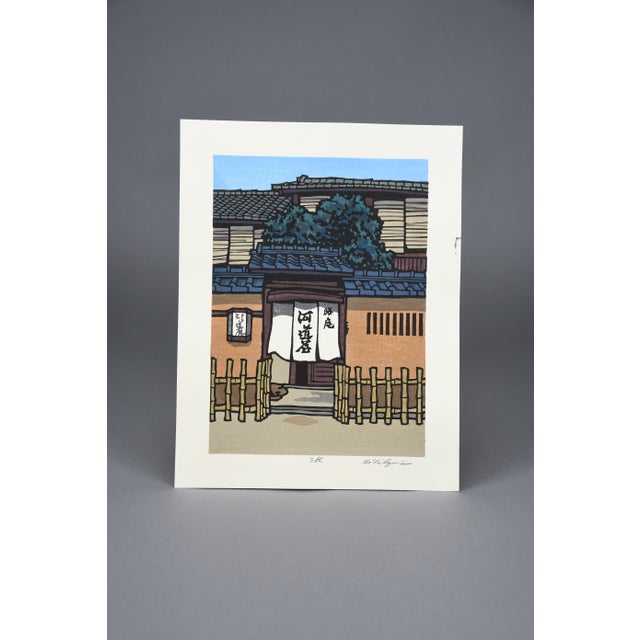
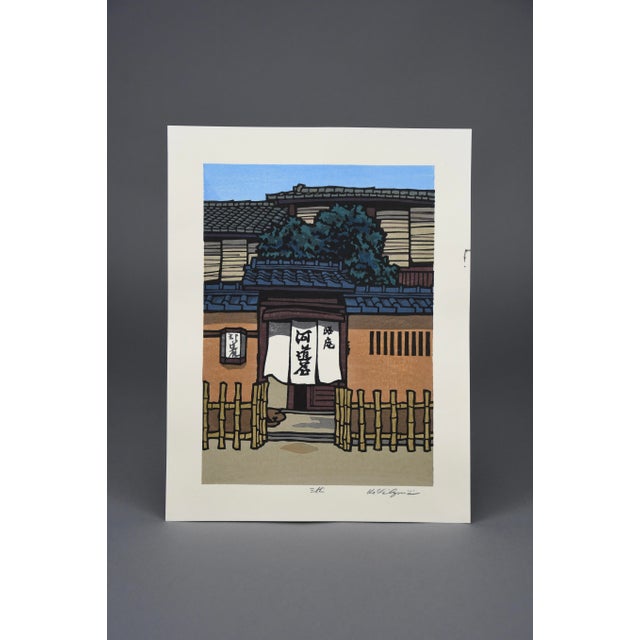
a masterwork of composed stillness, sanpuku presents the entrance facade of kawamichiya (河道屋) — one of kyoto’s most celebrated soba restaurants, whose history of buckwheat noodle-making stretches back over three hundred years to the early seventeenth century. The scene is deceptively simple: a bamboo fence lines the approach to a deep brown wooden gate, above which twin white noren (暖簾) hang motionless in the thick summer air, bearing the restaurant’s name in bold brushwork. Behind the gate, a single tree spreads in muted blue-green against the warm ochre of the mud-plastered walls, with a double-tiered tiled roof and pale blue sky completing the composition. To the left, a paper lantern reads 珈琲屋 — a coffee house — hinting at the quiet life of the street beyond the frame.
the title sanpuku (三伏) is the key to reading the entire image. A classical east asian concept, it refers to the three most sweltering periods of midsummer — the dog days of the japanese summer, when the heat is so intense that even the air seems to prostrate itself. Not a single figure appears. The noren hang without a breath of wind. The bamboo bakes in silence. Nishijima has captured something precise and rare: the suspended, breathless quality of a kyoto summer afternoon, when even a three-hundred-year-old institution seems to hold its breath.
the ochre of the earthen plaster, the blue-grey of the roof tiles, the golden yellow of bamboo, and the crisp white of the noren are orchestrated with the precision of a composer. It is an image that rewards prolonged looking — the more you sit with it, the more the heat seems to rise off the paper.
measurements: h. 33 × w. 26 cm (13 × 10¼ in.), sheet
medium: original woodblock print (moku-hanga), hand-printed
signed: pencil signature by the artist, lower right margin; title 三伏 inscribed in pencil lower left
condition: very good; bright colour, clean margins
what is kawamichiya?
misoka-an kawamichiya (晦庵 河道屋) is one of kyoto’s great culinary landmarks — a soba restaurant with a history dating back three centuries to the edo period, housed in a former merchant’s home with a central courtyard and intimate tatami rooms. Its speciality is hokoro, a one-pot dish prepared at the table with chicken, yuba (thin soybean curd), vegetables and soba noodles added to a simmering broth as the meal unfolds. The restaurant has been frequented over the decades by cultural figures and celebrities from around the world, among them steve jobs and david bowie, each drawn to the same quality nishijima depicts here: an atmosphere of unhurried, timeless refinement that kyoto alone seems to produce.
by depicting its entrance at the height of summer, nishijima immortalises not just a building but an institution — a place that embodies kyoto’s centuries-long devotion to craft, ritual, and quiet beauty.
about the artist
katsuyuki nishijima (born 1945, yamaguchi prefecture) is one of japan’s foremost contemporary woodblock print artists, celebrated for his quiet studies of traditional japanese architecture — tiled rooftops, thatched farmhouses, historic storefronts and shaded alleys rendered in bold planes of colour and geometric precision.
at the age of 19, he trained with the prestigious mikumo publishing house in kyoto, developing a deep and thorough grounding in traditional printmaking. From 1968 to 1972 he explored stencil dyeing and various other printmaking forms before finding his defining subject matter in the historic architecture of kyoto and its surroundings. All of his prints are carved and printed entirely by the artist himself — the defining hallmark of the sōsaku-hanga (creative print) movement — and he has authored a book on woodblock technique and taught design, carving and printing workshops, cementing his standing as both practitioner and leading authority in the field.
a hallmark of his entire body of work is the complete absence of human figures. The omission is not a limitation but a deliberate artistic choice: by removing all signs of human presence, nishijima forces the viewer into a different, slower kind of attention — one attuned to texture, light, structure, and mood rather than narrative. The result is work that feels genuinely timeless, suspended outside of any particular era.
his limited editions — typically 500 impressions — consistently sell out, demonstrating sustained and growing collector demand both in japan and internationally.
about japanese woodblock printing
the art of moku-hanga (木版画) has a continuous history of over three centuries, reaching its classical peak in the ukiyo-e prints of the edo period with masters such as hokusai and hiroshige. The process is as demanding as it is beautiful: each colour in a finished composition requires its own individually carved wooden block, inked and pressed in precise registered sequence onto dampened washi paper. A single print may demand a dozen or more separate blocks, and the characteristic warmth of the resulting surface — with its subtle ink gradations, the grain of the wood breathing through the image, and the yielding texture of hand-made paper — is entirely irreproducible by mechanical means.
in the 20th century, the shin-hanga movement revitalised the traditional publisher-led model, while the sōsaku-hanga movement — to which nishijima belongs — went further, insisting that the artist must personally conceive, carve, and print every work. This distinction matters profoundly for collectors: a signed nishijima print carries the hand of the artist at every single stage of its creation, from the first incision of the blade to the final impression on paper.
a rare opportunity to acquire a pencil-signed impression of one of nishijima’s most atmospherically charged compositions — the entrance to a three-hundred-year-old kyoto institution, caught in the breathless heat of a midsummer afternoon.
colors may slightly vary due to photographic lighting sources or your monitor settings.
wear consistent with age and use. This piece has an attribution mark,
i am sure that it is completely authentic and take full responsibility for any authenticity
issues arising from misattribution
See less
- Dimensions
- 10.24ʺW × 0.39ʺD × 12.99ʺH
- Period
- 1990s
- Country of Origin
- Japan
- Item Type
- Vintage, Antique or Pre-owned
- Materials
- Paper
- Condition
- Good Condition, Unknown, Some Imperfections
- Color
- Condition Notes
- Very Good — This vintage item has no defects, but it may show slight traces of use. Very Good — This vintage item has no defects, but it may show slight traces of use. less
Returns & Cancellations
Return Policy - All sales are final 48 hours after delivery, unless otherwise specified in the description of the product.
Cancellation Policy - Prior to shipping or local pickup, buyers may cancel an order for up to 48 hours, unless otherwise specified.
Related Collections
- Rattan Original Prints
- Soicher Marin Original Prints
- Medium-Density Fibreboard Original Prints
- Johannes Kip Original Prints
- Silver Finish Original Prints
- Sam Francis Original Prints
- Dye Transfer Original Prints
- Original Prints in Lexington, KY
- John Kiraly Original Prints
- Damien Hirst Original Prints
- Donald Sultan Original Prints
- Original Prints in Panama City, FL
- Original Prints in Salt Lake City
- Ralph Lauren Original Prints
- Botanical Prints
- Framed Prints
- Bird Prints
- Woodblock Prints
- Screen Prints
- Japanese Woodblock Prints
- Thomas McKnight Original Prints
- George Barbier Original Prints
- Frank Stella Original Prints
- Gustave Baumann Original Prints
- Teak Original Prints