




Details
Description
This significant and extremely rare work by the great italian artist aldo natili (rome, 1913–1975) depicts an urban or suburban …
Read more
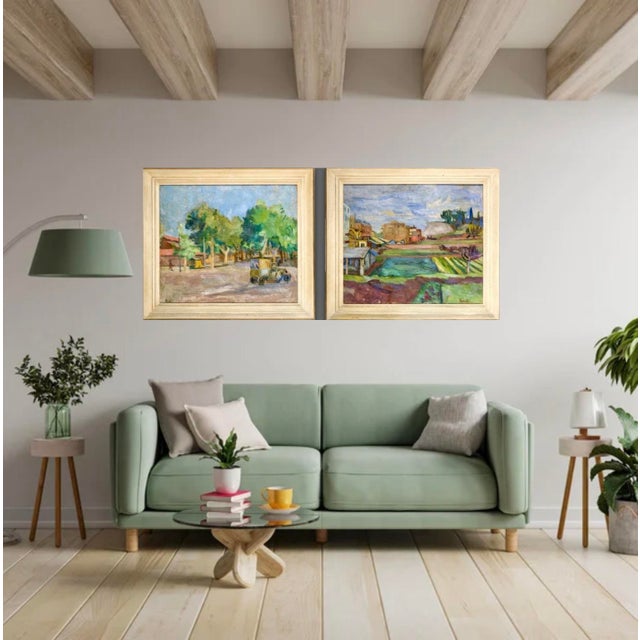
This significant and extremely rare work by the great italian artist aldo natili (rome, 1913–1975) depicts an urban or suburban scene characterised by dense vegetation.
signed ‘natili’ in the lower left-hand corner.
on the reverse are labels from two major exhibitions held at two highly prestigious art galleries in which this painting was featured in the 1950s.
one is the
galleria del secolo
rome - via vittorio veneto
and the other is the
studio d'arte palma
rome
piazza augusto imperatore, 31
in this important painting the foreground, on the right, stands out a vintage car with angular lines, rendered with swift, decisive brushstrokes.
on the left, a solitary human figure can be glimpsed walking near a low structure (perhaps a kiosk or a rural building).
the background is dominated by a row of majestic trees filtering a clear light, suggesting a scene captured en plein air.
the painting reflects natili’s adherence to roman-style realism.
the influence of the roman school’s tonalism is evident in the vibrant colour application and formal synthesis.
the brushwork is energetic and textured.
the artist does not dwell on details, but constructs volume and depth through colour combinations and contrasts between the shaded areas of the vegetation and the illuminated sections of the ground.
the palette is dominated by intense, earthy greens, with hints of blue in the sky, which appears ‘restless’ and airy—a characteristic of natili’s artistic maturity, where light becomes a structuring element.
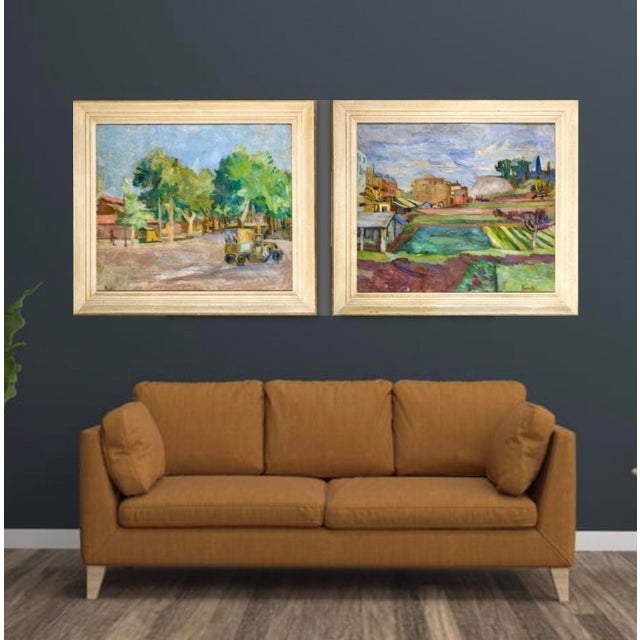
this beautiful work is part of a pair.
this artwork, never before on the market, comes from an important italian private collection and is beautified by an impressive antique frame in white laquered wood, in very good condition.
our company has been present on this platform for many years, with more than 100 sales made and just as many excellent reviews received that you can under our furniture account.
"in many ways, aldo natili's work can be considered emblematic of the positions, developments and even contradictions of italian painting between the 1930s and 1970s, particularly with regard to the situation in rome.
born in rome in 1913, natili spent his youth exploring themes close to those of the roman school, before turning his attention to social issues in the immediate post-war period, working alongside figures such as guttuso, fazzini and mafai in the libera associazione arti figurative (free association of figurative arts), which held its first exhibition in 1945.
this marked the beginning of a period of great recognition for natili, characterised by a convinced and passionate realist language with strong civil and political implications, which, in the suffering and defeated humanity that survived the war, apparently deprived of everything, traced the signs and certainties of a future of redemption.
his bluntly realistic, sometimes almost folksy language and his strong, immediate themes bring his work from these years closer to that of birolli, pizzinato, migneco and, of course, guttuso, with whom he also shared clear and courageous political stances.
these were the years in which natili successfully participated in the rome quadriennials (1948, 1952, 1956) and the memorable exhibition of art against barbarism (1951), and in which zavattini involved him in the famous “collezione roma” project (1946), when the writer asked around fifty roman artists to pay homage to the city by creating a small painting that portrayed one of its many contrasting aspects (among the many artists who took part in the initiative were afro, corpora, capogrossi, de chirico, donghi, guttuso, pirandello, prampolini, savinio, turcato and ziveri).
but a growing and unstoppable distrust of realism led natili, starting in the early 1960s, to completely different results in terms of expressive methods and pictorial composition: ‘many aesthetics,’ declared the painter in 1960, ‘which we had proudly adorned ourselves with and believed to be part of our very substance, a sure guide for our existence and our daily work as artists, proved to be fragile and alien to the new actions that ever-changing days forced upon us.’
this marked the beginning of the last phase of his work, openly informal and increasingly abstract, to which natili remained faithful until his death in rome in 1975. These are dense, dark, exasperated and sometimes desperate works, a vibrant testimony to an unmediated existential struggle: ‘i would like,’ says natili, ‘all my contradictions to come directly onto the canvas, as they really are, through the arteries of my brushes, just as blood is pushed by the heart.’
this informal period of natili's, characterised by a rich production of high quality, is in many ways still to be discovered and understood, as it is almost unknown except for the exhibition at the galleria san marco in 1963.
natili's work is therefore complex and diverse. Over his forty-year career, he moved, with inner consistency, from the intimism of the 1930s to the realism of the post-war period, culminating in the dramatic informal canvases of the last decade."
luca quattrocchi, full professor
of contemporary art history
at the university of siena
aldo natili taught from 1945 to 1955 at the academy of fine arts in rome (among his students was the painter giulia battaglia); from 1955 to 1963 at the academy of fine arts in carrara and from 1963 until 1975, the year of his death, at the art school in via ripetta, rome.
he was a close friend of roberto melli, afro, mirko and dino basaldella, salvatore scarpitta, leoncillo leonardi, giulio turcato, mario penelope, emilio villa, marcello venturoli and other artists and critics.
as anti-fascist, aldo natili was a friend of umberto terracini, mario alicata, antonio giolitti and adolfo battaglia, as well as poets and writers including pablo neruda and alberto moravia.
what follows is a very interesting text written directly by the artist on the occasion of one of his beautiful exhibitions that took place in one of the most prestigious art galleries: la nuova pesa di via frattina in rome
"the years go by.
many aesthetics that we had boasted, not without pride, and that we had believed part of our own substance, a sure guide for our existence and our daily work as artists, turned out to be fragile and alien to the new actions to which always new days forced us.
now i would like to talk about myself without complacenty.
i now know some of my contradictions, but i would not like to crush any of them, i would like them all to arrive directly on the canvas, as they really are, through the arteries of my brushes, as blood is pushed from the heart; and that only there - not before - they were composed, of course, according to their vitality.
i would like my instincts to arrive pure on the canvas, and there, bumping against the reality of colours and looks, become, as they can, ideas.
i would like to have the strength to be satisfied, even if they were modest or incomplete, without intervening in any way to give them more important or fairer opinions.
this, of course, is what i want for myself; i don't criticise anyone, i don't preach for anyone; i mean, this is just my personal experience.
every artist deals in the first place with the problem of reality, all, abstractists, realists, or that i know; and everyone militates with fervour in this or that trend precisely because he is convinced that on that path, and not for another, he will finally be able to meet that distant lady.
i believe that reality appears to us continuously in the relationship of two antagonistic forms. A reality is what i perceive on the outside, men, things, etc.; and it is also a reality what i feel living inside me, aspirations, instincts, inhibitions, etc.
the increasingly exasperated and i would say desperate emphasis that modern art has placed on the artist's ego, understood for the first time as a reality in itself, and not only as a means of expressing it, is, in my opinion, a profound and irreversible progress.
but, i think, as if to completely define a country it is not enough to know where the centre is, the capital, but you have to know its shape and size, and therefore the borders, the other countries, mountains and the seas that surround it, so and even more, precisely that individual reality that must be affirmed is denied in its integrity if we ignore the world of objects, of the non-i, which is its continuous and inescapable envelope.
the gulfs and promontors of our consciousness are the result of inner energy but also of external things they compress in every moment, every fragment of it.
this pressure is not only the limit, but the very condition of consciousness.
the reality therefore consists in the dynamic duality i - not - i; separating the terms, or assuming only one of them as true, does not lead us, i think, to the heart of the matter.
proceeding on the path of self-knowledge we will find a place, and it is the deepest and most true, where it can be clearly understood that the duality of the i and non-i has a unique essence, it is the fruit of a single energy, and the presence of the external world is no longer the tired and banal consequence of an absurd claim of objectivity, but it is our obvious, indispensable matter.
in that matter consist of the cause and purpose of art, the reason that constitutes in poetry the most daily moments of our lives: tenderness
of a smile is the same tenderness of a clod, the pain of a man is like the non-existence of a stone; a leaf, a wave, the internal space of the breath.
illuminating that place, opening up to that matter the most direct way to reach a canvas, i think is the task that is today in front of truly modern artists."
dimensions are frame included this piece has an attribution mark,
i am sure that it is completely authentic and take full responsibility for any authenticity
issues arising from misattribution
See less
- Dimensions
- 33.46ʺW × 2.76ʺD × 29.53ʺH
- Styles
- Mid-Century Modern
- Modern
- Period
- 1940s
- Country of Origin
- Italy
- Item Type
- Vintage, Antique or Pre-owned
- Condition
- Good Condition, Unknown, Some Imperfections
- Color
- Condition Notes
- Heavy Signs of Use,Patina Consistent with Age and Use Heavy Signs of Use,Patina Consistent with Age and Use less
Returns & Cancellations
Return Policy - All sales are final 48 hours after delivery, unless otherwise specified in the description of the product.
Cancellation Policy - Prior to shipping or local pickup, buyers may cancel an order for up to 48 hours, unless otherwise specified.
Related Collections
- Photorealism Canvas Paintings
- Ed Ruscha Paintings
- Photorealism Paintings in New York
- Richard Serra Paintings
- Herman Miller Paintings
- BDDW Paintings
- Louise Nevelson Paintings
- Karen Offutt Paintings
- Jo Baskerville Paintings
- James McCray Paintings
- Milton Avery Paintings
- Carl-Axel Acking Paintings
- Joseph Stella Paintings
- Karl-Erik Ekselius Paintings
- Leroy Neiman Paintings
- Photorealism Paintings in Los Angeles
- Jaanika Peerna Paintings
- Nicola Simbari Paintings
- Soicher Marin Paintings
- Cassina Paintings
- Lawson-Fenning Paintings
- Black Photorealism Paintings
- Jean-Paul Barray Paintings
- Hans Andersen Paintings
- Johannes Andersen Paintings