

Details
Description
Robert Rauschenberg (1925 - 2008)
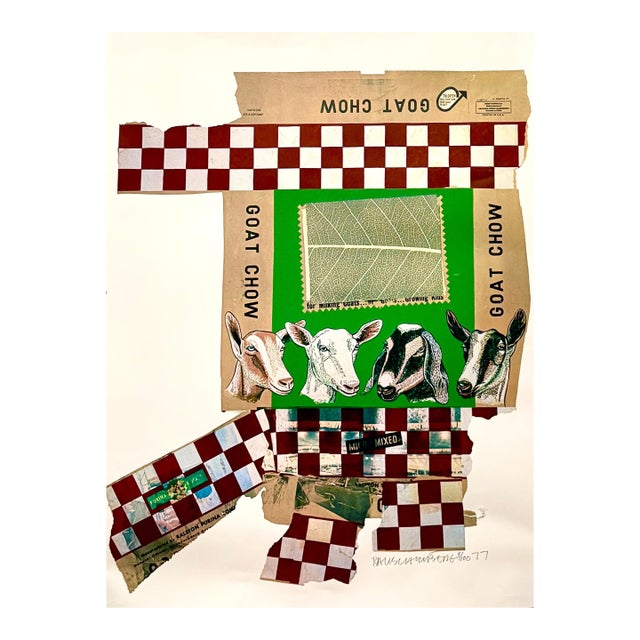
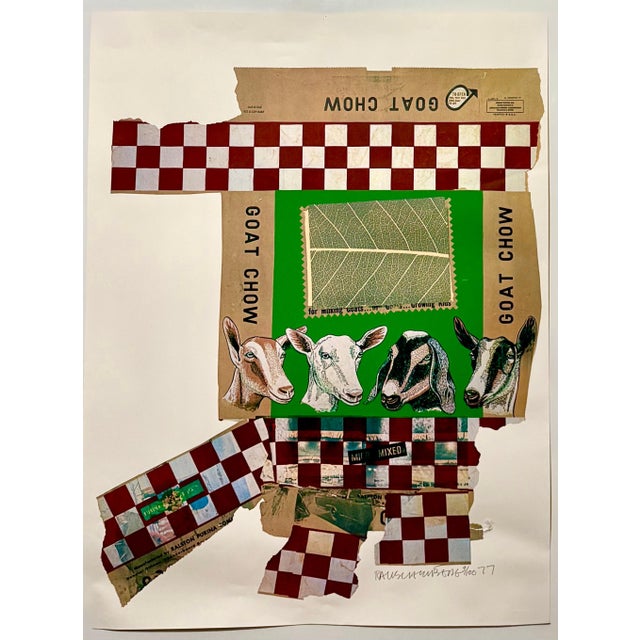
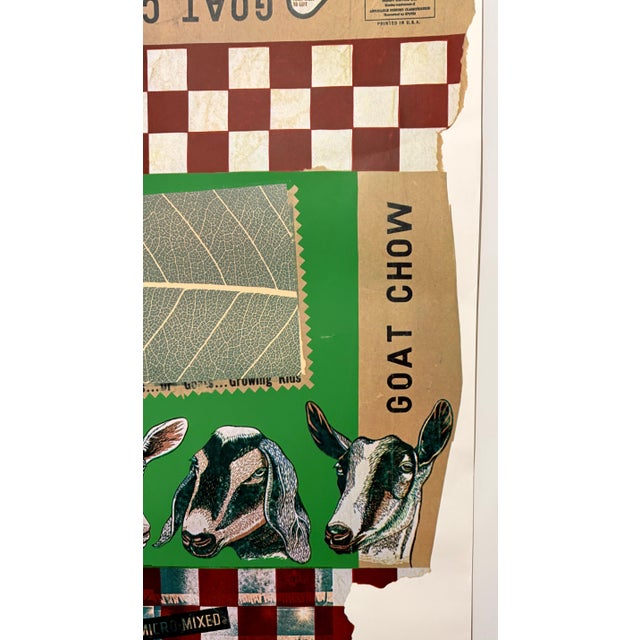
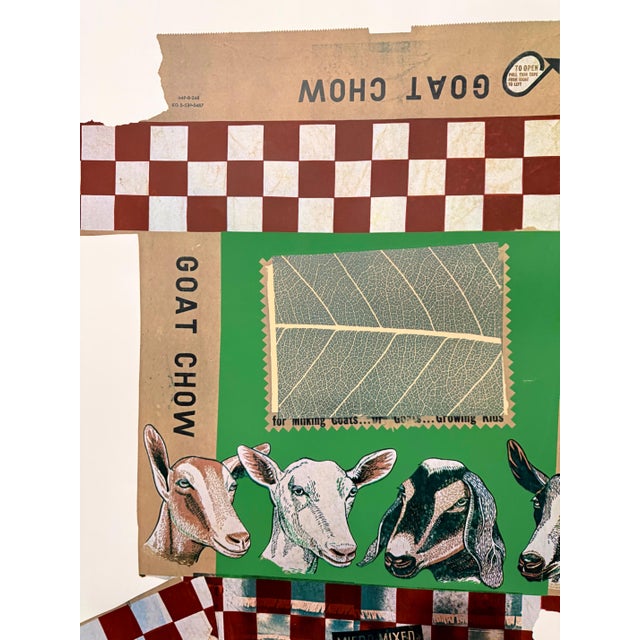
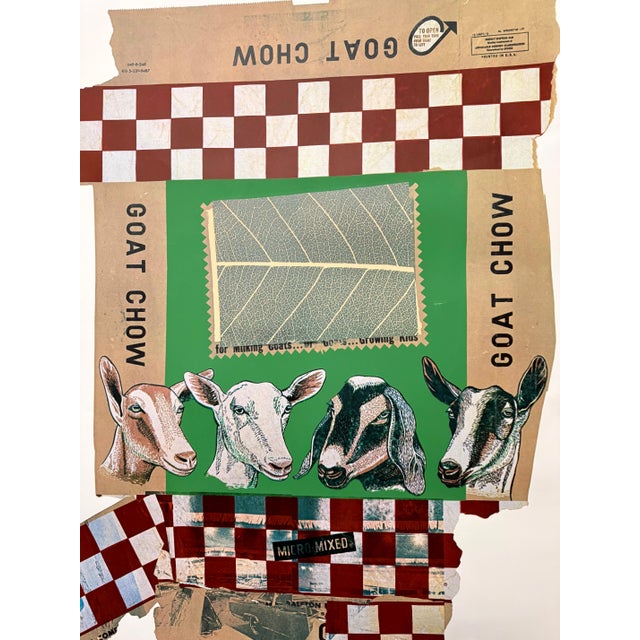
Artwork title: Goat Chow (Chow Bags)
Date: 1977
Medium: Color screenprint, stitching with collage and …
Read more
Robert Rauschenberg (1925 - 2008)
Artwork title: Goat Chow (Chow Bags)
Date: 1977
Medium: Color screenprint, stitching with collage and hand sewing on paper.
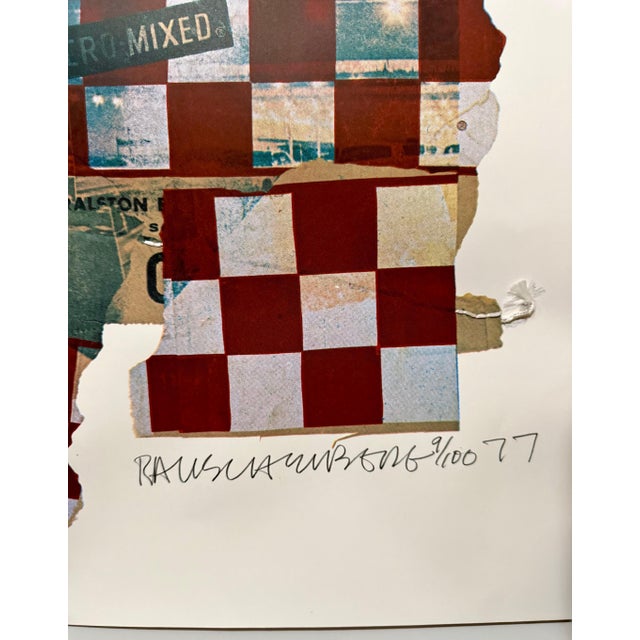
Hand signed lower right
Edition: 9/100
Dimensions: 48 1/8 × 36 5/16 in.
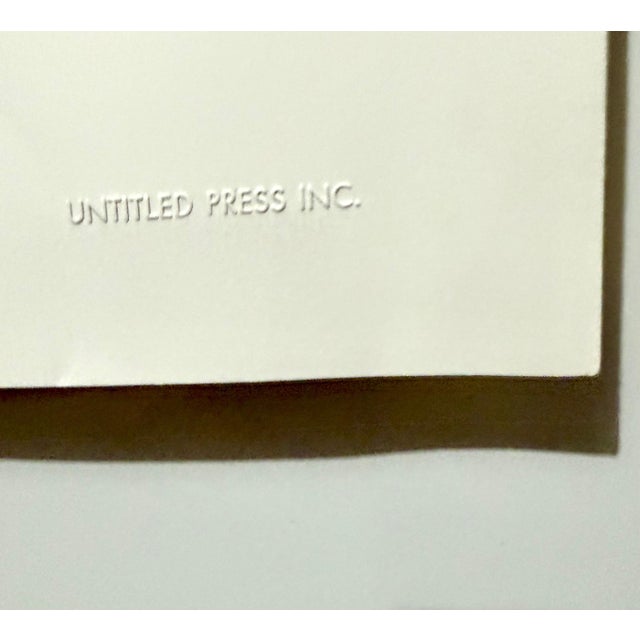
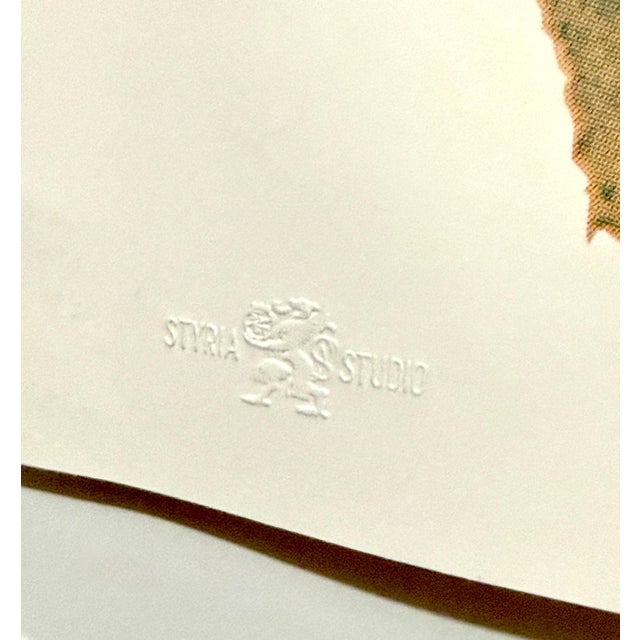
Published by Styria Studio
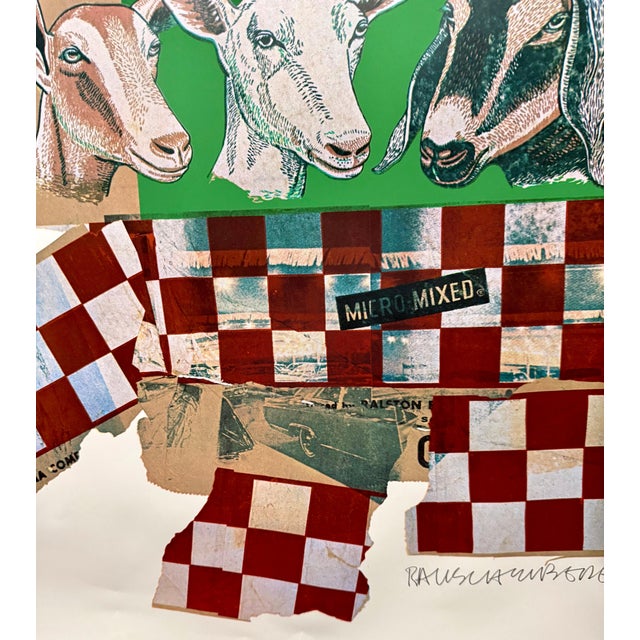
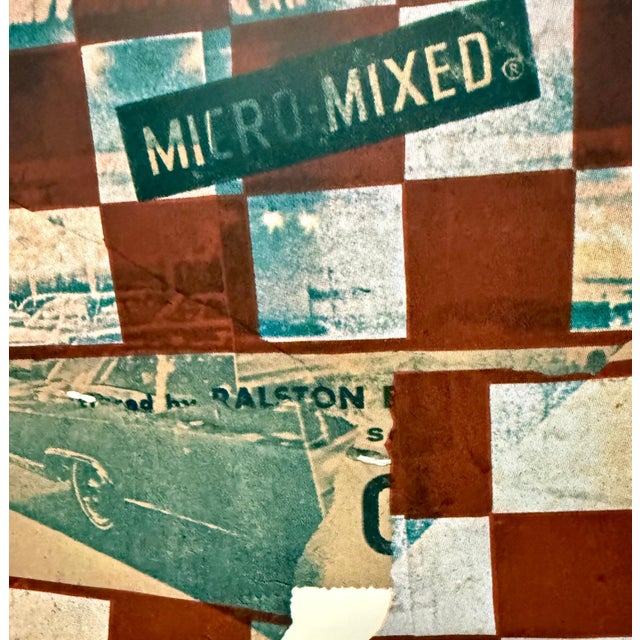
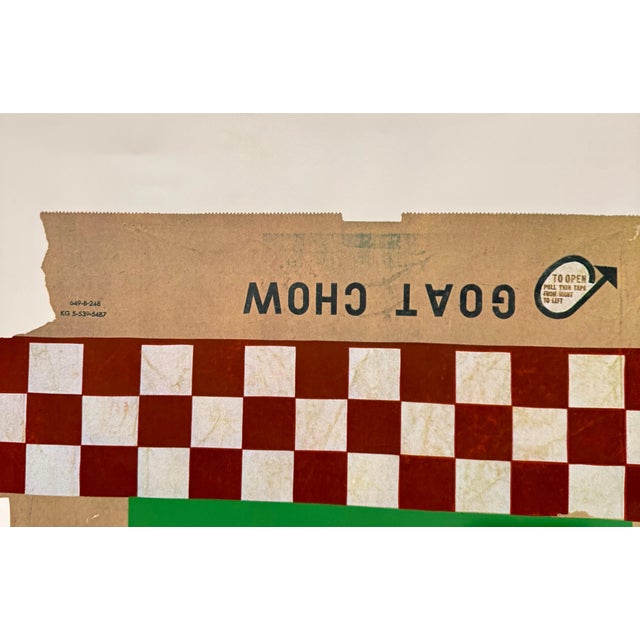
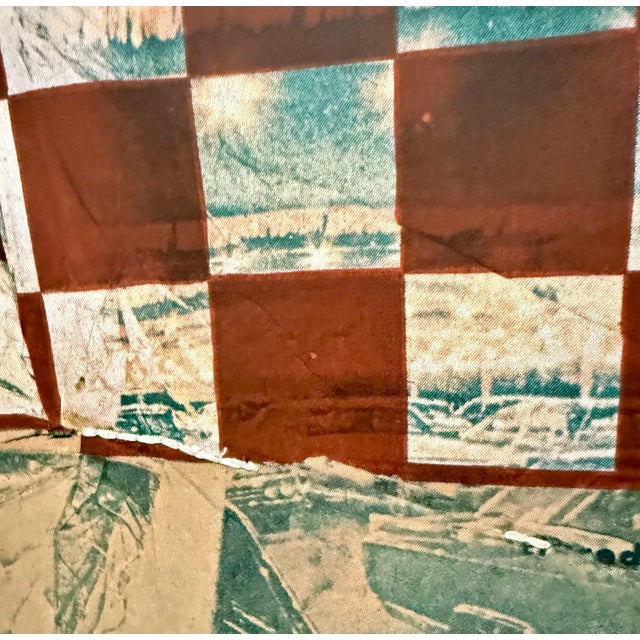
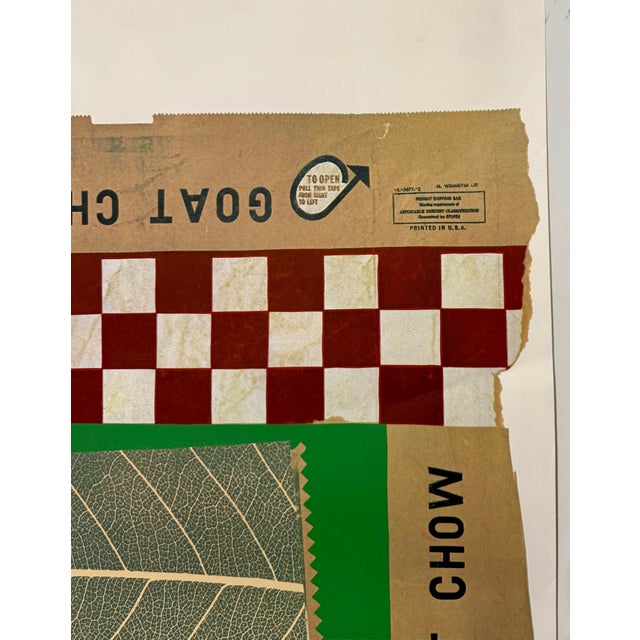
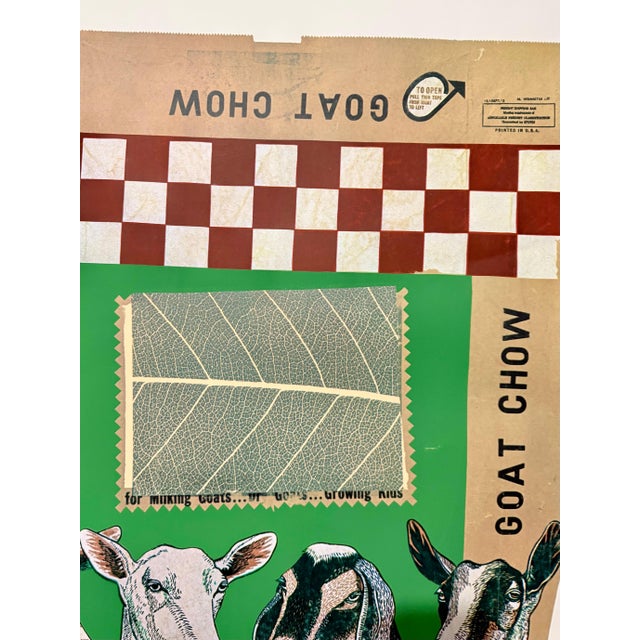
Robert Rauschenberg’s Chow Bags portfolio (1977) consists of six screen prints with graphite and plastic thread, each featuring a different domesticated animal. The prints are based on paper collages Rauschenberg created from actual bags of animal feed manufactured by Ralston Purina (now Purina Mills), a company best known for its Dog Chow and Cat Chow brands. The packaging for the less common feeds featured in Mink Chow, Goat Chow, Monkey Chow, Hog Chow, Rabbit Chow, and Calf Startena (based on a bag for a livestock feed supplemented with nutrients for early growth) shares the distinctive red-and-white checkered pattern made famous by Purina’s more familiar products. By incorporating this pattern and other prominent design elements of the bags, Rauschenberg’s Chow Bags call attention to the simultaneous familiarity and strangeness of Purina’s graphic identity.
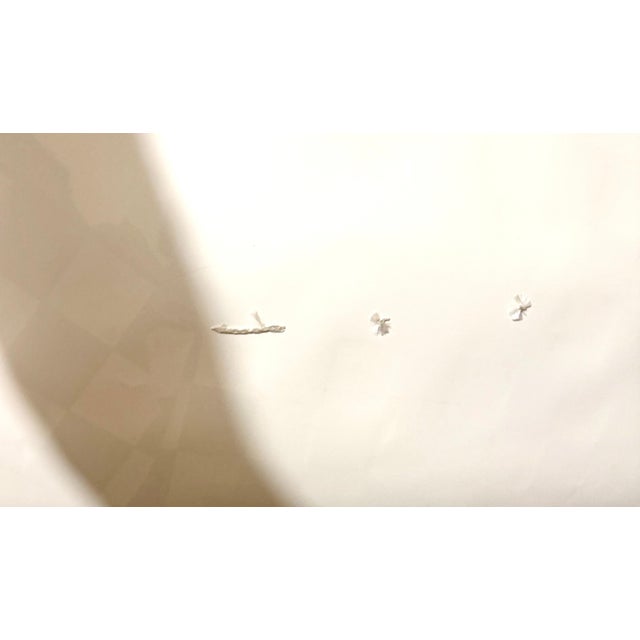
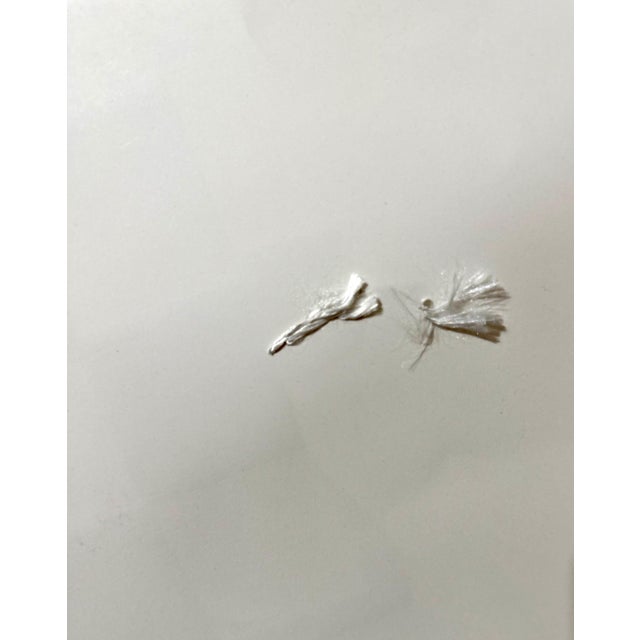
Although the artist selectively cut and partially flattened the paper feed bags to create his collages, he retained their rectangular shape and allowed this form to dictate the overall configuration of each print. The bold, graphic renderings of the animals at the center of these works are surrounded by various arrangements of fainter transfer images such as flowers and leaves, cars stuck in traffic, Coca-Cola bottles, and a woman’s glossy, manicured finger. The resulting compositions present the animals gazing out as in traditional portraiture, playfully framed by colorful graphics and strong geometric shapes. Photographs of the finished collages were used as the basis for the screen prints. After the silkscreen process, additional collage elements were applied to each print, including small pieces of fabric and plastic stitching that mimics the pull-strings used to open feed bags. The Chow Bags series was printed by Styria Studio in New York, and issued in an edition of 100.
Milton Ernest Robert or Bob Rauschenberg (American, 1925 – 2008) was an American painter and graphic artist whose early works anticipated the Pop art movement. Rauschenberg is well known for his Combines (1954–1964), a group of artworks which incorporated everyday objects as art materials and which blurred the distinctions between painting and sculpture. Rauschenberg was primarily a painter and a sculptor, but he also worked with photography, printmaking, papermaking and performance.
Rauschenberg received numerous awards during his nearly 60-year artistic career. Among the most prominent were the International Grand Prize in Painting at the 32nd Venice Biennale in 1964 and the National Medal of Arts in 1993.
Rauschenberg lived and worked in New York City and on Captiva Island, Florida, until his death in 2008.
Rauschenberg subsequently studied at the Kansas City Art Institute and the Académie Julian in Paris,France, where he met fellow art student Susan Weil. At that time he also changed his name from Milton to Robert. In 1948 Rauschenberg joined Weil in enrolling at Black Mountain College in North Carolina. At Black Mountain, Rauschenberg sought out Josef Albers, a founder of the Bauhaus in Germany, whom he had read about in an August 1948 issue of Time magazine. Although Rauschenberg considered Albers his most important teacher, he found a more compatible sensibility in John Cage, an established composer of avant-garde music. Like Rauschenberg, Cage had moved away from the teachings of his instructor, Arnold Schoenberg, in favor of a more experimentalist approach to music. Cage provided Rauschenberg with much-needed support and encouragement during the early years of his career, and the two remained friends and artistic collaborators for decades to follow. From 1949 to 1952 Rauschenberg studied with Vaclav Vytlacil and Morris Kantor at the Art Students League of New York, where he met fellow artists Knox Martin and Cy Twombly. Rauschenberg married Susan Weil in the summer of 1950 at the Weil family home in Outer Island, Connecticut. Their only child, Christopher, was born July 16, 1951. The two separated in June 1952 and divorced in 1953. Thereafter, Rauschenberg had romantic relationships with fellow artists Cy Twombly and Jasper Johns, among others. His partner for the last 25 years of his life was artist Darryl Pottorf, his former assistant.
Rauschenberg's approach was sometimes called "Neo-Dadaist," a label he shared with the painter Jasper Johns. Rauschenberg questioned the distinction between art objects and everyday objects, and his use of readymade materials reprised the intellectual issues raised by Marcel Duchamp's Fountain (1917). Duchamp's Dada influence can also be observed in Jasper Johns' paintings of targets, numerals, and flags, which were familiar cultural symbols: "things the mind already knows." At Black Mountain College, Rauschenberg experimented with a variety of artistic mediums including printmaking, drawing, photography, painting, sculpture, and theatre
Upon his return to New York City in 1953, Rauschenberg began creating sculpture with found materials from his Lower Manhattan neighborhood, such as scrap metal, wood, and twine. Throughout the 1950s, Rauschenberg supported himself by designing storefront window displays for Tiffany & Co. and Bonwit Teller, first with Susan Weil and later in partnership with Jasper Johns under the pseudonym Matson Jones.
In a famously cited incident of 1953, Rauschenberg requested a drawing from the Abstract Expressionist painter Willem de Kooning for the express purpose of erasing it as an artistic statement. This conceptual work, titled Erased de Kooning Drawing, was executed with the elder artist's consent.
By 1962, Rauschenberg's paintings were beginning to incorporate not only found objects but found images as well. After a visit to the Andy Warhol studio that year, Rauschenberg began using a silkscreen process, usually reserved for commercial means of reproduction, to transfer photographs to canvas. The silkscreen paintings made between 1962 and 1964 led critics to identify Rauschenberg's work with Pop art.
In 2006, the Museum of Contemporary Art, Los Angeles in association with the Metropolitan Museum of Art presented Robert Rauschenberg: Combines, an exhibition of over 65 of his works. It was shown at the Metropolitan Museum of Art from December 20, 2005 – April 2, 2006, and at the Museum of Contemporary Art, Los Angeles, May 21, 2006 – September 4, 2006.
Throughout his career, Rauschenberg designed numerous posters in support of causes that were important to him. In 1965, when Life magazine commissioned him to visualize a modern Inferno, he did not hesitate to vent his rage at the Vietnam War and other contemporary sociopolitical issues, including racial violence, neo-Nazism, political assassinations, and ecological disaster.
In 1969 the Metropolitan Museum of Art in New York City commissioned Rauschenberg to create a piece in honor of its centennial. He learned that the museum's original goals were detailed in a certificate from 1870 and created his 'Centennial Certificate' based on that object, with images of some of the best-known pieces in the museum and the signatures of the board at that time. Copies of the Centennial Certificate exist in numerous museums and private collections.
On December 30, 1979, the Miami Herald printed 650,000 copies of Tropic, its Sunday magazine, with a cover designed by Rauschenberg. In 1983, he won a Grammy Award for his album design of Talking Heads' album Speaking in Tongues. In 1986 Rauschenberg was commissioned by BMW to paint a full size BMW 635 CSi for the sixth installment of the famed BMW Art Car Project. Rauschenberg's car was the first in the project to feature reproductions of works from the Metropolitan Museum of Art, New York, as well as his own photographs.
In 1998, the Vatican commissioned a work by Rauschenberg in honor of the Jubilee year 2000 to be displayed in the Padre Pio Liturgical Hall, San Giovanni Rotondo, Italy. Working around the theme of the Last Judgement, Rauschenberg created The Happy Apocalypse (1999), a twenty-foot-long maquette. It was ultimately rejected by the Vatican on the grounds that Rauschenberg's depiction of God as a satellite dish was an inappropriate theological reference.
Exhibitions
Rauschenberg had his first solo exhibition at the Betty Parsons Gallery in spring 1951. In 1953, while in Italy, he was noted by Irene Brin and Gaspero del Corso and they organized his first European exhibition in their famous gallery in Rome. In 1953, Eleanor Ward invited Rauschenberg to participate in a joint exhibition with Cy Twombly at the Stable Gallery. In his second solo exhibition in New York at the Charles Egan Gallery in 1954, Rauschenberg presented his Red Paintings (1953–1953) and Combines (1954–1964). Leo Castelli mounted a solo exhibition of Rauschenberg's Combines in 1958. The only sale was an acquisition by Castelli himself of Bed (1955), now in the collection of the Museum of Modern Art, New York.
Rauschenberg's first career retrospective was organized by the Jewish Museum, New York, in 1963. In 1964 he became one of the first American artists to win the International Grand Prize in Painting at the Venice Biennale (James Whistler and Mark Tobey had previously won painting prizes in 1895 and 1958 respectively). A mid-career retrospective was organized by the National Collection of Fine Arts (now the Smithsonian American Art Museum), Washington, D.C., and traveled throughout the United States between 1976 and 1978.
In the 1990s a retrospective was held at the Solomon R. Guggenheim Museum, New York (1997), which traveled to museums in Houston, Cologne, and Bilbao through 1999. An exhibition of Combines was presented at the Metropolitan Museum of Art, New York (2005; traveled to Museum of Contemporary Art, Los Angeles, Centre Georges Pompidou, Paris, and Moderna Museet, Stockholm, through 2007). Rauschenberg's first posthumous retrospective was mounted at Tate Modern (2016; traveled to Museum of Modern Art, New York, and San Francisco Museum of Modern Art through 2017).
Further exhibitions include: Robert Rauschenberg: Jammers, Gagosian Gallery, London (2013); Robert Rauschenberg: The Fulton Street Studio, 1953–54, Craig F. Starr Associates (2014); A Visual Lexicon, Leo Castelli Gallery (2014); Robert Rauschenberg: Works on Metal, Gagosian Gallery, Beverly Hills (2014); Rauschenberg in China, Ullens Center for Contemporary Art, Beijing (2016); 2018 He was included in the show “Under Erasure” at Pierogi Gallery curated by Heather and Raphael Rubinstein. Artists included: Jean-Michel Basquiat, Mel Bochner, Jane Hammond, Glenn Ligon, Richard Prince, Robert Rauschenberg, Nicole Eisenman and Antoni Tapies and Rauschenberg: The 1/4 Mile at the Los Angeles County Museum of Art (2018–2019) as well as he was included in the show Contemporary Works from the Collection, MoMA along with Carl Andre, Ross Bleckner, Richard Artschwager, Marcel Broodthaers, Jim Dine, Howard Hodgkin, Jasper Johns, Donald Judd, Anish Kapoor, Ellsworth Kelly, Robert Mangold, Robert Rauschenberg, Pat Steir, Frank Stella and more From June 27, 2025 - February 15, 2026, the Virginia Museum of Fine Arts exhibited Robert Rauschenberg: Cardbirds. The works were created in 1971 “from photographic and mechanical transfers as well as relief printing. His prints were designed to look like actual flattened cardboard boxes, replete with labels and stickers.”
To celebrate the centenary of Rauschenberg’s birth, the Solomon R. Guggenheim Museum will host Robert Rauschenberg: Life Can’t Be Stopped featuring seminal works including Barge, a 32 foot long silkscreen he made mostly over the course of one day. The exhibition runs October 10, 2025 – April 5, 2026, and includes loans from the Robert Rauschenberg Foundation. It is one of several exhibits celebrating the centenary including Robert Rauschenberg: Fabric Works of the 1970s at the Menil Collection, Robert Rauschenberg: The Use of Images at the Fundación Juan March, and Five Friends: John Cage, Merce Cunningham, Jasper Johns, Robert Rauschenberg, Cy Twombly at the Museum Brandhorst and Museum Ludwig.
In 1986, Rauschenberg received the Golden Plate Award of the American Academy of Achievement. He was awarded the National Medal of Arts by President Bill Clinton in 1993. In 2000, Rauschenberg was honored with amfAR's Award of Excellence for Artistic Contributions to the Fight Against AIDS.
See less
- Dimensions
- 36.32ʺW × 1ʺD × 48.13ʺH
- Styles
- Pop Art
- Art Subjects
- Animals
- Frame Type
- Unframed
- Artist
- Robert Rauschenberg
- Designer
- Robert Rauschenberg
- Period
- 1970s
- Country of Origin
- United States
- Item Type
- Vintage, Antique or Pre-owned
- Materials
- Lithograph
- Condition
- Good Condition, Original Condition Unaltered, Some Imperfections
- Color
- Asparagus
Questions about the item?
Returns & Cancellations
Return Policy - All sales are final 48 hours after delivery, unless otherwise specified in the description of the product.
Cancellation Policy - Prior to shipping or local pickup, buyers may cancel an order for up to 48 hours, unless otherwise specified.
Related Collections
- George Barbier Original Prints
- Byzantine Original Prints
- Frank Stella Original Prints
- Rosenthal Original Prints
- Toledo Original Prints
- Fornasetti Original Prints
- Shaun Ellison Original Prints
- Abraham Rattner Original Prints
- Gustave Baumann Original Prints
- Silver Finish Original Prints
- Pedro Friedeberg Original Prints
- Botanical Prints
- Framed Prints
- Screen Prints
- Japanese Woodblock Prints
- Woodblock Prints
- Bird Prints
- Thomas McKnight Original Prints
- Teak Original Prints
- Paul Wunderlich Original Prints
- Spray Paint Original Prints
- Chaim Gross Original Prints