




Details
Description
19th Century Signed French Landscape Painting Credited Charles François Daubigny
This beautiful and significant painting is a fine example of …
Read more
19th Century Signed French Landscape Painting Credited Charles François Daubigny
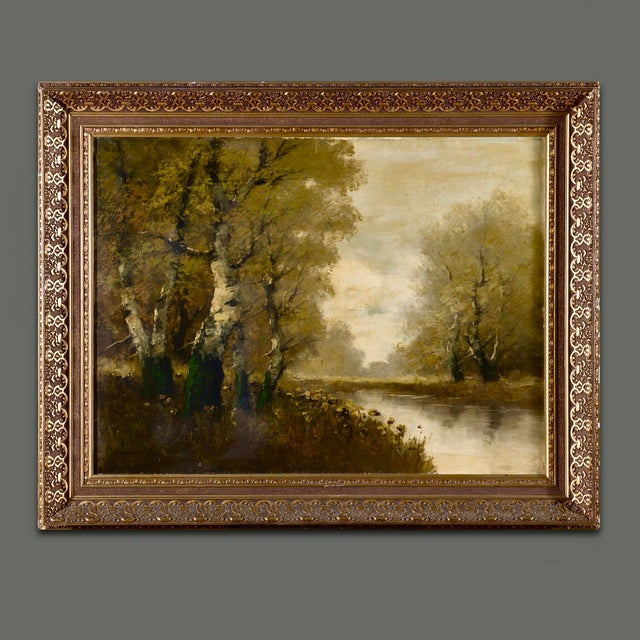
This beautiful and significant painting is a fine example of a river landscape from the Barbizon School, the famous French artistic movement active between 1830 and 1870 that paved the way for Impressionism.
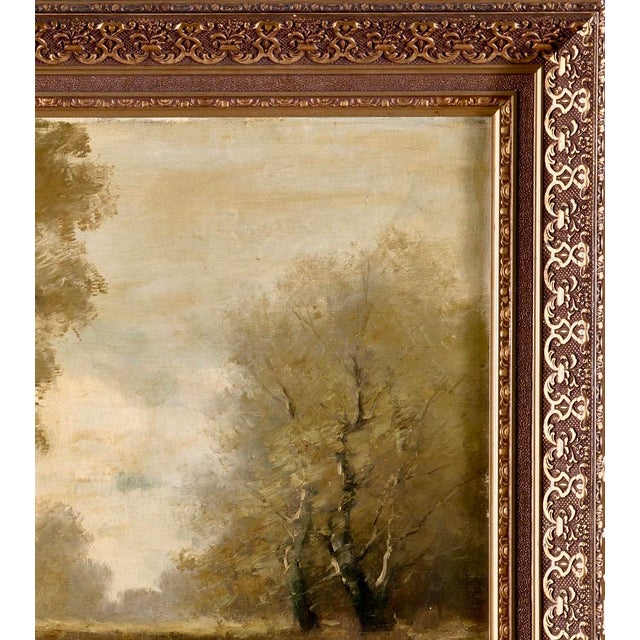
A waterscape featuring trees (probably birches, recognisable by their light-coloured trunks) reflected on the calm surface of a river.
The loose brushwork and attention to natural light suggest a painting executed en plein air (outdoors), typical of this school.
The golden light and mist in the background convey a sense of peace and contemplation typical of 19th-century French lyrical realism.
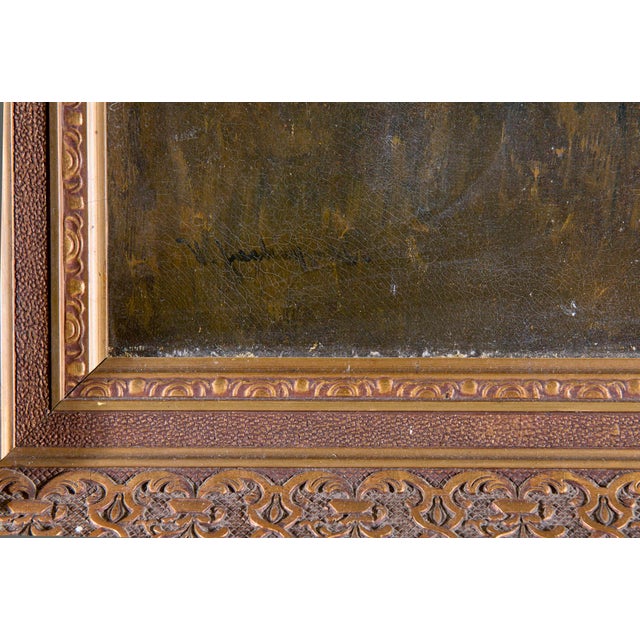
It is these characteristics, together with the signature in the lower left corner, that strongly suggest a consistent attribution to the great painter of the Barbizon School, Charles-François Daubigny (Paris, 15 February 1817 – Paris, 19 February 1878).
This attribution is confirmed by an oral tradition within the French family that has held this painting for several generations.
This artwork, never before on the market, comes from a Parisian important private collection and is beautified by an impressive antique frame in gilded wood, in very good condition.
Charles-François Daubigny (Paris 1817 – 1878) was a French painter, one of the members of the Barbizon school, and is considered an important precursor of impressionism.
He was also a prolific printmaker, mostly in etching, and one of the main artists who used the cliché verre technique.
Daubigny was born in Paris, into a family of painters; taught art by his father, Edmé-François Daubigny and his uncle, miniaturist Pierre Daubigny (1793–1858).
He was also a pupil of Jean-Victor Bertin, Jacques Raymond Brascassat and Paul Delaroche, from whom he would quickly emancipate himself.
Though best known for his painted landscapes, Daubigny survived for many years as a graphic artist, illustrating books, magazines and travel guides for publication.
In 1838, he set up, at the Rue des Amandiers-Popincourt, a community of artists, a phalanstery, with Adolphe-Victor Geoffroy-Dechaume, Hippolyte Lavoignat, Ernest Meissonnier, Auguste Steinheil, Louis Joseph Trimolet, with whom he already had expressed his interest in subjects drawn directly from daily life and nature.
These artists will work, among others, for the publisher Léon Curmer, who was specialized in books illustrated with vignettes.
from this period date the first confirmed engravings by Daubigny.
Initially Daubigny painted in a more traditional style, but this changed after 1843 when he settled in Barbizon to work outside in nature.
Even more important was his meeting with Camille Corot in 1852 in Optevoz (Isère).
from 1852 onward, he was influenced by Gustave Courbet.
The two artists were from the same generation and were driven by the realist movement: during a joint stay, each composed a series of views of Optevoz.
In 1848, Daubigny worked on behalf of the Chalcographie du Louvre, performing facsimiles, which testifies to his great expertise in this art, and revisiting the technique of aquatint in a less cumbersome process.
His famous series of Rolling Carts dates from this period.
In 1857, Daubigny bought a boat and outfitted it as a floating studio, taking his first excursion in November of that year. As "captain" of the Botin, he painted along the Seine and Oise, often in the region around Auvers.
In 1862, Daubigny published Voyage en Bateau, a series of 19 etchings (including the title page) depicting the artist's life on and along the water in his floating atelier, accompanied by a "cabin boy," his son Karl.
"This was a practice that greatly inspired Claude Monet, who followed Daubigny and made his own studio boat."
In 1862, with Corot, he experimented with the cliché-verre technique, a process halfway between photography and printmaking.
In 1866, he joined the jury of the Paris Salon for the first time, alongside his friend Corot. The same year, Daubigny visited England, eventually returning because of the Franco-Prussian War, in 1870.
In London he met Claude Monet, and they left for the Netherlands together.
Back in Auvers, he was visited by an admiring Paul Cézanne.
Daubigny died in Paris in 1878. His remains are interred at cimetière du Père-Lachaise.
Dimensions are frame included This piece is attributed to the mentioned designer/maker. It has no attribution mark and no
official proof of authenticity,
however it is well documented in design history. I take full responsibility for any authenticity
issues arising from misattribution
See less
- Dimensions
- 40.16ʺW × 4.72ʺD × 31.1ʺH
- Period
- 19th Century
- Country of Origin
- France
- Item Type
- Vintage, Antique or Pre-owned
- Condition
- Good Condition, Unknown, Some Imperfections
- Color
- Condition Notes
- Patina Consistent with Age and Use Patina Consistent with Age and Use less
Returns & Cancellations
Return Policy - All sales are final 48 hours after delivery, unless otherwise specified in the description of the product.
Cancellation Policy - Prior to shipping or local pickup, buyers may cancel an order for up to 48 hours, unless otherwise specified.
Related Collections
- Photorealism Canvas Paintings
- Ed Ruscha Paintings
- Photorealism Paintings in New York
- Richard Serra Paintings
- Herman Miller Paintings
- BDDW Paintings
- Louise Nevelson Paintings
- Karen Offutt Paintings
- Jo Baskerville Paintings
- Nicola Simbari Paintings
- Karl-Erik Ekselius Paintings
- Carl-Axel Acking Paintings
- Joseph Stella Paintings
- James McCray Paintings
- Milton Avery Paintings
- Photorealism Paintings in Los Angeles
- Leroy Neiman Paintings
- Jaanika Peerna Paintings
- Vienna Secession Paintings
- Cassina Paintings
- Black Photorealism Paintings
- Lawson-Fenning Paintings
- Jean-Paul Barray Paintings
- Hans Andersen Paintings
- Johannes Andersen Paintings