

Details
Description
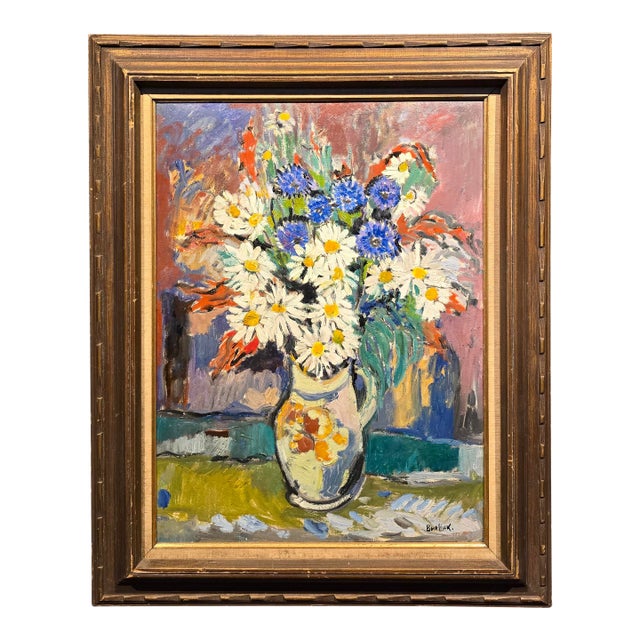
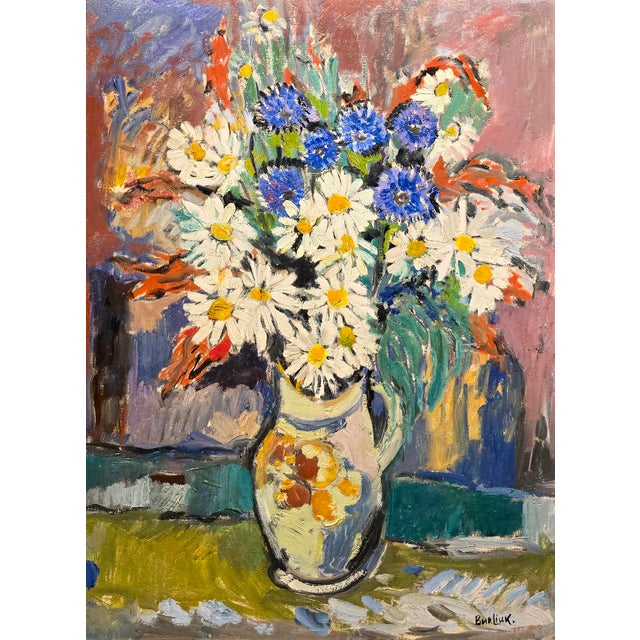
David Burliuk - Vibrant Floral Still Life in Vase– 1950s Oil Painting
Russian/Ukrainian Expressionist - Oil painting on canvas -Signed …
Read more
David Burliuk - Vibrant Floral Still Life in Vase– 1950s Oil Painting
Russian/Ukrainian Expressionist - Oil painting on canvas -Signed circa 1950s
Canvas size 24x18" Frame size 30x24"
Description:
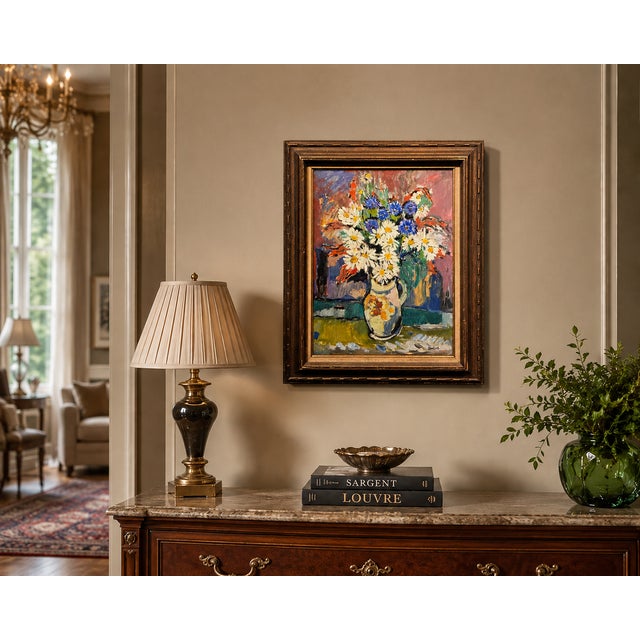
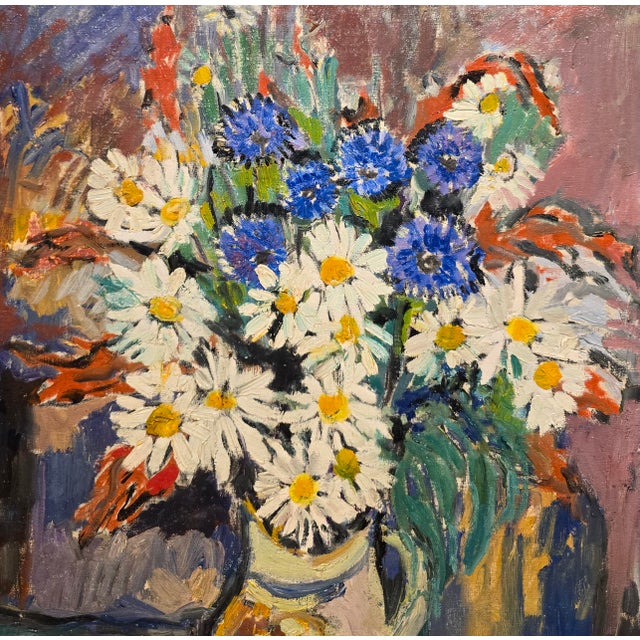
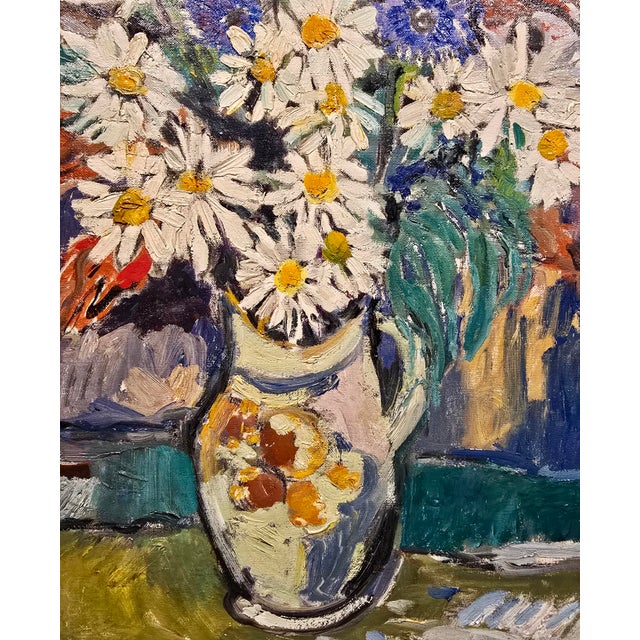
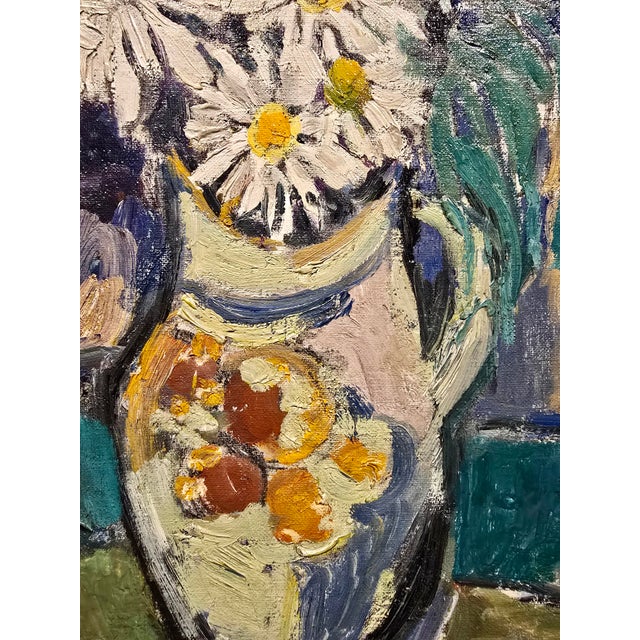
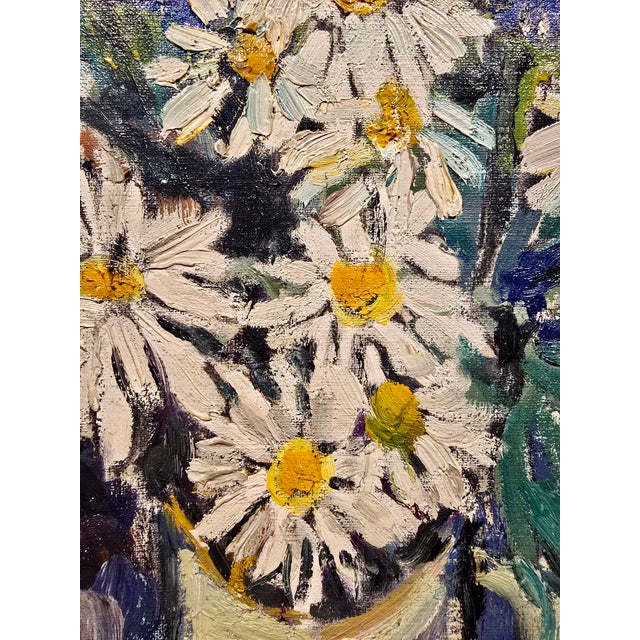
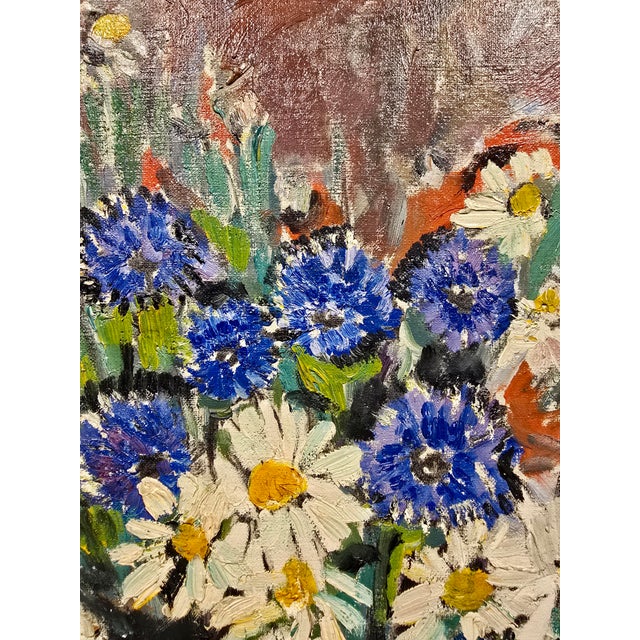
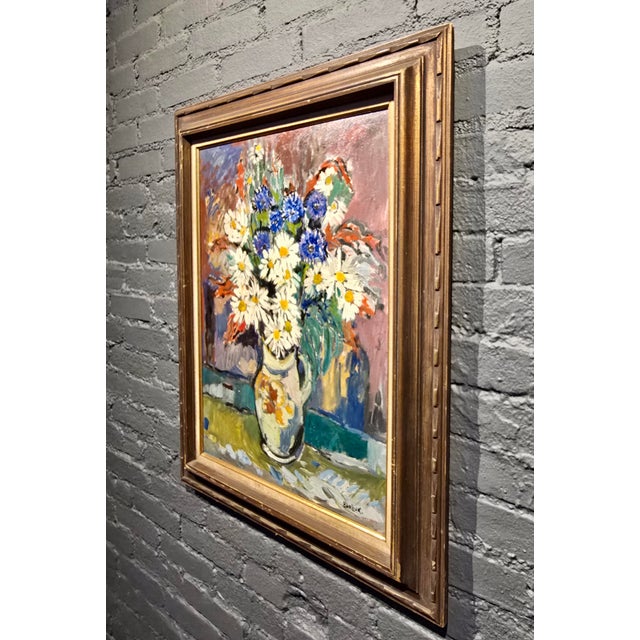
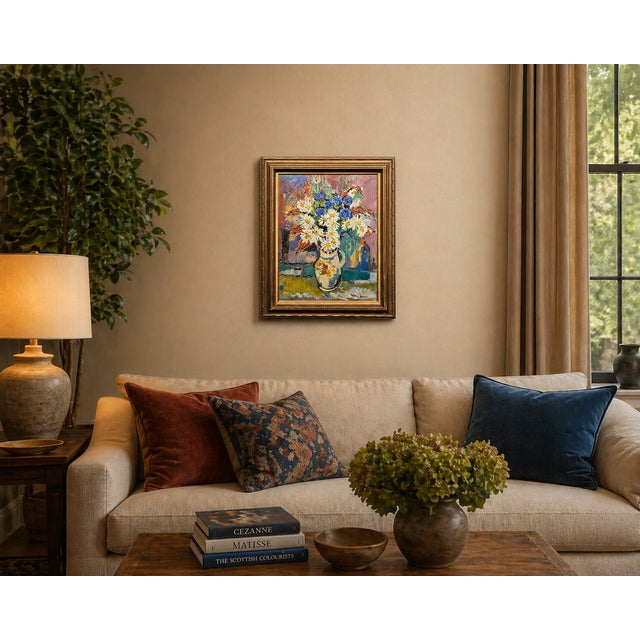
An arresting and joyful still life by Burliuk, this expressive composition captures a bouquet of daisies and wildflowers bursting with color and vitality. Rendered in confident, painterly brushstrokes, the work reflects a modernist sensibility—where form yields to movement, and color becomes the primary language of emotion.The bouquet, arranged in a decorative ceramic vase, is set against a richly abstracted background of warm rose, violet, and ochre tones. The interplay between the crisp whites of the daisies, the deep blues, and the energetic accents of vermilion creates a dynamic visual rhythm. The composition balances spontaneity with structure, evoking the spirit of early 20th-century European avant-garde painting.Executed with a thick, impasto technique, the surface reveals the artist’s hand—each stroke deliberate yet instinctive. The work carries a strong sense of immediacy, suggesting it was painted directly from life, a hallmark of modernist exploration.Presented in a handsome, period-style carved wood frame that complements the warmth and texture of the painting without overpowering it.
Details:
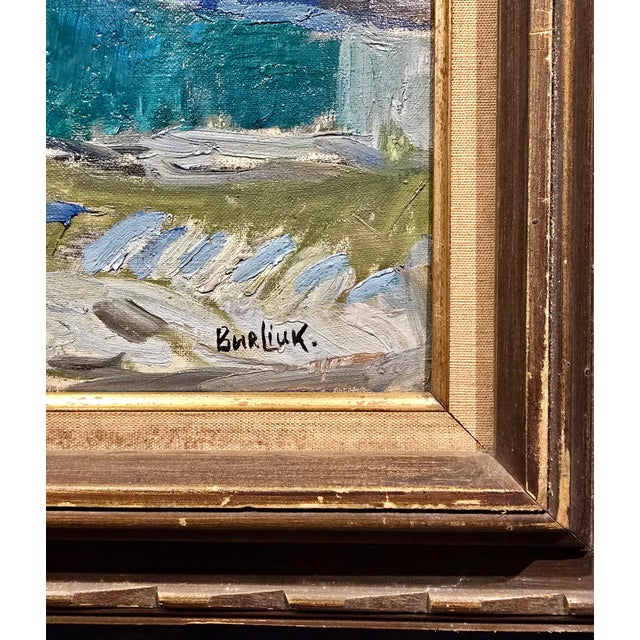
Artist: Burliuk
Medium: Oil on canvas
Subject: Floral still life (daisies in vase)
Frame: Original or period-style carved wood frame
Overall dimensions: Approx. 30” H x 24” W (including frame)
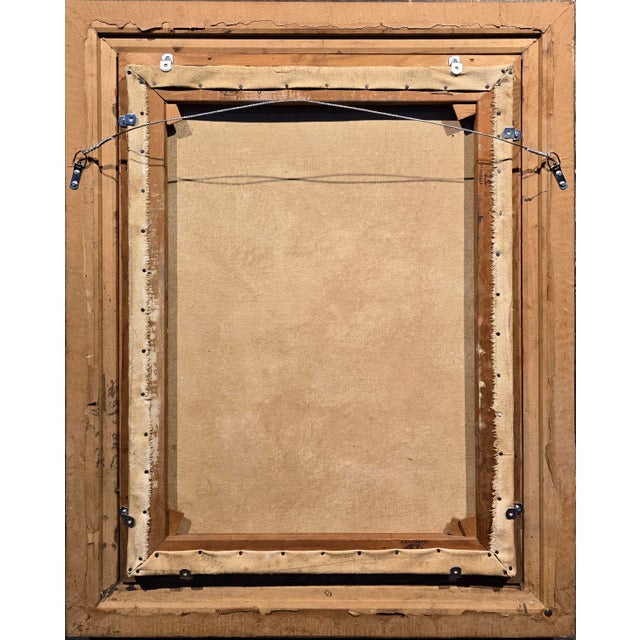
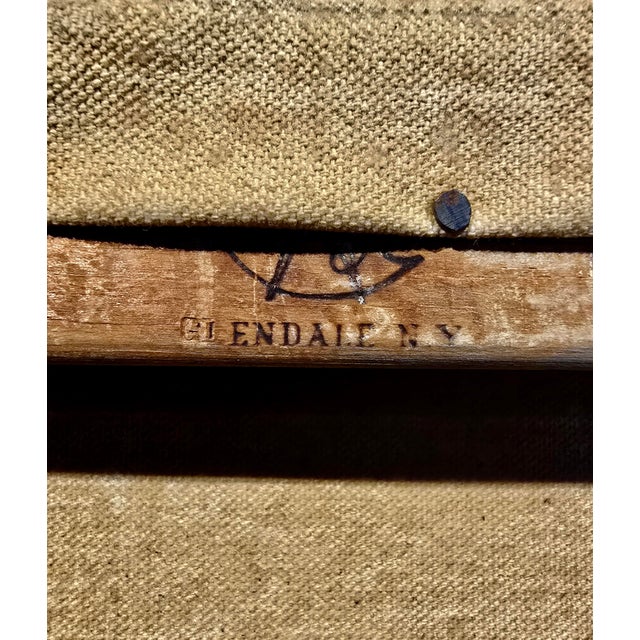
Condition: Good vintage condition with expected age-related wear to frame; painting surface retains strong color and texture
Provenance & Context:
David Burliuk (often referred to as the “father of Russian Futurism”) was known for his bold use of color and expressive handling of paint. Works in this spirit embody the transition from Impressionism into more liberated, avant-garde movements of the early 20th century. Floral still lifes such as this offered artists a space for experimentation—where composition, color, and gesture could be explored freely.
Collector’s Note:
A striking and decorative piece that bridges fine art and interior elegance—ideal for collectors drawn to modernist expression or for those seeking a sophisticated focal point that enlivens a room with color and artistic presence
Artist Biography
David Davidovich Burliuk (1882 - 1967) was active/lived in New York / Russian Federation, Ukraine, China.He is known for Modernist landscape, still life and figure painting.Considered the "Father of Russian Futurism" and one of the leading figures of the Modernist avant-garde, David Burliuk is experiencing an enormous resurgence of interest and critical attention forty years after his death. As painter, poet and writer of manifestos, Burliuk was a central figure in the intellectual and artistic avant-garde of early 20th century Russia. He was inspired by revolutionary Western European art movements ranging from Impressionism and Post-Impressionism to Fauvism, Cubism, German Expressionism, Italian Futurism and Symbolism, but also by the Orthodox religious icons and naive folk art of Russia and his birthplace, the Ukraine. Art movements to which he contributed include Russian Neo-Primitivism (1908-12), an infusion of Fauvist color and Expressionist brushwork into landscapes and portraits inspired by folk art; Rayonism (1912-14), a synthesis of Cubist configurations of space and Futurist representations of speed and dynamism; and Cubo-Futurism (1913-14), a blend of Neo-Primitivist subjects and Cubist or Futurist style. Burliuk participated in the foundational exhibition of Moscow's influential "Jack of Diamonds" group in 1910 and also in its subsequent shows, together with not only Russian artists - Chagall, Kandinsky, and Malevich among others - but also foreign celebrities including Picasso, Matisse, Braque and Derain. He also exhibited in Munich in 1911 with the international Der Blaue Reiter group that included Kandinsky, Jawlensky, Franz Marc and Paul Klee, and contributed an essay to the first volume of the Blaue Reiter group's Almanac. As a poet, he was co-author of the Russian Futurist manifesto, A Slap in the Face of Public Taste (1913). Born in the Ukriane in 1882, he enjoyed access to a high degree of education, with periods of study in Kazan, Odessa, Munich, Paris, and Moscow. His participation in the avant-garde spirit of the times led to his expulsion from the Moscow School of Painting, Sculpture and Architecture in 1914. Burliuk fled Russia in 1918 during the Bolshevik revolution and spent the next four years in Siberia and then Japan. He was court painter to the Japanese emperor from 1920 to 1922 and very well received there. However, anticipating war with Russia, the Japanese government requested that he leave in 1922. He then immigrated to New York and developed his "Radio" style, a dynamic and innovative blend of Symbolism, Neo-Primitivism and Expressionism, so called in reference to the advent of radio and its ability to make available a variety of cultures. Burliuk's critical acceptance in the New World came in 1923 with a major exhibition of his paintings at the Brooklyn Museum and soon thereafter a solo show at the Société Anonyme - the first museum of experimental modern art - established in New York by Marcel Duchamp, Man Ray and Katherine Dreier. In 1939, after experiencing increasing success as a writer, editor and painter, he moved his family from the Lower East Side to Hampton Bays, Long Island. He traveled again to Europe which prompted a series of pictures inspired by Van Gogh and by 17th century Dutch painters such as Pieter Brueghel the Younger. With his wife, Marussia, he collected modern art and published an art magazine called Color and Rhyme (1937-66). In addition to Cubo-Futurist and Symbolist paintings, he continued creating delightful, proto-naive paintings, depicting the American landscape as well as the Russian countryside of his memories. Burliuk died in 1967 and that same year was honored posthumously by induction into the American Academy of Arts and Letters. His work is in the collections of such prestigious museums as the Guggenheim, New York; the Museum of Modern Art, New York; the Whitney; the Metropolitan Museum of Art; the Brooklyn Museum; the Museum of Fine Arts, Boston; the Frederick R. Weisman Art Museum; the Phillips Collection; the Smithsonian American Art Museum; The State Russian Museum in St. Petersburg; the Thyssen-Bornemisza in Madrid; and the National Museum of Modern Art, Kyoto.
See less
- Dimensions
- 24ʺW × 2ʺD × 30ʺH
- Styles
- Expressionism
- Frame Type
- Framed
- Art Subjects
- Still Life
- Period
- 1950s
- Country of Origin
- Ukraine
- Item Type
- Vintage, Antique or Pre-owned
- Materials
- Canvas
- Oil Paint
- Condition
- Good Condition, Original Condition Unaltered, Some Imperfections
- Color
- Blue
- Condition Notes
- Excellent - Minor wear consistent with age and history Excellent - Minor wear consistent with age and history less
Questions about the item?
Returns & Cancellations
Return Policy - All sales are final 48 hours after delivery, unless otherwise specified in the description of the product.
Cancellation Policy - Prior to shipping or local pickup, buyers may cancel an order for up to 48 hours, unless otherwise specified.
Related Collections
- Photorealism Canvas Paintings
- Ed Ruscha Paintings
- Richard Serra Paintings
- Photorealism Paintings in New York
- Herman Miller Paintings
- Louise Nevelson Paintings
- Karen Offutt Paintings
- Jo Baskerville Paintings
- Nicola Simbari Paintings
- BDDW Paintings
- James McCray Paintings
- Leroy Neiman Paintings
- Jaanika Peerna Paintings
- Vienna Secession Paintings
- Johannes Andersen Paintings
- Pedro Friedeberg Paintings
- Peter Behrens Paintings
- Piet Hein Eek Paintings
- Raphael Paintings
- Jeff Slemmons Paintings
- Photorealism Paintings in Los Angeles
- Milton Avery Paintings
- Karl-Erik Ekselius Paintings
- Joseph Stella Paintings
- Hans Andersen Paintings