


Details
Description
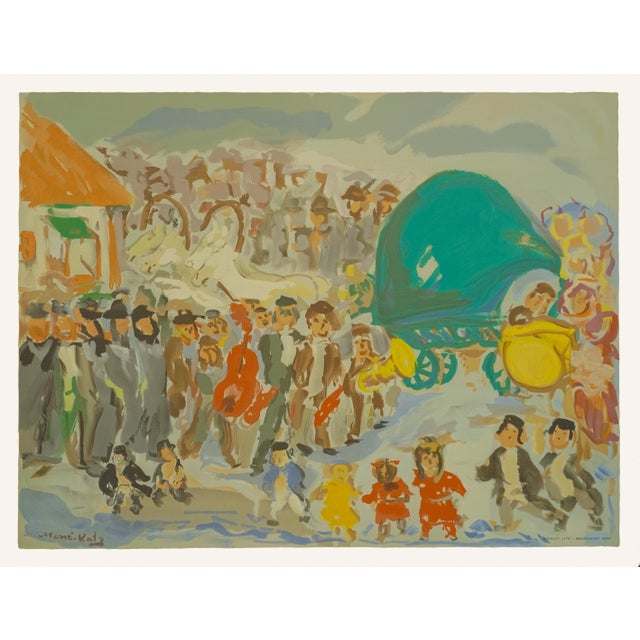
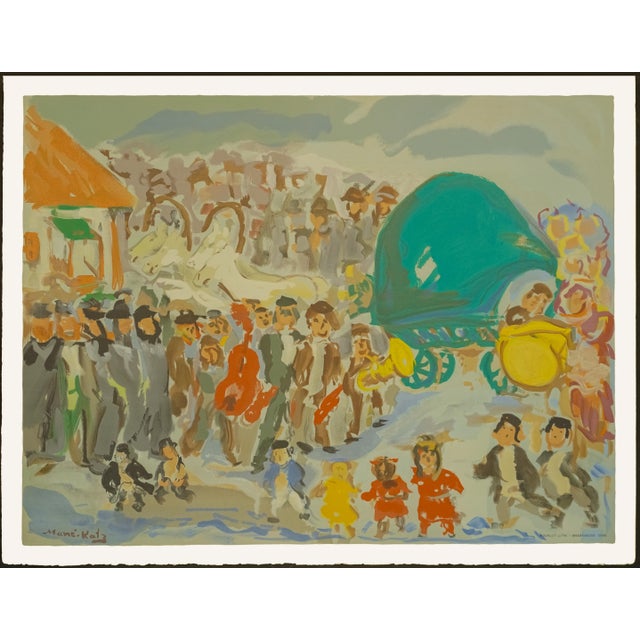
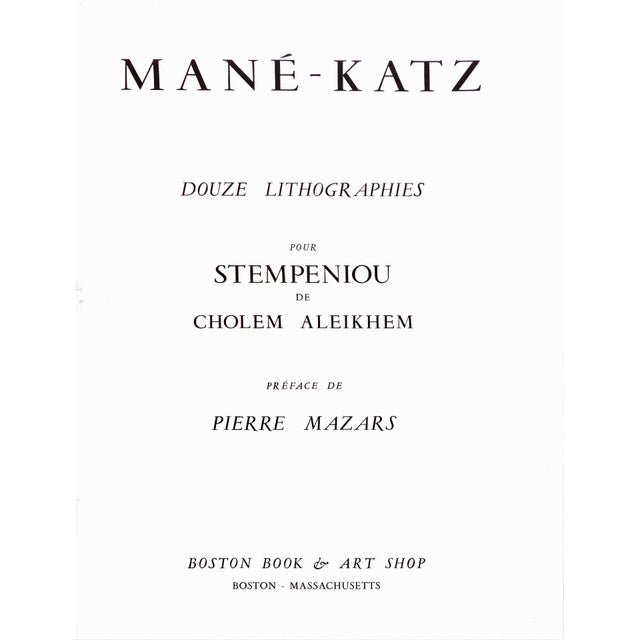
Original lithograph from the limited edition portfolio "Stempeniou de Cholem Aleikhem" by Emmanuel Mané-Katz, published in 1966 by Boston Book …
Read more
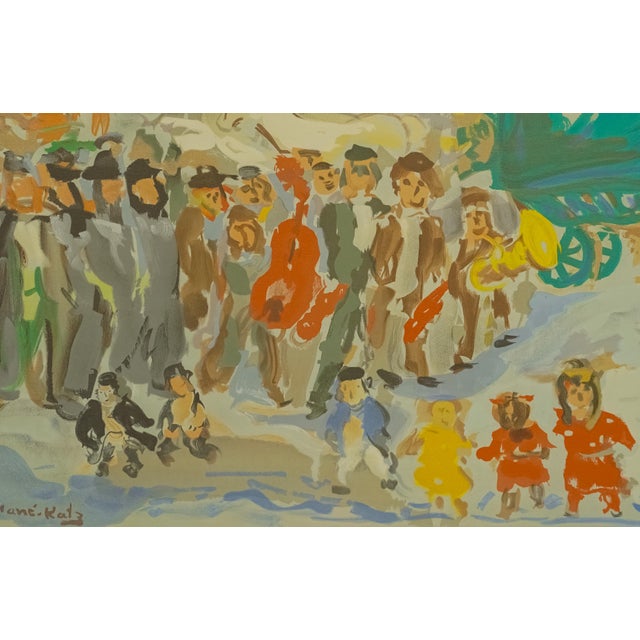
Original lithograph from the limited edition portfolio "Stempeniou de Cholem Aleikhem" by Emmanuel Mané-Katz, published in 1966 by Boston Book and Art, produced by André Sauret, and printed in France by Mourlot Frères. The lithographs illustrate the Yiddish novel by Cholem Aleikhem, depicting Klezmer musicians and Shtetl (small village) life through expressionistic, colorful scenes. Sheet size: 27-1/2 x 21 inches; print size: 26 x 19-1/2 inches; on deckle-edge Grand Vélin d'Arches. Signed in stone.
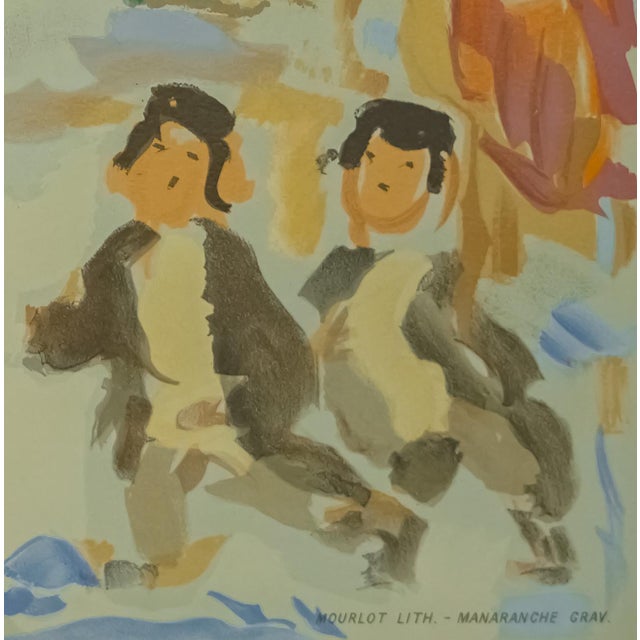
Per the Colophon: "This work produced by André Sauret, was completed printing in January 1966. The lithographs, whose placement on stone was started by Mané-Katz and finished by Alexis Manaranche, were printed in the workshops of Mourlot Frères in Paris. The typography is from the Union printing house in Paris. The print run was limited to three hundred copies on Grand Vélin d'Arches numbered from 1 to 300. In addition, a few non-commercial copies were printed and reserved." Our portfolio is a Hors Commerce (HC) (non-commerical) copy, and the prints are in mint condition.
Emmanuel Mané-Katz (1894–1962) was a significant figure of the School of Paris whose work combined modernist experimentation with a deep emotional commitment to Jewish identity and memory. Born in Kremenchuk, in the Russian Empire (now Ukraine), into a traditional Jewish family, he was exposed early to religious life, imagery, and music—elements that would later dominate his art. He studied at the Kyiv Art School before moving to Paris in 1913, where he encountered the flourishing avant-garde scene and formed connections with artists such as Marc Chagall and Chaïm Soutine. Although influenced by modernist movements like Expressionism and Fauvism, Mané-Katz developed a highly personal style marked by vigorous brushwork, dramatic contrasts, and an emphasis on psychological depth.
During World War I, he volunteered for the French Foreign Legion, an experience that interrupted his artistic development but strengthened his ties to France, where he would spend most of his life. After the war, he returned to Paris and began to achieve recognition through exhibitions and collectors, especially in Europe and the United States. Unlike some of his contemporaries who embraced abstraction, Mané-Katz remained committed to figurative painting, using distortion and color not to obscure reality but to heighten emotional and spiritual expression.
A central focus of his work was the world of Eastern European Jewry, particularly the Shtetl culture that was rapidly disappearing in the early 20th century and later devastated by the Holocaust. He painted rabbis wrapped in prayer shawls, wandering musicians, beggars, and scholars—figures rendered with elongated forms and intense, almost mystical expressions. His palette often featured rich blues, reds, and earthy tones, contributing to a sense of solemnity and introspection. In addition to oil paintings, he produced watercolors, drawings, and lithographs, many of which explored similar themes with a lighter, more fluid touch.
Mané-Katz also traveled widely, including visits to Palestine (later Israel), which influenced his later works with brighter light and color. He eventually formed a strong connection with the city of Haifa, where a museum dedicated to his work—the Mané-Katz Museum—was established, housing a large collection he donated. Throughout his career, he exhibited internationally and gained a reputation as one of the key visual chroniclers of Jewish life in the modern era. In the late 1950s, Mané-Katz created a series of gouaches to illustrate the story "Stempeniou", about a talented itinerant folk violinist. Fernand Mourlot was contacted to print a limited edition portfolio of original prints based on these gouaches. Mané-Katz and Fernand Mourlot started designing the lithograph plates in 1960, but Mané-Katz died before the project was completed, with his friend Alexis Manaranche completing it in 1966. Thus, the prints from this portfolio are the last works by Mané-Katz.
See less
- Dimensions
- 27.5ʺW × 0.1ʺD × 21ʺH
- Frame Type
- Unframed
- Styled After
- Marc Chagall
- Period
- 1960s
- Country of Origin
- France
- Item Type
- Vintage, Antique or Pre-owned
- Materials
- Lithograph
- Condition
- Mint Condition, No Imperfections
- Color
- Green
- Condition Notes
- Mint condition, taken from a complete Stempeniou de Cholem Aleikhem portfolio. Photographs are detailed and taken under controlled lighting; post-production … moreMint condition, taken from a complete Stempeniou de Cholem Aleikhem portfolio. Photographs are detailed and taken under controlled lighting; post-production is performed with calibrated monitors. Thus, our photographs accurately capture the work's condition and colors. However, monitors vary and can affect the way art appears online. Contact us for any concerns. less
Questions about the item?
Returns & Cancellations
Return Policy - All sales are final 48 hours after delivery, unless otherwise specified in the description of the product.
Cancellation Policy - Prior to shipping or local pickup, buyers may cancel an order for up to 48 hours, unless otherwise specified.
Related Collections
- Rattan Original Prints
- Medium-Density Fibreboard Original Prints
- Soicher Marin Original Prints
- Original Prints in Salt Lake City
- Original Prints in Panama City, FL
- Ralph Lauren Original Prints
- Damien Hirst Original Prints
- Sam Francis Original Prints
- Silver Finish Original Prints
- Johannes Kip Original Prints
- Dye Transfer Original Prints
- Donald Sultan Original Prints
- Original Prints in Lexington, KY
- Botanical Prints
- Framed Prints
- Bird Prints
- Woodblock Prints
- Screen Prints
- Japanese Woodblock Prints
- Thomas McKnight Original Prints
- George Barbier Original Prints
- Frank Stella Original Prints
- Gustave Baumann Original Prints
- Teak Original Prints
- Clay Original Prints