



Details
Description
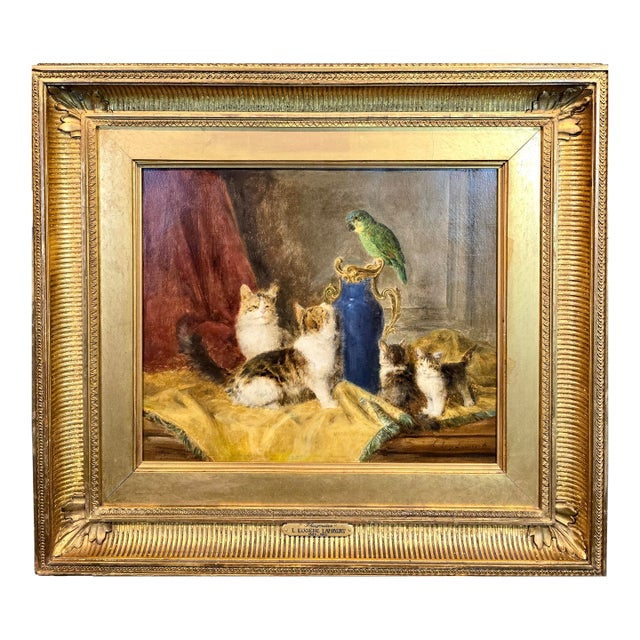
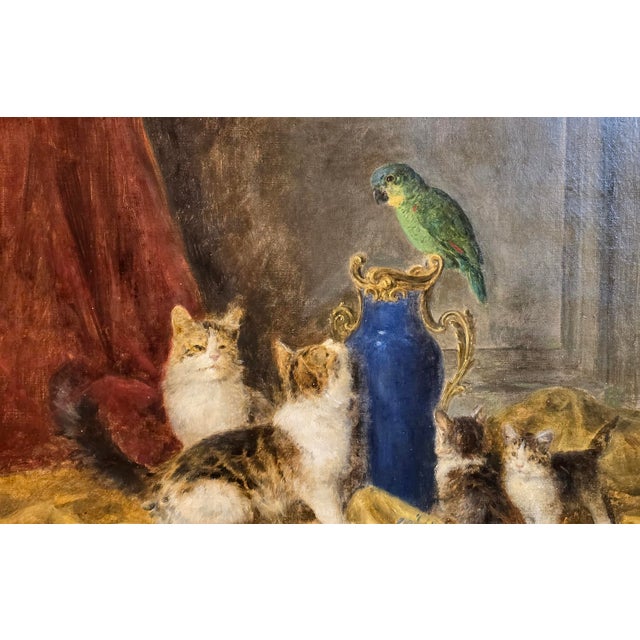
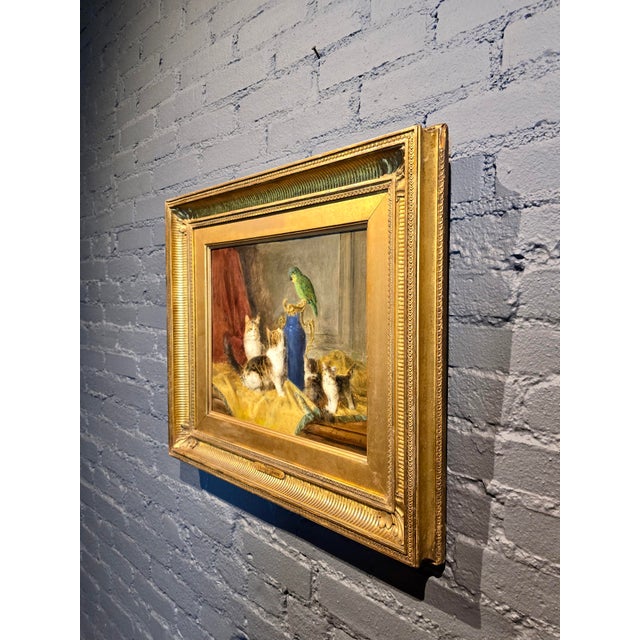
Louis Eugène Lambert- Four Cats playing w/a Parrot- 19th century Oil Painting
French Realist - Oil Painting on canvas- Signed …
Read more
Louis Eugène Lambert- Four Cats playing w/a Parrot- 19th century Oil Painting
French Realist - Oil Painting on canvas- Signed - circa 1860s
Canvas size: 14x16" - Frame size 22x24 x3"
Description
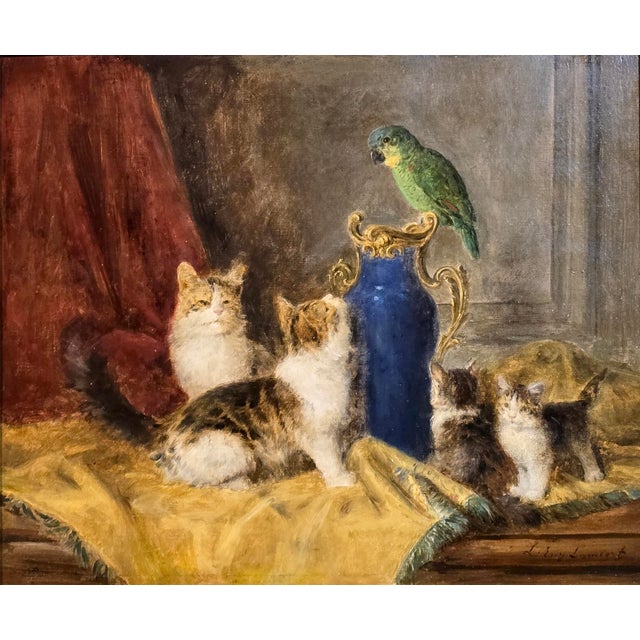
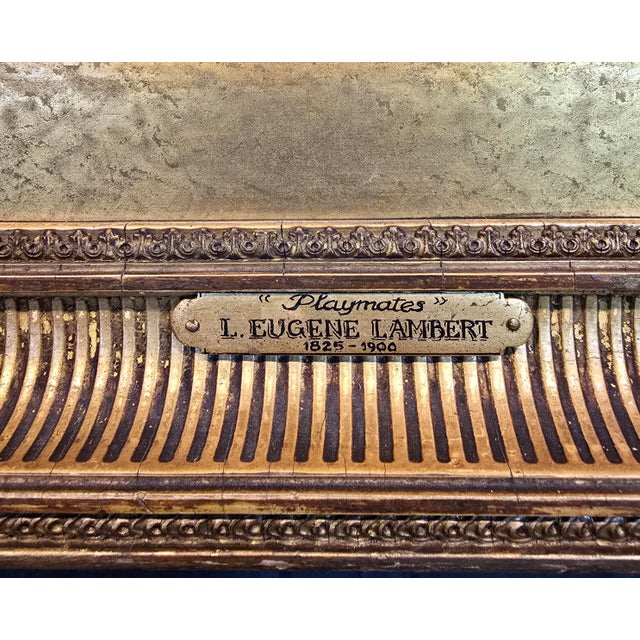
In "Playmates", the 19th-century French master Louis Eugène Lambert (1825–1900) presents a charming, if slightly tense, domestic encounter. Known as the "Raphael of Cats," Lambert’s skill shines here through his ability to capture both the distinct personalities of the animals and the tactile richness of their surroundings.
The Composition and Narrative
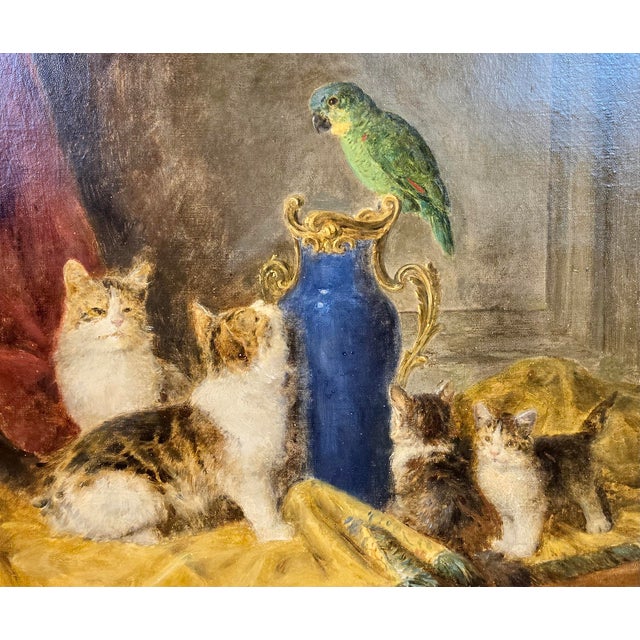
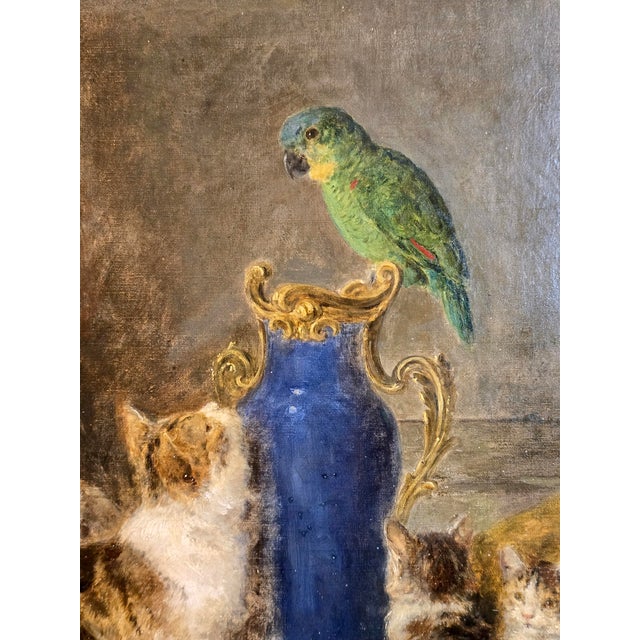
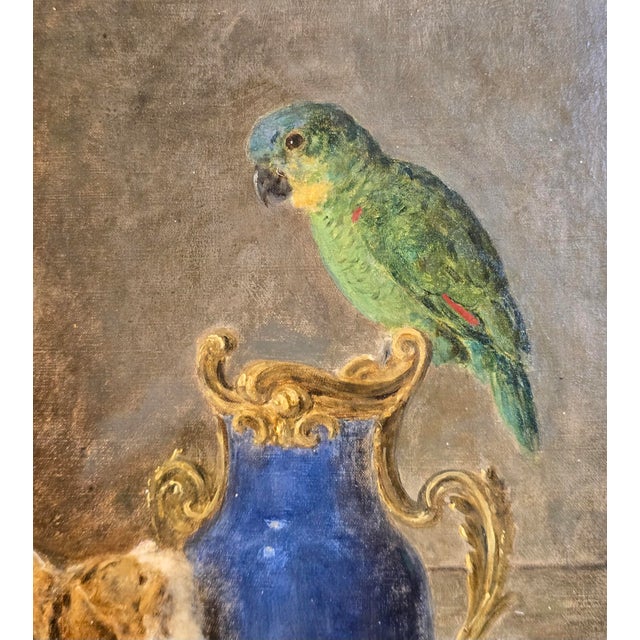
The scene is set in what appears to be a corner of an elegant atelier or salon. A group of four inquisitive cats—two older cats and two tiny kittens—have gathered around a tall, ornate Sèvres-style cobalt blue vase. Perched precariously on the rim is a bright green parrot, possibly an Orange-winged Amazon, which serves as the focal point for the cats’ curiosity.
The narrative tension is palpable: the cats gaze upward with a mix of predatory instinct and innocent wonder, while the parrot looks down from its height, seemingly calm yet watchful of the "playmates" below.
Color and Texture
The Palette: Lambert uses a sophisticated interplay of colors. The vibrant cobalt blue of the vase and the emerald green of the parrot provide brilliant pops of color against a more muted, earthy background.
Textile Detail: The animals rest upon a heavy, mustard-yellow fringed throw, which is draped over a wooden surface. To the left, a deep burgundy velvet curtain adds a sense of theatricality and warmth to the space.
Animal Fur: The artist’s technical mastery is most evident in the rendering of the cats’ fur. From the sleek, mottled coats of the calico and tabby adults to the soft, downy fuzz of the two kittens huddled to the right, each texture is rendered with delicate, individual brushstrokes.
Atmosphere and Style
The lighting is soft and directional, coming from the upper right, casting gentle shadows that give the vase and the cats a realistic, three-dimensional presence. The painting is a quintessential example of Academic Animalism, blending a high degree of anatomical accuracy with a sentimental, narrative charm that was immensely popular in late 19th-century European art.
Artist Biography
Born in Paris on September 24, 1825, Louis Eugène Lambert was one of the most celebrated animalist painters of the 19th century. His technical brilliance and warm, narrative style earned him the prestigious nicknames "Lambert of the Cats" and the "Raphael of Cats".
Early Training and Influences
Elite Mentorship: Lambert studied under the legendary Romantic painter Eugène Delacroix, who even helped finance some of his early work. He was also a pupil of Paul Delaroche. The Louvre and Flanders: He spent significant time at the Louvre copying the Old Masters, where he became deeply influenced by the Flemish School, known for its meticulous attention to detail and texture.Nohant Period: In 1844, he moved to the home of famous author George Sand in Nohant. Though he planned to stay for only a month, he remained for 14 years, becoming an essential part of the family and their theatrical troupe. Rise to Fame .The Breakthrough: While he debuted at the Paris Salon in 1847 with a still life of birds, his true career-defining moment came in 1857 with the painting "Cat and Parakeet". Its immense success led him to specialize almost exclusively in domestic cats and dogs.High Society Patronage: His reputation was solidified in 1874 when he was commissioned to paint Baron Nathaniel de Rothschild with his dogs. Legacy and Honors.Awards: Lambert was awarded medals at the Salon in 1865 and 1870 and was presented with the Chevalier of the Legion of Honor in 1874.Versatility: Beyond oil painting, he was an accomplished watercolorist and a member of the French Society of Watercolor. He also illustrated famous literary works, including the Fables of La Fontaine.Museum Collections: Today, his works are preserved in major international institutions, including the British Museum, the Brooklyn Museum, and the Musée des Beaux-Arts in various French cities. Lambert died in Paris on May 17, 1900, leaving behind a body of work that continues to be a staple of 19th-century European animalist art.
See less
- Dimensions
- 24ʺW × 3ʺD × 22ʺH
- Frame Type
- Framed
- Art Subjects
- Animals
- Period
- Mid 19th Century
- Country of Origin
- France
- Item Type
- Vintage, Antique or Pre-owned
- Materials
- Canvas
- Oil Paint
- Condition
- Good Condition, Original Condition Unaltered, Some Imperfections
- Color
- Yellow
- Condition Notes
- Excellent - Minor wear consistent with age and history Excellent - Minor wear consistent with age and history less
Questions about the item?
Returns & Cancellations
Return Policy - All sales are final 48 hours after delivery, unless otherwise specified in the description of the product.
Cancellation Policy - Prior to shipping or local pickup, buyers may cancel an order for up to 48 hours, unless otherwise specified.
Related Collections
- Steve Kaufman Paintings
- Margaret Kennedy Paintings
- Joseph Solman Paintings
- Limoges, France Paintings
- Donald Judd Paintings
- Jacobean Paintings
- Louis Wolchonok Paintings
- Michelle Arnold Paine Paintings
- Mark Lewis Paintings
- Mark Lewis Art Paintings
- Paintings in Panama City, FL
- Vienna Secession Paintings
- Nikolaos Schizas Paintings
- Keith Haring Paintings
- Paul Jenkins Paintings
- Photorealism Paintings in New York
- Black Photorealism Paintings
- Photorealism Canvas Paintings
- Sol LeWitt Paintings
- Lee Reynolds Paintings
- Mid-Century Modern Paintings
- Abstract Paintings
- Nautical Paintings
- Velvet Paintings
- Paintings in San Antonio