

Cheshire Antiques Consultant LTD
Chester, Cheshire West and Chester
Since 2021100+ sales
3x Super Seller

Details
Description
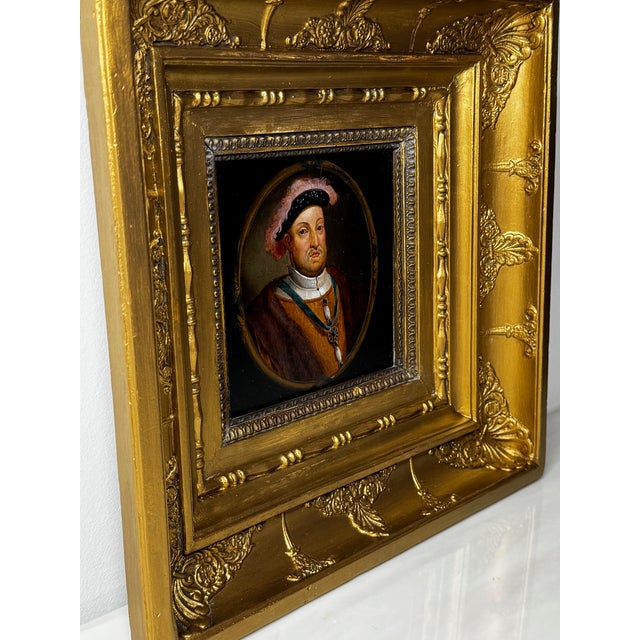
Antique English Portrait of King Henry VIII After Hans Holbein – Georgian Oil Painting on Oak Panel, Circa 1750
Portrait …
Read more
Antique English Portrait of King Henry VIII After Hans Holbein – Georgian Oil Painting on Oak Panel, Circa 1750
Portrait of King Henry VIII (1491–1547)
Following the Prototype, Wearing the Badge of the Order of the Garter
After Hans Holbein the Younger
English School, circa 1750
A refined Georgian antiquarian cabinet oil portrait reinterpreting the most iconic Tudor royal image. This 18th-century English painting combines Renaissance royal iconography with the intellectual historical revival of the Georgian period, making it an exceptional example of early antiquarian portrait collecting.
Subject and Medium
Oil on single chamfered oak panel
Panel dimensions: 15 cm × 15 cm
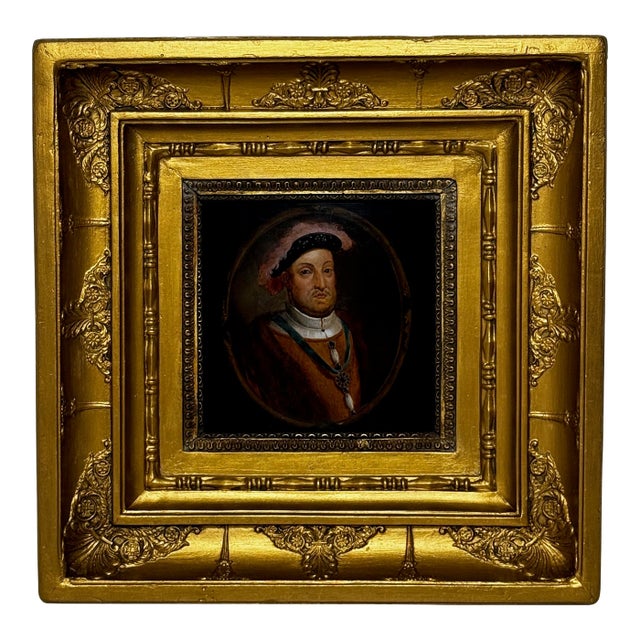
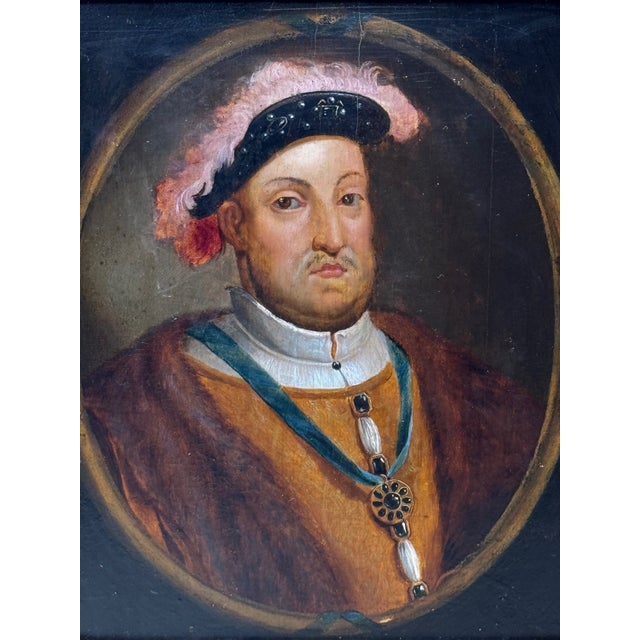
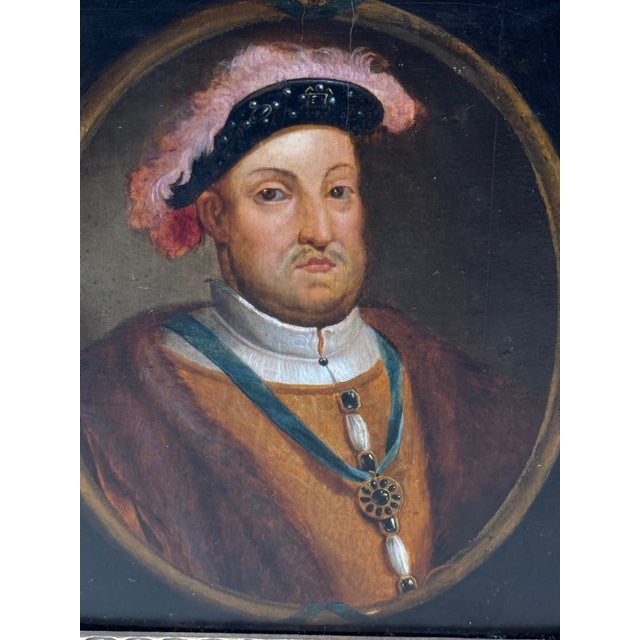
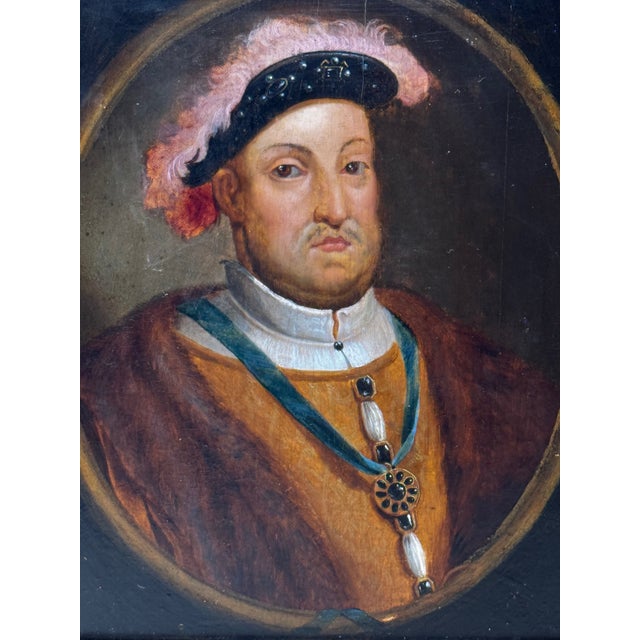
This mid-18th-century cabinet portrait depicts King Henry VIII in bust length within a painted feigned oval, following the well-known prototype derived from the lost Whitehall Palace mural painted by Hans Holbein the Younger in 1537 and later copied in 1561.
Holbein’s Whitehall portrait became the canonical image of Henry VIII, defining the visual identity of the Tudor monarch. Through painted copies and engraved reproductions, the image circulated widely across Europe and shaped the way later generations imagined the king. This Georgian interpretation belongs to that long tradition of historical portrait reproduction.
Composition and Technique
Henry VIII is presented frontally with a slight turn of the head, projecting the calm authority associated with Tudor royal portraiture. The painted oval frame isolates the monarch visually, creating the intimate and scholarly presentation typical of Georgian cabinet portraits.
The painting reflects mid-18th-century antiquarian technique:
Controlled linear modelling of the facial features
Subtle tonal transitions in the flesh passages
Simplified but precise rendering of costume details
Strong contrast between warm garment tones and dark background
The king’s jewelled cap and feather plume are clearly articulated, while highlights along the collar and Garter badge add depth and luminosity. The paint surface displays age-appropriate craquelure.
The use of a single chamfered oak panel is entirely consistent with Georgian cabinet portrait production.
About the Sitter: King Henry VIII
Henry VIII (1491–1547), King of England from 1509 until his death in 1547, remains one of the most influential monarchs in British history.
He is known for:
Establishing the Church of England
Initiating the English Reformation
Transforming the Tudor monarchy into a dominant dynastic power
In this portrait he wears a simplified version of the badge of the Most Noble Order of the Garter, of which he was Sovereign.
In full Tudor state portraits Henry appears wearing the elaborate Garter collar with the “Great George” pendant depicting Saint George slaying the dragon. In later engraved versions of the portrait, including those circulating in the 18th century, the insignia was often simplified into a jeweled medallion as seen here. This feature confirms adherence to established royal iconography.
Historical Significance
Painted around 1750, this work belongs to the Georgian antiquarian revival, a period when British collectors developed a strong interest in Tudor history and portraiture.
Historic royal portraits were frequently displayed in:
Country house libraries
Gentleman’s studies
Antiquarian collections
Architectural portrait galleries
The engraver George Vertue (1684–1756) played an important role in preserving Tudor imagery through prints and historical documentation. Through such engraved reproductions the lost Holbein mural at Whitehall Palace remained fixed in the cultural imagination.
This painting therefore represents not simply a portrait but an 18th-century act of historical interpretation and dynastic remembrance.
An early German descriptive label on the reverse indicates later continental ownership, demonstrating the international circulation of English royal portrait imagery during the 18th and 19th centuries.
About the Artist
English School, mid-18th century.
The painting is unsigned, which is typical for Georgian antiquarian cabinet portraits. The work displays characteristics associated with London’s antiquarian painting tradition:
Composition derived from historical engravings
Linear portrait modelling
Oak panel cabinet construction
Focus on historical fidelity rather than artistic signature
Such paintings were produced for collectors interested in British history and royal portraiture.
Signature
Unsigned, consistent with Georgian cabinet portrait production.
Frame
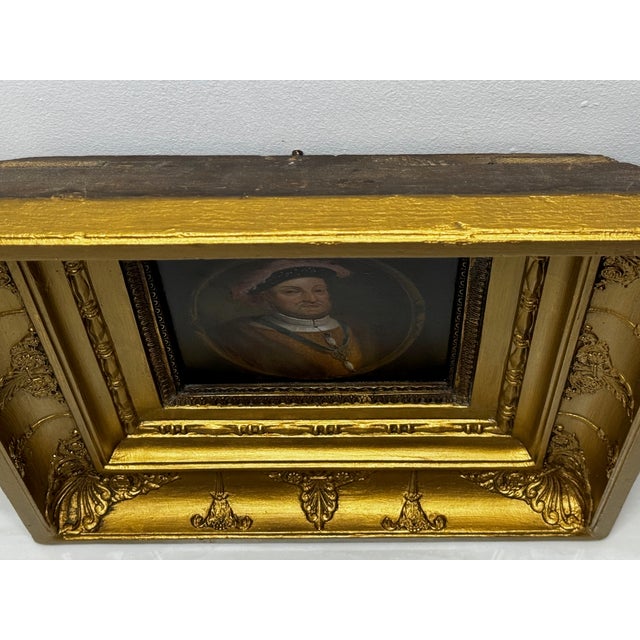
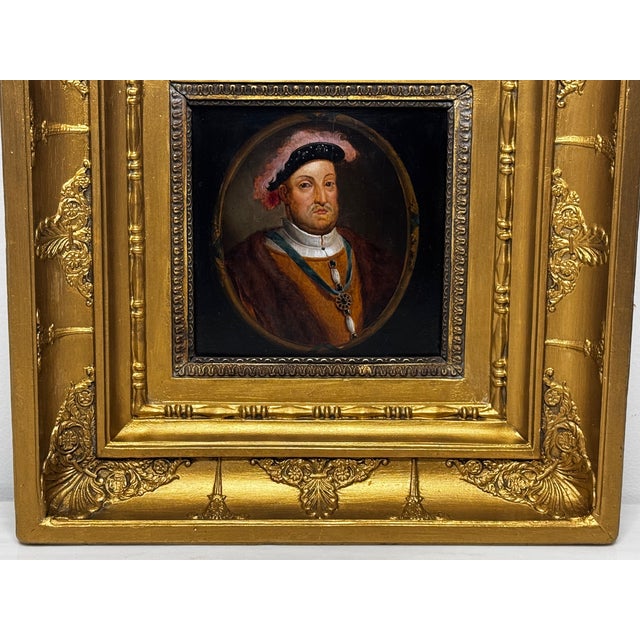
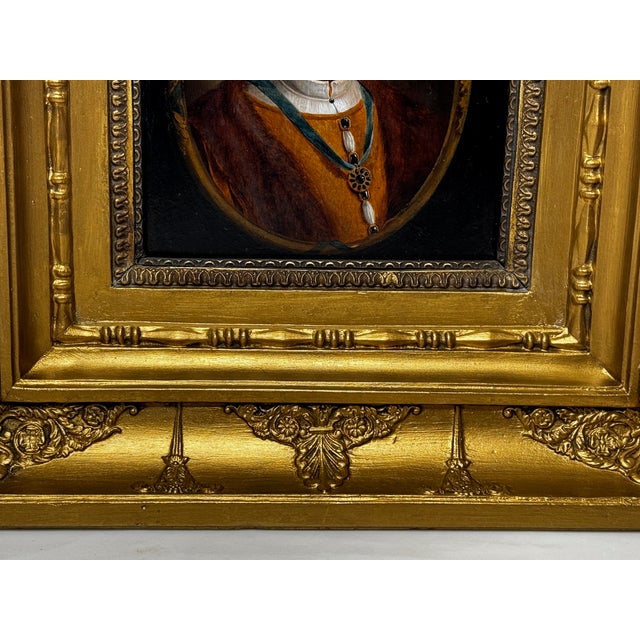
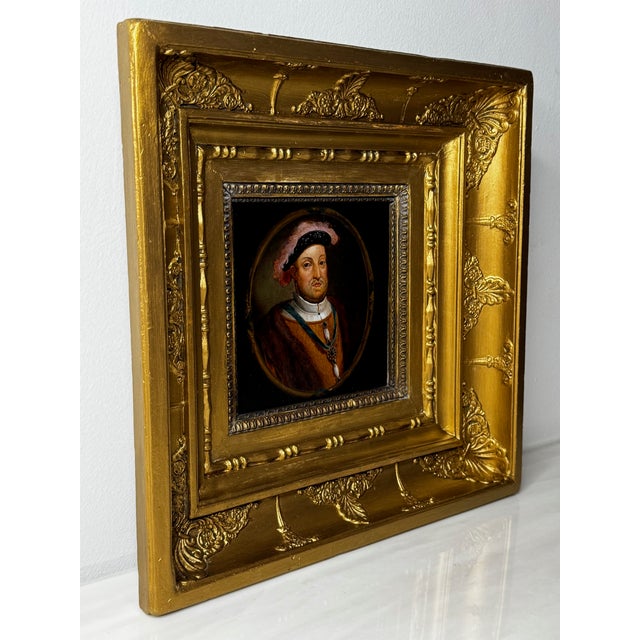
Presented in its original period 18th-century carved wooden gilt frame.
The frame retains its historic carved structure and has been recently overpainted in gilt. Age-related wear including small losses, cracking, chips, and historic repairs are visible and consistent with Georgian frames of this period.
Dimensions
Panel: 15 cm × 15 cm
Framed: 35 cm × 35 cm × 7 cm depth
Despite its intimate cabinet scale, the deep architectural frame gives the portrait strong decorative presence.
Provenance
Private German collection (early descriptive label on reverse)
Gorringes Auctioneers, Sussex – Fine Art and Interiors sale
Curated by Cheshire Antiques Consultant Ltd
Privately Loaned & Exhibited in the exhibition The Antiquarian King: Henry VIII and the Georgian Revival of Tudor Portraiture at the Famous Lord Hill Museum
The surviving German label provides evidence of historic continental ownership and adds documentary interest.
Why This Piece Stands Out
Classic Tudor royal portrait derived from the iconic Holbein prototype
18th-century Georgian antiquarian example
Oil painting executed on a single chamfered oak panel
Retains original 18th-century carved frame
Professionally conserved by Vanessa Andrew M.A., Fine Art Conservator based at Williamson Art Gallery
Exhibited in a Tudor revival style exhibition
Cross-collectible appeal for collectors of Tudor history, Georgian art, and royal portraiture
Jewel-like cabinet scale combined with a substantial architectural frame
Documented provenance including German collection history
Condition Report
Professional Conservation
The painting underwent professional conservation treatment in January 2026 by Vanessa Andrew M.A., Fine Art Conservator based at Williamson Art Gallery.
Treatment included:
Removal of surface dirt using 2% tri-ammonium citrate solution
Reduction and removal of aged varnish using propanol applied through Stoddard solvent
Removal of historic overpaint
Filling of paint losses using Mowiol G4-88 and whiting
Retouching using dry pigments dispersed in Paraloid B72
Application of Paraloid B72 varnish
Final protective MS2A varnish layer
Photographic documentation before, during, and after treatment accompanies the conservation report.
Panel Condition
The oak panel is structurally stable.
Age-consistent craquelure is present.
Historic paint losses have been professionally filled and retouched.
The paint surface is stable with no active flaking or panel movement.
Frame Condition
The original 18th-century carved wooden frame is structurally sound. Visible age-related wear includes gilt losses, surface cracking, small chips, and historic repairs. The frame has been recently overpainted in gilt while preserving the original carved structure.
A full digital copy of the January 2026 conservation treatment report is available upon request.
See less
- Dimensions
- 13.77ʺW × 2.75ʺD × 13.77ʺH
- Frame Type
- Framed
- Art Subjects
- Portrait
- Period
- Mid 18th Century
- Country of Origin
- United Kingdom
- Item Type
- Vintage, Antique or Pre-owned
- Materials
- Oak
- Oil Paint
- Condition
- Good Condition, Restored, Some Imperfections
- Color
- Beige
- Condition Notes
- Condition Report Professional Conservation The painting underwent professional conservation treatment in January 2026 by Vanessa Andrew M.A., Fine Art Conservator … moreCondition Report Professional Conservation The painting underwent professional conservation treatment in January 2026 by Vanessa Andrew M.A., Fine Art Conservator based at Williamson Art Gallery. Treatment included: Removal of surface dirt using 2% tri-ammonium citrate solution Reduction and removal of aged varnish using propanol applied through Stoddard solvent Removal of historic overpaint Filling of paint losses using Mowiol G4-88 and whiting Retouching using dry pigments dispersed in Paraloid B72 Application of Paraloid B72 varnish Final protective MS2A varnish layer Photographic documentation before, during, and after treatment accompanies the conservation report. Panel Condition The oak panel is structurally stable. Age-consistent craquelure is present. Historic paint losses have been professionally filled and retouched. The paint surface is stable with no active flaking or panel movement. Frame Condition The original 18th-century carved wooden frame is structurally sound. Visible age-related wear includes gilt losses, surface cracking, small chips, and historic repairs. The frame has been recently overpainted in gilt while preserving the original carved structure. A full digital copy of the January 2026 conservation treatment report is available upon request. less
Cheshire Antiques Consultant LTD
Chester, Cheshire West and Chester
Since 2021100+ sales
3x Super Seller
Questions about the item?
Returns & Cancellations
Return Policy - All sales are final 48 hours after delivery, unless otherwise specified in the description of the product.
Cancellation Policy - Prior to shipping or local pickup, buyers may cancel an order for up to 48 hours, unless otherwise specified.
Related Collections
- Photorealism Canvas Paintings
- Ed Ruscha Paintings
- Photorealism Paintings in New York
- Richard Serra Paintings
- Jo Baskerville Paintings
- Louise Nevelson Paintings
- Karen Offutt Paintings
- Nicola Simbari Paintings
- Herman Miller Paintings
- BDDW Paintings
- Jaanika Peerna Paintings
- Leroy Neiman Paintings
- Jeff Slemmons Paintings
- Vienna Secession Paintings
- Johannes Andersen Paintings
- Pedro Friedeberg Paintings
- Peter Behrens Paintings
- Piet Hein Eek Paintings
- Raphael Paintings
- Carl-Axel Acking Paintings
- Karl-Erik Ekselius Paintings
- Hans Andersen Paintings
- Jean-Paul Barray Paintings
- Cassina Paintings
- Soicher Marin Paintings