





Details
Description
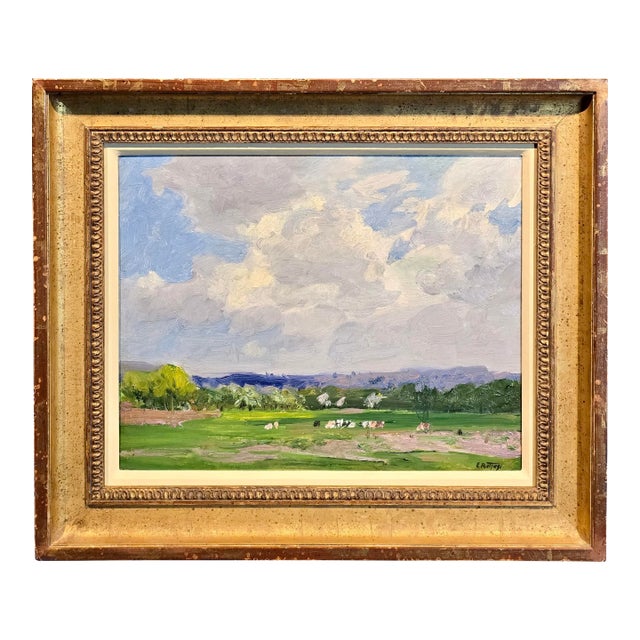
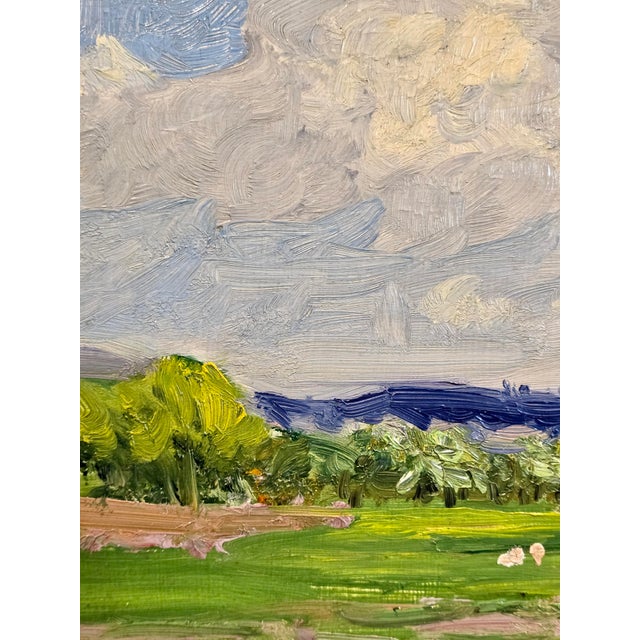
Edward Henry Potthast - Pastoral Landscape - Oil painting c.1910s
American Impressionist - Oil Painting on board - Signed - …
Read more
Edward Henry Potthast - Pastoral Landscape - Oil painting c.1910s
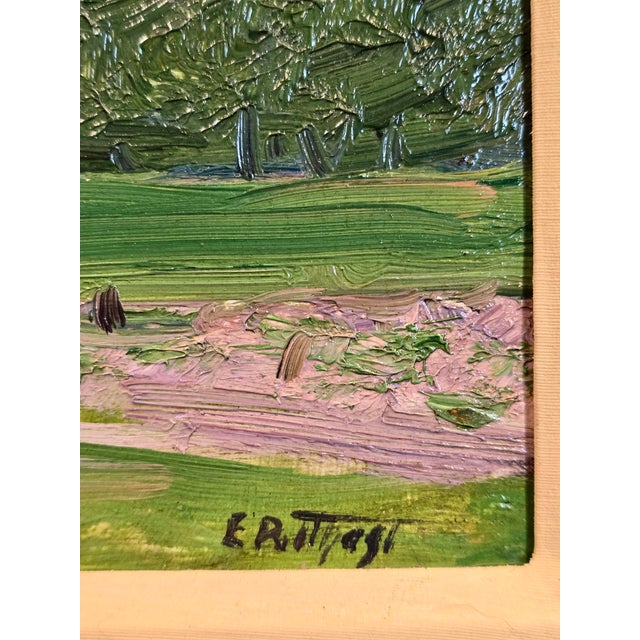
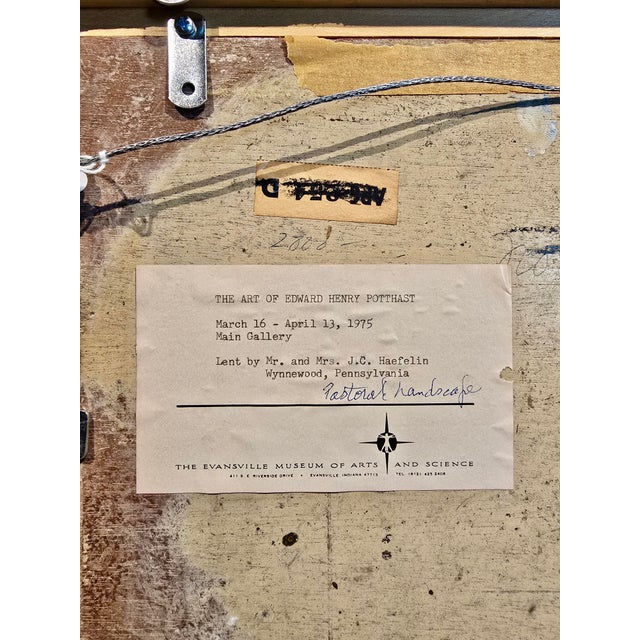
American Impressionist - Oil Painting on board - Signed - Gallery Label & Provenance in verso
board size 13x16" - Frame size: 18x21"
"Pastoral Landscape " created around the turn of the century c.1900s/1910s is a quintessential example of Edward Henry Potthast’s transitional and mature American Impressionist style. While he is most famous for his vibrant beach scenes, his rural landscapes like this one showcase his mastery of light and atmospheric effects.
a classic example of his en plein air style,
Exhibition History
As indicated by the label in verso the painting was included in "The Art of Edward Henry Potthast," held at the Evansville Museum of Arts and Science in Indiana from March 16 to April 13, 1975. This exhibition was a seminal event for the artist's legacy, bringing together significant works from various private and public collections.
Provenance and Identification
Lender: At the time of the 1975 show, the painting was lent by Mr. and Mrs. J.C. Haefelin of Wynnewood, Pennsylvania. The Haefelins were notable collectors of American Impressionism and owned several other major works by Potthast, including "At the Beach" and "In Central Park".
Title: The handwritten text identifies this specific work as "Pastoral Landscape" this label confirms the title used by its long-term private owners.
Significance for Collectors
Having a museum exhibition label from the 1975 Evansville retrospective is highly desirable for several reasons:Authenticity: It serves as strong evidence of the painting's authenticity, as it was vetted by museum curators and scholars over 50 years ago.
Valuation: Pieces with documented museum histories and prestigious previous owners (like the Haefelins) typically command higher prices in Galleries .
Catalogue Raisonné: This specific exhibition is often cited in the official research for the upcoming Potthast Catalogue Raisonné (a comprehensive list of all known works by the artist) currently being compiled by scholar Mary Ran
Composition and Subject Matter
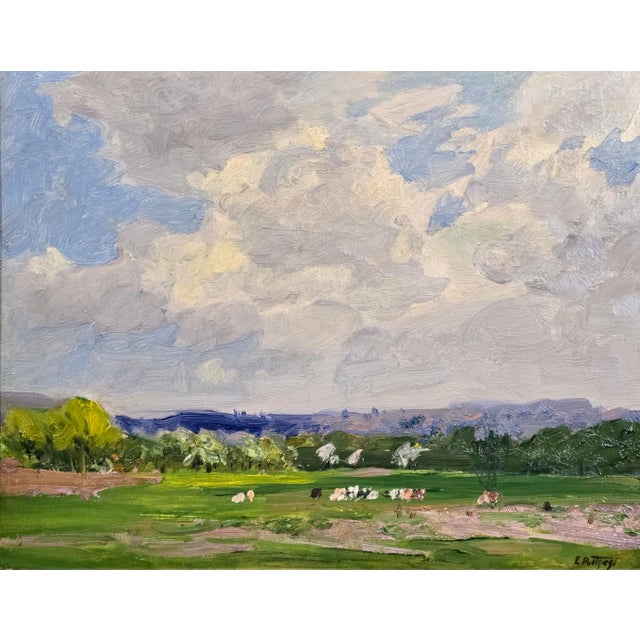
The painting is divided into three distinct horizontal zones, with the expansive sky occupying more than two-thirds of the canvas:
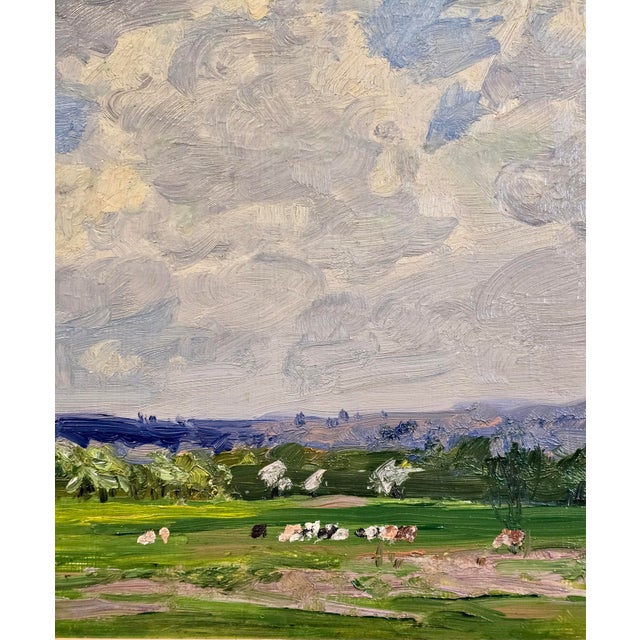
The Sky: The dominant feature of the work is a dynamic, high-reaching sky filled with voluminous, soft-edged white and grey cumulus clouds. Hints of a pale blue sky peek through the formations, suggesting a bright, breezy day.
The Midground: A low-lying ridge of dark blue and purple hills creates a soft boundary between the earth and sky. Below this, a dense line of lush green and flowering white trees stretches across the horizon.
The Foreground: A vibrant green meadow takes up the lower third of the piece. In the center, a small herd of cows is depicted with minimal, gestural brushstrokes, appearing as dabs of white, brown, and black.
Artistic Style and Technique
Potthast’s Impressionist roots are evident in his technique:
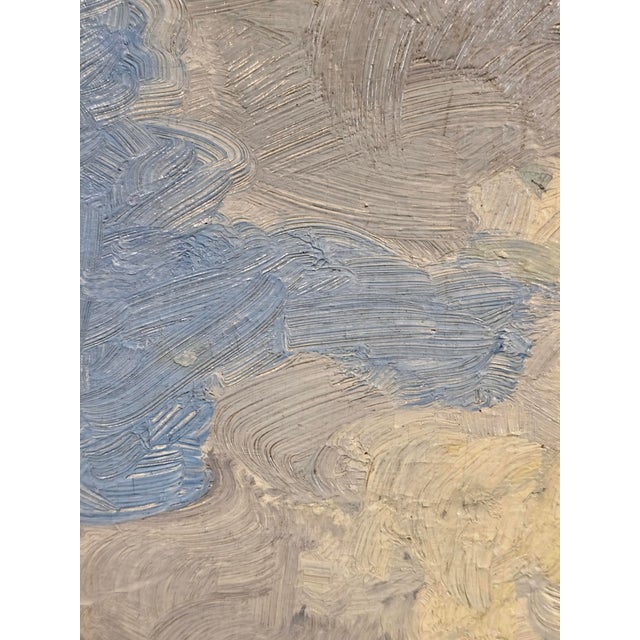
Brushwork: The artist uses visible, energetic brushstrokes that give the scene a sense of movement. The clouds are rendered with thick, impasto-like applications, while the grass is created with horizontal, sweeping strokes.
Color Palette: The palette is bright and naturalistic, dominated by verdant greens, various shades of blue, and bright whites. The subtle use of purples and pinks in the landscape adds depth and suggests the play of light and shadow.
Light: The painting feels filled with "Summer Light," a hallmark of Potthast's work. The bright whites of the clouds and the grazing cattle suggest a high, overhead sun.
Presentation
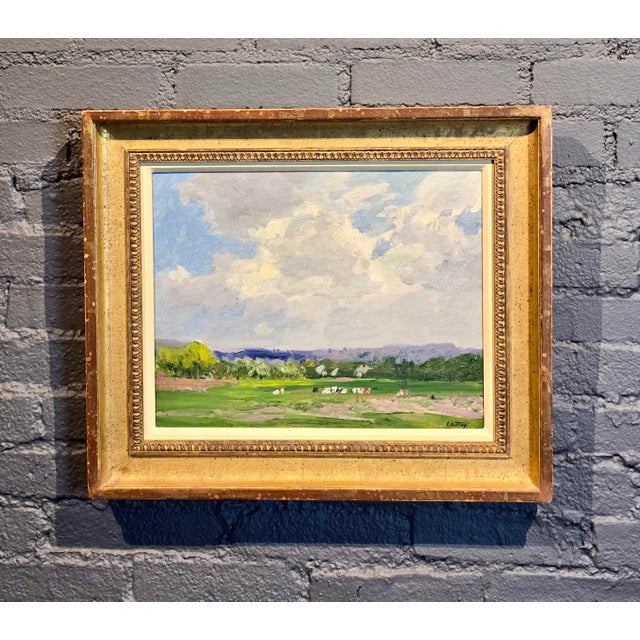
The painting is housed in an ornate, gilded gold frame featuring intricate floral or scrolled patterns. This traditional framing contrasts with the loose, modern feel of the Impressionist brushwork, emphasizing the artwork's status as a classic piece of American fine art.
Artist Biography
Born in Cincinnati to a family of artisans, Edward Henry Potthast (1857–1927) became one of the most beloved figures of American Impressionism. His career followed a classic trajectory of 19th-century American artists—evolving from rigorous European training to a sun-drenched, uniquely American style.
Early Years and Education
Artistic Roots: At just twelve, Potthast was a charter student at the McMicken School of Design (now the Art Academy of Cincinnati).
The Lithographer's Trade: For over twenty years, he supported himself as a commercial lithographer. This technical background instilled a disciplined work ethic and an eye for composition that would later define his fine art.
European Training: In his thirties, he traveled to Europe, studying at the Royal Academy in Munich and the Académie Julian in Paris. His early style was marked by the Munich School's dark tones and dramatic "chiaroscuro" (light and shadow).
Transformation into Impressionism
The French Influence: Around 1889, while in the French art colony of Grez-sur-Loing, Potthast encountered the work of Robert Vonnoh and French Impressionists. This exposure led to an "immediate and irrevocable" shift toward a lighter, more vibrant palette and broken brushwork.
The Move to New York: In 1895, Potthast settled in New York City, where he established a studio in the famous Gainsborough Building overlooking Central Park.
Mature Style and Legacy
The "Painter of Leisure": Potthast became famous for portraying the Gilded Age's spirit of leisure. His signature works include sun-saturated scenes of families at Coney Island, children wading in the surf, and boaters in Central Park.
Quiet Master: Despite his public success and membership in the National Academy of Design, Potthast was an intensely private bachelor who "died at his easel" in his studio at age 69.
Historical Significance: Today, he is celebrated for capturing a specific moment of American optimism and harmony before the complexities of modernism took hold
See less
- Dimensions
- 21ʺW × 2ʺD × 18ʺH
- Styles
- American
- Impressionist
- Frame Type
- Framed
- Art Subjects
- Landscape
- Period
- 1910s
- Country of Origin
- United States
- Item Type
- Vintage, Antique or Pre-owned
- Materials
- Oil Paint
- Wood
- Condition
- Good Condition, Original Condition Unaltered, Some Imperfections
- Color
- Sky Blue
- Condition Notes
- Excellent - Minor wear consistent with age and history Excellent - Minor wear consistent with age and history less
Questions about the item?
Returns & Cancellations
Return Policy - All sales are final 48 hours after delivery, unless otherwise specified in the description of the product.
Cancellation Policy - Prior to shipping or local pickup, buyers may cancel an order for up to 48 hours, unless otherwise specified.
Related Collections
- Lee Krasner Paintings
- Steve Kaufman Paintings
- Richard Anuszkiewicz Paintings
- Limoges, France Paintings
- Paintings in Panama City, FL
- Margaret Kennedy Paintings
- Keith Haring Paintings
- Laminate Paintings
- Jacobean Paintings
- Mark Lewis Art Paintings
- Mark Lewis Paintings
- Louis Wolchonok Paintings
- Joseph Solman Paintings
- Nikolaos Schizas Paintings
- Michelle Arnold Paine Paintings
- Damien Hirst Paintings
- Sol LeWitt Paintings
- Donald Judd Paintings
- BandB Italia Paintings
- Ralph Lauren Paintings
- Vienna Secession Paintings
- Camille Pissarro Paintings
- Paul Jenkins Paintings
- Lee Reynolds Paintings
- Mid-Century Modern Paintings