

Details
Description
Dimensions board backing is 2 X 18.5 board opening is 16.5 X 13 inches
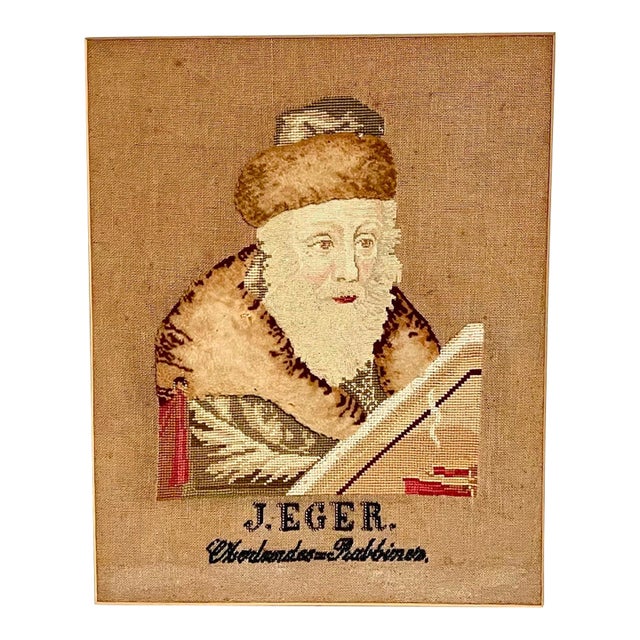
19th Century framed tapestry of a …
Read more
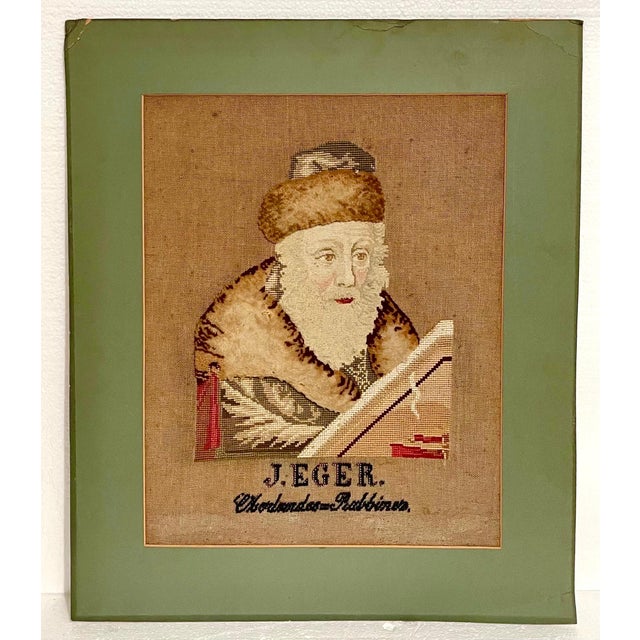
Dimensions board backing is 2 X 18.5 board opening is 16.5 X 13 inches
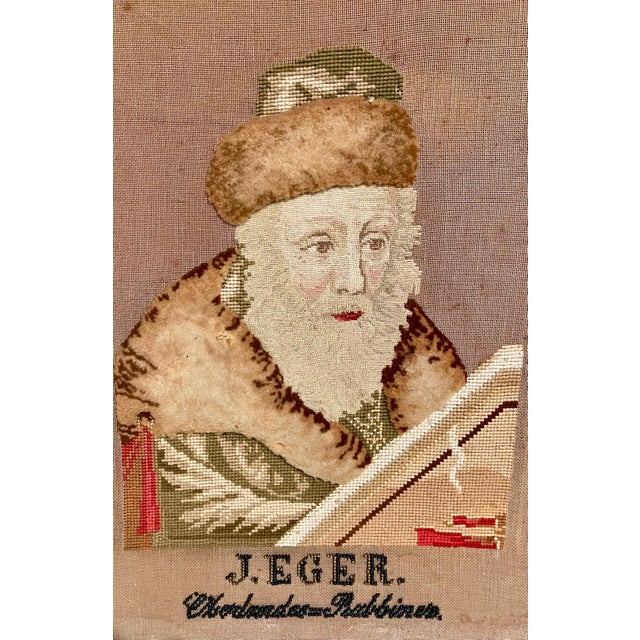
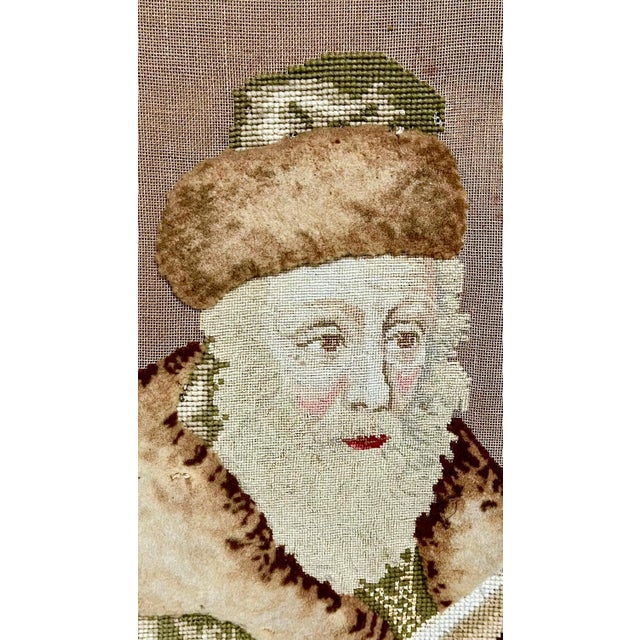
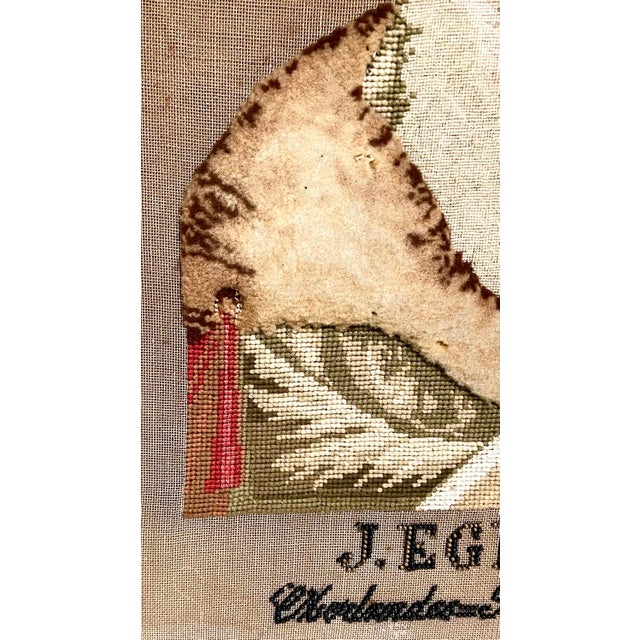
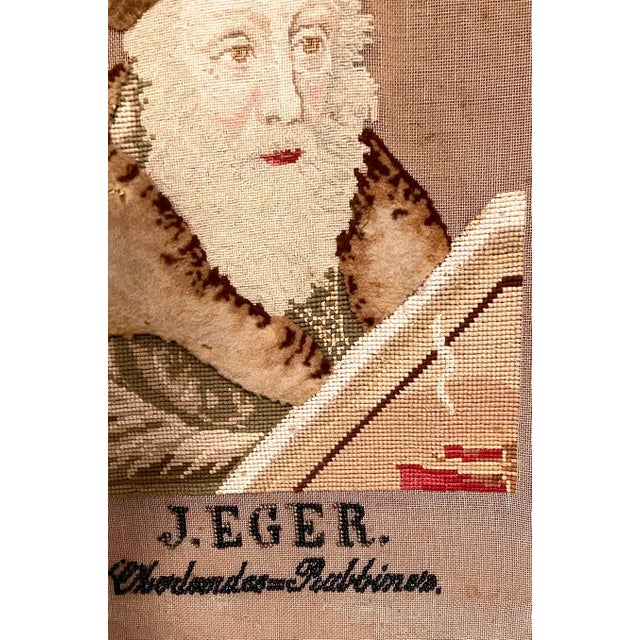
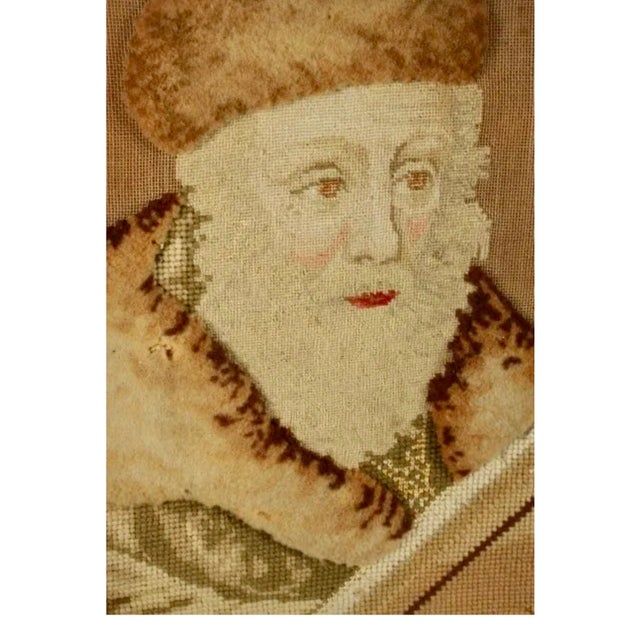
19th Century framed tapestry of a Rabbi, embroidered sampler, with beaded script below. (it reads J. Eger Oberlandes Rabbiner or Oberlander Rabbiner) There is some sort of texture and dimension to his fur hat (Shtreimel) and coat collar. This is being sold without the frame..
Rabbi Akiba Eger (5521-5598; 1761-1838)
Rabbi Akiba Eger was one of the greatest scholars of his time, who had a great influence on Jewish life. He was born in Eisenstadt, Hungary, in the year 5521 (1761), nearly two hundred years ago. The city of his birth was a seat of learning for centuries, and his family was a family of scholars and Rabbis.Rabbi Akiba Eger, who was Rabbi in the famous community of Pressburg (also Hungary, but since 1913 it belonged to Czechoslovakia and was called Bratislava). He was invited to become Rabbi of the famous city of Posen, and in fact became the chief rabbi of the entire Posen province, though he did not carry that title. His famous son-in-law, Rabbi Moshe Sofer (known as the 'Chasam Sofer'), Rabbi of Pressburg, who had married Rabbi Akiba Eger's daughter. King Frederick III of Prussia honored him with a special medal. Rabbi Akiba Eger was recognized as a great authority on Jewish law, and many well known rabbis and Jewish leaders turned to him for advice and decisions on points of law.
"This sort of art, craft work, emerges from a long tradition of Jewish folk art.
Today, many of these artists are professionally trained and bring a fine arts sensibility to their Judaica work. This is a relatively new phenomenon. Only in the last few centuries have Jewish artists trained in the fine arts. For the greater part of Jewish history, most Judaica artists were untrained, and their art was not their life’s work, but was simply one form of devotion to God. Known today as “Jewish folk art,” the tradition of Jewish visual expression includes paper-cutting, creation of the mizrach and shivitti (two forms of decorative signs), and the art of micography (using words to create images). Looking with contemporary eyes at these primarily self-taught forms of expression offers inspiration and assurance that the visual arts hold a prominent place in Jewish civilization.
At first glance, any work of “folk art” may at first seem childish or naive; what makes it great art is that at second glance, the art reveals depth and substance. Jewish paper cutting was, for centuries, more or less of a hobby of a primarily male, religious population. These men, and women, included rabbis, yeshiva teachers, and students, people who had time to use their hands even as they focused on study and discussion.
Paper-cutting was an inexpensive art — no fancy materials were needed, just a scrap of paper, a pencil, a knife. At the same time, some artists used more expensive materials, such as parchment, resulting in paper-cut art better able to be preserved. The tradition of Jewish paper-cutting was borrowed by the Jews of the Middle Ages’ Christian and Muslim neighbors. It can be traced as far back as the 14th century, and it continued to play a major cultural role in Jewish tradition through the 19th and early 20th centuries.s
The craft takes a simple art–cutting paper to create a design (think of making a snowflake in grade school)–and transforms it into an expression of devotion. The artist would take a line of text, from Psalms, for instance, and would strive to bring the imagery of the text alive in the paper-cut.
As time went on, paper-cutting became more esteemed, and soon paper-cut designs became connected with certain lifecycle events and holidays. Artists used paper-cutting to illustrate ketubot (marriage contracts), for example, and would create certain designs for the Jewish festivals of Sukkot and Shavuot. While Jewish literary tradition focused on the importance of words, the folk art tradition brought visual representations of words and ideas to life.
Artists often used paper-cutting to create a mizrach (which literally means “east”). The mizrach was a wall hanging for the most eastern wall of the Jewish home, reminding them which way to face while praying–toward Jerusalem–and directing the family’s thoughts to that holy city during prayer. In Eastern Europe, the mizrach was frequently an object not just of devotion, but also of beauty. Elaborate mizrachim (plural of mizrach), created by paper-cutting techniques adorned many Jewish homes. Though the intention of the mizrach was to serve a simple, religious function, the art of the mizrach shows the high regard that was paid to good craftsmanship and beautiful aesthetic sense. Many mother and Jewish woman made a wimpel for their children's births. Another example of Jewish folk art, dating back to the Middle Ages, was the creation of the shiviti (meaning “awareness.”). Similar to the mizrach in that its function was to focus attention, the shivviti would hang in the synagogue. Inspired by a line from Psalms, “Shivitti Adonai Lanegdi Tamid”– I am ever aware of the Eternal One’s presence”–the shivviti employed the Hebrew letters “yud, hay, vav, hay” which together symbolize God’s name. It is interesting to note that while it was forbidden to try to utter the name of God, the shivviti used these letters in an artistic design to represent God’s presence. The shivviti might include other Biblical phrases or lines from Psalms, but the focus of its design was always the letters “yud, hay, vav, hay.” The shivviti, like the mizrach, was often created by paper-cutting, although examples of shivviti created by embroidery, drawing, and other media do exist. (Credit: My jewish Learning)
See less
- Dimensions
- 18.5ʺW × 1ʺD × 22ʺH
- Styles
- Folk Art
- Period
- 1900 - 1909
- Country of Origin
- United States
- Item Type
- Vintage, Antique or Pre-owned
- Materials
- Mixed-Media
- Wool
- Condition
- Good Condition, Original Condition Unaltered, Some Imperfections
- Color
- Brown
- Condition Notes
- Good wear commensurate with age. with some minor toning, staining. needs new mounting. mat has wear. Good wear commensurate with age. with some minor toning, staining. needs new mounting. mat has wear. less
Questions about the item?
Returns & Cancellations
Return Policy - All sales are final 48 hours after delivery, unless otherwise specified in the description of the product.
Cancellation Policy - Prior to shipping or local pickup, buyers may cancel an order for up to 48 hours, unless otherwise specified.
Related Collections
- Cashmere Textile Art
- Rug and Kilim Textile Art
- Textile Art in Santa Fe
- Workaday Handmade Textile Art
- Louis XIII Textile Art
- Hair on Hide Textile Art
- Cork Textile Art
- Old New House Textile Art
- Chanel Textile Art
- Antique Gold Finish Textile Art
- Edwardian Textile Art
- Mid-Century Modern Textile Art
- Framed Scarves
- Tapestry
- Chinese Textile Art
- Japanese Textile Art
- Scandinavian Textile Art
- Aubusson Tapestry
- Brutalist Textile Art
- Märta Måås-Fjetterström Textile Art
- Space Age Textile Art
- Cardboard Textile Art
- Surrealism Textile Art
- Asian Style Textile Art