

Details
Description
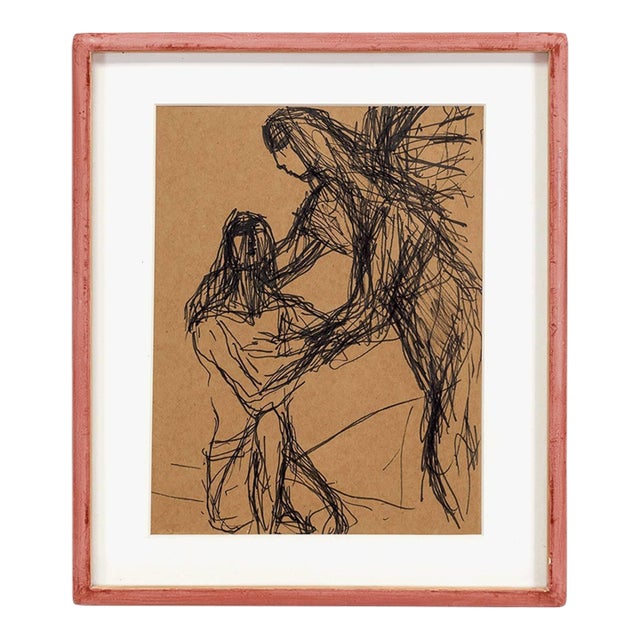
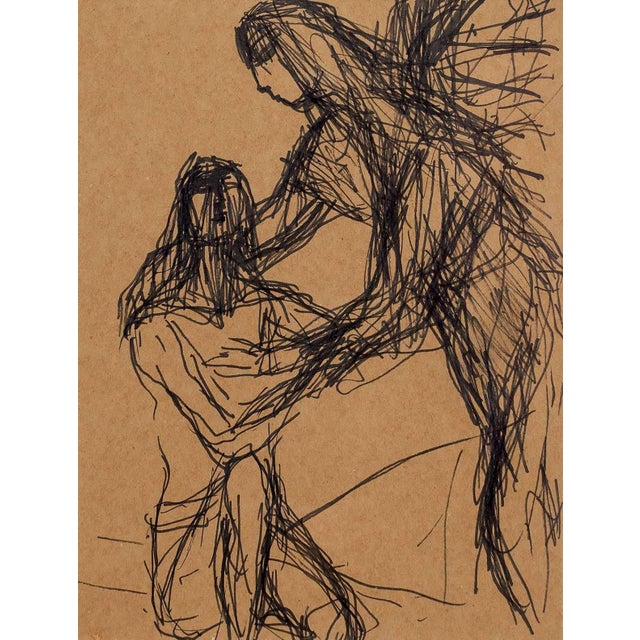
Genre: Expressionist
Subject: Figures
Medium: Ink
Surface: Paper
Dimensions w/Frame: 14 1/4" x 12 1/4"
Zygmunt (Sigmund) Menkes
born in …
Read more
Genre: Expressionist
Subject: Figures
Medium: Ink
Surface: Paper
Dimensions w/Frame: 14 1/4" x 12 1/4"
Zygmunt (Sigmund) Menkes
born in Lviv (Galicia, Austro-Hungarian Empire) Polish painter of Jewish origin, born in 1896 in Lvov, died in 1986 in Riverdale, New York. Member of the École de Paris group in the 1920s and 1930s. From the beginning of 1935 he lived and worked in the United States; he was a representative of the Expressionist Colorism movement.
Menkes began his artistic studies in 1912 at the Industrial School in Lviv. At the same time he worked as a restorer of rural churches. Between 1919 and 1922 he supplemented his studies at Krakow's Academy of Fine Arts and in 1922 expanded on this education and broadened his artistic skills in the private studio of Alexander Archipenko in Berlin. In 1923 Menkes settled in Paris, where he became a member of the École de Paris - a community that was primarily made up of artists hailing from Central and Eastern Europe who rented inexpensive studios in the "La Ruche" building in the Montparnasse district. Menkes developed close friendships with Eugeniusz Zak and Marc Chagall. Two years later, Menkes made the decision to settle permanently in France. He participated in a series of the city's salons, including the Salon d'Automne (1924, 1925, 1927), the Salon des Independants (1925-1928), and Tuileries Salon (1928, 1929, 1931, 1938). He presented his works in a number of Parisian galleries, among them, the Bernheim, de France, and Le Portique. In 1930 the artist traveled to the United States to present his work in Cleveland and New York. He also exhibited his paintings in Canada and England. He visited Poland frequently, spent time in Berlin in 1928, and toured Spain with Artur Nacht-Samborski in 1935, moving to the United States the same year.
In 1936 Menkes had his first solo exhibition in New York at the Sullivan Gallery on 57th Street. He also worked with the Associated American Artists Gallery and the French Art Gallery, and for years was a lecturer at the Art Students League. Solo exhibitions of his work were organized by the Galerie Le Portique in Paris (1928), the Friends of Fine Arts Society in Lviv (1930), and at the Jewish Society for Support of the Fine Arts in Warsaw (1931). In Poland the artist was a member of groups with a Coloristic orientation, including Nowa Generacja (New Generation) and Zwornik (Keystone), participating in their exhibitions in Lviv (1932, 1935) and Warsaw (1935, 1938). Menkes received a series of important distinctions for his work, including the Carol H. Beck Medal of the Pennsylvania Academy of Fine Arts (Philadelphia, 1943), the Gold Medal of the Corcoran Gallery (Washington, D.C., 1947), the Andrew Carnegie Award of the National Academy of Design (New York, 1955), and the Alfred Jurzykowski Award (New York, 1967).
Menkes's repertoire included figural compositions, portraits, nudes, still lifes, and landscapes. Early in his career his paintings exhibited a Fauvist aesthetic. Menkes's creative stance was especially strongly influenced by the work of Henri Matisse. Women depicted in interiors were a frequent motif; their approximated shapes were surrounded by fluid, bending contour lines that at times broke free of the color areas they surrounded. There was a decorative value in his canvasses, deriving from the inclusion of various fabric and wallpaper designs in the composition. Menkes also frequently painted scenes from the lives of the Jewry, depicting religious rituals and rabbis penetrating the words of the Torah. With time he intensified the expressiveness of his paintings, using only color patches to build forms, placing paint on canvas quickly and spontaneously. The artist's signature, signed with vigor in vermilion red, was also an important element in the structure of his compositions. Menkes's works of the late 1920s and the 1930s are compared with Chaim Soutine's Expressionistic formulas of representation. The artist drew his iconography from the Bible, saturating his religious scenes with nostalgia (Ecce Homo). His landscapes, painted in provincial towns and the mountains of southern France, emanate sensuality and demonstrate the artist's extreme sensitivity for the qualities of color and light. Menkes also created a moving series of World War II paintings depicting Jews enclosed in the Warsaw Ghetto and murdered there by the Nazis. These works were distinct for their washed out dominant blues and grays. In time the artist began to paint increasingly complicated configurations of lines, thickened line configurations, and richly textured planes. His expansive still lifes and interior scenes - often depicting the artist's studio in Riverdale, New York - were composed of balanced, multi-directional configurations of lines. Figures and objects were melded ever more precisely with backgrounds, while his color schemes, dominated by hues of blue, black and white, evoked nostalgia. Lively accents were restricted to small patches of pink and yellow. In his later works, which bordered on abstract allusions, we encounter a radical turn towards geometric forms painted in a range of intense, strong, contrasting colors. In addition to painting oils on canvas, Menkes produced gouaches, watercolors, and drawings. He also created a series of sculptures, primarily during a prolonged visit to Italy with Jacques Lipchitz.
The work of Mr. Menkes, an Expressionist, won many awards and hangs in major art institutions and private collections, including the recently closed Museum of the Jeu de Paume in Paris; the Philadelphia Museum of Art; the Whitney Museum in Manhattan; the Wichita (Kan.) Museum; the Newark Museum; the Corcoran Museum in Washington; the Cranbrook Academy in Detroit; the Jewish Museum in Manhattan; the Betsalel Museum in Jerusalem, and the Tel Aviv Museum.
Among the awards he received were the Clark Prize of the Corcoran Gallery, in 1941; the Carol H. Beck Medal of the Pennsylvania Academy, in Philadelphia, in 1943; the Andrew Carnegie award from the National Academy of Design, in Manhattan, in 1955, and the National Academy award for foreign painters, in 1963.
See less
- Dimensions
- 12.25ʺW × 1ʺD × 14.25ʺH
- Styles
- Expressionism
- Frame Type
- Framed
- Art Subjects
- Figure
- Period
- Mid 20th Century
- Country of Origin
- United States
- Item Type
- Vintage, Antique or Pre-owned
- Materials
- Pen and Ink
- Condition
- Good Condition, Original Condition Unaltered, Some Imperfections
- Color
- Gold
- Condition Notes
- Good frame has some wear. Good frame has some wear. less
Questions about the item?
Returns & Cancellations
Return Policy - All sales are final 48 hours after delivery, unless otherwise specified in the description of the product.
Cancellation Policy - Prior to shipping or local pickup, buyers may cancel an order for up to 48 hours, unless otherwise specified.