

Details
Description
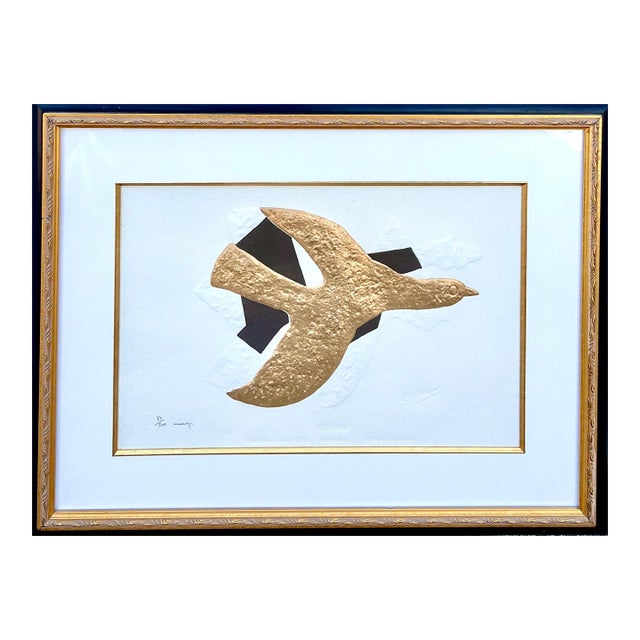
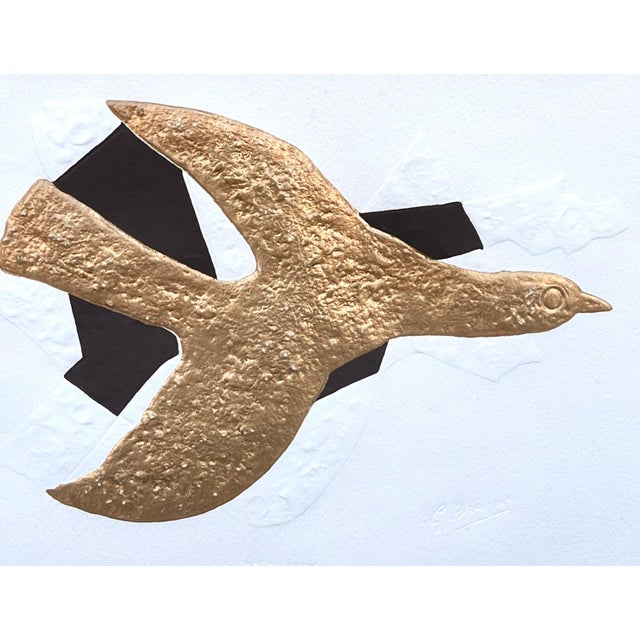
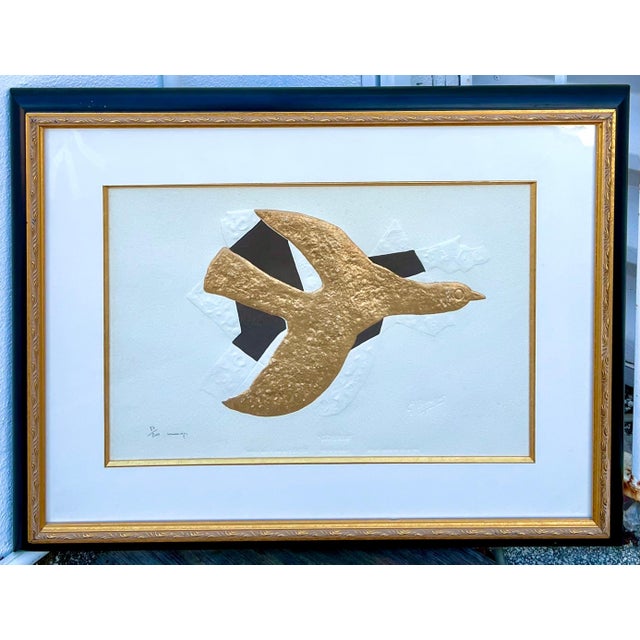
Embossed print after Braque, based on his sculpture by the same name.
Embossed in the print paper is "'Cephale', Hommage …
Read more
Embossed print after Braque, based on his sculpture by the same name.
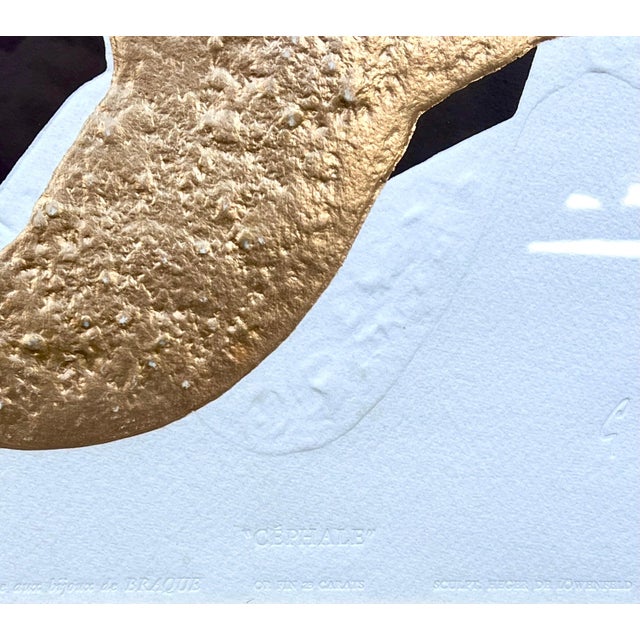
Embossed in the print paper is "'Cephale', Hommage aux bijoux de braque, or fin 23 carat, sculpt heger de Lowenfeld" ("tribute to Braque jewelry, 23 carat fine gold, sculpture, Heger de Lowenfeld").
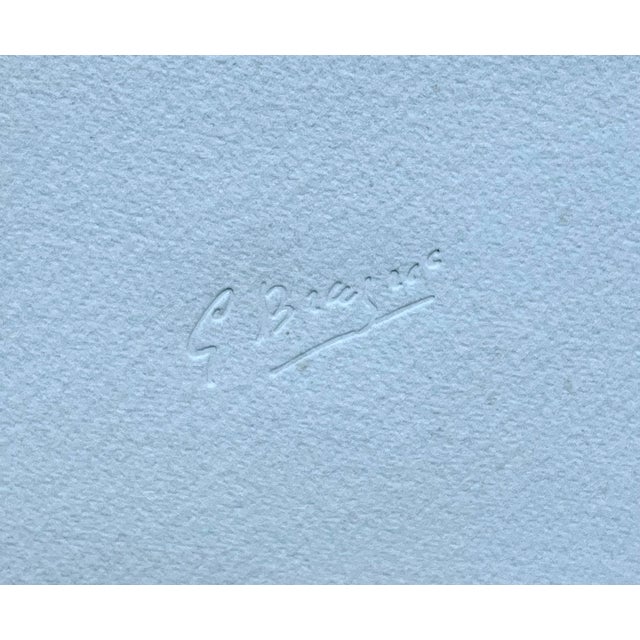
The Print is signed in embossing "G. Braque" for Georges Braque.
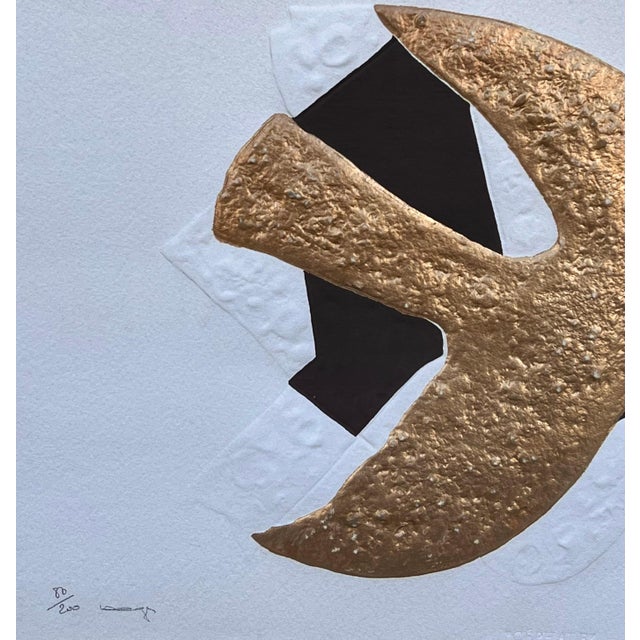
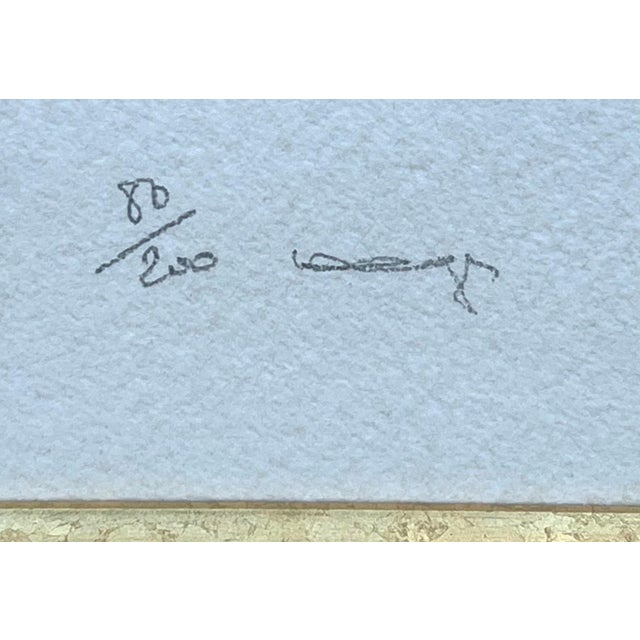
The Work is numbered, "80/200" and hand signed "Lowenfeld" in lower left in pencil.
The Print is deeply embossed, and the bird is in gold leaf.
Sight area measures 13 1/2" x 20 1/2", while the Frame measures 23 1/2' x 30"
After Georges Braque (French, 1882-1963)
Lithograph on embossed etching paper, gilt and fine gold leaf sculpture by Georges Braque. numbered in pencil and Pencil Signed by Heger de Loewenfeld. embossed in the paper is the signature "G Braque" below image at right, also embossed in the paper is the title at bottom center; also embossed along bottom edge: "Hommage aux bijoux de BRAQUE," "OR FIN 23 CARATS," "SCULPT. HEGER DE LOWENFELD".
From the suite "Hommage aux bijoux de Braque" created to commemorate a series of Braque Jewelry, which were created in gold with enamel by the same atelier that made these embossed prints. With titles from Greek mythology. limited edition of 200. on heavy deckle edged, mould made paper.
22 x 15 in. (55.88 x 38.1 cm.).
Georges Braque was a major 20th-century French painter, collagist, draughtsman, printmaker and sculptor. His most important contributions to the history of art were in his alliance with Fauvism from 1906, and the role he played in the development of Cubism. Braque’s work between 1908 and 1912 is closely associated with that of his colleague Pablo Picasso. He grew up in Le Havre and trained to be a house painter and decorator like his father and grandfather. However, he also studied artistic painting during evenings at the École des Beaux-Arts, in Le Havre, from about 1897 to 1899. In Paris, he apprenticed with a decorator and was awarded his certificate in 1902. The next year, he attended the Académie Humbert, also in Paris, and painted there until 1904. It was here that he met Marie Laurencin and Francis Picabia.
Braque's earliest works were impressionistic, but after seeing the work exhibited by the artistic group known as the "Fauves" (Beasts) in 1905, he adopted a Fauvist style. The Fauves, a group that included Henri Matisse and André Derain among others, used brilliant colors to represent emotional response. Braque worked most closely with the artists Raoul Dufy and Othon Friesz, who shared Braque's hometown of Le Havre, to develop a somewhat more subdued Fauvist style. In 1906, Braque traveled with Friesz to L'Estaque, to Antwerp, and home to Le Havre to paint.
In May 1907, he successfully exhibited works of the Fauve style in the Salon des Indépendants. The same year, Braque's style began a slow evolution as he became influenced by Paul Cézanne who had died in 1906 and whose works were exhibited in Paris for the first time in a large-scale, museum-like retrospective in September 1907. The 1907 Cézanne retrospective at the Salon d'Automne greatly affected the avant-garde artists of Paris, resulting in the advent of Cubism.
Beginning in 1909, Braque began to work closely with Pablo Picasso who had been developing a similar proto-Cubist style of painting. At the time, Pablo Picasso was influenced by Gauguin, Cézanne, African masks and Iberian sculpture while Braque was interested mainly in developing Cézanne's ideas of multiple perspectives. During his recovery he became a close friend of the cubist artist Juan Gris. He continued to work during the remainder of his life, producing a considerable number of paintings, graphics, and sculptures. Braque, along with Matisse, is credited for introducing Pablo Picasso to Fernand Mourlot, and most of the lithographs and book illustrations he himself created during the 1940s and '50s were produced at the Mourlot Studios.
Braque died on 31 August 1963 in Paris. He is buried in the cemetery of the Church of St. Valery in Varengeville-sur-Mer, Normandy whose windows he designed. Braque's work is in most major museums throughout the world.
On 20 May 2010, the Musée d'Art Moderne de la Ville de Paris reported the overnight theft of five paintings from its collection. The paintings taken were Le pigeon aux petits pois (The Pigeon with the Peas) by Pablo Picasso, La Pastorale by Henri Matisse, L'Olivier Près de l'Estaque (Olive Tree near Estaque) by Georges Braque, La Femme à l'Éventail (fr) (Woman with a Fan) by Amedeo Modigliani and Nature Morte aux Chandeliers (Still Life with Chandeliers) by Fernand Léger and were valued at €100 million ( $123 million USD). A window had been smashed and CCTV footage showed a masked man taking the paintings. Authorities believe the thief acted alone. The man carefully removed the paintings from their frames, which he left behind. Georges Braque was a major 20th-century French painter, collagist, draughtsman, printmaker and sculptor. His most important contributions to the history of art were in his alliance with Fauvism from 1906, and the role he played in the development of Cubism. Braque’s work between 1908 and 1912 is closely associated with that of his colleague Pablo Picasso. He grew up in Le Havre and trained to be a house painter and decorator like his father and grandfather. However, he also studied artistic painting during evenings at the École des Beaux-Arts, in Le Havre, from about 1897 to 1899. In Paris, he apprenticed with a decorator and was awarded his certificate in 1902. The next year, he attended the Académie Humbert, also in Paris, and painted there until 1904. It was here that he met Marie Laurencin and Francis Picabia.
Braque's earliest works were impressionistic, but after seeing the work exhibited by the artistic group known as the "Fauves" (Beasts) in 1905, he adopted a Fauvist style. The Fauves, a group that included Henri Matisse and André Derain among others, used brilliant colors to represent emotional response. Braque worked most closely with the artists Raoul Dufy and Othon Friesz, who shared Braque's hometown of Le Havre, to develop a somewhat more subdued Fauvist style. In 1906, Braque traveled with Friesz to L'Estaque, to Antwerp, and home to Le Havre to paint. In May 1907, he successfully exhibited works of the Fauve style in the Salon des Indépendants. The same year, Braque's style began a slow evolution as he became influenced by Paul Cézanne who had died in 1906 and whose works were exhibited in Paris for the first time in a large-scale, museum-like retrospective in September 1907. The 1907 Cézanne retrospective at the Salon d'Automne greatly affected the avant-garde artists of Paris, resulting in the advent of Cubism.
Beginning in 1909, Braque began to work closely with Pablo Picasso who had been developing a similar proto-Cubist style of painting. At the time, Pablo Picasso was influenced by Gauguin, Cézanne, African masks and Iberian sculpture while Braque was interested mainly in developing Cézanne's ideas of multiple perspectives. During his recovery he became a close friend of the cubist artist Juan Gris. He continued to work during the remainder of his life, producing a considerable number of paintings, graphics, and sculptures. Braque, along with Matisse, is credited for introducing Pablo Picasso to Fernand Mourlot, and most of the lithographs and book illustrations he himself created during the 1940s and '50s were produced at the Mourlot Studios.
Braque died on 31 August 1963 in Paris. He is buried in the cemetery of the Church of St. Valery in Varengeville-sur-Mer, Normandy whose windows he designed. Braque's work is in most major museums throughout the world.
On 20 May 2010, the Musée d'Art Moderne de la Ville de Paris reported the overnight theft of five paintings from its collection. The paintings taken were Le pigeon aux petits pois (The Pigeon with the Peas) by Pablo Picasso, La Pastorale by Henri Matisse, L'Olivier Près de l'Estaque (Olive Tree near Estaque) by Georges Braque, La Femme à l'Éventail (fr) (Woman with a Fan) by Amedeo Modigliani and Nature Morte aux Chandeliers (Still Life with Chandeliers) by Fernand Léger and were valued at €100 million ( $123 million USD). A window had been smashed and CCTV footage showed a masked man taking the paintings. Authorities believe the thief acted alone. The man carefully removed the paintings from their frames, which he left behind. This is similar to the suite "Hommage aux bijoux de Braque" by Heger de Lowenfeld. Created to commemorate a series of Braque Jewelry, which were created in gold with enamel by the same atelier that made these embossed intaglio prints. With titles from Greek mythology. in 1961 Georges Braque decided with his lapidary friend Heger de Loewenfeld to pick up certain of his works to in order to create artworks. Armand and Georges Israel, publishers.
See less
Questions about the item?
Returns & Cancellations
Return Policy - All sales are final 48 hours after delivery, unless otherwise specified in the description of the product.
Cancellation Policy - Prior to shipping or local pickup, buyers may cancel an order for up to 48 hours, unless otherwise specified.
Related Collections
- Gustave Baumann Original Prints
- Dye Transfer Original Prints
- Louis XIII Original Prints
- Johannes Kip Original Prints
- Medium-Density Fibreboard Original Prints
- Original Prints in Lexington, KY
- Soicher Marin Original Prints
- Rattan Original Prints
- Silver Finish Original Prints
- Sam Francis Original Prints
- Robert Kipniss Original Prints
- Botanical Prints
- Framed Prints
- Bird Prints
- Woodblock Prints
- Screen Prints
- Japanese Woodblock Prints
- Thomas McKnight Original Prints
- Frank Stella Original Prints
- George Barbier Original Prints
- Teak Original Prints
- Chaim Gross Original Prints