

Details
Description
Regency Revival: Herculaneum Neo-Classical Greek Pattern Printed Dish
________________________________________
This is an impressive English Transfer-Printed Dish from the Herculaneum Pottery …
Read more
Regency Revival: Herculaneum Neo-Classical Greek Pattern Printed Dish
________________________________________
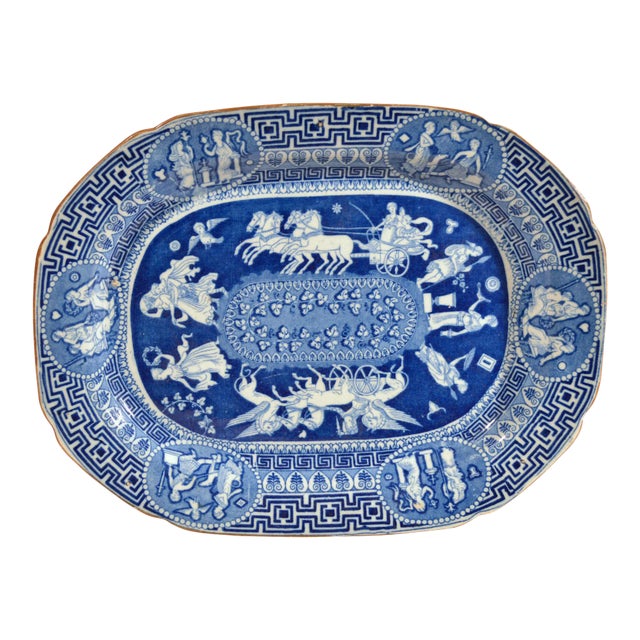
This is an impressive English Transfer-Printed Dish from the Herculaneum Pottery of Liverpool, dating to the height of the Greek Revival style. The piece showcases a densely packed and dramatic neoclassical scene executed in a deep, vibrant underglaze blue.
• Pattern: Known simply as the "Greek" pattern (or sometimes "Etruscan"), the central portion features a continuous series of vignettes inspired by ancient Greek vase painting.
• Central Motifs: The primary scenes include:
o A Grand Chariot: Three female figures riding a chariot drawn by five powerful horses, representing a classical procession or mythological scene.
o The Griffin Attack: A winged griffin or sphinx attacking a female figure in a smaller, two-wheeled chariot.
• Central Reserve: These scenes encircle a central oval reserve decorated with a fine, repeating leafy vine or palmette design.
• Border: The wide border is heavily decorated with the unmistakable geometric Greek Key (meander) design, interspersed with six cartouche-shaped reserves, each containing a different classical figure or motif.
• Material: The dish is made from English earthenware (likely Pearlware), a material prized for its smooth, pale surface that provided the perfect canvas for the underglaze blue transfer print.
• Manufacturer: Herculaneum Pottery (Liverpool, England)
• Pattern: Neo-classical "Greek" Pattern
• Date: Early 19th Century (Pattern introduced circa 1806)
• Style: Greek Revival / Neoclassical
• Material: Pearlware Earthenware, Underglaze Blue Transfer Print
• Mark: Unmarked (Common for early Herculaneum transferware)
• Condition: Good antique condition, with a tiny frit (small chip) noted on the rim at the 2 o'clock position.
• Dimensions: 13 inches Wide x 10 inches Deep x 141 inches High
Historical Context: The Classical Source
This dish is a literal translation of classical source material onto mass-produced domestic pottery, reflecting one of the defining intellectual and artistic movements of the Regency era.
The Greek Revival Trend
The popularity of the "Greek" pattern, introduced circa 1806, was directly fueled by the Greek Revival—a wave of enthusiasm for the art and architecture of antiquity that swept through Europe and America. Excavations like those at Herculaneum and Pompeii spurred immense interest.
Sir William Hamilton's Vases
The actual imagery for this pattern was not taken directly from ancient artifacts, but rather from a highly influential book of engravings: Outlines from the Figures and Compositions upon the Greek, Roman and Etruscan Vases of the late Sir William Hamilton (1804), which was drawn and engraved by Mr. Kirk. Sir William Hamilton, the British Envoy to Naples, amassed one of the world's finest collections of ancient vases, and this published catalog provided potters like Herculaneum (and Spode, who produced a similar pattern) with ready-made, authentic-looking classical motifs for their mass-produced transferware.
By using this recognizable, scholarly source, the pottery allowed the average consumer to participate in the sophisticated, neoclassical aesthetic of the time.
References
• Drakard, David & Holdway, Paul. Spode Transfer Printed Ware 1784–1833. (Documents the "Greek" pattern, its origin in the Kirk engravings, and its use by both Spode and rival factories like Herculaneum).
• Transferware Collectors Club (TCC). Pattern databases and scholarly discussion confirming the Herculaneum attribution and dating to the early 19th century.
• Hamilton, Sir William, and Kirk, Mr. Outlines from the Figures and Compositions... (1804). (The original published source of the imagery).
(Ref: VM98380)
See less
- Dimensions
- 13ʺW × 10ʺD × 1.25ʺH
- Period
- Early 19th Century
- Country of Origin
- United Kingdom
- Item Type
- Vintage, Antique or Pre-owned
- Materials
- Engraving
- Pottery
- Condition
- Good Condition, Original Condition Unaltered, Some Imperfections
- Color
- Blue
- Condition Notes
- Good with a tiny frit to the rim at 2 o'clock Good with a tiny frit to the rim at 2 o'clock less
Questions about the item?
Returns & Cancellations
Return Policy - All sales are final 48 hours after delivery, unless otherwise specified in the description of the product.
Cancellation Policy - Prior to shipping or local pickup, buyers may cancel an order for up to 48 hours, unless otherwise specified.
Related Collections
- 22K Gold Serving Dishes and Pieces
- Gold Finish Serving Dishes and Pieces
- Carlsbad Porcelain Serving Dishes and Pieces
- Societa Ceramica Italiana Serving Dishes and Pieces
- Luneville Serving Dishes and Pieces
- Ralph Lauren Serving Dishes and Pieces
- Melamine Serving Dishes and Pieces
- Studio Pottery Serving Dishes and Pieces
- Tole Serving Dishes and Pieces
- Cake Stands
- Crystal Serving Dishes and Pieces
- Amber Serving Dishes and Pieces
- Silver Serving Dishes and Pieces
- Carnival Glass Candy Dishes
- Chinese Serving Dishes and Pieces
- Glass Serving Dishes and Pieces
- Limoges, France Serving Dishes and Pieces
- Aluminum Serving Dishes and Pieces
- Mid-Century Modern Serving Dishes and Pieces
- Italian Serving Dishes and Pieces
- English Traditional Serving Dishes and Pieces
- French Serving Dishes and Pieces
- Wedgwood Serving Dishes and Pieces
- Red Wing Pottery Serving Dishes and Pieces
- Pink Serving Dishes and Pieces