

Details
Description
1930s Signed Painting Otto Heinrich Engel Credited
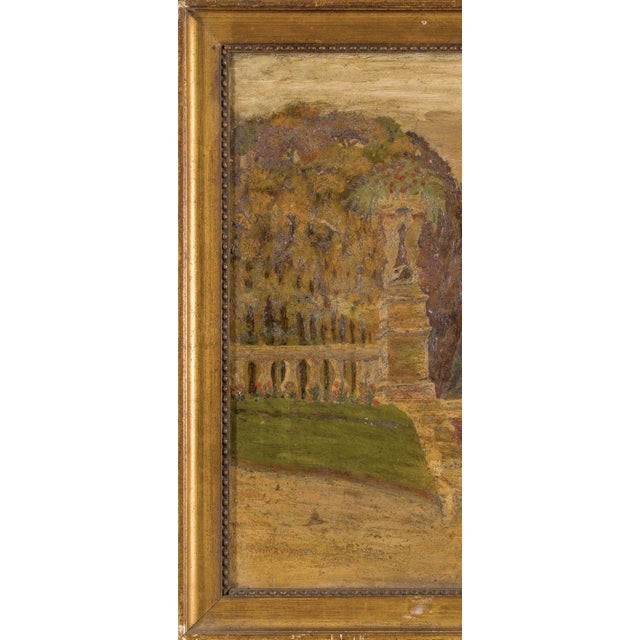
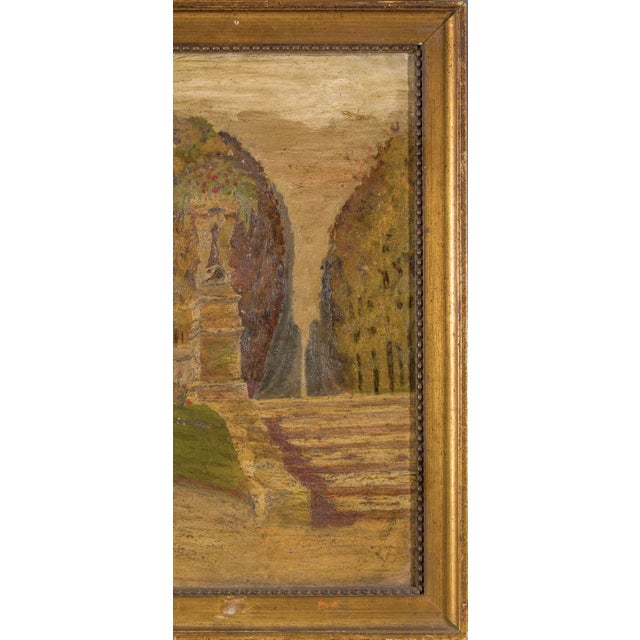
This beautiful oil painting on canvas depicts a poetic garden scene, probably a …
Read more
1930s Signed Painting Otto Heinrich Engel Credited
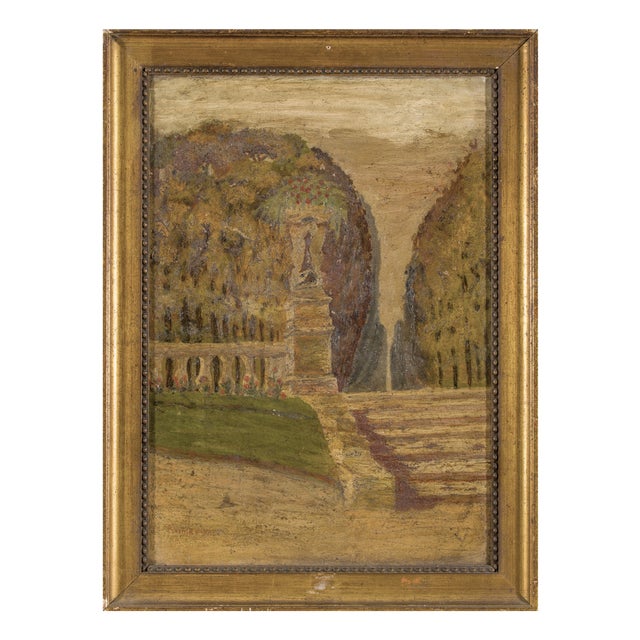
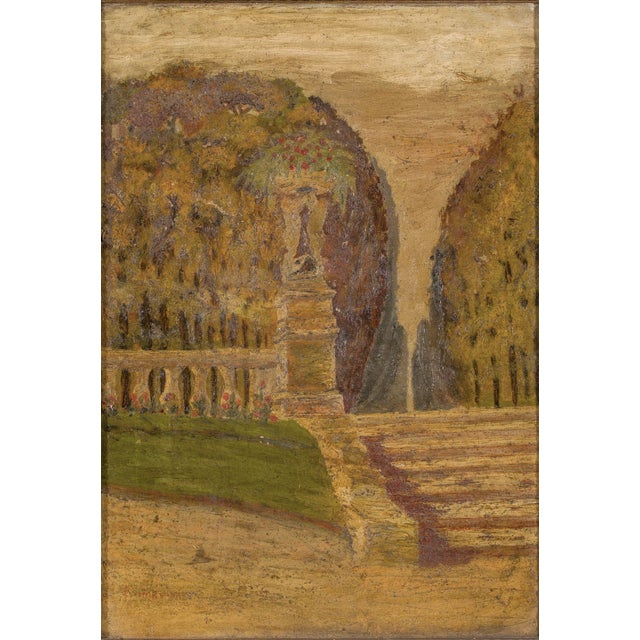
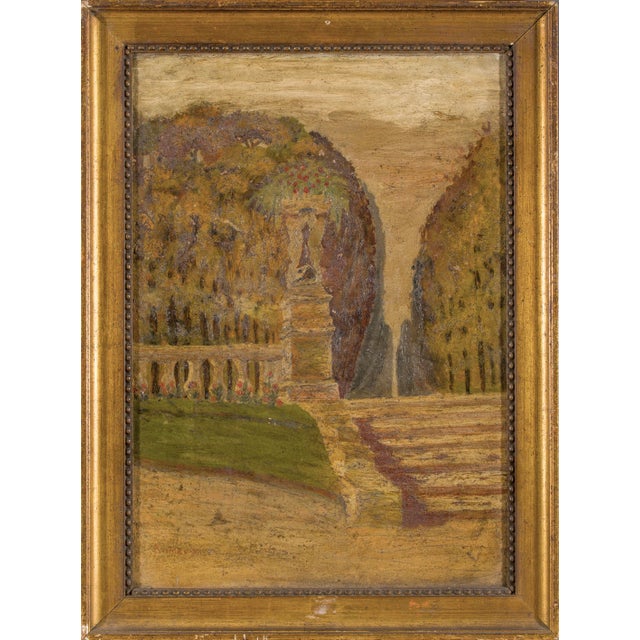
This beautiful oil painting on canvas depicts a poetic garden scene, probably a park or estate.
According to a detailed analysis of the period, style and extremely high quality of the brushwork, the painting can most likely be attributed to the great German artist Otto Heinrich Engel (1866 Erbach im Odenwald - 1949 Glücksburg).
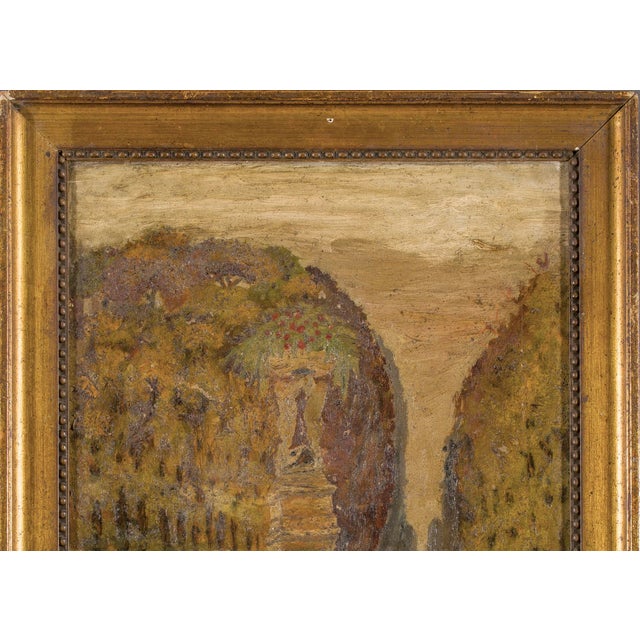
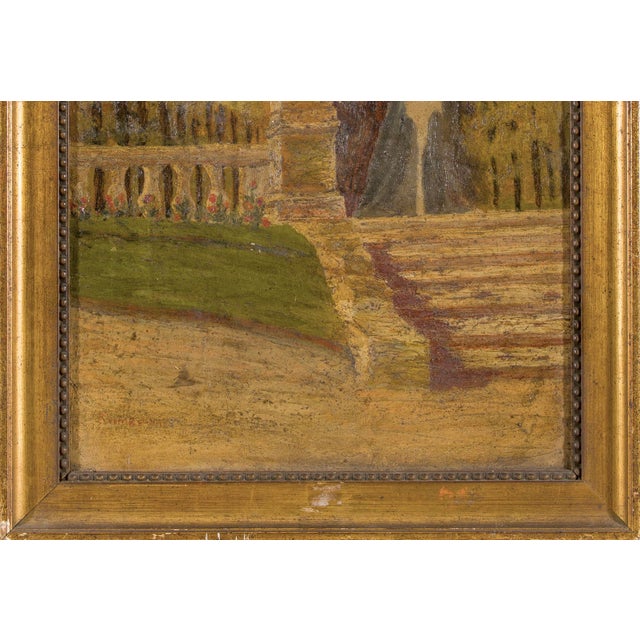
The work shows a path or staircase leading upwards, flanked by a stone balustrade on the left and dense, beautiful vegetation.
In the centre, in the foreground on the left, is a stone pedestal or monument with a small sculpture on top.
The painting uses a technique of dense, visible brushstrokes, with a palette of autumnal or earthy colours dominated by dark greens, browns and ochre yellows.
The style suggests an Impressionist or Post-Impressionist approach, focusing on atmosphere and light rather than precise details.
Signed lower left
This artwork, never before on the market, comes from an important French private collection and is beautified by an impressive antique frame in gilded wood, in very good condition.
Otto Heinrich Engel was born on 27 December 1866 in the small town of Erbach in the Odenwald region, which at the time belonged to the Grand Duchy of Hesse.
from 1868 to 1873, the family lived in Gelnhaar, where his father worked as a pastor. There, too, he wrote articles for various Christian-conservative newspapers until he was appointed editor-in-chief of the daily newspaper Der Reichsbote in Berlin in 1873.
In Berlin, Engel first attended the Döbbelin boys' high school before transferring to the Joachimsthal Gymnasium in 1877.
He began his academic training as a painter in 1886, after passing the entrance examination for the newly founded Berlin Academy of Fine Arts, whose director since 1875 was Anton von Werner.
In 1890, he moved to Karlsruhe to attend the Grand Ducal Art School of Baden, where he took Caspar Ritter's painting course.
In the following years, he maintained friendly relations with his fellow students Robert Grabbert and Ernst Eitner from Hamburg, Wilhelm Schulz from Lüneburg, and Georg Burmester from Kiel.
In 1891, Engel moved to Munich to study at the Academy of Fine Arts, where his teacher Paul Hoecker had a significant influence on his further development as an artist.
In the 1820s, he remained faithful to his familiar motifs and learned painting techniques, closing himself off to new artistic movements.
He focused increasingly on portraiture and worked as a book illustrator.
To escape the economic situation and growing political instability in Berlin, he moved alone to Glücksburg in 1933.
Engel spent the next few years in isolation on the Flensburg Fjord, maintaining contact only with friends and colleagues, including Hans Holtorf from Friedrichstadt and Albert Johannsen from Husum.
Engel is considered one of the pioneers of modern avant-garde painting in Germany. In 1898, together with Walter Leistikow, Ludwig Dettmann, Oskar Frenzel, Curt Herrmann, Fritz Klimsch and Max Liebermann, he was one of the founding members of the Berlin Secession, which advocated a departure from academic painting. However, Engel's involvement in this movement for artistic emancipation was essentially limited to the early years, and he left the group in 1902, rejoining the Berlin Artists' Association.
Between 1901 and 1914, his annual summer stays on the island of Föhr in the North Sea, accompanied by prolific painting, were a distinctive feature of his work. On the advice of his long-time friend Hans Peter Feddersen, he stayed at the inn run by Grethjen Hayen in Alkersum.
The inn is now part of the Museum Kunst der Westküste (West Coast Art Museum) complex.
Through a direct and impasto application of paint, Engel was able to quickly capture the moods of a moment and document their fleeting nature using the medium of painting itself. To this day, Otto Heinrich Engel is considered the painter of the island of Föhr, its landscape and its people.
.
Dimensions are frame included This piece is attributed to the mentioned designer/maker. It has no attribution mark and no
official proof of authenticity,
however it is well documented in design history. I take full responsibility for any authenticity
issues arising from misattribution
See less
- Dimensions
- 22.44ʺW × 1.57ʺD × 29.53ʺH
- Styles
- Modern
- Period
- 1930s
- Country of Origin
- Germany
- Item Type
- Vintage, Antique or Pre-owned
- Condition
- Good Condition, Unknown, Some Imperfections
- Color
- Condition Notes
- Patina Consistent with Age and Use Patina Consistent with Age and Use less
Returns & Cancellations
Return Policy - All sales are final 48 hours after delivery, unless otherwise specified in the description of the product.
Cancellation Policy - Prior to shipping or local pickup, buyers may cancel an order for up to 48 hours, unless otherwise specified.
Related Collections
- George Coggeshall Paintings
- Paul Jenkins Paintings
- Richard Serra Paintings
- Margaret Kennedy Paintings
- Photorealism Paintings in New York
- Joseph Solman Paintings
- Donald Judd Paintings
- Photorealism Canvas Paintings
- Vienna Secession Paintings
- Jeff Slemmons Paintings
- Karen Offutt Paintings
- William IV Paintings
- Black Photorealism Paintings
- Michelle Arnold Paine Paintings
- Keith Haring Paintings
- Lowell Nesbitt Paintings
- Jacobean Paintings
- Francine Tint Paintings
- Louis Wolchonok Paintings
- Jean Calogero Paintings
- Damien Hirst Paintings
- Sol LeWitt Paintings
- Photorealism Paintings in Los Angeles
- Paintings in Panama City, FL
- Lee Reynolds Paintings