

Details
Description
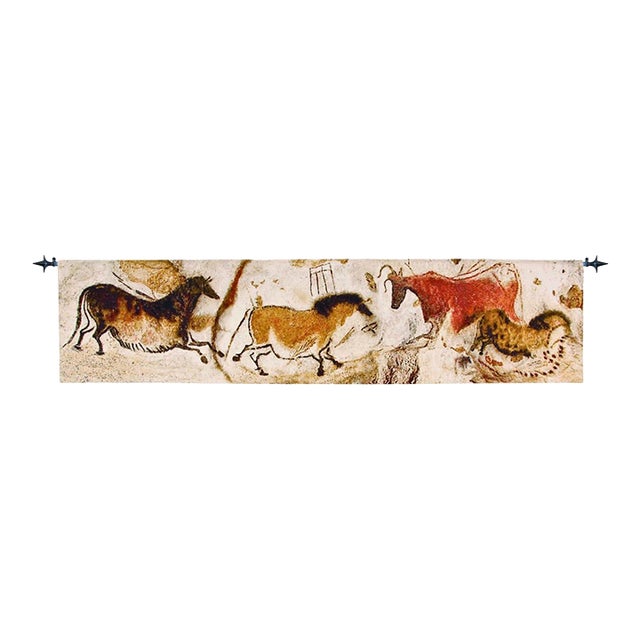
Lascaux (Lascaux Caves) is the setting of a complex of caves in south-western France, famous for its Paleolithic cave paintings. …
Read more
Lascaux (Lascaux Caves) is the setting of a complex of caves in south-western France, famous for its Paleolithic cave paintings. The original caves are located near the village of Montignac, in the department of Dordogne. They contain some of the best-known Upper Paleolithic art. These paintings are estimated to be several thousands of years old. They primarily consist of images of large animals, most of which are known from fossil evidence to have lived in the area at the time. In 1979, Lascaux was added to the UNESCO World Heritage Sites list along with other prehistoric sites in the Vzre valley. The cave contains nearly 2,000 figures, which can be grouped into three main categories: animals, human figures and abstract signs. The paintings contain no images of the surrounding landscape or the vegetation of the time.
Most of the major images have been painted onto the walls using mineral pigments, although some designs have also been incised into the stone. Many images are too faint to discern, and others have deteriorated entirely. Over 900 can be identified as animals, and 605 of these have been precisely identified. Out of these images, there are 364 paintings of equines as well as 90 paintings of stags. Also represented are cattle and bison, each representing 4 to 5% of the images. A smattering of other images include seven felines, a bird, a bear, a rhinoceros, and a human. There are no images of reindeer, even though that was the principal source of food for the artists. Geometric images have also been found on the walls.
A painting referred to as ""The Crossed Bison"", found in the chamber called the Nave, is often submitted as an example of the skill of the Paleolithic cave painters. The crossed hind legs create the illusion that one bison is closer to us than the other. This visual depth in the scene demonstrates a primitive form of perspective which was particularly advanced for the time.
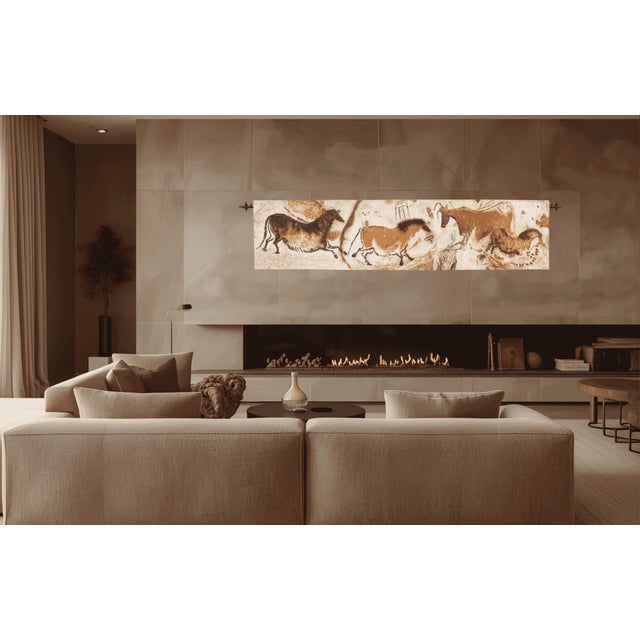
This beautiful tapestry is woven on a jacquard loom by skilled weavers, keeping alive the centuries old tradition of tapestry manufacturing from generation to generation. This tapestry is fully lined incorporating a sleeve along the top for hanging with a Hines hanging rod. Alternatively, this tapestry can be hung with a wooden batten which is a concealed method of hanging.
Composition: 42% cotton, 40% wool, 18% trevira
Finish on reverse: This tapestry is fully backed with luxury cotton lining incorporating a sleeve along the top for hanging purposes.
See less
- Dimensions
- 90.55ʺW × 0.1ʺD × 21.26ʺH
- Country of Origin
- United Kingdom
- Item Type
- Made to Order
- Estimated Lead Time: 14 days
- Materials
- Cotton
- Wool
- Color
- Cream
Questions about the item?
Returns & Cancellations
Return Policy - All sales are final 48 hours after delivery, unless otherwise specified in the description of the product.
Cancellation Policy - Prior to shipping or local pickup, buyers may cancel an order for up to 48 hours, unless otherwise specified.
Related Collections
- Loloi Rugs Textile Art
- Louis XIII Textile Art
- Resin Textile Art
- Workaday Handmade Textile Art
- Chanel Textile Art
- Antique Gold Finish Textile Art
- Kenneth Ludwig Chicago Textile Art
- Mid-Century Modern Textile Art
- Chinese Textile Art
- Japanese Textile Art
- Tapestry
- Framed Scarves
- Scandinavian Textile Art
- Aubusson Tapestry
- Edwardian Textile Art
- Cardboard Textile Art
- Ralph Lauren Textile Art
- Märta Måås-Fjetterström Textile Art
- Pablo Picasso Textile Art
- Space Age Textile Art
- Surrealism Textile Art
- Brutalist Textile Art