

Details
Description
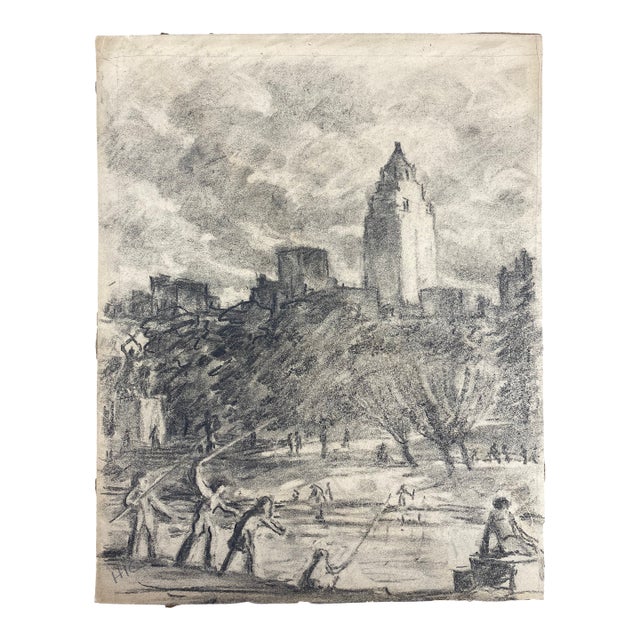
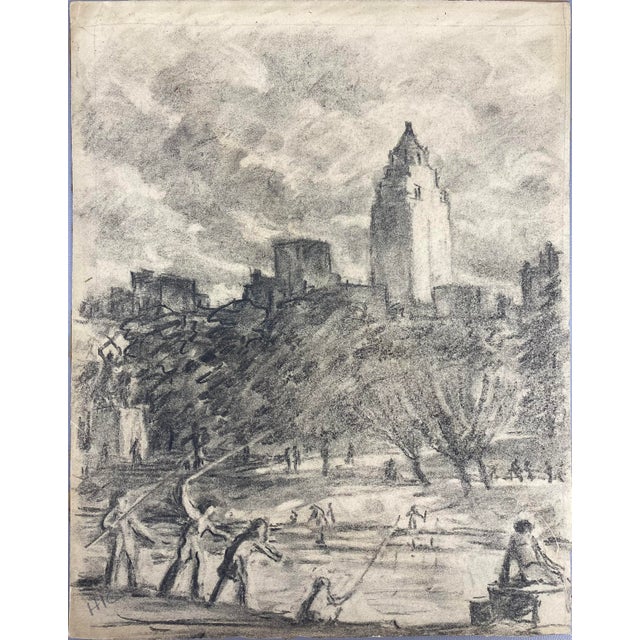
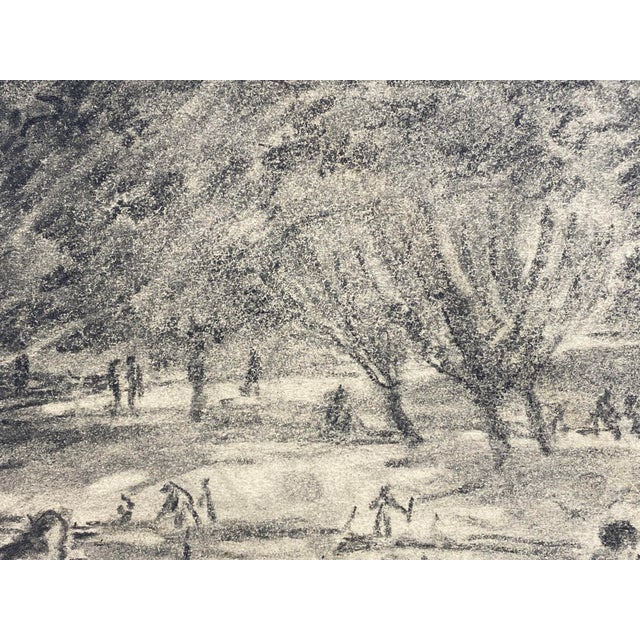
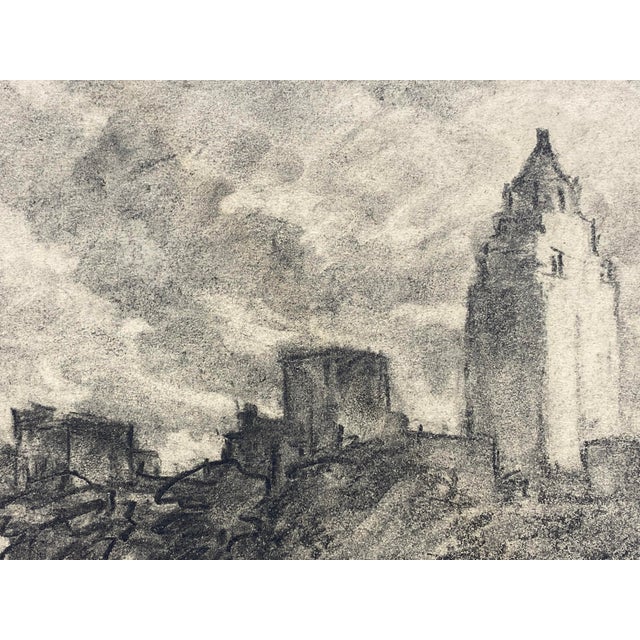
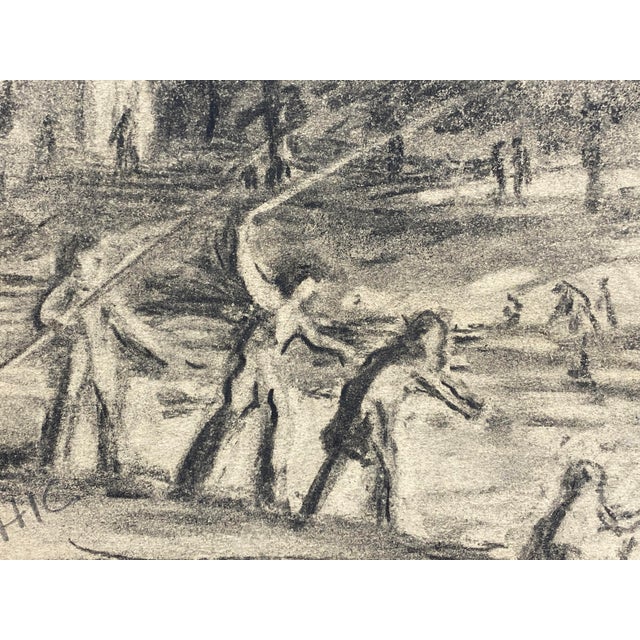
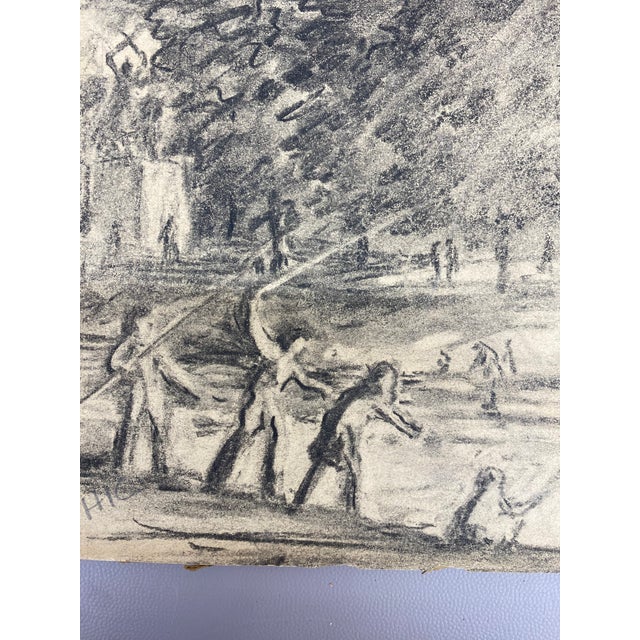
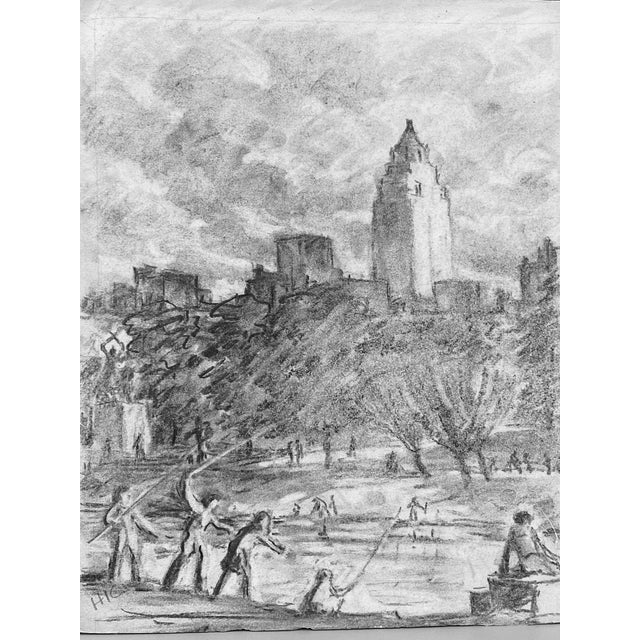
A wonderfully playful charcoal sketch on paper rendering of Central Park, New York City. Circa 1930. Signed with initials, HIC, …
Read more
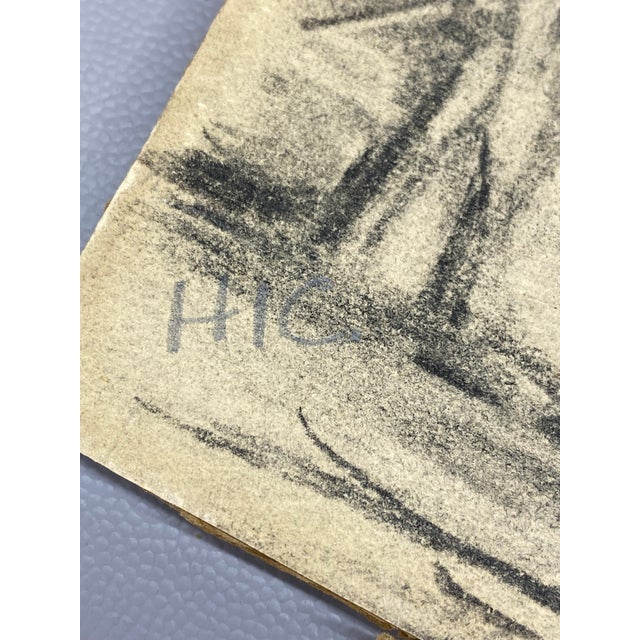
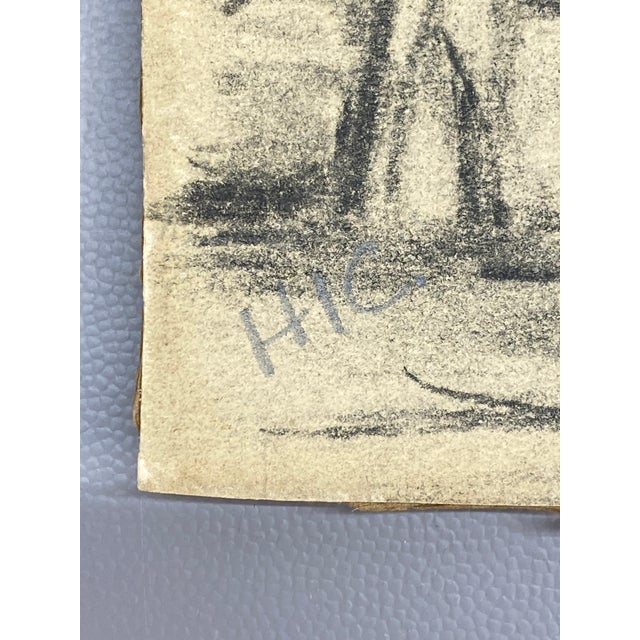
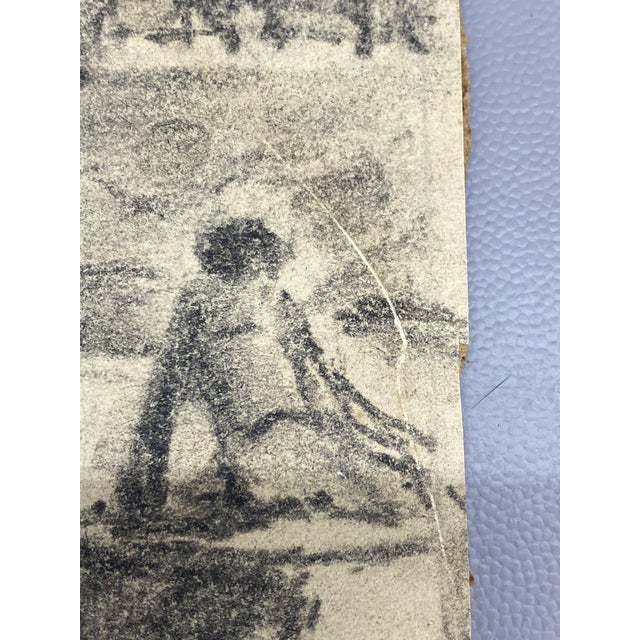
A wonderfully playful charcoal sketch on paper rendering of Central Park, New York City. Circa 1930. Signed with initials, HIC, lower left corner. Possibly a drawing for a later painting. Paper mounted on board. Good overall condition with minor cosmetic wear. There's a small scratch in the lower right corner (see photo). Unframed. The work on paper measures approximately 10.75" wide x 13.38" high.
Biography from the Archives of askART:
Henry Ives Cobb, Jr. (1883 - 1974) was an American artist and architect who lived and worked in New York, New York. He is primarily known for his paintings of scenes in and around Manhattan, especially Central Park. He was a member of the Art Students League* of New York as well as the Society of Independent Artists* and the Royal Academy.
Cobb was born March 24, 1883, in Illinois, the first of ten children of architect Henry Ives Cobb and Emma Martin Smith.
He attended Harvard University, worked on the Harvard Lampoon, and was a member of the Hasty Pudding Club along with Franklin Delano Roosevelt. In 1904, Cobb graduated cum laude and with honorable mention in the fine arts, and in August of that year he went to Paris to study architecture at the Ecole des Beaux Arts.*
In the summer of 1906, he married Carolyn Satterlee Postlethwaite, daughter of William Morton Postlethwaite, chaplain and professor at West Point. The Reverend Endicott Peabody, founder of the Groton School, presided. The wedding made the national news, appearing in newspapers as far away as Palestine, Texas. In the fall of 1907, his son Henry Ives Cobb, III, was born in Paris. In 1908, Cobb joined his father's architecture firm at 42 Broadway, New York, New York. His daughter Margaret Baron Cobb was born the same year.
In January 1915, Cobb left his father's firm, his wife, and his two young children, and went to Europe. Despite having worked as an architect for seven years, he identified himself as a "painter" on his passport application. Later that month, Carolyn Postlethwaite Cobb filed for divorce in the third district court at Ada, Idaho. Mrs. Cobb subsequently moved to England and with her partner Norman Webb ran the Easton Park Hotel in Chagford, Devon, where Evelyn Waugh wrote much of Brideshead Revisited.
In his 30's, Cobb made a brief foray into stage and set design. He created the scenery for a Nora Bayes show in 1916 , and designed the sets for the Jerome Kern / Guy Bolton / P.G. Wodehouse musical Have a Heart, which starred Billy B. Van and Louise Dresser. The musical opened at Broadway's Liberty Theater in January 1917 and was favorably reviewed by writers of The New York Times and the New York Sun . In April, the show played at the Capital in Washington, D.C. and was well-received by reviewers of the Washington Times .
In May 1917, he entered Officers' Training Camp in Plattsburgh, NY. In August, he was commissioned a 1st lieutenant, Field Artillery, and sailed for France on September 6, 1917. He worked as a translator, was discharged as a captain, and returned to the United States in September 1919.
In October 1920, Cobb married Gwendolyn Wickersham Akin, daughter of George W. Wickersham, U.S. Attorney General under William Howard Taft. The Reverend William Laurence Sullivan presided. From 1926 to 1927, building permits were secured for three buildings designed by Cobb in New York City. Two of the buildings, one at 150 East 50th Street (now the San Carlos Hotel) and one at 152 East 39th Street (The Hotel Dryden), still exist. One, at 64-66 Park Avenue, has been demolished.
In May 1929, Cobb gave a lecture on "the Practical Aspects of Interior Architecture" at Kauffman's department store in Philadelphia. He was identified in the advertisement as the "son of the illustrious architect who designed the beautiful Gothic buildings on the University of Chicago campus, a Beaux Arts man, and a member of the Royal Academy of Munich*." The advertisement continues, "His philosophy proceeds somewhat as follows: 'We should be doing things that suit American living -- not looking back over our shoulders to follow the details of 200 years ago. I believe that if we do this we shall have a truly American style within the next hundred years."
Throughout the 1920's and 30's, Cobb wrote articles on interior design and architecture for Good Housekeeping magazine.
Cobb's father died in 1931. According to a letter he wrote in the 1950s to Julius Lewis, a Henry Ives Cobb scholar, Cobb Jr. closed the architecture firm very closely after his father's death to "pursue the elusive muse of painting."
Cobb spent the years from 1931 through at least 1959 immersed in the fine arts, creating many sketches, lithographs*, and paintings. He worked primarily in oil and gouache, although he also created many political cartoons, some indicating opposition to The New Deal, in charcoal. The Kleeman galleries in New York City held a show of his political cartoons in January of 1936.
Pair on board Signed with initials, HIC.
In 1934, James Newlin Price held a show of Cobb's paintings at his Ferargil Galleries at 63 East 57th Street, New York.
His work has been in the collection of the Muscarelle Museum of Art at the College of William and Mary as well as in the private collection of Leona Helmsley. All, or very nearly all, of Cobb's paintings which have sold at auction have been attributed to his father, despite some being signed "II" or "Jr.," and some bearing dates later than 1931. He commonly signed his oil paintings "HIC," and his gouache works with a block-printed "Henry Ives Cobb," only once or twice adding "II" or "Jr." to the signature. His father, by contrast, signed his work with a cursive signature.
Henry Ives Cobb died in August, 1974 in Monterey, Massachusetts, probably while visiting his step-daughter Mildred Akin Lynes and her husband Russell Lynes, an author, tastemaker, and former managing editor of Harper's Magazine, who had a home in North Egremont.
See less
- Dimensions
- 10.75ʺW × 0.13ʺD × 13.38ʺH
- Styles
- Art Deco
- Impressionist
- Frame Type
- Unframed
- Period
- 1930s
- Country of Origin
- United States
- Item Type
- Vintage, Antique or Pre-owned
- Materials
- Charcoal
- Paper
- Condition
- Good Condition, Original Condition Unaltered, Some Imperfections
- Color
- Charcoal
- Condition Notes
- Good overall condition with minor cosmetic wear. There's a small scratch in the lower right corner (see photo). Unframed. Good overall condition with minor cosmetic wear. There's a small scratch in the lower right corner (see photo). Unframed. less
Questions about the item?
Returns & Cancellations
Return Policy - All sales are final 48 hours after delivery, unless otherwise specified in the description of the product.
Cancellation Policy - Prior to shipping or local pickup, buyers may cancel an order for up to 48 hours, unless otherwise specified.
Related Collections
- Jeff Slemmons Drawings
- Maison Jansen Drawings
- Tempera Drawings
- John James Audubon Drawings
- Leroy Neiman Drawings
- Guillaume Azoulay Drawings
- Joseph Stella Drawings
- Erté Drawings
- Salvador Dalí Drawings
- Piet Hein Eek Drawings
- Carl-Axel Acking Drawings
- Charcoal Drawings
- Fashion Drawings
- 1950s Fashion Drawings
- Pencil Drawings
- Ink Drawings
- Gustavian (Swedish) Drawings