




Details
Description
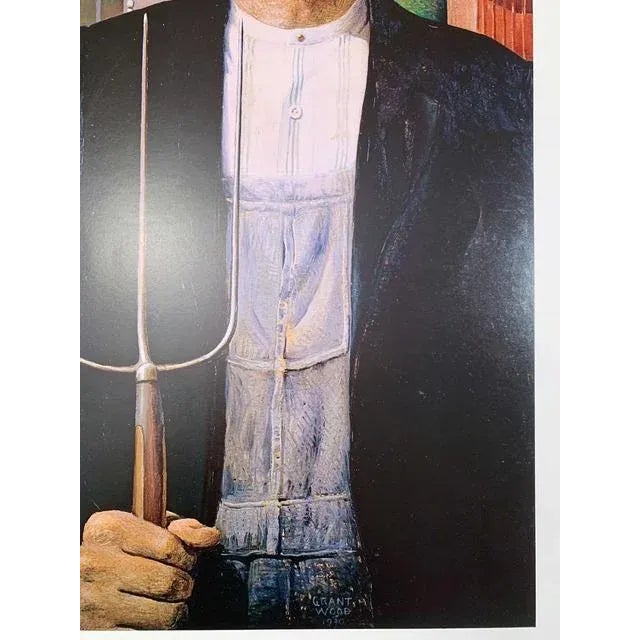
The Art Institute of Chicago, American Gothic, Grant Wood, Continuous Tone (No Dots) Lithographic Poster, 1985
High Quality Oversize Museum …
Read more
The Art Institute of Chicago, American Gothic, Grant Wood, Continuous Tone (No Dots) Lithographic Poster, 1985
High Quality Oversize Museum Exhibition Continuous Tone (No Dots) Lithographic Poster
39 × 25 in
99.1 × 63.5 cm
This an oversize high quality poster printed for a major exhibition for this American image that has defined a generation. It is printed one time only for an exhibition at the Art Institute of Chicago. Due tot he printing process it looks and feels like an original stone litho not a cheap poster. In the last few year's this painting has toured the major Art Museum's of Europe. I am not sure of the date of the actual exhibition, but we have to list a date for Artsy, I don't think 1985 is that far off from the actual exhibition date. As soon as we find the exhibition date we will list it.
I have included two extra photos of the black area to try and show the soft creases, but you cant even see them with two strong studio lights.
This is the original poster done for the exhibition at the Art Institute of Chicago, it also printed by a special printing process, call Continuo=ious Tone printing, which uses not dots.
About the Continuous Tone Printing Process:
Screenless lithography, by eliminating the use of halftone screens and halftone dots achieves extraordinary fidelity, fullness of tone, color and detail, impressive color saturation and clear line resolution. Museums, fine artists and publishers with exacting standards use this remarkable process to re-create their finest works of art. Continuous tone lithography (as in a photograph with no dots) evolved from collotype printing. When Black Box Collotype ultimately closed its doors in 2004, it was one of just a few printers left in the world that had mastered the collotype process. While it was a highly desirable reproduction process for the fine art world, it was a laborious, time consuming (read “expensive”) process. Since there was no screen involved, a collotype print could be 27 colors without fear of a moiré. But in the old days, on Black Box’s one-unit press, those 27 colors had to be laid down one color at a time. So the most complex jobs could take months to complete.
Offset lithography is far faster and less expensive than collotype. Suddenly, four colors and halftone dot patterns were “good enough” because they were so economical. Black Box Collotype was one of the last printing houses in America, if not the world that used the collotype-continuous tone process.
Medium Posters
Condition Excellent condition as it was never sold or circulated, minor creases in the black area only seen in strong raking light, will frame up ok
Signature Not Signed, not signed
Frame Not included
Publisher The Art Institute of Chicago, Kerrwerks, and Black Box Collotype, Chicago
See less
Questions about the item?
Returns & Cancellations
Return Policy - All sales are final 48 hours after delivery, unless otherwise specified in the description of the product.
Cancellation Policy - Prior to shipping or local pickup, buyers may cancel an order for up to 48 hours, unless otherwise specified.
Related Collections
- Le Corbusier Posters
- Baroque Posters
- Posters in Savannah
- Posters in Naples, FL
- Ceramic Posters
- Silk Posters
- Screen Print Posters
- Marc Chagall Posters
- Art Deco Posters
- Mid-Century Modern Posters
- Mark Rothko Posters
- Posters in Los Angeles
- Pablo Picasso Posters
- French Posters
- Milton Avery Posters
- Peter Max Posters
- Museum Posters
- Polish Posters
- Lee Krasner Posters
- Japanese Posters
- Keith Haring Posters
- Framed Posters
- Posters in Orlando
- Woodcut Posters