




Details
Description
This tall French statue of St. Bartholomew was hand-carved from oak in the 1700’s. This depiction of St. Bartholomew is …
Read more
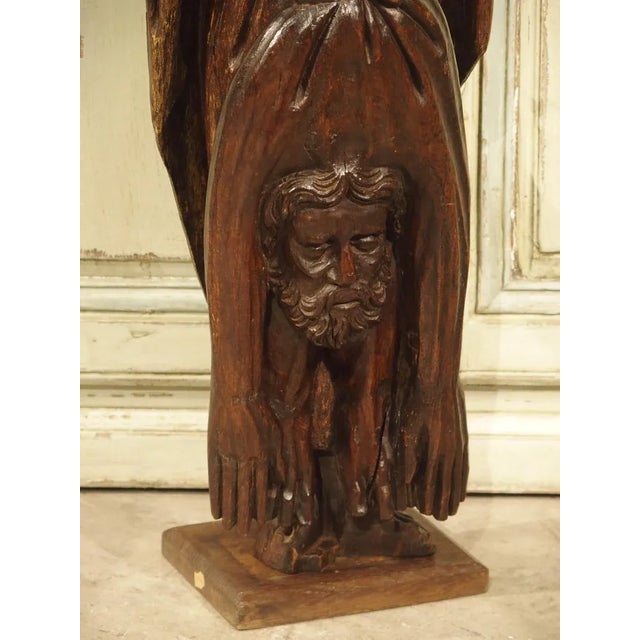
This tall French statue of St. Bartholomew was hand-carved from oak in the 1700’s. This depiction of St. Bartholomew is not often seen in art, except for one of the most well known renditions, which is in the Last Judgement by Michelangelo. This painting, which is just behind the altar of the Sistine Chapel was done in the early 1500s.
Our Bartholomew has wavy shoulder length hair with a thick beard and mustache. This is a standard depiction of him in art, as it is presumed this is how he looked at the time of his death. He is clad in a long, flowing tunic with a low-cut collar and a cincture around the waist. Wrapped around his shoulders is a long sleeve cloak that extends down to his ankles. The fabric of both garments has folds and bunches, implying movement. St Bartholomew stands barefoot on a rectangular plinth with beveled edges.
When portrayed in art, Bartholomew is typically seen holding his flayed skin, indicating that the suffering he endured is his badge of honor. The Bartholomew in our statue is holding his skin by the lower back with his right hand. Bartholomew is venerated as the patron saint of tanners (among other classes) and is almost always shown with a flaying knife in hand. Our statue probably once held such a knife in the left hand. In Michelangelo’s The Last Judgment wall fresco at the Sistine Chapel, Bartholomew is positioned next to Jesus, indicating his importance. Recent discoveries have led art experts to suggest that the face seen on the flayed skin is a portrait of Michelangelo himself.
A controversial figure, some scholars believe that Bartholomew is “Nathanael” in the Bible. In the Gospel of John, Philip introduces Nathanael to Jesus, becoming one of the twelve apostles. While this is not a consensus view, it is universally accepted that Bartholomew was martyred while spreading Christianity to the Middle East. At one point, Bartholomew converted King Polymius (of Armenia or India) to Christianity, angering the king’s brother. Prince Astyages ordered that Bartholomew be flayed alive.
Although this piece represents the sad story of St. Bartholomew, it is a magnificent work of sculptural art. It is an unusual example of religious statuary, and would be a wonderful additional to any serious collection of European religious carvings.
See less
- Dimensions
- 10ʺW × 8.5ʺD × 35ʺH
- Art Subjects
- Figure
- Period
- 18th Century
- Country of Origin
- France
- Item Type
- Vintage, Antique or Pre-owned
- Materials
- Oak
- Condition
- Good Condition, Original Design Modified, Some Imperfections
- Color
- Brown
- Condition Notes
- Wear commensurate to age and use, with age separations and rubs. Minor losses throughout with a missing element in the … moreWear commensurate to age and use, with age separations and rubs. Minor losses throughout with a missing element in the left hand as well as part of the feet. Small square platform is not original. less
Questions about the item?
Returns & Cancellations
Return Policy - All sales are final 48 hours after delivery, unless otherwise specified in the description of the product.
Cancellation Policy - Prior to shipping or local pickup, buyers may cancel an order for up to 48 hours, unless otherwise specified.
Related Collections
- Straw Sculpture
- Constantin Brancusi Sculpture
- Louis XIV Sculpture
- Fernando Botero Sculpture
- Roman Bronze Works Sculpture
- Recycled/Repurposed Sculpture
- Worlds Away Sculpture
- Flavio Poli Sculpture
- Bentwood Sculpture
- Far Pavilions Sculpture
- Georgian Sculpture
- Maison Jansen Sculpture
- Bakelite Sculpture
- Magenta Sculpture
- Antique Iron Finish Sculpture
- Photography Sculpture
- Gold-Plate Sculpture
- Medium-Density Fibreboard Sculpture
- Sculpture in Columbus
- Polished Brass Finish Sculpture
- Barovier and Toso Sculpture
- Geode Sculpture
- René Lalique Sculpture
- Albert Ernest Carrier-Belleuse Sculpture
- Sculpture in Panama City, FL