



Details
Description
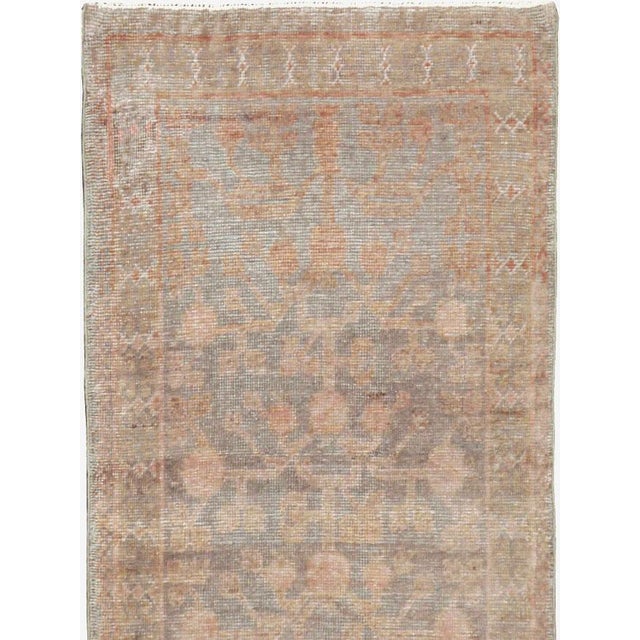
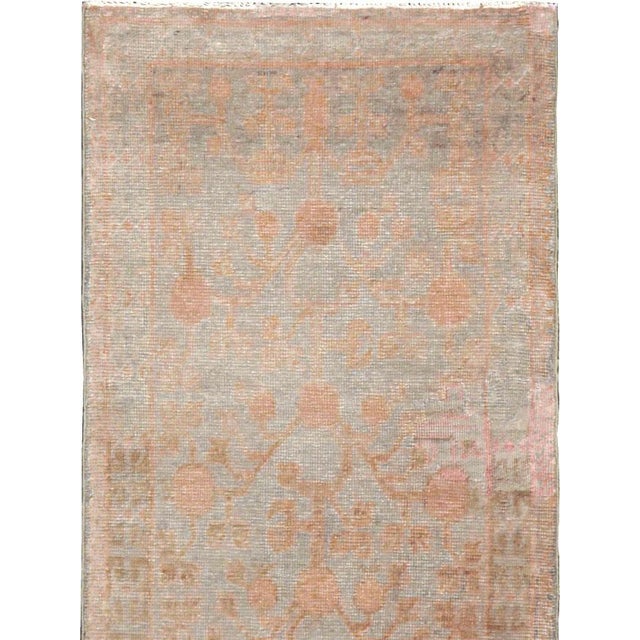
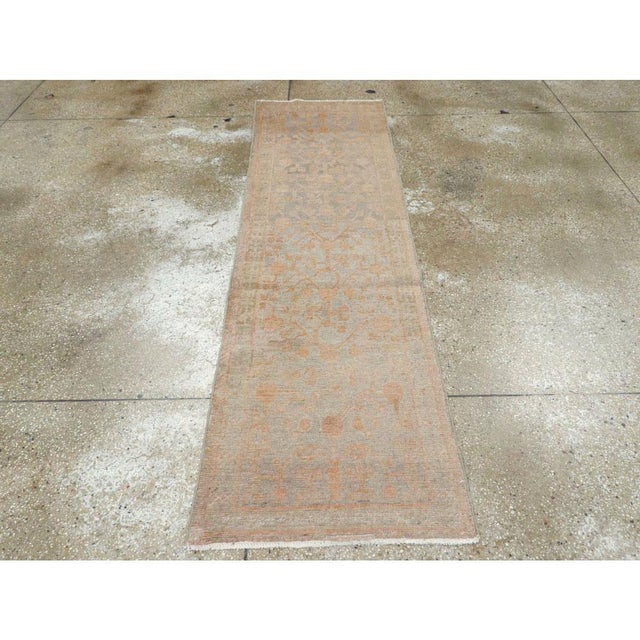
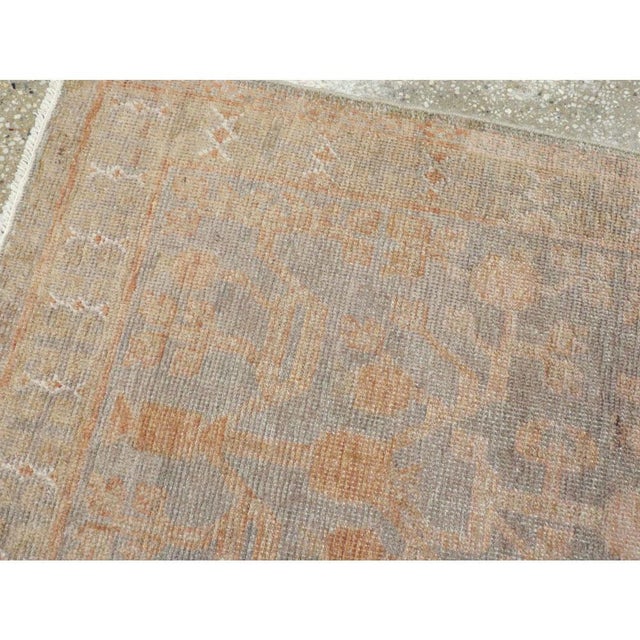
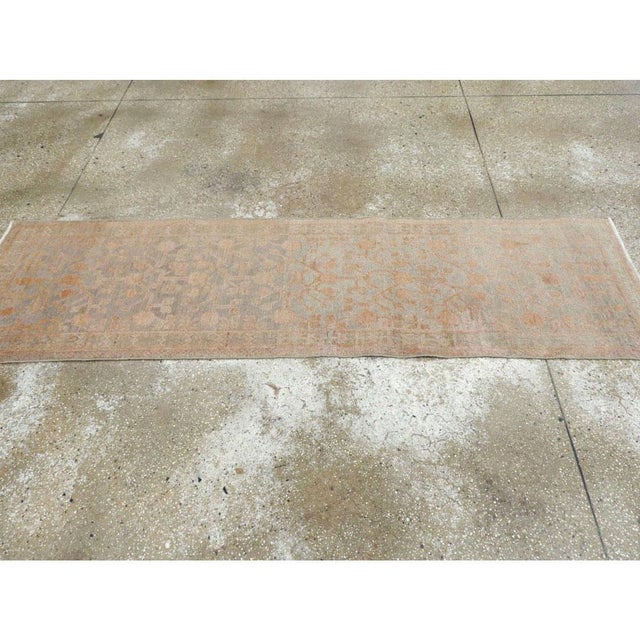
An antique East Turkestan Khotan rug in runner format with a pomegranate design handmade during the mid-20th century.
Central Asian …
Read more
An antique East Turkestan Khotan rug in runner format with a pomegranate design handmade during the mid-20th century.
Central Asian Rugs & Carpets:
Central Asia is a vast area stretching from Northeastern Persia to western China, and from northern Afghanistan to the southern edge of Russia. The carpets can be usefully divided into three groups: the nomadic Turkmen rugs of Turkmenistan, northern Afghanistan, and northeastern Persia; the non-Turkmen tribal pieces from Kazakhstan, Uzbekistan, and Kirghizstan; and the urban creations of Khotan, Yarkand, and Kashgar, oasis cities of Western China (Xinjiang Province).
Commercially, the most important group is from Khotan, the easternmost of the Chinese Turkestan cities. The craft of rug weaving is primarily in the hands of Muslim Uighurs. Khotan carpets mix purely Central Asian design themes with Chinese elements. Native Khotan devices include pomegranate trees, upright flowers, round medallions, and yellow or red grounds. Chinese motives include triangular fretwork corners, swastika fretwork, and Yun-Tsao Tou (clouds and rain) diagonally striped polychrome borders. Cotton foundations, asymmetrical (Persian) knots, and medium weaves are standard. Some vintage Khotan are in horizontal, pictorial layouts with multiple various vases and plants. Saphs (multiple prayer niche panel carpets) are also a Khotan specialty. Others employ stepped and layered lozenge medallions, singly or in pairs. Still others, almost all antique, feature a stylized version of the allover Persian Herati design. Many of the oldest pieces employ brown wool wefts. Antique and vintage Khotans are almost always in the k’ang (double square) layout, conforming to the local household plans. Only relatively recently has the 6’ by 12’ or 7’ by 16’ format been replaced by the 9’ by 12’ size. As a result, an antique room size Khotan carpet is very uncommon. Reds are cinnamon, tomato and rust, never wine reds, crimson, or scarlet. Yarkand, farther west on the old Silk Road specializes in multi-medallion long carpets while Kashgar, farthest west and most under Persian influence, has traditionally knotted allover pattern pieces with finer weaves, often with silk piles, and enriched with medal thread, on cotton foundations. Extant Kashgars go back to the 17th century, but the carpet craft in Chinese Turkestan must be much older as fragments have been recovered from local tombs of the early C.E. period. Kashgars are the rarest of all East Turkestan rugs. Most available vintage East Turkestan carpets are interwar Khotans, many with pleasingly soft decorative palettes.
The non-Turkmen nomads include the Kazakh, Kirghiz, Uzbek, and Karakalpak groups. Like the Turkmen, they were once all seasonally migratory, dwelling in round felt tents (yurts), but have been settled, at least partially, in the villages, and have taken up crafts and agriculture instead of sheep herding. As a result, carpet production has transitioned from domestic tent use to commercial sale, but the roots of long traditions are still evident. The Uzbeks weave carpets in the general Ersari “gul” Turkmen style, but wilder and less disciplined, suzanis (needlework) hangings and covers, and silk ikats in the cities of Bokhara and Khiva. The Karakalpaks weave “gul” rugs, somewhat in the Turkmen style, but heavier in handle. The Kirghiz knot red and blue allover pattern carpets with wool foundations, and often with Chinese design influences, while the Kazakhs, many still nomadic, weave a variety of conjoint strip rugs (julchirs), long pile “gul” carpets and shaggy tent paraphernalia. Generally all-wool construction, moderate to coarse weave, asymmetric (Persian) knots.
The Turkmens, the archetypal Central Asian tribal people inhabit Turkmenistan, northeast Afghanistan, and Northeast (Khorassan Province) Persia. They are divided into the Tekke, Saryk, Salor, Yomud, Chodor, Ersari, and distinct smaller tribal groupings. The most important, rug wise, are the Tekkes around Ashkabad in Turkmenistan, the Yomuds on the east side of the Caspian Sea, and the Ersaris from Northwest Afghanistan and Uzbekistan. All the tribes weave “gul” carpets, carpets displaying their emblematic tribal medallions (“guls”) repeated across, and up and down the field. Fields are generally in shades of red, ranging from tomato to rust-brown to coral to aubergine (eggplant) to wine. Accent tones include dark and light blue, burnt apricot, and ivory. Guls may be large or small, stretched, elliptical, beveled squares or truly octagonal. Also, a range of lesser pieces is woven including ‘ensis (tent doors)’ usually in cross layouts and scatter sizes, large and small bags, tent bands, and various domestic paraphernalia for their tents. The Ersari also weave long ‘kellegi (gallery format)’ carpets with geometric Persian allover patterns including the Herati palmette, Harshang, and cloud bands. These, mostly antique, rugs were made for the houses in the cities of Bokhara, Khiva, and Samarkand. Tribal weavers, urban clientele. Both Turkmen and Non-Turkmen tribal carpets generally range up to seven by ten or eleven feet, except for longer Ersaris. A true modern room size is rare. Generally all-wool construction, coarse to ultra-fine weave, symmetric (Turkish) or asymmetric (Persian) knots.
Contemporary weavers in Afghanistan have begun to weave larger, very attractive carpets combining Turkmen, Caucasian, and Persian pattern elements. It will be interesting to see where this recent development goes. These carpets should age well into desirable antiques.
Although the carpets of Central Asia may share common places of origin, they are so diverse that they require extensive study within each group. They have never gone out of style in Western homes.
Measures: 2' 2" x 7' 6"
See less
- Dimensions
- 2′2″ × 7′6″ and 0.5″ thick
- Styles
- Modern
- Pattern
- Other
- Rug Construction
- Hand Knotted
- Period
- Early 20th Century
- Item Type
- Vintage, Antique or Pre-owned
- Materials
- Wool
- Condition
- Good Condition, Original Condition Unaltered, Some Imperfections
- Color
- Beige
- Condition Notes
- Excellent. Additions or alterations made to the original: This carpet has been professionally antique washed to soften its tonality. Excellent. Additions or alterations made to the original: This carpet has been professionally antique washed to soften its tonality. less
Questions about the item?
Returns & Cancellations
Return Policy - All sales are final 48 hours after delivery, unless otherwise specified in the description of the product.
Cancellation Policy - Prior to shipping or local pickup, buyers may cancel an order for up to 48 hours, unless otherwise specified.
Related Collections
- Seagrass Rugs
- Louis XVI Rugs
- Bamboo Fabric Rugs
- Josef Albers Rugs
- Beaux-Arts Rugs
- Classical Greek Rugs
- Cashmere Rugs
- Rugs in Chicago
- Rugs in New York
- Moroccan Rugs
- Persian Rugs
- Scandinavian Rugs
- Rugs in Los Angeles
- Art Nouveau Rugs
- Rugs in Dallas
- Spanish Rugs
- Karastan Rugs
- Rugs in Washington DC
- Art Deco Rugs
- Early American Rugs
- Rugs in San Francisco
- Rugs in Philadelphia
- French Rugs
- Khotan Rugs
- Southwestern Rugs