




Details
Description
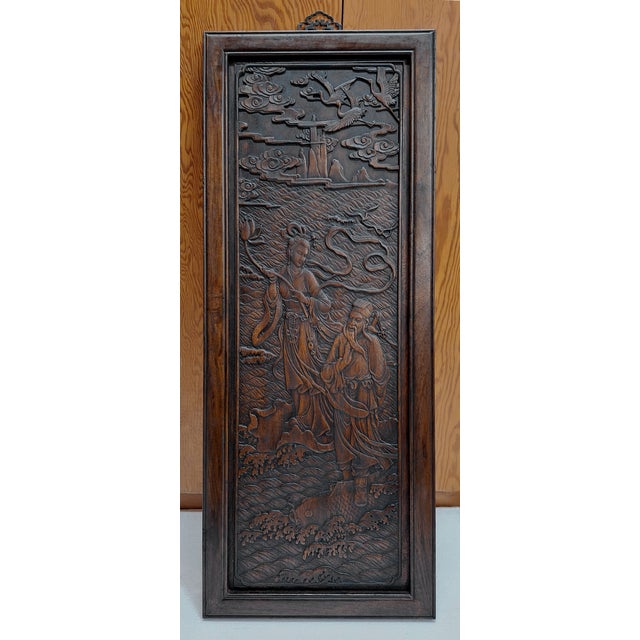
Set of four hongmu Bā Xiān Guò Hǎi plaques, finely carved and detailed depiction of The Eight Immortals in bas-relief, …
Read more
Set of four hongmu Bā Xiān Guò Hǎi plaques, finely carved and detailed depiction of The Eight Immortals in bas-relief, two figures for each of the eight plaques, in Chinese rosewood plaques and frames, done with fine Chinese joinery. Each wall mounted plaque has a traditional bronze hanger. Circa Republic of China era. Please message me if shipping outside of the USA.
site size: 29.125" high x 9.25" wide
Bā Xiān Guò Hǎi: A book written during the Ming (c. 14th–15th centuries), by an anonymous writer, called The Eight Immortals Cross the Sea (八仙過海; bā xiān guò hǎi). It is about the Eight Immortals on their way to attend the Conference of the Magical Peach (蟠桃會; pán taó huì) when they encounter the Bohai Sea. Instead of relying on their clouds to get them across, Lü Dongbin suggested that they each should exercise their unique powers to get across. Derived from this, the Chinese proverb "The Eight Immortals cross the sea, each reveals its divine powers" (八仙過海,各顯神通; bā xiān guò hǎi, gè xiǎn shén tōng) indicates the situation that everybody shows off their skills and expertise to achieve a common goal.
The Eight Immortals: a group of legendary xian (immortals) in Chinese mythology. Each immortal's power can be transferred to a vessel (法器) that can bestow life or destroy evil. Together, these eight vessels are called the "Covert Eight Immortals" (暗八仙). Most of them are said to have been born in the Tang or Song Dynasty. They are revered by the Taoists and are also a popular element in secular Chinese culture. They are said to live on a group of five islands in the Bohai Sea, which includes Mount Penglai.
The Immortals are paired, from left to right, on the plaques:
Li Tieguai (李鐵拐), considered to be mentally disturbed and associated with medicine and easing the suffering of the sick and needy, identified by his iron crutch and calabash bottle.
Lan Caihe (藍采和), originally pictured as female; later becoming ambiguous, and is considered the patron of florists and gardeners.
He Xiangu (何仙姑), in modern context generally seen as the only female of the group, often depicted holding a lotus flower.
Lü Dongbin (呂洞賓), a scholar and poet considered to be the leader of the Eight Immortals.
Zhongli Quan (鍾離權), associated with death and the power to create silver and gold, often depicted holding a fan.
Cao Guojiu (曹國舅), related to a Song dynasty emperor before he became an immortal.
Han Xiangzi (韓湘子), a flute artist.
Zhang Guolao (張果老), a fangshi symbol of longevity.
See less
- Dimensions
- 51ʺW × 1.12ʺD × 32.88ʺH
- Period
- Early 20th Century
- Country of Origin
- China
- Item Type
- Vintage, Antique or Pre-owned
- Materials
- Bronze
- Wood
- Condition
- Good Condition, Original Condition Unaltered, Some Imperfections
- Color
- Brown
- Condition Notes
- Excellent vintage condition. Excellent vintage condition. less
Questions about the item?
Returns & Cancellations
Return Policy - All sales are final 48 hours after delivery, unless otherwise specified in the description of the product.
Cancellation Policy - Prior to shipping or local pickup, buyers may cancel an order for up to 48 hours, unless otherwise specified.
Related Collections
- Helmut Friedrich Schäffenacker Sculptural Wall Objects
- Antique Copper Finish Sculptural Wall Objects
- Medium-Density Fibreboard Sculptural Wall Objects
- Dada Sculptural Wall Objects
- Maison Jansen Sculptural Wall Objects
- Ralph Lauren Sculptural Wall Objects
- Asian Sculptural Wall Objects
- Greg Copeland Sculptural Wall Objects
- Mid-Century Modern Sculptural Wall Objects
- Curtis Jere Sculptural Wall Objects
- Plaster Sculptural Wall Objects
- Brutalist Sculptural Wall Objects
- Japanese Sculptural Wall Objects
- Sarreid Ltd. Sculptural Wall Objects
- Wenge Sculptural Wall Objects
- Arteriors Home Sculptural Wall Objects
- Silverplate Sculptural Wall Objects
- Platinum Sculptural Wall Objects
- The American School Sculptural Wall Objects
- Stainless Steel Sculptural Wall Objects