



Details
Description
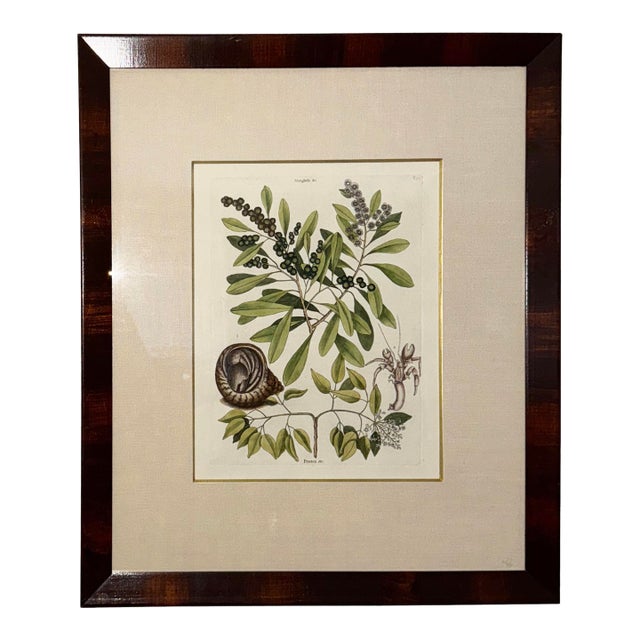
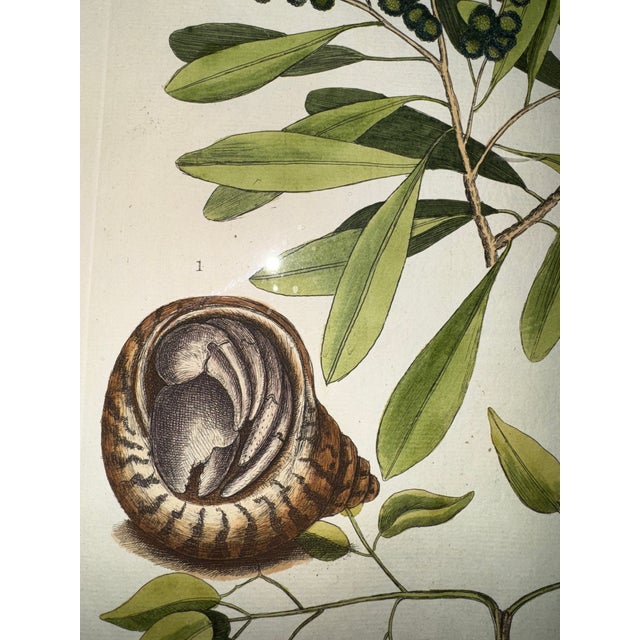
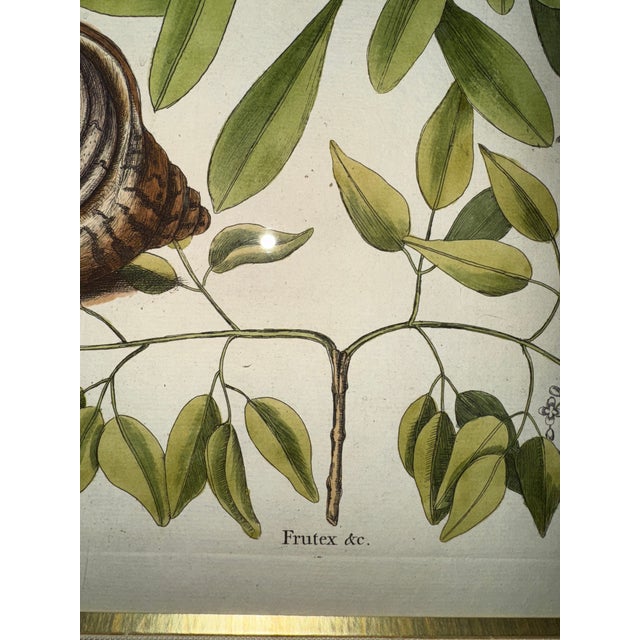
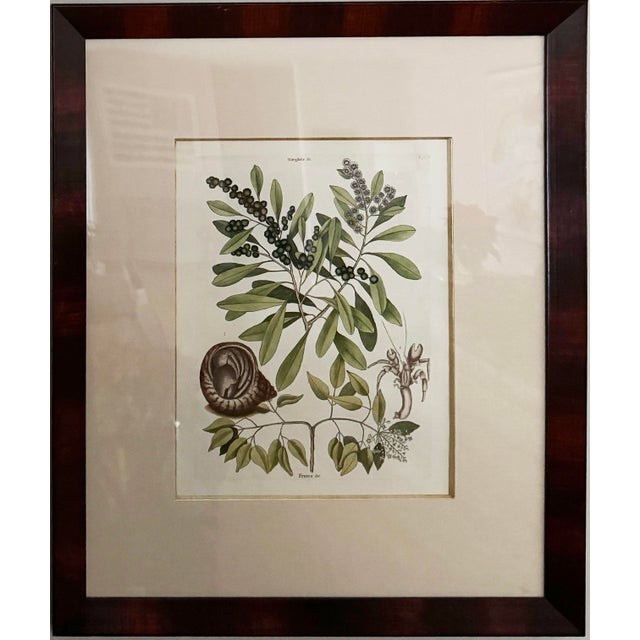
Mark Catesby (English, 1679–1749), hand colored copper plate engraving titled “The Sea Hermit Crab, Frutex,” Plate 33 from The Natural …
Read more
Mark Catesby (English, 1679–1749), hand colored copper plate engraving titled “The Sea Hermit Crab, Frutex,” Plate 33 from The Natural History of Carolina, Florida and the Bahama Islands, Second Edition, London, 1754, depicting a finely observed botanical branch with elongated olive green leaves and clustered berries accompanied by a meticulously rendered sea hermit crab and shell, executed with crisp engraved linework and subtle watercolor washes in earthy greens and warm browns characteristic of 18th century natural history illustration, presented in a dark stained wood frame with gilt inner liner and wide cream mat, framed by W. Graham Arader III, provenance Property from Credit Suisse’s Americana Collection, sight size 15" x 11 1/2"; size with frame 26.75" x 22.5"
The flora and fauna of the New World were a matter of supreme interest to eighteenth-century European naturalists. The astute observations and detailed illustrations of Mark Catesby in The Natural History of Carolina, Florida and the Bahama Islands, which he published in sections beginning in 1731, were the first glimpse at what he termed the "productions of nature," as well as the most complete natural history of that region. The two-volume work contained over two hundred plates that were engraved (and often personally hand colored) by Catesby. It was the product of his collecting expeditions in Virginia from 1712 to 1719, his three-year sojourn (beginning in 1722) in the Carolinas, Florida, and Georgia, and his visit to the Bahamas prior to his return to England in 1726.
Mark Catesby was born in the remote town of Sudbury in Suffolk, England, in 1682. He was the fourth child and youngest son of John and Elizabeth (Jekyll) Catesby. Little is known about his education, but his father was a prominent lawyer, and, although there is no evidence that the younger Catesby attended university, he displayed knowledge of Latin in his writing. (This was possibly the result of an education with a private tutor, which would be in keeping with the family's status.) His maternal uncle, Nicholas Jekyll, was a naturalist who developed a botanical garden at the Castle Hedingham in Suffolk. He served as a mentor to his young nephew, supporting his developing interest in natural science.
In 1711, Mark Catesby, a twenty-nine-year-old bachelor, left for the Royal Crown Colony of Virginia to visit his sister, Elizabeth, who was married to Dr. William Cocke, a well-established and respected physician in Williamsburg, the colony's capital. Catesby became acquainted with the social circle of his sister and brother-in-law and soon had access to plantations along the James River, where he collected specimens. He developed techniques for preserving the specimens and drawing them from life while still in the field, and he wrote extensive commentary on the habitats, life cycles, and migration patterns of the birds and animals he observed. When he returned to England, the naturalists in London were astounded by the results of his efforts and encouraged him to embark upon a second voyage to America in order to provide them with even more material.
Catesby's second trip to the American colonies was sponsored by a group of patrons, many of whom were members of the Royal Society of London. They were eager to have specimens and seeds from the colonies. They sought to satisfy their intellectual curiosity about the myriad natural wonders of the New World, but, pragmatically, they also sought seeds that were known for their culinary and medicinal value. A result of this partnership was that trees and plants native to the New World were established in the English gardens of his sponsors, and English seeds made their way into colonial gardens as part of the two-way exchange. Catsby spent the four years on this trip assiduously documenting as many species as possible. Although untrained as an artist, he paid careful attention to the coloring and movements of the animals he portrayed, preferring to draw from life. As paper was expensive and difficult to maintain in the field, he portrayed plants and animals together, a method that was adopted by subsequent naturalists.
In 1726, Catesby resettled in London, intent on publishing his findings. His sponsors, though ecstatic with the material, did not want to lend the additional financial support necessary to produce an expensive publication with numerous, costly illustrations. Catesby found work in a nursery that contained many of the species of plants he had sent to London as seeds and attempted to secure subscriptions for his proposed publication. Eventually, Peter Collinson, a prosperous merchant and avid naturalist, proposed Catesby for membership in the Royal Society and lent him a considerable sum of money, interest free, which enabled Catesby to commence putting his findings together in publishable form. To save money, he learned to engrave his own plates by seeking instruction from the printmaker Joseph Groupy.
The first volume, dedicated to Queen Caroline, contained a preface, introduction, list of subscribers, and the first hundred etchings, illustrating, principally, birds and the plants they feed on. He produced it in sections of twenty plates that sold for one guinea. Volume two, produced between 1734 and 1743, contained one hundred plates illustrating fish, reptiles, amphibians, mammals, and insects in environments in which he also depicted important plants. In 1747 an appendix of twenty plates was produced.
In order to reach a wider audience, Catesby translated the watercolors that illustrated his book into individual prints. Occasionally, he corrected errors and added minute details to these works. His book was reprinted twice after his death, and pirated editions were published in Germany, France, and the Netherlands. In 1749, Catesby produced a smaller book that was devoted to the domestication of North American plants in Great Britain. It too was reprinted. Linnaeus did not develop his classification system until after the publication of his Catesby's magnum opus, but his fidelity to detail enabled Linnaeus, who never visited the Americas, to use Catesby's illustrations in classifying certain specimens. As a mark of his respect, he honored Catesby by naming two species—Rana catesbiana (American bullfrog) and Gentiana catesbaei (soapwort gentian)—after him.
Four hand-colored etchings by Catesby, a gift to the Morris Museum of Art from Marie J. Hulbert, are the oldest works in the museum's permanent collection. Two contain Catesby's distinctive monogram, one that has been likened to the "guise of a spider."
Written and submitted by Karen Towers Klacsmann
Adjunct Assistant Curator for Research
Morris Museum of Art
Augusta, Georgia
See less
- Dimensions
- 22.5ʺW × 2ʺD × 26.75ʺH
- Styles
- English
- Frame Type
- Framed
- Art Subjects
- Botanic
- Period
- 18th Century
- Country of Origin
- United Kingdom
- Item Type
- Vintage, Antique or Pre-owned
- Materials
- Engraving
- Glass
- Paper
- Wood
- Condition
- Good Condition, Original Condition Unaltered, Some Imperfections
- Color
- Tan
- Condition Notes
- Very good condition Very good condition less
Questions about the item?
Returns & Cancellations
Return Policy - All sales are final 48 hours after delivery, unless otherwise specified in the description of the product.
Cancellation Policy - Prior to shipping or local pickup, buyers may cancel an order for up to 48 hours, unless otherwise specified.
Related Collections
- Medium-Density Fibreboard Original Prints
- Rattan Original Prints
- Soicher Marin Original Prints
- Johannes Kip Original Prints
- Sam Francis Original Prints
- Damien Hirst Original Prints
- Silver Finish Original Prints
- Dye Transfer Original Prints
- Original Prints in Lexington, KY
- Original Prints in Panama City, FL
- Original Prints in Salt Lake City
- John Kiraly Original Prints
- Ralph Lauren Original Prints
- Donald Sultan Original Prints
- Botanical Prints
- Framed Prints
- Bird Prints
- Woodblock Prints
- Screen Prints
- Japanese Woodblock Prints
- Thomas McKnight Original Prints
- George Barbier Original Prints
- Frank Stella Original Prints
- Gustave Baumann Original Prints
- Teak Original Prints