



Details
Description
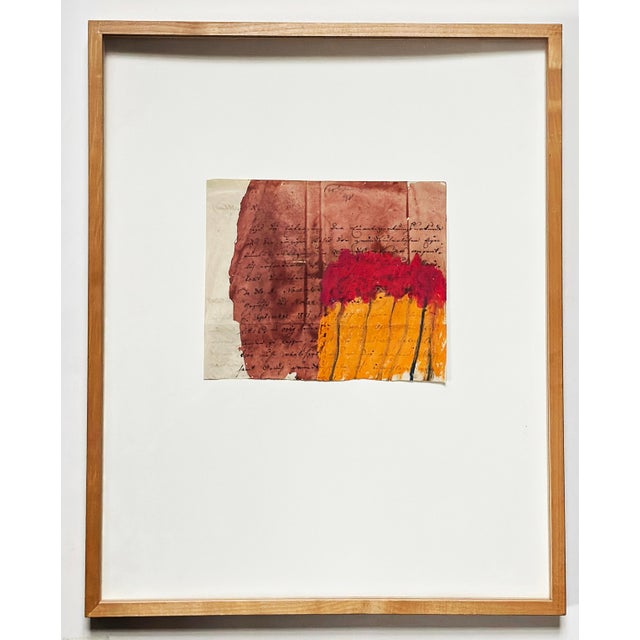
Karl Bohrmann
Mannheim 1928 - Cologne 1998
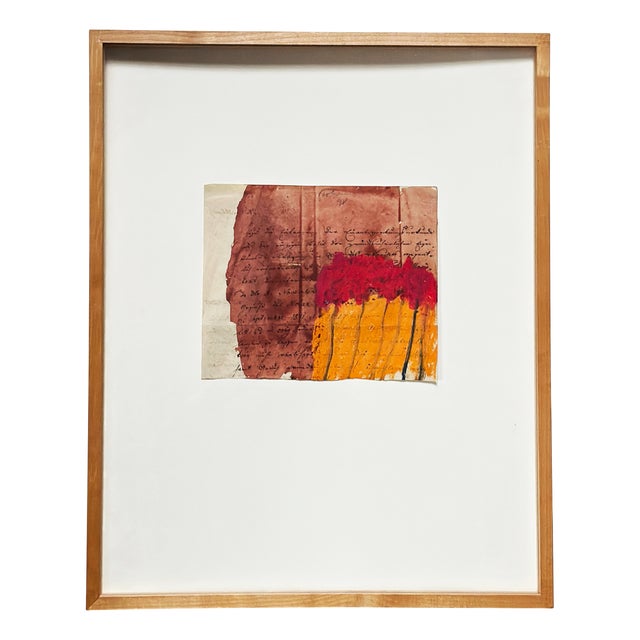
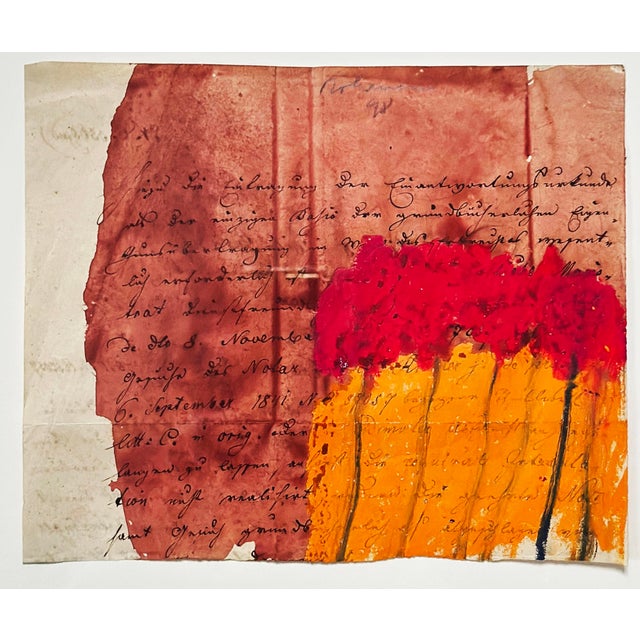
Letters from Vienna, 1998
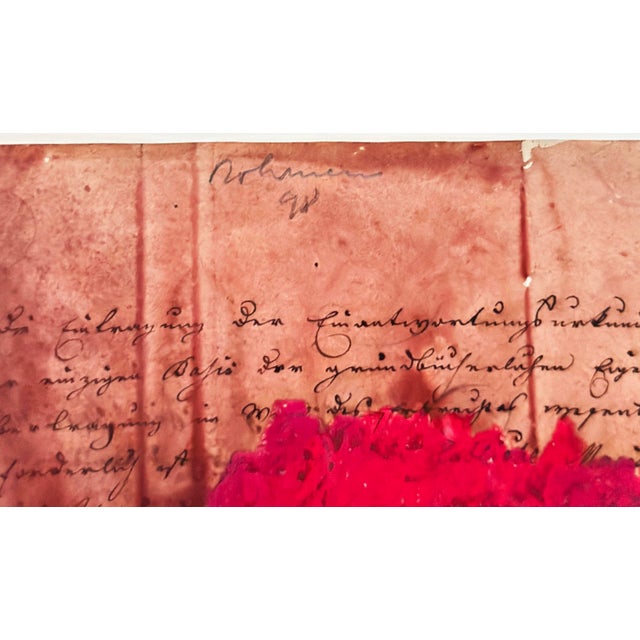
Oil pastel, watercolor over letter
Signed and dated in …
Read more
Karl Bohrmann
Mannheim 1928 - Cologne 1998
Letters from Vienna, 1998
Oil pastel, watercolor over letter
Signed and dated in the center at the top
Sheet size: approx. 17.5 x 21.5 cm
Frame: 51.5 x 41.5 cm
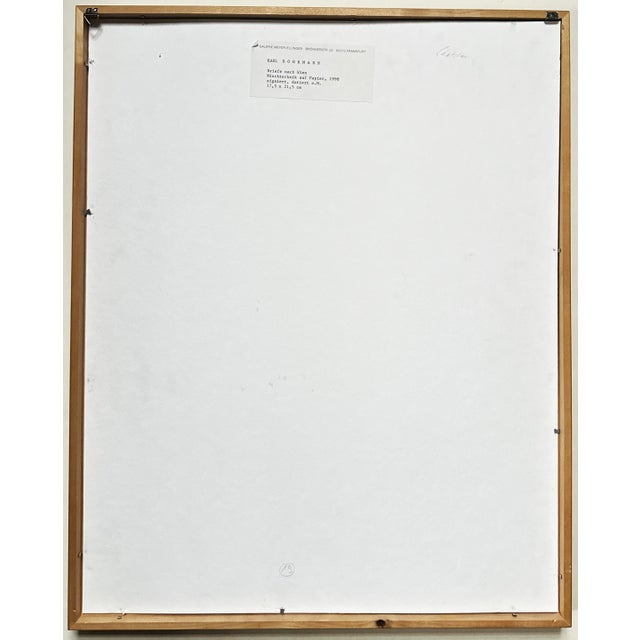
Provenance: Galerie Meyer-Ellinger, Frankfurt am Main (label)
Authenticity will be confirmed in writing.
Karl Bohrmann was born on October 29, 1928, in Mannheim. He began drawing and painting as a schoolboy. At the Mannheim Art Gallery, he was inspired by the works of Caspar David Friedrich and Carl Gustav Carus. Bohrmann met the artist Rudolf Scharpf (1919-2014), who lived in Ludwigshafen am Rhein, and whom he later described as his true teacher. After studying at the Saarbrücken School of Art and Crafts (1947-48) under Karl Kunz and Boris Kleint, and at the Stuttgart Academy of Fine Arts (1948-49) under Willi Baumeister, Bohrmann worked as a freelance artist in the Palatinate Forest, where he and his wife, the artist Maria Reuter, set up a studio in the Morschbacher Hof. In 1952, Bohrmann received a two-year working grant from the state of Rhineland-Palatinate and moved into the studio building in Koblenz that had been specially established for this purpose. Here he met the sculptor Michael Croissant and his wife, the sculptor Christa von Schnitzler. He produced almost exclusively etchings during this period. In 1954, Bohrmann returned to Ludwigshafen am Rhein. During trips to Italy (1953, 1954), Bohrmann encountered the work of Giorgio Morandi, which had a lasting influence on him. In 1957, he was awarded the Baden-Württemberg Youth Art Prize, and in 1958, the Palatinate Prize. Due to his friendship with Michael Croissant, Bohrmann moved to Munich in 1959, where he met Gerhard von Graevenitz. In Munich, the gallery owner Günther Franke included Bohrmann in his program. A trip to Paris led to his encounter with drawings by Alberto Giacometti. Enthralled, Bohrmann began to focus more on drawing. During a several-month trip to Greece in 1962, Bohrmann discovered color and painting. He created watercolor drawings in a delicate, colorful network of lines, influenced by Art Informel, suggesting landscapes and the bodies of slaughtered animals, as he had observed them on his journey. In 1962, Bohrmann received the Rhineland-Palatinate Advancement Award, in 1964 the Premio Lugano, and in 1969 the German Prize at the Mostra Biennale Internazionale della Grafica in Florence. After a trip to New York in 1969, he created his first large-format canvases. In the early 1970s, Bohrmann turned his attention to the theme of figure and space in his drawings. He created watercolor pencil drawings of interiors featuring nudes, as well as tables and lamps suggesting the studio environment. In the winter semester of 1970/71, Bohrmann accepted a guest lectureship at the Städel School in Frankfurt am Main, and from the winter semester of 1971/72, he was the head of instruction at the Städel Evening School. Bohrmann primarily taught figure drawing. In 1972, Bohrmann moved to Frankfurt am Main. He bought a house in Amsterdam, which he occupied during semester breaks. Bohrmann began to explore photography, experimenting with photocollage and collage. In 1977, Bohrmann was represented at documenta 6 with seven large-format watercolor drawings. Teaching at the Städel Evening School stifled Bohrmann; he truly unleashed his creativity during semester breaks in Amsterdam. In 1980, Bohrmann resigned his position at the Städel School and moved permanently to Amsterdam. The Lenbachhaus Municipal Gallery held the first retrospective of Bohrmann's work. In 1982, Bohrmann was awarded the Villa Romana Prize. In Florence, he began to devote himself intensively to painting. The series of paintings on burlap began. It sensitively combines drawing and painting and incorporates Bohrmann's existing repertoire of motifs, such as the house, the interior, the window, the nude, the landscape, and celestial phenomena. with the works on burlap, Bohrmann's line became bolder. He began using oil pastels in addition to oil pastels. He also drew and created collages. After returning to Germany, Bohrmann settled in Düsseldorf in 1983 and in Cologne in 1986. from 1985 onward, drawing, along with collage, once again became Bohrmann's most important artistic means of expression. Varying repetitions of the “objects” of his “iconography” characterize Bohrmann’s work of the 1990s: his prominent, highly esteemed series such as the “Nude with Red Coat”, the “Red Figure”, Trees, Red Trees, Steamers, Ladders, Still Lifes, “Letters to Vienna” and the celestial phenomena were created – works of the highest poetic sensitivity and magical suggestion. This piece has an attribution mark,
I am sure that it is completely authentic and take full responsibility for any authenticity
issues arising from misattribution
See less
- Dimensions
- 16.14ʺW × 1.18ʺD × 20.08ʺH
- Art Subjects
- Nude
- Period
- 1990s
- Country of Origin
- Germany
- Item Type
- Vintage, Antique or Pre-owned
- Condition
- Good Condition, Original Condition Unaltered, Some Imperfections
- Color
Returns & Cancellations
Return Policy - All sales are final 48 hours after delivery, unless otherwise specified in the description of the product.
Cancellation Policy - Prior to shipping or local pickup, buyers may cancel an order for up to 48 hours, unless otherwise specified.