



Details
Description
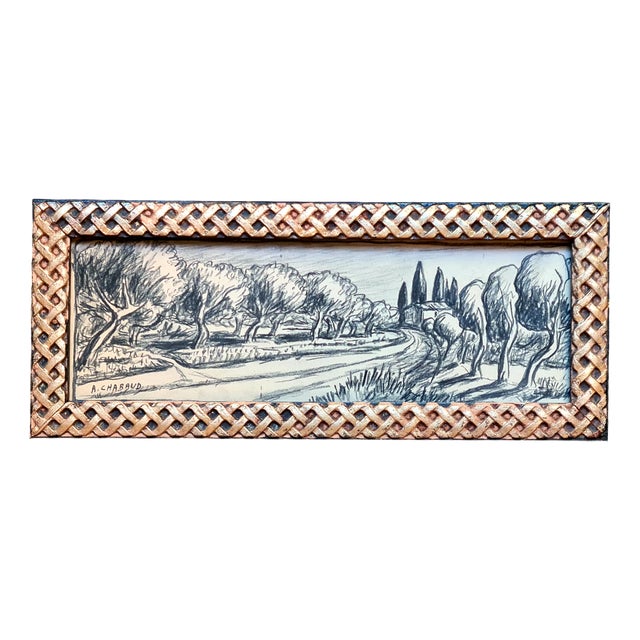
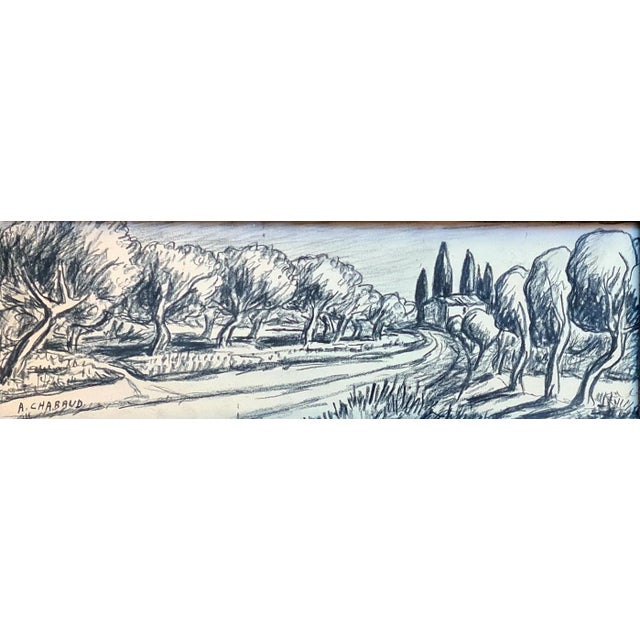
French Fauvist landscape drawing by Auguste Chabaud. The drawing is signed bottom left and carries the atelier stamp and reference …
Read more
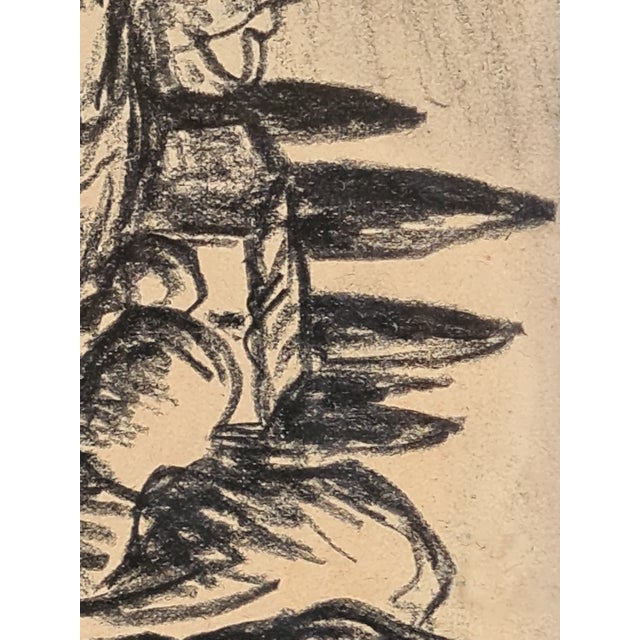
French Fauvist landscape drawing by Auguste Chabaud. The drawing is signed bottom left and carries the atelier stamp and reference numbers to the back. Presented in a fine black and gilt custom frame with glass to back and front.
Provenance: from the collection of famous French actor Pierre Richard.
This artwork is a captivating landscape drawing, featuring a serene rural scene. The winding road acts as a compelling focal point, meandering through a grove of gracefully bending olive trees on either side, leading the viewer’s eye toward a distant cluster of pointed cypress trees beside a quaint house. The fluid, sweeping lines create a sense of movement and tranquillity, highlighting the natural beauty of the setting. Chabaud masterfully employs contrasts and shading to evoke depth, with trees casting long shadows that dance across the road. This monochromatic palette enhances the timeless quality of the rural landscape, making it feel both nostalgic and inviting. Notably, the meticulous texture of the foliage and the rhythmic arrangement of the trees add a distinctive charm and organic flow, engaging the observer in a peaceful, contemplative journey through this harmonious scenery.
Auguste CHABAUD was born in Nîmes on October 3, 1882.
At the age of fourteen Chabaud joined the Ecole des Beaux-Arts in Avignon. In 1899 he went to Paris to continue his artistic training at the Academie Julian and the Ecole des Beaux Arts. There he met Henri Matisse and André Derain. In 1900 he returned to his parents' vineyard in southern France briefly before returning to Paris.
In 1901, he was forced to leave Paris again in order to secure his livelihood. He worked on a ship and got to know the West African coast. Upon his return in 1907 and in the following years, he became acquainted with and captured in his paintings the excitement of the Parisian nightlife. In the Paris neighbourhood Montmartre, where he had his studio, he painted various scenes of Parisian life and cafe society.
At the same time, he continued to paint Provence and took part in the Salon des Indépendants and the Salon d’Automne, where he exhibited with the Fauves.
Chabaud's Cubist phase began in 1911, where he also began sculpting. In the following years he had many exhibitions, including 1913 in New York, where his works were exhibited alongside those of artists such as Matisse, Derain, Vlaminck and Picasso.
After his return from the first World War Chabaud settled down in Graveson. from 1920 he had his "blue period". He used the Prussian Blue as the only colour in his works. from then, he focused exclusively on the south of France. He painted scenes of rural life, the farmers, and the hills and trails of the Alpilles.
A very important retrospective exhibition of his work took place in Paris in 1952, which gave him the opportunity to return to Paris, which he had left in 1914. Another retrospective exhibition in Paris took place in 1965 commemorating the tenth anniversary of his death.
He died in 1955 in Graveson.
In 1966, he was represented at the exhibition “Le Fauvisme français et les débuts de l’impressionnisme Allemand” (French Fauvism and the beginnings of German Impressionism) which were held at the Musée d’Art Moderne in Paris and at the Haus Der Kunst in Munich.
In 1992, the Regional Council of Provence-Alpes-Côte d'Azur opened the Musée Auguste Chabaud in his honour. This piece has an attribution mark,
I am sure that it is completely authentic and take full responsibility for any authenticity
issues arising from misattribution
See less
- Dimensions
- 17.32ʺW × 0.39ʺD × 8.27ʺH
- Period
- 1920s
- Country of Origin
- France
- Item Type
- Vintage, Antique or Pre-owned
- Condition
- Good Condition, Original Condition Unaltered, Some Imperfections
- Color
- Gray
Returns & Cancellations
Return Policy - All sales are final 48 hours after delivery, unless otherwise specified in the description of the product.
Cancellation Policy - Prior to shipping or local pickup, buyers may cancel an order for up to 48 hours, unless otherwise specified.