





Details
Description
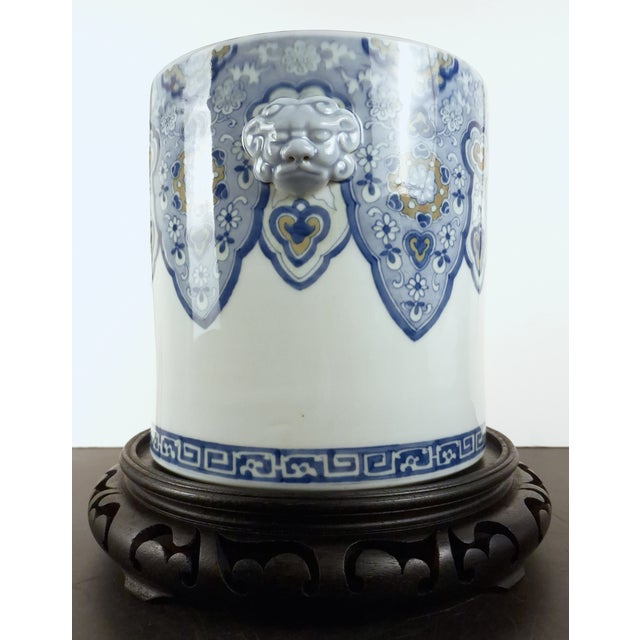
Chinese porcelain Tao Tie handles bitong, a large, finely formed, heavy, cylindrical brush pot with straight sides and a white …
Read more
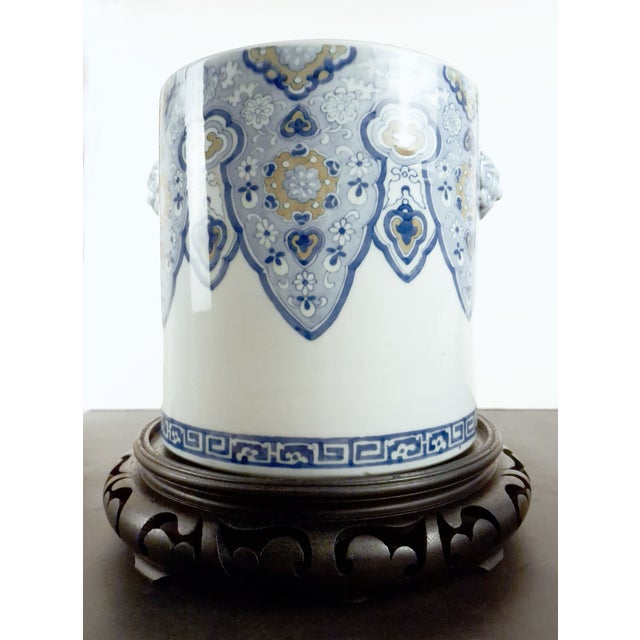
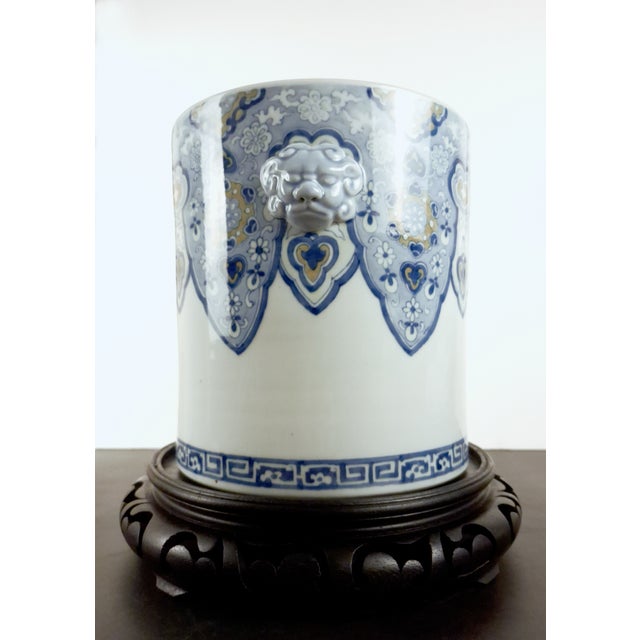
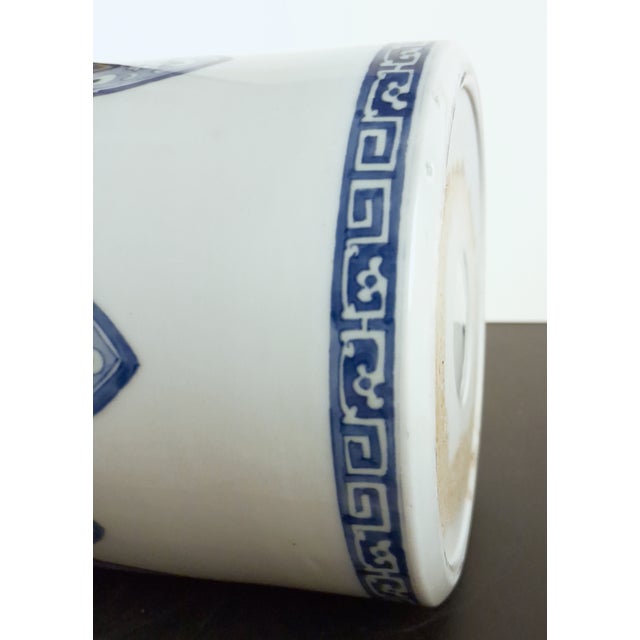
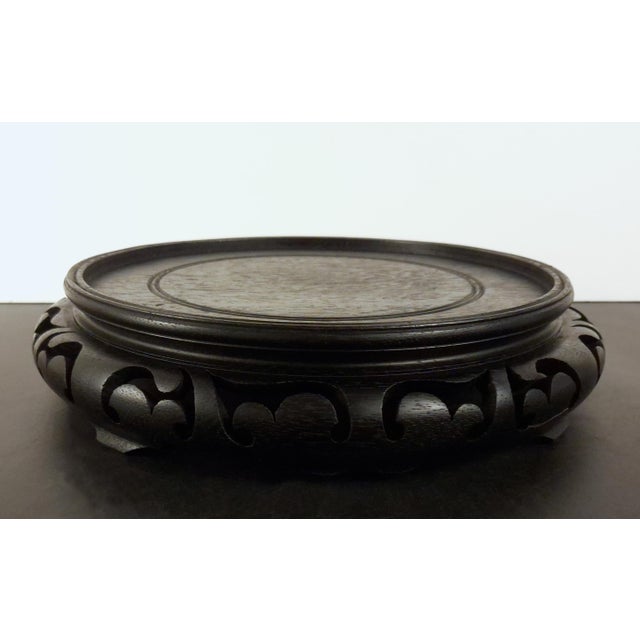
Chinese porcelain Tao Tie handles bitong, a large, finely formed, heavy, cylindrical brush pot with straight sides and a white glazed exterior, interior and inset base. The heavy rim is decorated with a band of small, dark and light blue, four leaf medallions that present as small dark blue diamonds in light blue circles. The upper body of the brush pot is decorated with six, finely drawn, very large, ornate, Ru Li lappets in white, and dark and light blue, with mustard yellow highlights, overlaid with smaller ornate, Ru Yi lappets near the rim, all decorated with floral medallions. Two, finely carved, sky blue, Tao Tie handles divide the six large Ru Yi lappets on the upper sides of the pot. The bottom of the pot has a narrow band of dark blue, double, cloud and thunder meanders alternating with double, stylized dragon symbols on a light blue ground. A dark blue, lacewing symbol is glazed to the circular inset of the base. The finely carved, traditional, reticulated, hongmu stand is included. Circa Republic of China period.
bitong: 10.375" high x 9.5 diameter
stand: 2.75" high x 12.25" diameter
Tao Tie: The first known usage of Tao Tie is in the Zuo Zhuan, a narrative history of China written in 30 chapters between 722 and 468 BCE. It is used to refer to one of the four evil creatures of the world, (四凶; sì xiōng), a greedy and gluttonous son of the Jinyun clan, who lived during the time of the mythical Yellow Emperor. Within the Zuo Zhuan, Tao Tie is used by the writer to imply gluttony. A well-known later list of the Nine Children of the Dragon given by Yang Shen (1488–1559) accords with both the ancient and the modern usage of the term: The Tao Tie likes to eat and drink; it used to appear on the surface of the dings.
The historian Luo Bi [zh], of the Southern Song dynasty, connected the Tao Tie motif to Chiyou, writing in the Lushi that the Yellow Emperor "cut his head off; and for this reason sages later cast his portrait on bronzes to warn the greedy. Luo Bi's son, Luo Ping (historian), expanded on this further, writing that:
Chiyou was a spirit of the heavenly magic; his nature and shape were never consistent. The bronzes from the three dynasties were often cast with Chiyou's portrait to warn those who are greedy. The form of Chiyou is most likely an animal, with the addition of wings of flesh; it started at the time of the Yellow Emperor.
See less
- Dimensions
- 12.25ʺW × 12.25ʺD × 12.75ʺH
- Styles
- Chinese
- Traditional
- Period
- 1930s
- Country of Origin
- China
- Item Type
- Vintage, Antique or Pre-owned
- Materials
- Porcelain
- Wood
- Condition
- Good Condition, Original Condition Unaltered, Some Imperfections
- Color
- Blue
- Condition Notes
- A stable hairline can be seen on the upper interior wall (see 7th pic). The rim has two kiln glaze … moreA stable hairline can be seen on the upper interior wall (see 7th pic). The rim has two kiln glaze defects (see pic 8). The interior and exterior bottom of the pot have roughly finished overglazes, otherwise excellent vintage condition. less
Questions about the item?
Returns & Cancellations
Return Policy - All sales are final 48 hours after delivery, unless otherwise specified in the description of the product.
Cancellation Policy - Prior to shipping or local pickup, buyers may cancel an order for up to 48 hours, unless otherwise specified.