




Details
Description
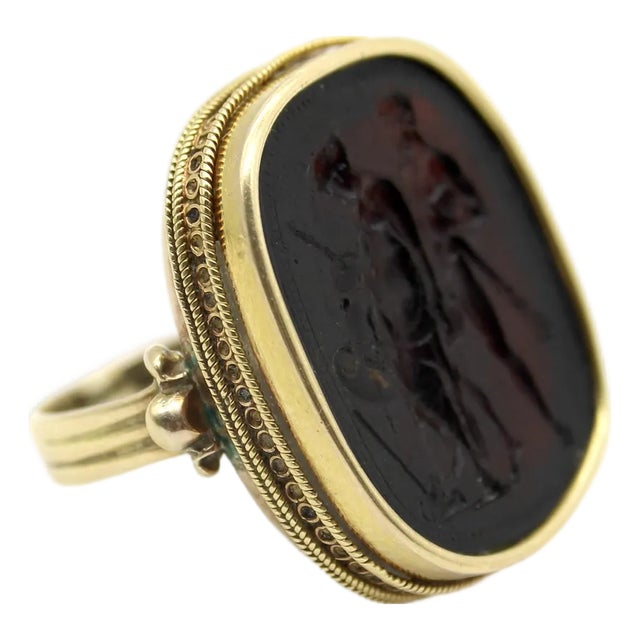
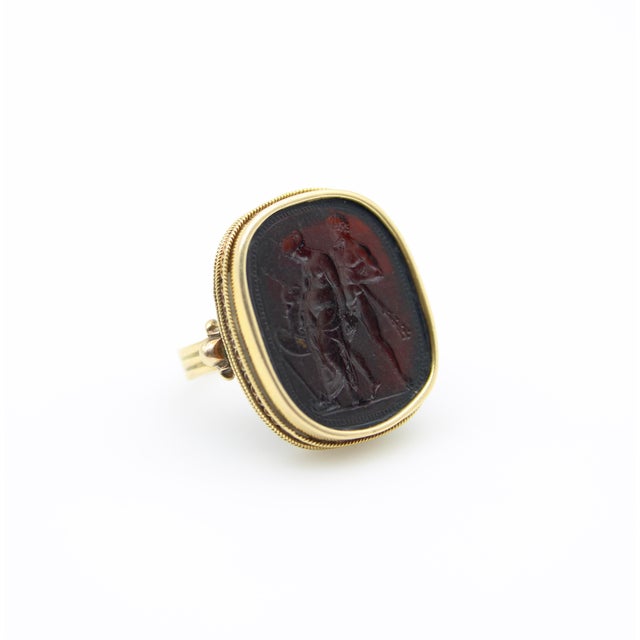
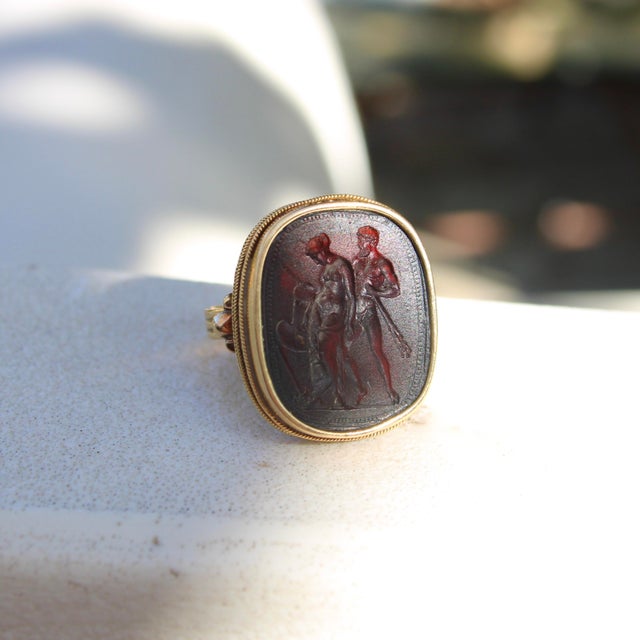
This 18k gold ring features an intaglio attributed to James Tassie, circa 1760-1780. The deep, red cast glass intaglio is …
Read more
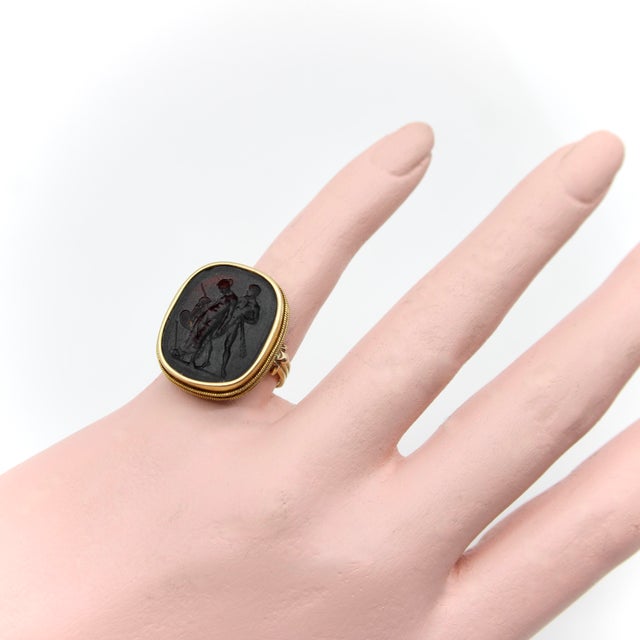
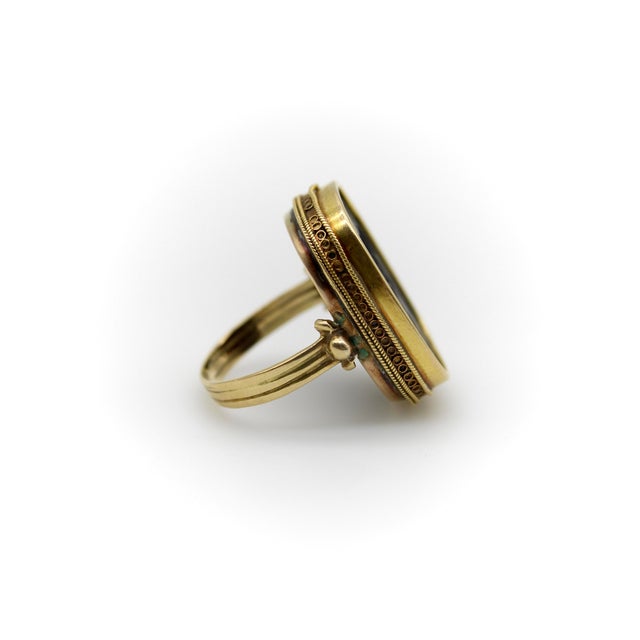
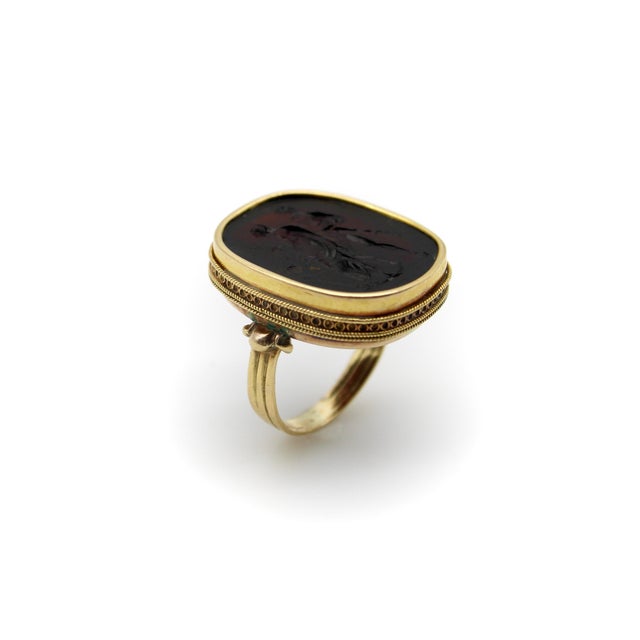
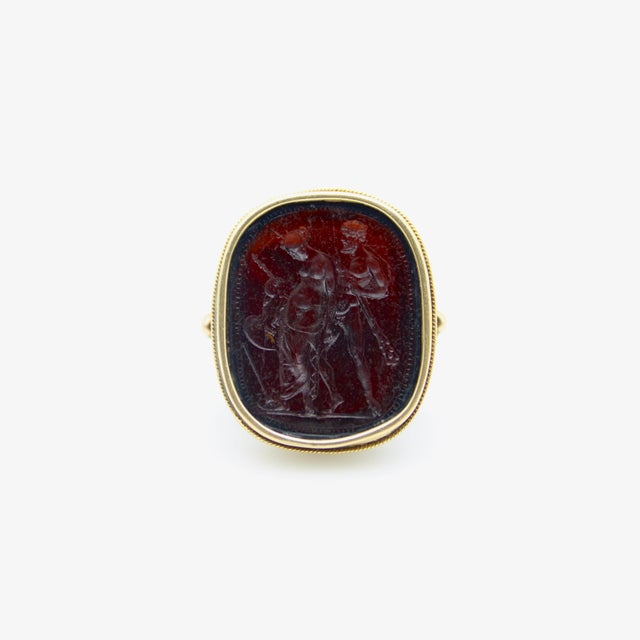
This 18k gold ring features an intaglio attributed to James Tassie, circa 1760-1780. The deep, red cast glass intaglio is embossed with an image of Hercules and Omphale, standing in an embrace. The image of the two lovers creates an elegant composition on the cushion-shaped intaglio. When held up to the light, the translucent glass glows a blood red, and the details of the carving are even more visible. The intaglio, which would have originally been used as a seal, is bezel set in a 14k gold ring, with Etruscan Revival details. Though we aren’t quite sure of the age of the ring, we can date it to at least 1820-1840 and believe it may be even older. The ring has classic Etruscan Revival twisted wirework around the sides of the bezel—braided and with intricate repeating circles. It connects with a tiny ball detail to a band that is divided into three lines. The imagery of the intaglio combined with the luminous dark red makes this an intriguing and romantic ring.
There are many stories of lovers in Greek mythology, and the romantic element of these millennia-old tales is part of what captures our imagination. The details of this intaglio suggest that the lovers represented in this ring are Hercules and Omphale. Hercules was often depicted with a large wooden club or staff, as seen held behind him on this ring. Omphale has a weapon, perhaps an axe or another club, at her feet and a shield before her. In the classic myth, Hercules was ordered to be Omphale’s servant, as a punishment for accidentally murdering Iphitus. Omphale demanded that Hercules wear women’s clothing and spin wool, while she wore the skin of a lion and worked on making a club. By the time Hercules’s punishment was over, he had fallen in love with Omphale and eventually married her.
Born in 1735, James Tassie was a Scottish stonemason who invented a glassy white paste perfect for replicating gemstones. Tassie was commissioned across Europe, first by Catherine the Great of Russia, then by the Wedgwood factory, to create imitation gemstones and elaborately carved intaglios. In 1773, most of the infamous blue and white cameos in the Wedgwood catalogue were cast from molds made by Tassie. The artist left behind a collection of over 15,800 intricate pieces of artwork. Many of Tassie’s intaglios were cast in glass-paste or plaster, which could eventually break. However, some were cast into bronze—which have survived for centuries. These pieces are rare treasures that capture Tassie’s incredible skill.
The face of the ring measures 15/16” x 13/16” and is 1/4” deep. The band is 3 mm wide. The ring weighs 8.5 grams. Unmarked but acid tests as 18k. In very good antique condition.
Ring size 6. Resizable by a knowledgable jeweler.
See less
- Styles
- Georgian
- Ring Size
- 6
- Period
- 18th Century
- Item Type
- Vintage, Antique or Pre-owned
- Materials
- 18K Gold
- Glass
- Condition
- Good Condition, Original Condition Unaltered, Some Imperfections
- Color
- Gold
- Condition Notes
- In very good condition with no visible wear. In very good condition with no visible wear. less
Questions about the item?
Returns & Cancellations
Return Policy - All sales are final 48 hours after delivery, unless otherwise specified in the description of the product.
Cancellation Policy - Prior to shipping or local pickup, buyers may cancel an order for up to 48 hours, unless otherwise specified.