




Details
Description
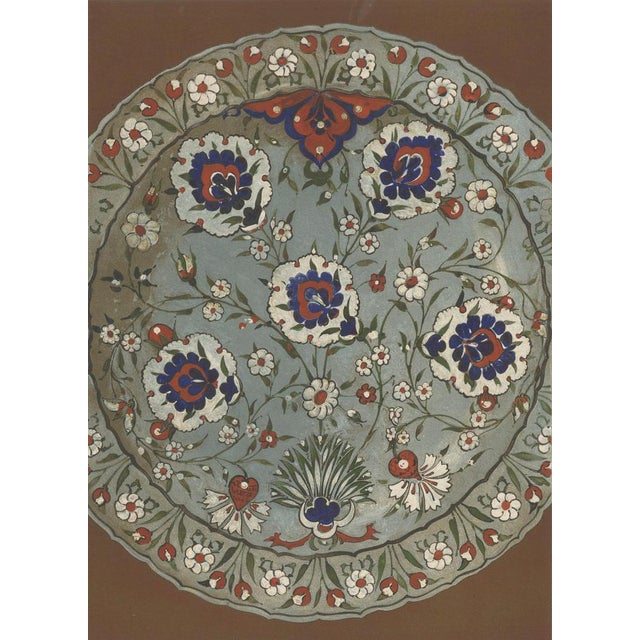
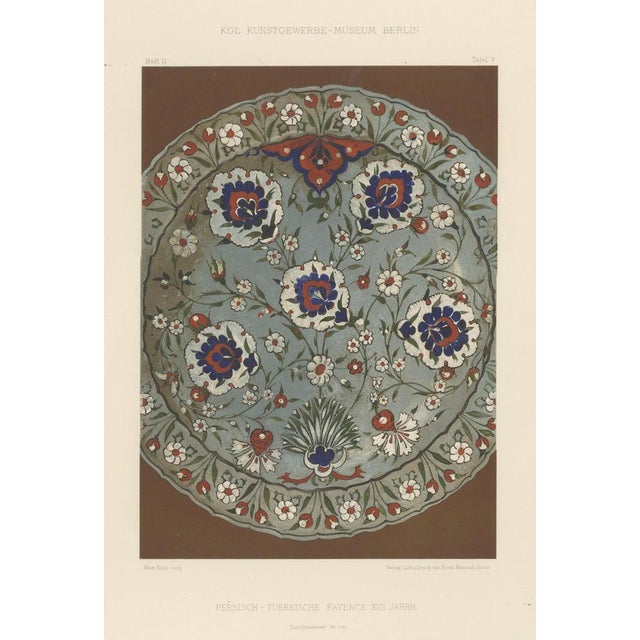
Persian-Turkish Faience Plate with Carnation Motif – Julius Lessing, Berlin 1890 : A richly detailed chromolithograph from Julius Lessing’s Persisch-Türkische … Read more Persian-Turkish Faience Plate with Carnation Motif – Julius Lessing, Berlin 1890 : A richly detailed chromolithograph from Julius Lessing’s Persisch-Türkische Fayencen (Persian-Turkish Faience), published by Ernst Wasmuth in Berlin, 1890, as part of Vorbilder-Hefte aus dem Königlichen Kunstgewerbe-Museum, Heft 11. This plate (Tafel 9) reproduces a 16th-century faience dish from the celebrated collection of the Royal Museum of Decorative Arts in Berlin. The print captures the exquisite ornamentation of an Iznik plate decorated with scrolling floral patterns and stylized carnations — one of the most recognizable elements in Ottoman ceramic art. The design features large composite blossoms surrounded by delicate stems of smaller flowers and leaves, harmoniously arranged across a pale blue background. A border of alternating blossoms and buds encircles the rim, unifying the pattern within a rhythmic botanical framework. Rendered in deep cobalt blue, coral red, turquoise, white, and sage green, the palette reflects the distinct color harmony of 16th-century Iznik pottery, famous for its refinement and luminosity. The central floral arrangement radiates elegance and serenity, exemplifying the synthesis of Persian-inspired motifs and Ottoman artistry that defined the era’s ceramics. Drawn by Max Koch and printed by the distinguished Berlin lithographer Ernst Wasmuth, this chromolithograph belongs to one of the most influential late 19th-century series documenting decorative arts worldwide. Under the direction of Julius Lessing (1843–1908), the *Vorbilder-Hefte* publications aimed to provide authentic visual references for artists, architects, and craftsmen, promoting appreciation for the ornament traditions of Islamic, Asian, and European art. Condition report: Excellent condition with vivid, unfaded colors. Slight marginal toning and faint handling marks at edges, well within acceptable range for age. Wide margins preserved. Framing tips: A simple ivory or sand-toned mat with a medium oak or gilt frame will complement the soft blue and red tones beautifully. Pairs well with other plates from the *Persisch-Türkische Fayencen* series for a cohesive display. Technique: Chromolithograph Maker: Julius Lessing, Berlin, 1890 See less
- Dimensions
- 12.99ʺW × 19.29ʺH
- Art Subjects
- Figure
- Period
- Late 19th Century
- Country of Origin
- Germany
- Item Type
- Vintage, Antique or Pre-owned
- Materials
- Paper
- Condition
- Good Condition, Unknown, Some Imperfections
- Color
- Blue
- Condition Notes
- Very Good — This vintage item has no defects, but it may show slight traces of use\. Excellent condition with … moreVery Good — This vintage item has no defects, but it may show slight traces of use\. Excellent condition with vivid, unfaded colors. Slight marginal toning and faint handling marks at edges, well within acceptable range for age. Wide margins preserved. less
Returns & Cancellations
Return Policy - All sales are final 48 hours after delivery, unless otherwise specified in the description of the product.
Cancellation Policy - Prior to shipping or local pickup, buyers may cancel an order for up to 48 hours, unless otherwise specified.
Related Collections
- Tatiana Alida Original Prints
- Greg Copeland Original Prints
- Clay Walker Original Prints
- Balmain Original Prints
- Carrie Bergey Original Prints
- George Barbier Original Prints
- William Meyerowitz Original Prints
- Gustave Baumann Original Prints
- Louis XIII Original Prints
- Frank Stella Original Prints
- Gorman Original Prints
- Leonardo Nierman Original Prints
- Byzantine Original Prints
- Chaim Gross Original Prints
- Teak Original Prints
- Crystal Original Prints
- Abraham Rattner Original Prints
- Botanical Prints
- Japanese Woodblock Prints
- Bird Prints
- Woodblock Prints
- Framed Prints
- Thomas McKnight Original Prints
- Screen Prints
- Black and White Prints