




Details
Description
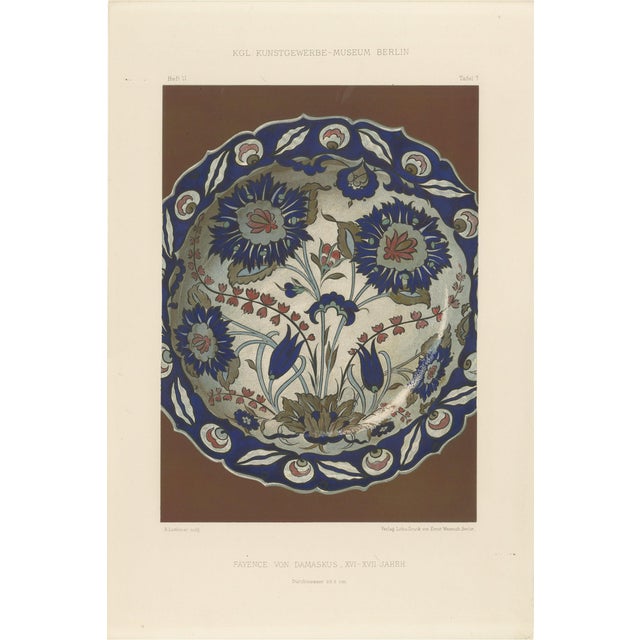
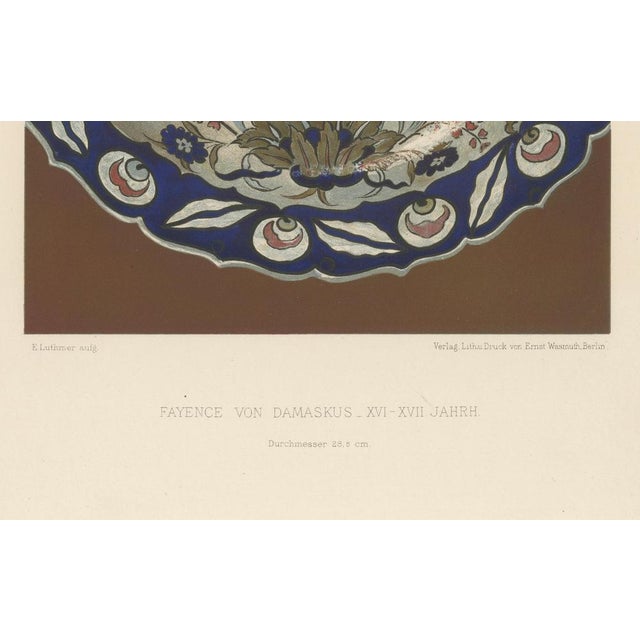
Damascus Faience Plate with Carnations and Tulips – Julius Lessing, Berlin 1890 : A striking chromolithograph from Julius Lessing’s Persisch-Türkische … Read more Damascus Faience Plate with Carnations and Tulips – Julius Lessing, Berlin 1890 : A striking chromolithograph from Julius Lessing’s Persisch-Türkische Fayencen (-Turkish Faience), published by Ernst Wasmuth, Berlin, in 1890 as part of Vorbilder-Hefte aus dem Königlichen Kunstgewerbe-Museum, Heft 11. This print (Tafel 7) reproduces a 16th–17th-century faience plate from Damascus, part of the Royal Museum of Decorative Arts in Berlin’s collection of Islamic ceramics. The plate displays a vivid arrangement of stylized carnations, tulips, and rosettes, characteristic of Syrian faience from the late Ottoman and Mamluk periods. The design radiates with a refined interplay of cobalt blue, turquoise, sage green, and soft red against a pale ground, enclosed within a scalloped rim of bold undulating leaves and blossoms. The naturalistic yet stylized floral composition embodies the transitional style of 16th-century Damascus pottery, blending influence with local Levantine flair. Unlike the pure white background of Iznik ware, Damascus faience often features a subtle grayish or silvery tone, enhancing the depth of the colors. The rhythmic floral pattern and balanced symmetry evoke a sense of harmony and divine geometry, reflecting Islamic art’s emphasis on beauty as a reflection of order in the universe. Drawn by E. Luthmer and printed under the direction of Julius Lessing (1843–1908), this plate was part of the pioneering Vorbilder-Hefte series published to inspire European designers and craftsmen with the ornamental traditions of global art. Lessing’s dedication to the study of Islamic ceramics helped introduce Ottoman and decorative art to Western design education and the emerging Art Nouveau movement. Condition report: Excellent condition with crisp, vibrant coloration and wide margins. Minor edge toning and faint handling marks, consistent with age. Image area clean and fresh. Framing tips: A dark brown or mahogany frame with a cream mat will enhance the rich cobalt and red hues of this composition. Ideal as a stand-alone display or in combination with other plates from Lessing’s *Persisch-Türkische Fayencen* series. Technique: Chromolithograph Maker: Julius Lessing, Berlin, 1890 See less
- Dimensions
- 12.99ʺW × 19.29ʺH
- Art Subjects
- Figure
- Period
- Late 19th Century
- Country of Origin
- Germany
- Item Type
- Vintage, Antique or Pre-owned
- Materials
- Paper
- Condition
- Good Condition, Unknown, Some Imperfections
- Color
- Blue
- Condition Notes
- Very Good — This vintage item has no defects, but it may show slight traces of use\. Excellent condition with … moreVery Good — This vintage item has no defects, but it may show slight traces of use\. Excellent condition with crisp, vibrant coloration and wide margins. Minor edge toning and faint handling marks, consistent with age. Image area clean and fresh. less
Returns & Cancellations
Return Policy - All sales are final 48 hours after delivery, unless otherwise specified in the description of the product.
Cancellation Policy - Prior to shipping or local pickup, buyers may cancel an order for up to 48 hours, unless otherwise specified.
Related Collections
- Tatiana Alida Original Prints
- Greg Copeland Original Prints
- Clay Walker Original Prints
- Balmain Original Prints
- Carrie Bergey Original Prints
- George Barbier Original Prints
- William Meyerowitz Original Prints
- Gustave Baumann Original Prints
- Louis XIII Original Prints
- Frank Stella Original Prints
- Gorman Original Prints
- Leonardo Nierman Original Prints
- Byzantine Original Prints
- Chaim Gross Original Prints
- Teak Original Prints
- Crystal Original Prints
- Abraham Rattner Original Prints
- Botanical Prints
- Japanese Woodblock Prints
- Bird Prints
- Woodblock Prints
- Framed Prints
- Thomas McKnight Original Prints
- Screen Prints
- Black and White Prints