




Details
Description
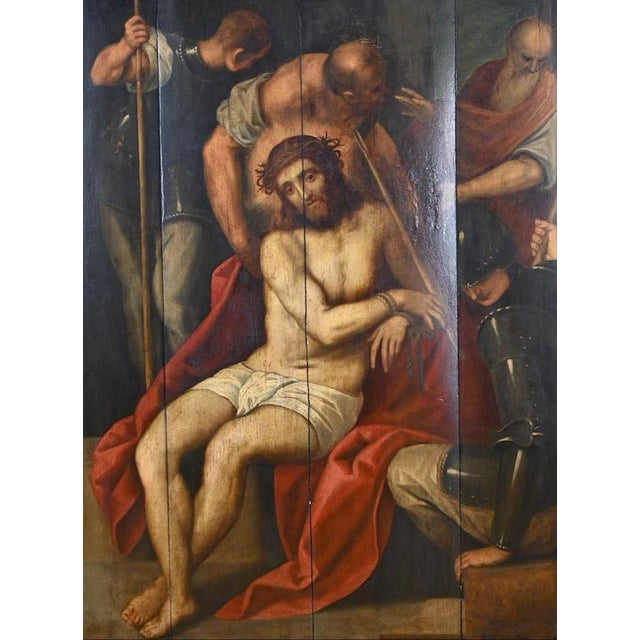
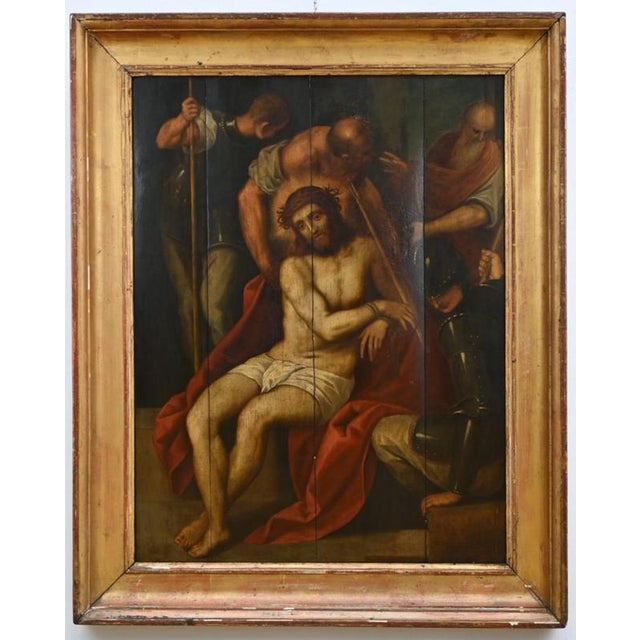
Italian Panel, Circle of Jacopo Palma the Younger, late 16th–early 17th century " Ecce Homo" (91 x 120 x 0 …
Read more
Italian Panel, Circle of Jacopo Palma the Younger, late 16th–early 17th century " Ecce Homo" (91 x 120 x 0 cm) Good condition The image is an artistic representation of the biblical scene known as "Ecce Homo." This moment, which means "Behold the man" in Latin, refers to the words spoken by Pontius Pilate when he presented Jesus, crowned with thorns and wearing a robe, to the hostile crowd before his crucifixion. The scene takes place after Christ's scourging and crowning with thorns. Pilate presents Jesus to the crowd, indicating that he finds no guilt in him, but the people demand his crucifixion. The theme has been depicted by numerous artists throughout history, including Caravaggio, Bosch, and Titian. The representation of Jesus as "Ecce Homo" is a symbol of suffering and martyrdom. Jacopo Negretti, or Giacomo, called Palma the Younger, to distinguish him from his great-uncle Jacopo Palma the Elder (Venice, September 1549 – Venice, October 17, 1628), was an Italian painter and citizen of the Republic of Venice, an important exponent of the Venetian school. Born to Antonio Palma, a painter, and Giulia Brunello, members of a family with a strong artistic inclination, he was immediately initiated into the study of painting, following in the footsteps of his father's uncle, Palma the Elder, and his mother's aunt's husband, Bonifacio de' Pitati (known as Bonifacio Veronese). In 1564, the Duke of Urbino, Guidobaldo II della Rovere, visiting Venice, appreciated Jacopo's artistic talents. He first invited him to court and then, in May 1567, sent him to Rome as a guest of his ambassador, Trajan Marius, for four years.[1] from his Roman period is the Portrait of Matteo da Lecce, which bears the inscription "pitor in Roma" (pictor in Rome) from 1568. He studied and was influenced by Raphael and Tintoretto, and executed several copies of Titian, his true master, with whom he later collaborated, also completing the famous painting, La Pietà. He trained during the Venetian school and Roman Mannerism, which he learned during his four-year stay in Rome. His artistic production began around 1565. In 1582, he married Andriana Fondra, who, however, caused the painter considerable concern due to her unstable spirit, a situation exacerbated by the premature death of the couple's two children, and which led to her death in February 1605. He enjoyed great success in the Bergamo area, his father's hometown, and was among the most active in the late 16th century. He died "oppressed by catarrh" in 1628, without any of his heirs (his daughters Crezia and Giulia and his grandchildren Andriana and Giacomo) continuing the Palma family's artistic endeavors. This piece is attributed to the mentioned designer/maker. It has no attribution mark and no
official proof of authenticity,
however it is well documented in design history. I take full responsibility for any authenticity
issues arising from misattribution
See less
Returns & Cancellations
Return Policy - All sales are final 48 hours after delivery, unless otherwise specified in the description of the product.
Cancellation Policy - Prior to shipping or local pickup, buyers may cancel an order for up to 48 hours, unless otherwise specified.
Related Collections
- Lee Krasner Paintings
- Limoges, France Paintings
- Steve Kaufman Paintings
- Richard Anuszkiewicz Paintings
- Laminate Paintings
- Donald Judd Paintings
- Michelle Arnold Paine Paintings
- Jacobean Paintings
- Louis Wolchonok Paintings
- Nikolaos Schizas Paintings
- Francine Tint Paintings
- Jean Calogero Paintings
- Joseph Solman Paintings
- Keith Haring Paintings
- Paul Jenkins Paintings
- René Magritte Paintings
- Vienna Secession Paintings
- Camille Pissarro Paintings
- Paintings in Panama City, FL
- Mark Lewis Paintings
- Mark Lewis Art Paintings
- BandB Italia Paintings
- Damien Hirst Paintings
- Sol LeWitt Paintings
- Ralph Lauren Paintings