





Details
Description
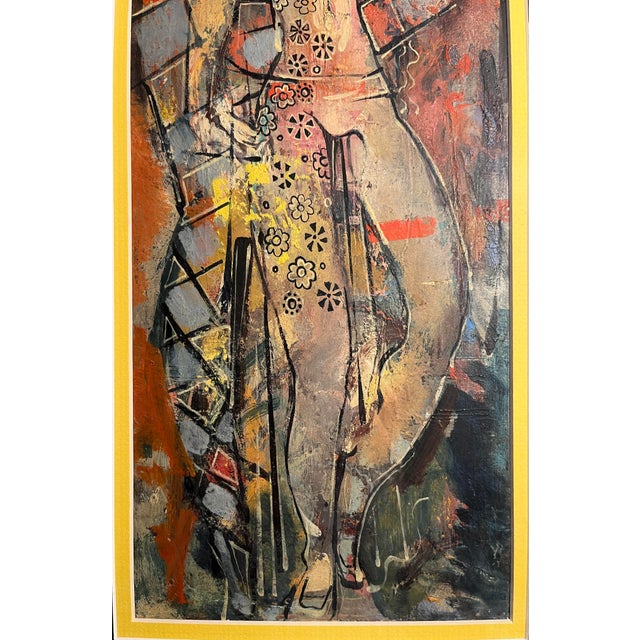
1963 Oil on Board Painting by American Artist Wilfred A. Lang Jr. Dated and Signed
Aprox. dimensions:
Frame: 27"H x …
Read more
1963 Oil on Board Painting by American Artist Wilfred A. Lang Jr. Dated and Signed
Aprox. dimensions:
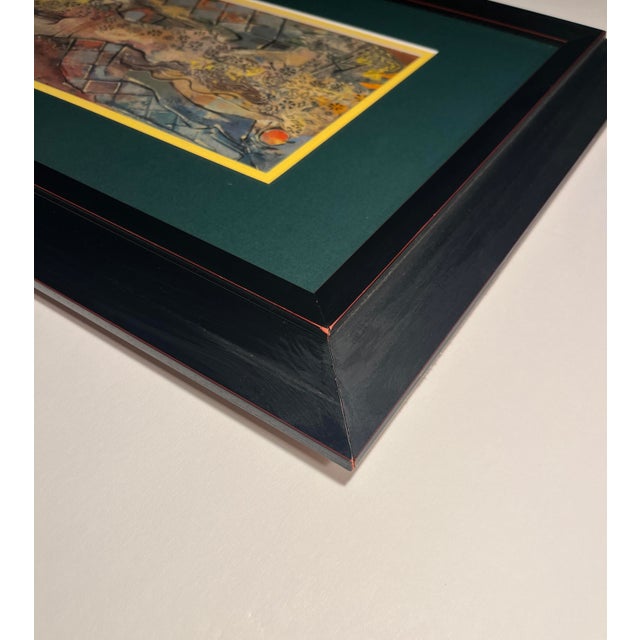
Frame: 27"H x 15.5"W
Painting: 18"H x 7"W
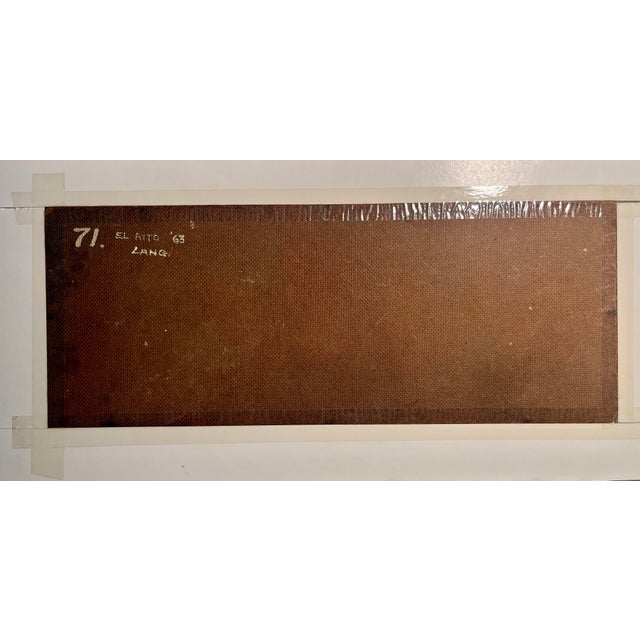
Very good original condition! Pictures #5 & 6 show the back of the painting before restoration, including the date of creation and the artist's name. The painting has since been reframed with acid free materials and protective glass.
Wilfred A. Lang Jr. 1915-1994 - Biographical Notes:
1915-1923 Born in Withee Wisconsin April 28, 1915, of Danish and English parents. The Family lived for a short time in Omaha Nebraska, and moved to Colorado in 1919 where most of his early life was spent in Pueblo, La Junta, and Beulah.
1924-1930 A serious accident at the age of 9 resulted in a shattered hip which required nearly two years hospitalization in Eugene Oregon under the supervision of his aunt Dr. Leslie Kent. Wilfred returned to Colorado to continue school after recovery and dropped out of school at age 16 due to lost years making him much older than classmates and making it difficult to readjust.
1931-1933 Worked for Rocky Mountain News in La Junta Colorado, on local ranches near Pueblo and Beulah, and on an uncle's dairy farm in Wisconsin.
1934- Entered CCC camp in Beulah Colorado for 18 months.
1935-1938 At the insistence Dr. Kent, and with her assistance, returned to Eugene Oregon and entered the University of Oregon School of Fine Arts as a special student. Notable among his artistic influences at the University was Maude Kerns, who had studied at the Bauhaus with Klee and Kandinsky and taught composition, color theory, design and art history. During the first summer vacation Wilfred rode freight cars in an abortive venture to Alaska where he was turned back after entering Canada, due to lack of funds, and returned to work construction on the Grand Coulee Dam. Wilfred worked part-time as a bell-hop at Eugene's Osborn Hotel during the rest of his University years in Eugene.
1939- Married Katherine Elizabeth Felton, fellow art student at the University, and moved to San Francisco to enter the Livingston School of Advertising Art. Realizing after six months that he was interested only in the fine arts Wilfred enrolled in the San Francisco School of Fine Arts as a sculpture student and apprenticed under Ralph Stackpole.
1940-1945 Returned to Oregon in the late spring of 1940, where first child Sonia was born, and spent three years in Eugene working at surveying and again at the Osborn Hotel. During this time Wilfred studied with Jack Wilkinson, a guest painting instructor, at the University. Moved to Portland in 1943, where second child Justeena was born, and formed close relationships with northwest painters C.S. Price, Morris Graves, Charles Heaney, and Howard Sewell, as well as with members of the Fine Arts Group at the Civilian Public Service camp at Waldport Oregon, notably William Everson (Brother Antoninus). He worked as art editor of Compass magazine and associated closely with Illiterati magazine and the Untide Press publications at Waldport, a group that later became nucleus of the Interplayers in San Francisco. Wilfred designed and illustrated a small collection of George Woodcock's early poems. Wilfred also worked at Allied Arts, a firm of custom decorators in Portland, where he entered into the world of theater, designing and building theatrical props and worked part-time as a stage hand on the Monte Carlo Ballet, Shipstad and Johnson's Ice Follies, and Shakespearean road shows. Wilfred considered this a richly stimulating experience that had influence on his painting. Wilfred set up his first formal studio in Portland Oregon in a spacious seven room suite costing $15.00 a month rent with a balcony overlooking the Skidmore Fountain.
1946- Moved to the Olympic Peninsula in Washington's Puget Sound with several of the Fine Arts Group from Waldport for a year's experience in subsistence living and where third child Peter was born. Arduous winter weather along with unsatisfactory possibilities for painting caused a move back to California.
1947-1954 Spent the following seven years in Sonoma County California at Bernard Zakheim's Farm Arts, Hamilton Tyler's Treesbank, Duncan's Mills, Pond Farm and Guerneville. A fourth child Stanley was born in 1947. Betty Lang, in need of a major operation, took the children to her family in Oregon where she stayed for a year. Wilfred worked as a carpenter, custom home builder, and cabinet maker during the years at Sonoma County while painting in all his free time. Wilfred still considered himself a student of fine art during this time and did not show his work or attempt to sell any paintings though many had been given to friends and a few had been purchased by friends Belle Zabins, Ivan Rainer, Walter and Edith Hofmann, and George Tiegel, during 1953-1954. Wilfred and Betty separated in February of 1954 and Wilfred stayed on property bought in Mays Canyon near Guerneville until may of 1955. Late in 1954, through the influence of George Tiegel, Alfred Neumeyer, curator of the Mills College Gallery, saw a few of the major paintings and arranged a show at Mills College for December 1954 and January 1955, the first occasion on which the paintings had been shown publicly.
1955-1957 Wilfred acquired a Monterey fishing boat in Bodega Bay California, and satisfying a lifelong desire to become water-borne, reached the decision which proved a turning point in his life and career, and abandoned the home he built in Mays Canyon, and with the children and Marcia Dickinson, sailed the boat up the San Joaquin River. Wilfred settled the family on a small island amid the complex of waterways and cultivated islands that make up the California Delta. The first months proved so rewarding and promised so rich a life that he determined finally to give up the frustration of part-time painting while working for a living, and devoted his efforts to living in a manner conducive to creative work, and began to paint full time and leave the future to Providence. Although no income could be foreseen, he set about preparing for the winter and establishing a camp on Hog Island, a small tule island unfit for commercial cultivation and uninhabited except for an eighty year old Dutch sailor, Gus Lawrence, and built a primitive barge of drift wood and steel drums that became the center of the camp and studio. Masonite panels generously supplied by George Tiegel from a former door manufacturing plant were used in the construction and also provided material for painting for several years. These paintings on masonite can be identified by scars on the backs of the paintings where the glued door bracing was removed. Allan Engel, owner of Sausalito's Glad Hand, showed paintings in January of 1956 resulting in the sale of several paintings and provided a reliable income for the next two years that enabled the family to live a simple, uncluttered, and very satisfactory life on Hog Island in the California Delta. Fifth child, Lawrence ("Skipper"), was born in 1956. The children attended school in the delta and alternating short periods in Marin County with their Mother. Fish, fowl, game, and vegetables garden and nearby islands provided a large share of food supplemented by monthly boat trips to Stockton for essential staples and hardware.
1958-1960 By 1958 a stockpile of paintings was achieved and a decision was made to spend few months traveling in Mexico. A camper was built on the back of a 1948 Chevrolet truck, which had served well during his carpentering years, and with Walter and Edith Hofmann assuming responsibility for privately showing and selling the paintings and handling all finances and business, the first border crossing was made at Nogales in February 1958. Deeply inspired by the Mexican people, climate, geography, coastlines, and architecture, particularly the ruins, and enabled by good fortune and the low cost of living in Mexico, he traveled extensively throughout Mexico, Yucatan, and Quintana Roo. Walter and Edith Hofmann's unstinted devotion and promoting the sale of paintings allowed unrestricted travel and the opportunity to paint. The sixth child, Marc, was born Atlixco Puebla in August of 1960 and Wilfred traveled to Tucson Arizona to finish paintings.
1961-1964 36 paintings from the three year period of painting in Mexico and Tucson were taken to San Francisco in the spring of 1961 to deliver to Walter Hofmann. Winter of 1961 was spent in Aransas Pass Texas in the aftermath of Hurricane Carla which proved to dissuade any continued life on the water, and success of sales by Walter Hofmann and Candi Tabb of Berkeley who sold some of the earlier paintings, enabled life to continue during the next two years in the small village of El Rito in northern New Mexico. Life in El Rito, where the Mexican-American culture was reminiscent of Mexico and the desolate passive grandeur of the terrain similar to southern Colorado of his adolescence, provided a good atmosphere for painting. This period was very productive and the association with many stimulating and supportive friends, Don and Elaine Devereux, Tomas Atencio, Bob Hill, Leo Neuerburg, Manuel Baca and many others produced a climate for reevaluating and forming a more positive statement. The summer of 1964 was spent wandering in Arizona and California with two trucks and a travel trailer. Private showing of 27 paintings in Los Angeles and then back to Columbus New Mexico for the winter and school for the children.
1965-1966 Columbus proved ill chosen with the threat of the Pan American highway to be built through the middle of the tiny town and with the death of Wilfred Lang Sr. the following summer was spent wandering and camping in New Mexico. A show was organized at Ghost Ranch, National Conference Center for the United Presbyterian Church, and then settling in Alamogorda New Mexico for the winter. Wilfred and Marcia separated and the summer of 1966 was spent wandering and camping in Utah, Arizona, and New Mexico. The lost of his father in the fall of 1965 and Walter Hofmann in a boating accident in the spring of 1966 both having an emotional impact of his life. Shows were organized with the help of Don Devereux at UCLA and USC and a show at the San Francisco Steam Brewery ended 1966.
See less
- Dimensions
- 15.5ʺW × 1ʺD × 27ʺH
- Styles
- Mid-Century Modern
- Frame Type
- Framed
- Period
- 1960s
- Country of Origin
- United States
- Item Type
- Vintage, Antique or Pre-owned
- Materials
- Masonite Board
- Oil Paint
- Condition
- Good Condition, Original Condition Unaltered, Some Imperfections
- Color
- Yellow
- Condition Notes
- Very good original condition! Pictures #5 & 6 show the back of the painting before restoration, including the date of … moreVery good original condition! Pictures #5 & 6 show the back of the painting before restoration, including the date of creation and the artist's name. The painting has since been reframed with acid free materials and protective glass. less
Questions about the item?
Returns & Cancellations
Return Policy - All sales are final 48 hours after delivery, unless otherwise specified in the description of the product.
Cancellation Policy - Prior to shipping or local pickup, buyers may cancel an order for up to 48 hours, unless otherwise specified.
Related Collections
- Photorealism Canvas Paintings
- Ed Ruscha Paintings
- Richard Serra Paintings
- Photorealism Paintings in New York
- Louise Nevelson Paintings
- Karen Offutt Paintings
- Jo Baskerville Paintings
- Nicola Simbari Paintings
- Herman Miller Paintings
- BDDW Paintings
- James McCray Paintings
- Leroy Neiman Paintings
- Jaanika Peerna Paintings
- Vienna Secession Paintings
- Johannes Andersen Paintings
- Pedro Friedeberg Paintings
- Peter Behrens Paintings
- Piet Hein Eek Paintings
- Raphael Paintings
- Jeff Slemmons Paintings
- Photorealism Paintings in Los Angeles
- Milton Avery Paintings
- Karl-Erik Ekselius Paintings
- Hans Andersen Paintings
- Jean-Paul Barray Paintings