




Details
Description
An Egyptian Revival gouache painting on papyrus, depicting a scene of daily life in ancient Egyptian, which an Ophthalmologist doctor …
Read more
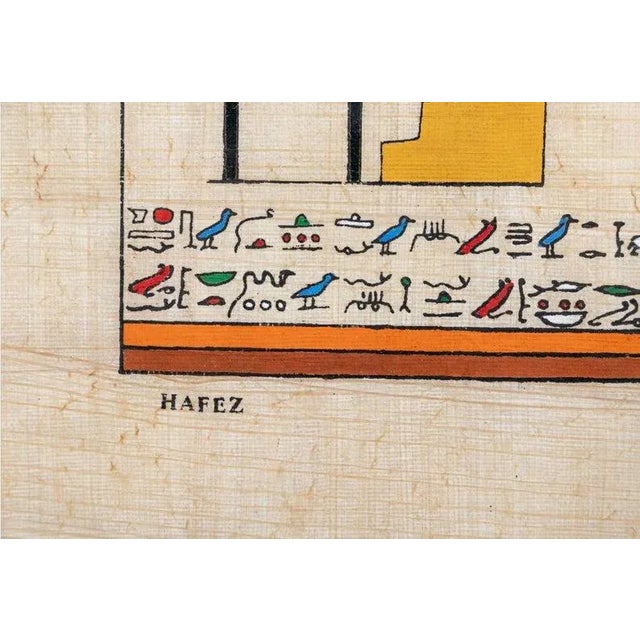
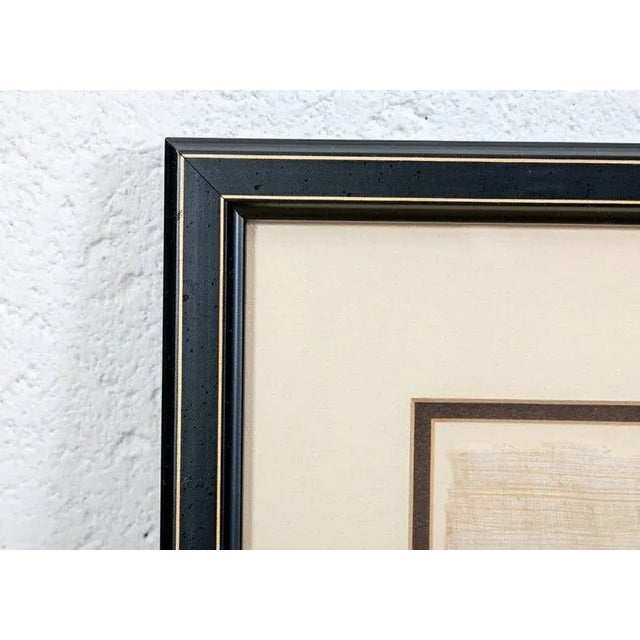
An Egyptian Revival gouache painting on papyrus, depicting a scene of daily life in ancient Egyptian, which an Ophthalmologist doctor is treating a patient by performing delicate eye surgery. Having hieroglyphic accents to the borders, beautiful polychrome decoration, and rich detailing throughout. Signed “Hafez” to bottom left. Professionally framed and matted.
This work was modeled after a painting in Cairo, Istituto Del Papiro. That work is a reconstruction of a fresco from the Theban tomb of Ipi, originally dating back to the Dynasty XIX or 19th Dynasty of Egypt (1292BC - 1189BC). Also known as the Ramesside period,this Dynasty was founded by Vizier Ramesses I, whom Pharaoh Horemheb chose as his successor to the throne.
Provenance:
A fine private estate in Dallas, Texas
Dimensions:
Overall 12.5” W x 15” H x 1” D (frame)
Sight: 7.5” W x 10” H (papyrus)
History:
Surgery was performed on a routine basis in ancient Egypt. Medical records on papyrus along with physical remains and wall paintings, show us that they were quite sophisticated. The Egyptians have left us with some of the earliest ‘hard’ evidence of surgical techniques, tools and reasoning. Many ideas remain true to this day.
Whilst the Egyptians did not perform major surgery as conducted today, they did make major developments in surgical knowledge and practice. Egyptian physicians are known to have performed some minor surgical operations however. The Papyrus Edwin Smith informs us of methods used to treat dislocated bones, the Papyrus Ebers informs us of practices relating to the removal of cysts and tumours’ and offers a variety of methods to achieve this (cautery and bleeding).
Egyptians used antiseptic to aid the healing process, another major development in medical practice (they used Willow leaves and bark which are known to decrease the likelihood of infection). During the ancient period, anaesthetics were not available. Interestingly Egyptians had a reasonable understanding of the functions of major organs, knew that vessels carries blood around the body, as surgical practices were written down and taught to physicians. Additionally, surgery was often conducted in conjunction with healing methods derived from religious beliefs
See less
- Dimensions
- 12.5ʺW × 1ʺD × 15ʺH
- Period
- Mid 20th Century
- Item Type
- Vintage, Antique or Pre-owned
- Materials
- Gouache
- Condition
- Good Condition, Original Condition Unaltered, Some Imperfections
- Color
- Cream
- Condition Notes
- Good vintage condition Good vintage condition less
Questions about the item?
Returns & Cancellations
Return Policy - All sales are final 48 hours after delivery, unless otherwise specified in the description of the product.
Cancellation Policy - Prior to shipping or local pickup, buyers may cancel an order for up to 48 hours, unless otherwise specified.
Related Collections
- Kenneth Ludwig Chicago Signs
- Antique Steel Signs
- Medium-Density Fibreboard Signs
- Bottle Green Signs
- Lithograph Signs
- Nicolette Mayer Collection Signs
- Burnt Orange Signs
- Neoclassical Signs
- Street Signs
- Chinese Signs
- Coca-Cola Signs
- Restaurant Signs
- Antique Signs
- French Signs
- Industrial Signs
- Antique Wood Advertising Signs
- Signs in Los Angeles
- Mid-Century Modern Signs
- American Classical Signs