


Details
Description
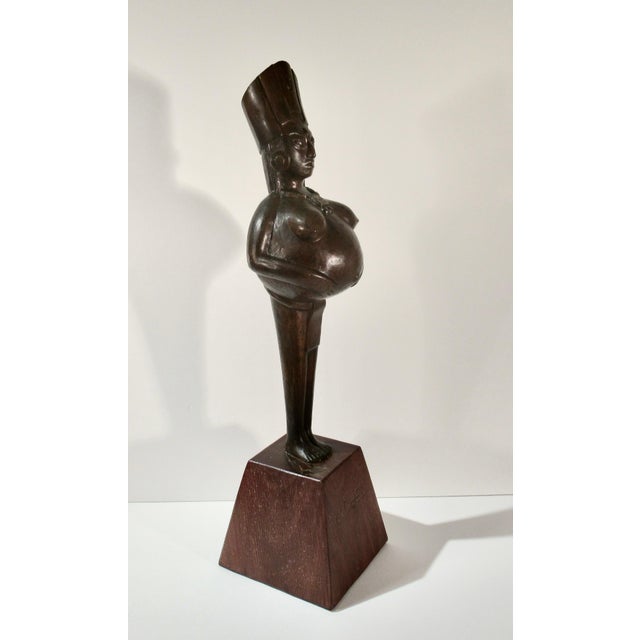
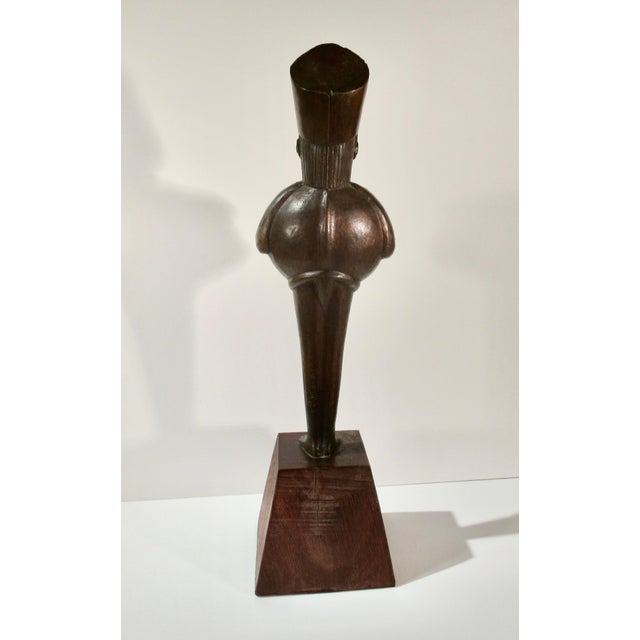
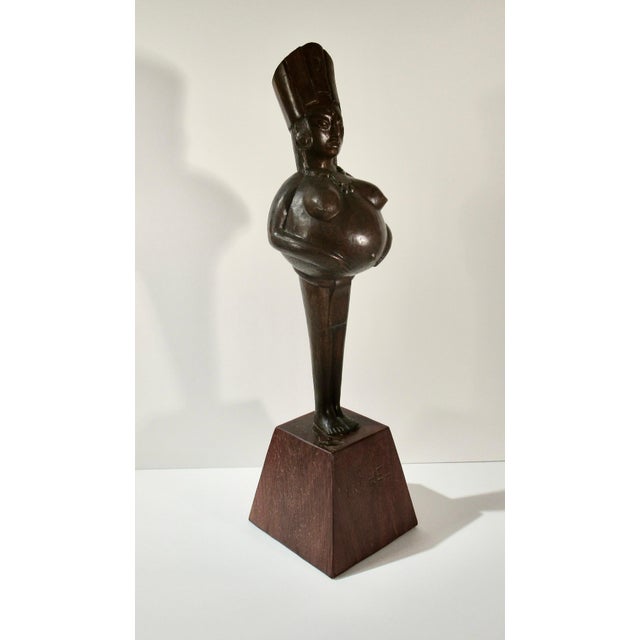
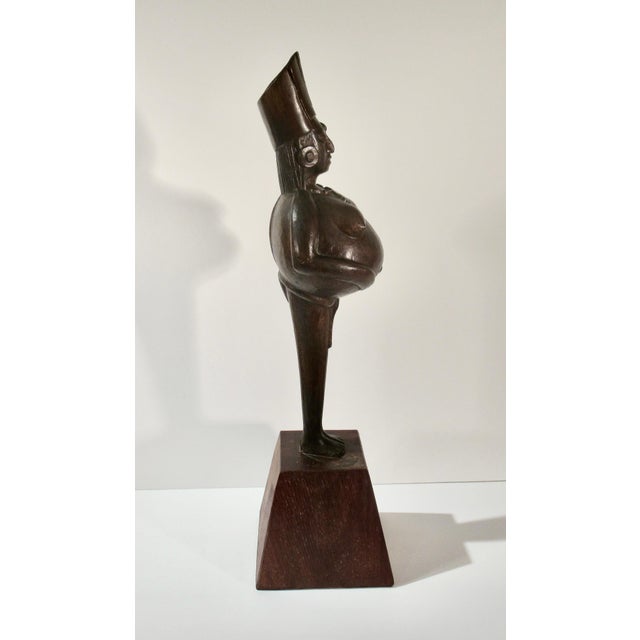
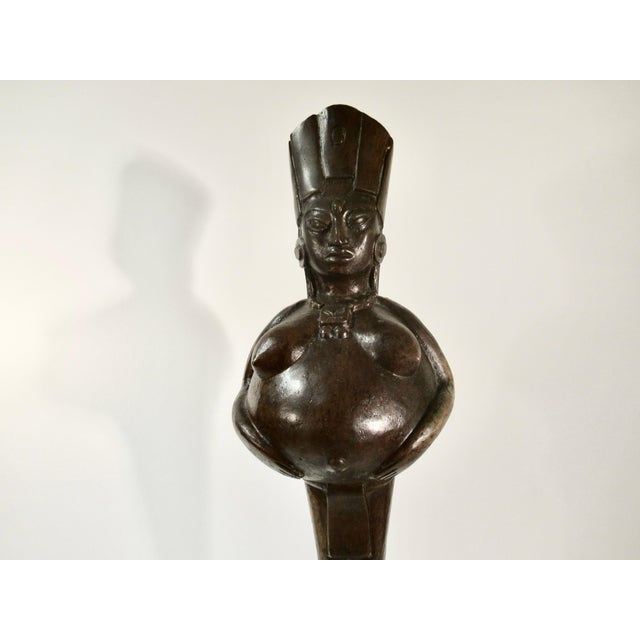
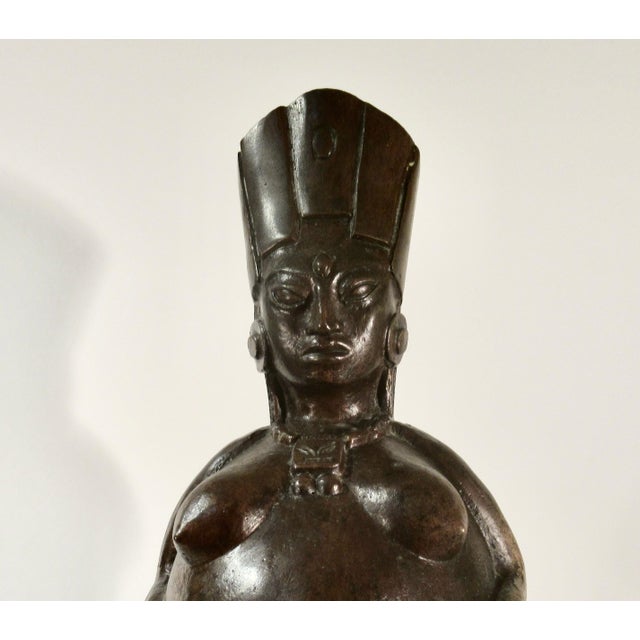
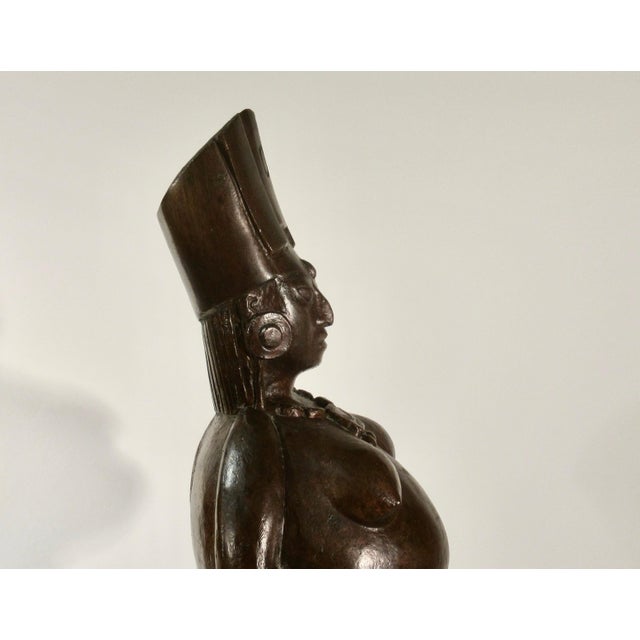
This artwork titled "Ixchel" 1977, is a bronze sculpture with brown patina by noted Mexican artist Enrique Gottdiener Soto, 1909-1986. …
Read more
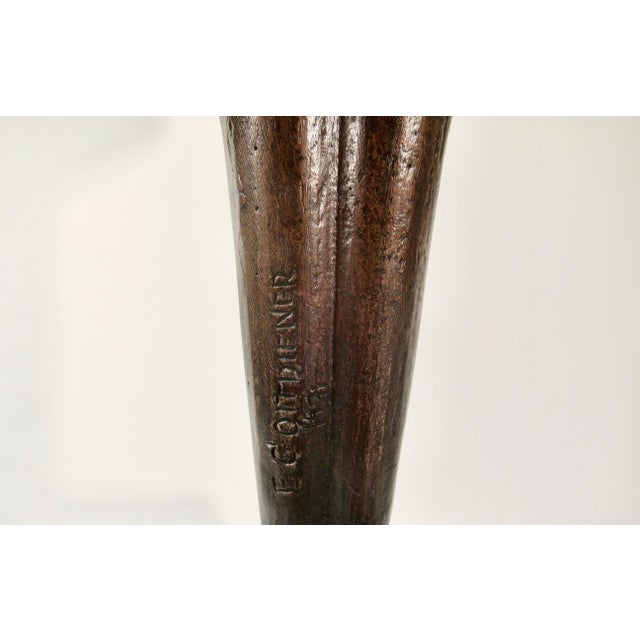
This artwork titled "Ixchel" 1977, is a bronze sculpture with brown patina by noted Mexican artist Enrique Gottdiener Soto, 1909-1986. Signature is impressed on the bronze. The sculpture size is 15.35 x 5 inches, with the wood base is 20.25 x 5.35 inches. It is in excellent condition, the wood base have some minor restorations, practically invisible.
About the artist:
Gottdiener Soto, Enrique (1909-1986) Sculptor. He was born and died in Mexico City. His parents were Marcos Gottdiener, of Austro-Hungarian origin, and Esther Soto, a Mexican. When he was a child, his grandfather took him to Austria, where he began his studies in the art of miniatures with a Viennese goldsmith named Kurt Beckman. During this time he studied violin, a discipline that he could not continue practicing because he lost the last phalanx of his middle finger at a baptism party for which he was hired to play and which ended in a violent manner. Later, he was a student of Luidwig Weiss, a wax sculptor, but when he left Austria he was apprenticed to Feltheim, whom he could not stand because of his bad temper. He moved to Budapest, Hungary, where he entered the Munkasci School of Art; later he worked with the cabinetmaker Gustav Herbert. When he felt that he had some mastery in woodworking, he decided to go to Transylvania, today Romania, and in Oradea he worked in the workshop of the Engelstein brothers. Later he visited Odessa, Kiev and Beirut, where he fought alongside Lebanese students against French colonialism. From Beirut he went to Vienna, from there to Prague, returned to Vienna and left for Berlin, where he entered the Molzschnitzerschule or woodcarving school. Then he went to Holland, from there to France, Belgium and Spain. In Santander, to earn a living, he specialized in carving figures of Saint Francis and Saint Anthony. In Vigo, taking advantage of the fact that Galicians were recruiting to go to Cuba to cut sugarcane, he signed up and embarked for the island. After spending two months in Cuba, he decided to embark for Veracruz. In Mexico he studied at the San Carlos School and then at the Coyoacán Open Air Painting School, where he received the teachings of Ramón Martínez. In Mexico he learned to carve, gilding and the restoration of antiques. He was an assistant to Carlos Bracho and a friend of Francisco Montoya de la Cruz and Rodolfo González, prominent native artists from Durango.
For a time he lived in Guadalajara, where he began to work with the master Pablo Valdez. There he devoted himself to making miniatures in ivory and worked at the State Museum. In Guadalajara he met Jesús Guerrero Galván and Raúl Anguiano. Later he settled in Guanajuato, where he taught fine arts and history at the State College. He did not stay long in Bajío because, influenced by the Vasconcelos spirit of the time, he decided to join the cultural missions project. Thanks to this he was able to travel around the country, and get to know the people and landscapes of rural Mexico. He spent 10 years dedicated to these tasks, several of them in the Sierra de Oaxaca. During these wanderings he was able to get to know the Southeast where he had the opportunity to make sketches of the men and women of Yucatán. These were the inspiration and basis for his later sculptural works. After working in the cultural missions he decided to stay and live in Yucatán. Settled in Mérida, he devoted himself for many years to the creation of antique-style furniture and art objects emulating European ones. He also sculpted classical busts and beautiful miniatures. He was an antique dealer and came to possess a notable collection of art objects.
In 1973 he presented his first exhibition of Yucatecan sculptures, with 20 works in lost-wax bronze, which demonstrated the maturity reached by the artist. In his indigenous heads, in his small peasant figures, the influence of Mayan art can already be perceived. For more than 30 years he was a history teacher at the Federal School Number 1, in Mérida, and during the period of Governor Luis Torres Mesías (1964-1970) he held the position of head of the General Directorate of Fine Arts, after having taught at the School of Plastic Arts for more than 30 years. In 1972 he was awarded the Yucatán Medal, and in 1979, the Eligio Ancona Medal. As a miniaturist he created works in ivory, hardwoods and metals. He participated in countless exhibitions in Yucatán, Campeche and other parts of the country and abroad. Various of his works can be found in Belgium, Israel, Iran, France, England, Hungary, Romania, Italy and the United States of America.
It was during his most mature period that he began to produce works of a distinctly Yucatecan character, in which he managed to capture the daily life and tragedy of the Mayan people. Among his copious production are: Ixchel , Mayan goddess of fertility; Mestiza , One more son , Mayan Indian with machete , Sitting mother and Mother with child , The weeder , Walking mestiza , Particular express , Goyita , Doña Zenaida , Naked old woman , Sitting wizard and The sorcerer, which is perhaps his most finished work and the one for which he is always remembered. He also made busts of his contemporaries who stood out in art and literature: Ermilo Abreu Gómez, Armando García Franchi, Leopoldo Peniche Vallado, Antonio Mediz Bolio, Eduardo Urzaiz Rodríguez, Guty Cárdenas. The one of Mediz Bolio is considered a masterpiece of characterization. He was not prodigal in statuary; However, he left behind, among others, a bronze high relief of Manuel Antonio Ay, in Chichimilá, Yucatán; Indigenous Mother with Child , in Tixpéhual, Yucatán; the monument to Friar Diego de Landa, in Izamal , Yucatán; the bust of Jacinto Canek and that of Alfredo Barrera Vásquez, in Mérida. He also collaborated in the realization of the Monument to the Child Heroes, in the park of La Mejorada. Gottdiener, referring to his sculptural work, said: "I try to rescue the cultural values of a race, of an ethnic group. Of this wonderful people that is the Maya. Good, peaceful, humane people; people of exquisite and delicate artists, whose cultural manifestations are never an invitation to kill. We must revive the values of this race. This humanism deserves our support. With my sculptures I intend to move people so that they realize the value that respect for man contains." As a tribute to his work, on December 13, 1981, the state government established the Gottdiener Room at the Juan Gamboa Guzmán Art Gallery in Mérida, which exhibits 37 of his bronzes.
See less
- Dimensions
- 5.35ʺW × 5.35ʺD × 20.25ʺH
- Styles
- Figurative
- Art Subjects
- Figure
- Period
- Late 20th Century
- Item Type
- Vintage, Antique or Pre-owned
- Materials
- Bronze
- Condition
- Good Condition, Original Condition Unaltered, Some Imperfections
- Color
- Bronze
- Condition Notes
- Excellent Excellent less
Questions about the item?
Returns & Cancellations
Return Policy - All sales are final 48 hours after delivery, unless otherwise specified in the description of the product.
Cancellation Policy - Prior to shipping or local pickup, buyers may cancel an order for up to 48 hours, unless otherwise specified.
Related Collections
- Straw Sculpture
- Roman Bronze Works Sculpture
- Constantin Brancusi Sculpture
- Louis XIV Sculpture
- Fernando Botero Sculpture
- Antique Iron Finish Sculpture
- Medium-Density Fibreboard Sculpture
- Gold-Plate Sculpture
- Bakelite Sculpture
- Polished Brass Finish Sculpture
- René Lalique Sculpture
- Albert Ernest Carrier-Belleuse Sculpture
- Sculpture in Panama City, FL
- Gourd Sculpture
- Recycled/Repurposed Sculpture
- Photography Sculpture
- Geode Sculpture
- Worlds Away Sculpture
- Barovier and Toso Sculpture
- Far Pavilions Sculpture
- Emmanuel Villanis Sculpture
- Maison Jansen Sculpture
- Flavio Poli Sculpture
- Georgian Sculpture
- Sculpture in Columbus