



Details
Description
Artist: Rafael Bogarin – Venezuelan (1946- )
Title: Jupiter 4
Year: 1980
Medium: Screen Print
Sight size: 19.5 x 25.5 …
Read more
Artist: Rafael Bogarin – Venezuelan (1946- )
Title: Jupiter 4
Year: 1980
Medium: Screen Print
Sight size: 19.5 x 25.5 inches.
Sheet size: 22.5 x 28.5 inches.
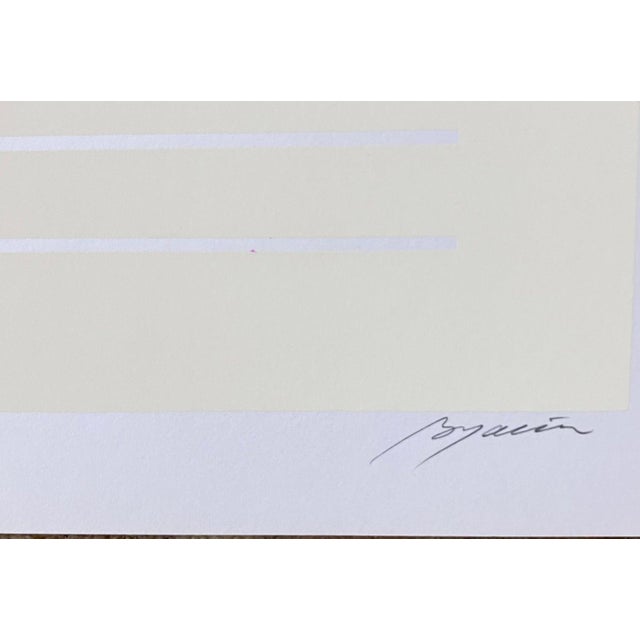
Signature: Signed lower right
Edition: 295 This one: 116/295
Condition: Excellent
Unframed
This exceptional geometric abstract serigraph is by the noted Venezuelan artist Rafael Bogarin (1946- ). This is Jupiter 4. I have others from the series, also for sale. The print has never been framed and is in excellent condition. It measures 22.5" x 28.5".
Rafael Bogarin is an established contemporary Venezuelan artist known for his abstract serigraphs. Bogarin was born in 1946, in El Tigre, where he grew up making his own toys and learning to draw. He studied in Caracas at the Cristobal Rojas School of Fine Arts, specializing in lithography and etching.
From 1970 to 1992, Bogarin, like so many artists, lived in New York. As he explored various techniques, he became an expert in serigraphs, earning himself acclaim in Latin America as a pioneer. In South America he traveled the continent giving classes and learning about native cultures. When he returned to the land of his youth, he was inspired to create the concept of the entire world in the Museo Vial in El Tigre in 1982. Later he made others along the route between Colombia and Venezuela. Recently he has been creating and realizing ideas like the Museo de Murales a Cielo Abierto (Museum of Murals to the Open Sky).
Detailed biographical information (source: artist's website):
Rafael Bogarín was born in El Tigre, Anzoátegui state, Venezuela, on January 20, 1946. He studied at the Cristóbal Rojas School, which he finished in 1966; Among his teachers are Luis Guevara Moreno, Pedro León Zapata, Luisa Palacios and Luis Chacón. Upon returning from school he founded the Zapato Roto group with other artists, with the aim of taking art to the streets. In 1966 he directed the outdoor exhibitions of the Venezuelan American Center, and two years later he participated in the XXVIII Official Salon, where he received the Rome Prize.
During that time he ordered elements such as nuts and serrated blades in relation to discs engraved with burin and other techniques, and made the final impression in planes of one color. In 1970 he received a scholarship and traveled to New York; He studies at the Pratt Graphic Center and the Blackburn Printmaking Workshop. In 1973 he founded, together with Manuel Kohn, the Bogarín Printmaking Workshop, a workplace for Venezuelan artists living in the United States; This workshop, of which he has been master printer, allowed continuity to his artistic work. Bogarín investigates the possibilities of super eight cinema and makes films with quality similar to commercial formats; From these experiences emerge The Lonely World (1975) and New World Symphony (1976). In 1977 he deepened his study of color with The New Color, a portfolio where he produced superimposed colors through transparencies and glazes.
His teaching experience includes courses at the Rafael Monasterios School of Plastic Arts in Maracay (1969-1970), Ceagraf (1979), as well as workshops in various cities around the world. In 1980 he made an exhibition of silkscreen prints in cities in Italy, El Salvador, Colombia, Mexico and the United States. That year he resumed his interest in outdoor exhibitions with a museum project with murals by 30 artists for El Tigre (Venezuela); The Rafael Bogarín Road Museum was inaugurated in 1982 and brought together 30 murals on 2 x 4 meter fences, by artists such as Mario Toral, Édgar Sánchez and Paul Davis. He carried out the project to recover the architectural spaces of El Tigre (Venezuela), through murals, sculptures, plazas and humanized spaces.
In 2006 he painted the largest painted flag in the world in El Tigre, Venezuela. Bogarín has exhibited his work on all 5 continents and currently lives and works in Panama City in his private workshop and in the Articruz workshop.
Individual exhibitions
Ø 1966. Gallery of the Medical College. Caracas Venezuela.
Ø 1966. Venezuelan American Center. Caracas Venezuela.
Ø 1970. Protobello Gallery. Caracas Venezuela.
Ø 1977. First National Bank of Louisville. Luosville, Kentucky, USA.
Ø 1978. Venezuela Gallery. New York City, USA.
Ø 1979. Julián Marchena Room, Museum of Costa Rica. San Jose Costa Rica.
Ø 1979. La Otra Banda Gallery. Merida, Venezuela.
Ø 1980. Galeter Center. Adro, Italy.
Ø 1980. Gallery of Modern Art. Santo Domingo Dominican Republic.
Ø 1980. Jewish Community Center. Monmouth, New Jersey, USA.
Ø 1980. Frank Fedele Fine Arts. New York City, USA.
Ø 1980. El Túnel Gallery. Guatemala, Guatemala.
Ø 1981. Garcés – Velásquez Gallery. Bogota Colombia.
Ø 1982. Siete Siete Gallery. Caracas Venezuela.
Ø 1984. Acquavella Gallery. Caracas Venezuela.
Ø 1985. Cultural Center. Santa Cruz, Bolivia.
Ø 1992. Sotage Gallery, Puerto La Cruz, Venezuela.
Ø 2017. Arteconsult Gallery. Panama City, Panama.
Awards
Ø 1969. Rome Prize. XXIX Official Salon of Venezuelan Art, Museum of Fine Arts. Caracas Venezuela.
Ø 1971. Honorable mention. First Young Artists' Salon. Maracay, Venezuela.
Ø 1984. First prize, Salón Aragua. Maracay, Venezuela.
Murals
Ø 1974. Venezuelan Consulate. New York City, USA.
Ø 1982. Creator of the First Road Museum in the World. El Tigre, Venezuela.
Ø 1983. Road Museum. Roldanillo, Colombia.
Ø 1984. Bicentennial Road Museum. Cucuta, Colombia.
Ø 2000. Ceramic mural. Dairy, Venezuela.
Group exhibitions
Ø 1963 to 1966. Spiral Gallery. Caracas Venezuela.
Ø 1966. El Pez Dorado Gallery. Caracas Venezuela.
Ø 1966. “Zapato Roto” Festival. Caracas Venezuela.
Ø 1967. D´Empaire Hall. Maracaibo Venezuela.
Ø 1970. Drawings and engravings room. Central University of Venezuela. Caracas Venezuela.
Ø 1966 and 1971. Arturo Michelena Hall. Valencia, Venezuela.
Ø 1966 to 1968. Annual Venezuelan Art Salon. Museum of Fine Arts. Caracas Venezuela.
Ø 1968. Luis Ángel Arango Library. Bogota Colombia.
Ø 1969. Tertulia Room. Cali, Colombia.
Ø 1969. Lunn Gallery. Washington, DC, USA.
Ø 1969. Gallery of Visual Arts. Maracay, Venezuela.
Ø 1970. Venezuelan Cultural Week. Miami and Jamaica.
Ø 1972. Two Rivers Gallery. Binghampton, New York City, USA.
Ø 1972. Moos Gallery. Montreal, Canada.
Ø 1973. Spoleto Festival. Italy.
Ø 1974. Young Artists, Union Carbide Building. New York City, USA.
Ø 1975. Government of Caracas. Caracas Venezuela.
Ø 1975. Graphic VII, Mendoza Gallery. Caracas Venezuela.
Ø 1976. Brooke Alexander Gallery. New York City, USA.
Ø 1977. Denise Rene Gallery. New York City, USA.
Ø 1978. Sam Flax Gallery. New York City, USA.
Ø 1978. Rizzoli Gallery and Window. Fifth Avenue, New York City, USA.
Ø 1978. First International Salon of Graphic Arts. Bolivia.
Ø 1979. School of Fine Arts. San Jose Costa Rica.
Ø 1979. Juannio Room. Guatemala, Guatemala.
Ø 1979. El Círculo Gallery. Mexico City, Mexico.
Ø 1979. Fourth Latin American Biennial. San Juan Puerto Rico.
Ø 1980. First Latin American Graphics Biennial. Cayman Gallery. New York City, USA.
Ø 1981. Forma Gallery. Miami, USA.
Ø 1982. Kouros Gallery. New York City, USA.
Ø 1986. Puerto Rico Biennial. San Juan Puerto Rico.
Ø 1986. Mocha Biennal. New York City, USA.
Ø 1987. Cork Gallery. Lincoln Center. New York City, USA.
Ø 2015. Marion Gallery. Panama City, Panama.
Ø 2018. Salvador Allende Solidarity Museum, Santiago de Chile, Chile.
Important collections
Ø Venezuelan Embassy before the Organization of American States. Washington, DC, USA.
Ø Cisneros Collection. Venezuela.
Ø University of Austin. Austin, Texas.
Ø Conicit Institute. Caracas Venezuela.
Ø Conac Institute. Caracas Venezuela.
Ø National Gallery. Caracas Venezuela.
Ø Venezuelan Institute of Scientific Research (IVIC). Caracas Venezuela.
Ø Myth Juan Company. Caracas Venezuela.
Ø Tourism Corporation. Caracas Venezuela.
Ø IBM Corporations. New York City, USA.
Ø Chase Manhattan Bank. New York City, USA.
Ø E.FX Film Laboratory. New York City, USA.
Ø Museum of Costa Rica. San Jose Costa Rica.
Ø School of Fine Arts. San Jose Costa Rica.
Ø Venezuelan Consulate. New York City, USA.
Ø Venezuelan Embassy before the United Natios. New York City, USA.
Ø House of the Americas. Havana Cuba.
Ø Latin American Museum. Washington, DC, USA.
Ø Dade Public Library. Miami, USA.
Ø Bibliotheque Nationale Cabinet des Estampes. France.
Ø Omar Rayo Museum. Roldanillo, Colombia.
Ø Banco Latino. Caracas Venezuela.
Ø Gathering Room. Cali, Colombia.
Private collections
Ø Italy, Spain, Colombia, United States, France, Panama, Mexico, Trinidad, Japan, Israel, Ecuador, Chile, Canada, Dominican Republic, Guatemala, Costa Rica, Greece, Brazil and Venezuela.
See less
- Dimensions
- 28.5ʺW × 0.1ʺD × 22.5ʺH
- Styles
- Abstract
- Frame Type
- Unframed
- Art Subjects
- Geometric
- Period
- 1980s
- Item Type
- Vintage, Antique or Pre-owned
- Materials
- Paper
- Screen Print
- Condition
- Good Condition, Original Condition Unaltered, Some Imperfections
- Color
- Beige
- Condition Notes
- Excellent Excellent condition. Excellent Excellent condition. less
Questions about the item?
Returns & Cancellations
Return Policy - All sales are final 48 hours after delivery, unless otherwise specified in the description of the product.
Cancellation Policy - Prior to shipping or local pickup, buyers may cancel an order for up to 48 hours, unless otherwise specified.
Related Collections
- Patrick Nagel Reproduction Prints
- Hable Reproduction Prints
- Reproduction Prints in Panama City, FL
- Sister Parish Reproduction Prints
- William Hogarth Reproduction Prints
- Jonathan Adler Reproduction Prints
- Lauren Ralph Lauren Reproduction Prints
- Edward S. Curtis Reproduction Prints
- Jute Reproduction Prints
- Sam Francis Reproduction Prints
- William Gropper Reproduction Prints
- Alvar Aalto Reproduction Prints
- Utagawa Kunisada (Toyokuni Iii) Reproduction Prints
- Daylight Dream Editions Reproduction Prints
- Reproduction Prints in Mobile
- Gold-Plate Reproduction Prints
- Polychrome Reproduction Prints
- Restoration Hardware Reproduction Prints
- Joshua Reynolds Reproduction Prints
- Port 68 Reproduction Prints
- Tuscan Reproduction Prints
- Dorothy Draper Reproduction Prints
- Ralph Lauren Reproduction Prints
- Mark D. Sikes Reproduction Prints
- Bunny Williams Home Reproduction Prints