

Details
Description
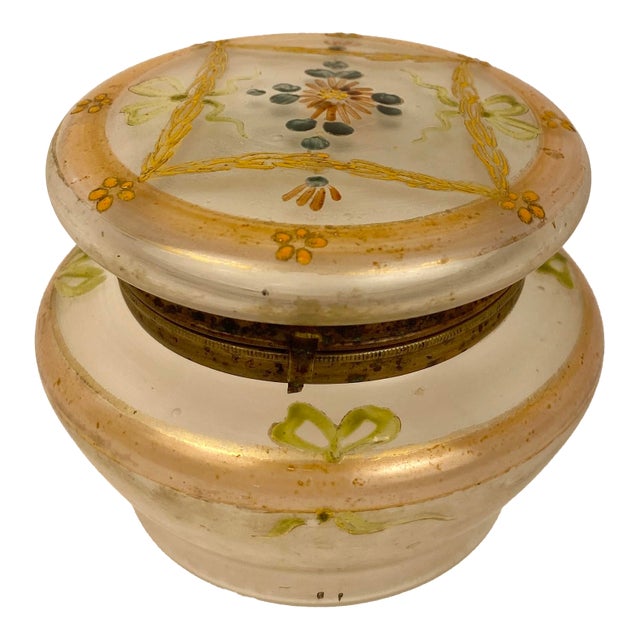
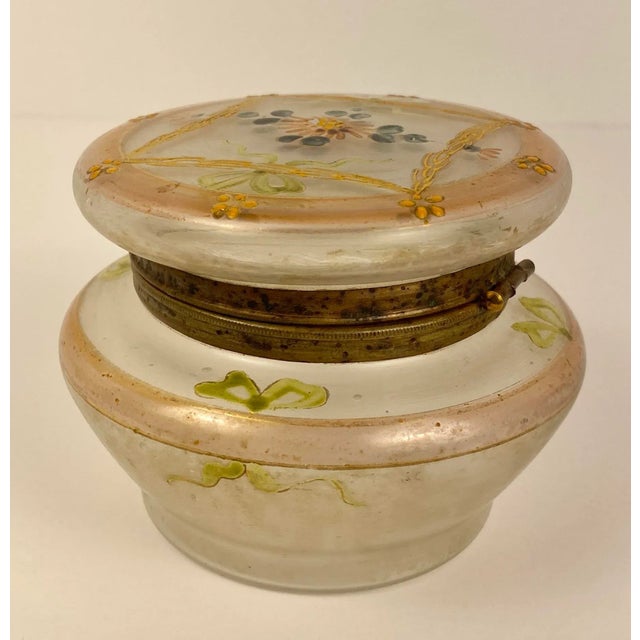
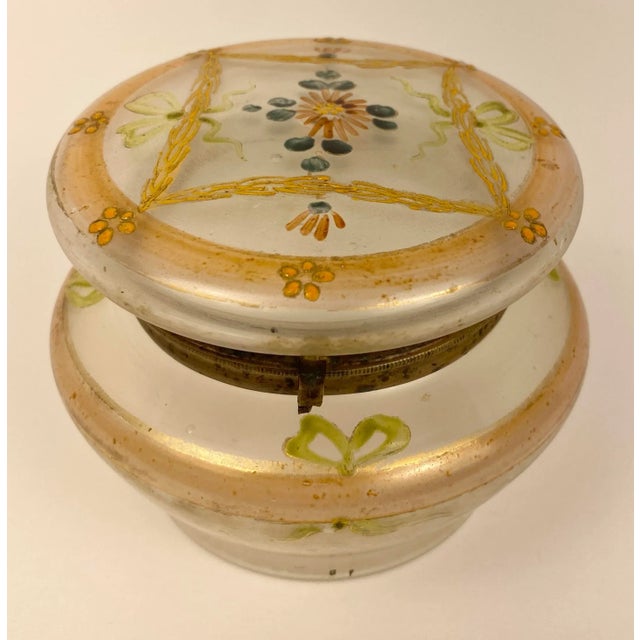
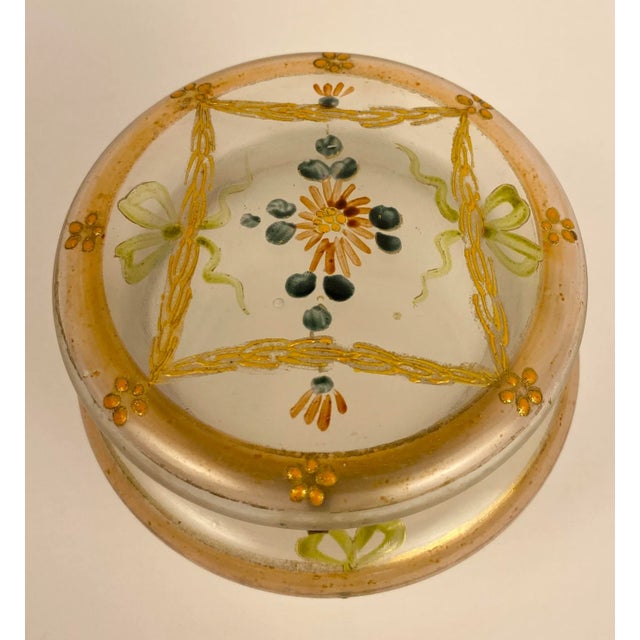
French Art Nouveau Enameled Glass Trinket or Jewelry Box by Legras Glassworks, France
A beautiful hand-crafted and richly decorated French …
Read more
French Art Nouveau Enameled Glass Trinket or Jewelry Box by Legras Glassworks, France
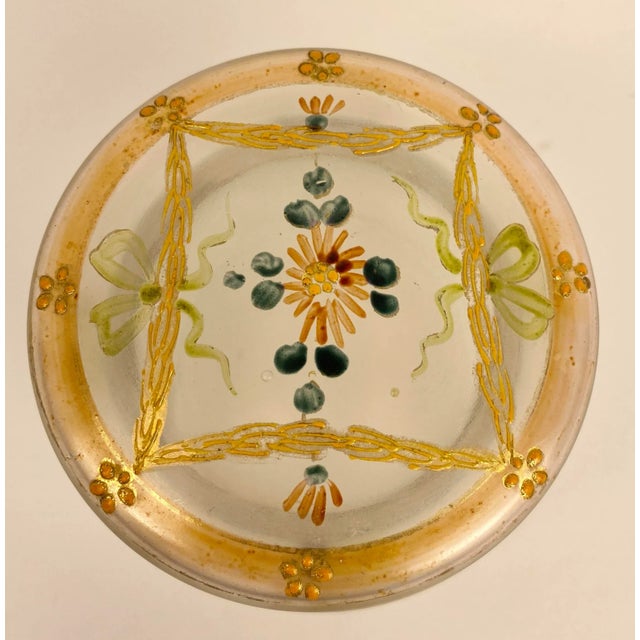
A beautiful hand-crafted and richly decorated French Art Nouveau enameled glass trinket or jewelry box, attributed to Legras Glassworks. The piece features delicately applied enamel in soft, natural tones typical of the Art Nouveau movement, highlighting its elegant floral and organic motifs.
Finely detailed and highly decorative, this lidded box exemplifies the refined craftsmanship for which Legras was renowned. Perfect for holding small treasures or displayed simply as a work of art.
Dimensions: 4" Diameter × 3 1/4" High
A wonderful collectible French Art Nouveau glass box—an ideal decorative accent or thoughtful gift.
Legras Art Glass History:
The Legras glassworks – ultimately a multi-centered concern employing hundreds of people across several manufacturing centers – produced enough highly-distinctive pieces to be considered an art-glass movement in its own right.
It’s more accurate, of course, to consider the name one of the foremost in the panoply of innovative, experimental and overtly artistic producers who revolutionized decorative glassware from the mid 1860's, throughout the fin de siècle, across the duration of the Great War and beyond.
The founding father of the company, François-Théodore Legras, came from humble stock, having begun life as a woodsman in the Vosges department south of Strasbourg. In 1859, Legras determined that there was potentially more to life than trees and leaves, and secured himself a clerical apprenticeship at the glassworks in Clairey, a long-established manufactory producing drinking glasses and tableware which – crucially for Legras – included the manufacture of crudely-frosted pieces.
After learning his trade for five years, Legras moved to Paris and took a job at the Plaine St Denis factory, securing a senior managerial role by the age of 27. He was director of the works when, underwritten by expat-philanthropist Sir Richard Wallace, it was significantly extended and modernized; the duo also took over another factory at Pantin, on the northern fringes of the city.
Unrestrained by the financial strictures of facilities lacking patrons such as Wallace, Legras was able to encourage an experimental approach to glass production, harking back to his childhood in the Darney Forests and using opaque glass – based on Clairey’s frosted material – as a canvas on which designs could be created. The businesses were also underwritten by the production of utilitarian glassware for industry – distilleries and pharmacies – and this security gave François-Théodore the freedom to develop his art-glass production techniques. Intricately cut cameo glass pieces, acid-etched and enameled imagery – requiring up to five separate firing processes to achieve the desired effect – became the Legras hallmark, with many pieces featuring forested landscapes and the favored themes of the artistic director - irises, orchids and chrysanthemums.
Additional members of the Legras family were apprenticed in to the company, notably a nephew – Charles – whose expertise in the chemical treatment of glass to produce marbled, opaline surfaces on which designs could be overlayed, was to prove a valuable commodity. Charles was ultimately to take over the running of the businesses in 1909, seven years before the death of his uncle. He was able to maintain a level of innovation which sustained the company for another decade – achieving notable successes in developing synthesized “gemstones” which could be ground up and incorporated in to the glass melt to give an extraordinary depth of colouration which provided the base for the production of striking cameo vessels.
A second nephew, Theodore, took over the running of the company after Charles’ death in 1922, but the quality and volume of outturn began to decline, and the operation passed out of the family’s hands in 1928, transferring to Heiligenstein, Souchon-Neuvessel and Francois Coty in turn – all of whom continued to produce material under the Legras name, trading on the reputation left by an extraordinarily rich and varied back-catalogue of wares left by six decades of superlative craftsmanship.
See less
- Dimensions
- 4ʺW × 4ʺD × 3.25ʺH
- Brand
- Verrerie Legras
- Period
- Early 20th Century
- Country of Origin
- France
- Item Type
- Vintage, Antique or Pre-owned
- Materials
- Art Glass
- Condition
- Good Condition, Original Condition Unaltered, Some Imperfections
- Color
- Amber
- Condition Notes
- Wear consistent with age and use. Minor fading. The original brass mount and hinge retain their beautiful aged patina consistent … moreWear consistent with age and use. Minor fading. The original brass mount and hinge retain their beautiful aged patina consistent with age and use. Subtle oxidation and surface spotting are visible, adding to the authentic antique character of the piece. The hinge functions well and closes securely. less
Questions about the item?
Returns & Cancellations
Return Policy - All sales are final 48 hours after delivery, unless otherwise specified in the description of the product.
Cancellation Policy - Prior to shipping or local pickup, buyers may cancel an order for up to 48 hours, unless otherwise specified.
Related Collections
- Tony Duquette Boxes
- Polyester Boxes
- Enzo Mari Boxes
- Alessandro Albrizzi Boxes
- Port 68 Boxes
- Anthony Redmile Boxes
- Silk Velvet Boxes
- Abaca Boxes
- Violet Boxes
- Acacia Wood Boxes
- Bright Green Boxes
- Ettore Sottsass Boxes
- Jewelry Boxes
- Burlwood Boxes
- Hat Boxes
- Silver Boxes
- Japanese Boxes
- Pill Boxes
- Maitland - Smith Boxes
- Alabaster Boxes
- Tool Boxes
- Cigar Boxes
- Porcupine Quill Boxes
- Porcelain Boxes
- Mother-of-Pearl Boxes