




Details
Description
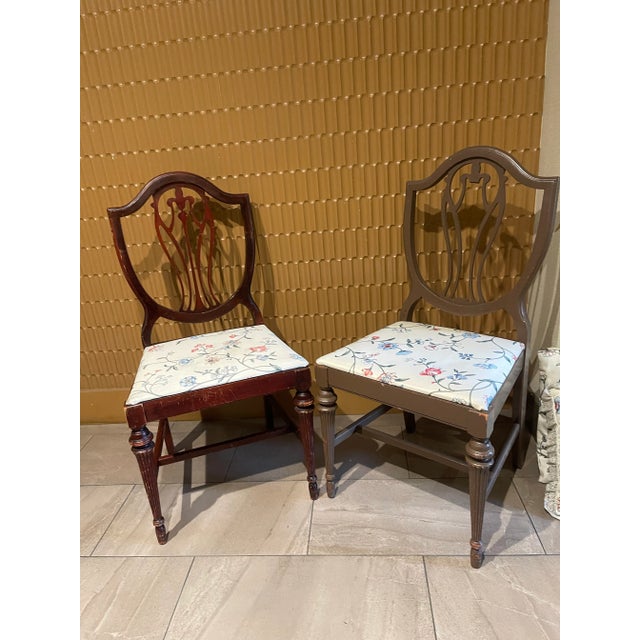
A mis-matched (due to paint restoration) pair of mahogany George III Hepplewhite camel back Cuban mahogany pair of dining chairs …
Read more
A mis-matched (due to paint restoration) pair of mahogany George III Hepplewhite camel back Cuban mahogany pair of dining chairs in modified condition. Square legs, united by stretchers with lovely shape moulded and carved back. The chairs have a flat seat with very nice handsewn covers. The chairs are solid and in acceptable condition for their age. Details on modifications and repair appear below.
Stamped on bottom with alleged design numbers. These stamps are consistent with the style of Duncan Phyfe, however, the actual designer is unverified.
Measurements:
18in. width by 16in. depth by 38in. height overall. Seat height is 17in.
Brief History of Duncan Phyfe and Phyfe-style Furnishings:
The evolution of Duncan Phyfe furniture is an American cabinetmaker’s success story. From humble beginnings, Phyfe became known for his contributions to fine American furniture.
Duncan Phyfe was born in Scotland in 1768, and he moved to the United States with his family in 1784. Phyfe and his family moved to New York state, where his exposure to fine furniture began. At first, he apprenticed in a cabinetmaker’s shop in Albany, New York. Soon after, Phyfe moved to New York City and opened his own furniture-making business on Fulton Street.
By the early 19th century, Duncan Phyfe’s furniture had become increasingly popular with wealthy East Coast customers. He often crafted entire furniture suites for affluent clients.
Duncan Phyfe’s appeal didn’t stop in the 19th century. Throughout the 20th century, Phyfe enthusiasts continued to purchase his original works along with numerous reproduction pieces. Even in 21st century America, he is often called the most famous American cabinetmaker. The Metropolitan Museum of Art in New York City contains numerous Phyfe-attributed or authenticated pieces.
Duncan Phyfe didn’t achieve his wide acclaim by inventing an entirely new furniture style. Instead, he based his designs on fashionable European styles of the late 18th century and early 19th century.
Phyfe was known for his furniture’s excellent proportions and graceful lines, both well-known Neoclassical style hallmarks. Around 1800, Phyfe’s furniture craftsmen were producing delicately-finished furniture pieces in the Sheraton, French Directoire, and Regency styles. By 1825, buyers’ preferences shifted to the heavier Empire style, so Phyfe changed with the times, and began producing pieces in that genre. Fortunately, his well-heeled customers continued to purchase his furniture.
Duncan Phyfe was a furniture manufacturing pioneer. When his furniture-making business was at its peak, he employed over 100 skilled craftsmen to turn out Phyfe-style furniture. In addition to their prolific production, numerous cabinetmakers copied the Phyfe furniture style during the late 1800s and early 1900s.
Identification of Phyfe furnishings:
Many Duncan Phyfe-era cabinetmakers placed their company’s name on every finished furniture piece. Phyfe, on the other hand, put his signature on only a few creations. This means that the great majority of Phyfe furniture pieces have no signature or other identifying marks.
In addition, there is no evidence that Phyfe’s skilled craftsmen labeled their work. However, their furniture would carry the Duncan Phyfe furniture shop pedigree.
If your piece doesn’t have a signature, there are other ways to confirm whether one has a Duncan Phyfe original. Each Duncan Phyfe furniture piece combines then-fashionable style features with his sense of refinement. Certain identifiers appear in many Phyfe furniture pieces. Each Duncan Phyfe chair back features a five-thunderbolt motif with a center bow knot. Phyfe’s scroll-backed chairs often carry this characteristic flourish. Duncan Phyfe designs often exhibit Neoclassical style elements that utilize ancient Grecian symbols. Lyres, scrolls, and acanthus leaves are common. Duncan Phyfe crafted his furniture from quality materials. For the frames, he chose from domestic and exotic hard woods. Mahogany Duncan Phyfe furniture pieces are common. Phyfe also used rosewood, black walnut, cherry, and maple woods.
During the early 20th century, American furniture makers began marketing reproduction Duncan Phyfe furniture. These Duncan Phyfe style items often resemble original Duncan Phyfe pieces and have largely retained their value. A reproduced Duncan Phyfe dining-room set from the early to mid-1900s recently sold for thousands of dollars.
Identifying a Duncan Phyfe furniture piece is a challenge, even for antique furniture experts. For perspective, more than 300 cabinetmakers crafted Phyfe-style furniture in the period from 1810 to 1820.
Hepplewhite shield-back armchairs with floral upholstered seats. There are back pillows available in two differing styles (one is attached with button closures and the other is a loose throw pillow). There is also additional fabric included for further sewing work.
The chairs have been reupholstered at home. The pillows are hand-sewn. Regrettably, one of the chairs has been painted over in a grayish color. Therefore these two chairs are non-matching. The paint can be removed and the chairs need restoration. There are significant markings and scratches throughout the wood. Due to the unique antique design, I have included this well-designed set my Chairish shop. However, these are sturdy project chairs, and they need to be sanded and refinished. The fabric is newly achieved and is in good condition.
See less
- Dimensions
- 18ʺW × 16ʺD × 38ʺH
- Styles
- Hepplewhite
- Seat Height
- 17.0 in
- Seat Interior Depth
- 16.0 in
- Number of Seats
- 2
- Seat Interior Width
- 18.0 in
- Styled After
- Duncan Phyfe
- Period
- Early 20th Century
- Country of Origin
- United States
- Item Type
- Vintage, Antique or Pre-owned
- Materials
- Mahogany
- Condition
- Original Design Modified, Needs Restoration
- Color
- Brown
- Condition Notes
- As mentioned in the description, these are a sturdy set of antique chairs with a lovely design. However, they are … moreAs mentioned in the description, these are a sturdy set of antique chairs with a lovely design. However, they are in need of major restoration to remove the non-matching paint from the one chair and to sand and re-stain the wood on both chairs. Offered at a reduced price due to the restoration work needed. less
Questions about the item?
Returns & Cancellations
Return Policy - All sales are final 48 hours after delivery, unless otherwise specified in the description of the product.
Cancellation Policy - Prior to shipping or local pickup, buyers may cancel an order for up to 48 hours, unless otherwise specified.
Related Collections
- Willett Furniture Dining Chairs
- Tommy Bahama Dining Chairs
- Sally Sirkin Lewis Dining Chairs
- Charles Limbert Dining Chairs
- Bevan Funnell Ltd. Dining Chairs
- Joe and Linda Ricchio Dining Chairs
- Sergio Rodrigues Dining Chairs
- J. Robert Scott Dining Chairs
- Silk Velvet Dining Chairs
- Cork Dining Chairs
- Wittmann Dining Chairs
- Giuseppe Scapinelli Dining Chairs
- Medium-Density Fibreboard Dining Chairs
- Henredon Dining Chairs
- McGuire Dining Chairs
- Burlwood Dining Chairs
- Thomasville Dining Chairs
- Duncan Phyfe Dining Chairs
- Drexel Dining Chairs
- Bentwood Dining Chairs
- Thonet Dining Chairs
- Wrought Iron Dining Chairs
- Hitchcock Dining Chairs
- Chippendale Dining Chairs
- Queen Anne Dining Chairs