




Details
Description
Prattware Prince of Wales Feathers Pearlware Plaques, Pair, Circa 1800–1820
Staffordshire, England, Circa 1800–1820
Made in Staffordshire in the years …
Read more
Prattware Prince of Wales Feathers Pearlware Plaques, Pair, Circa 1800–1820
Staffordshire, England, Circa 1800–1820
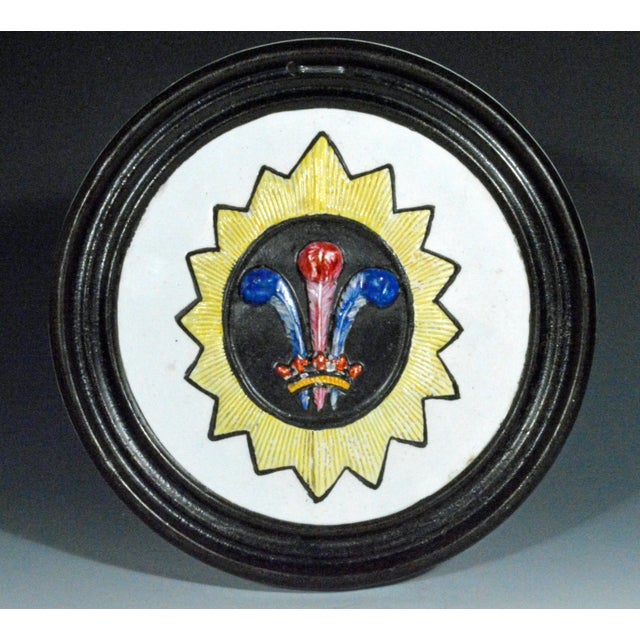
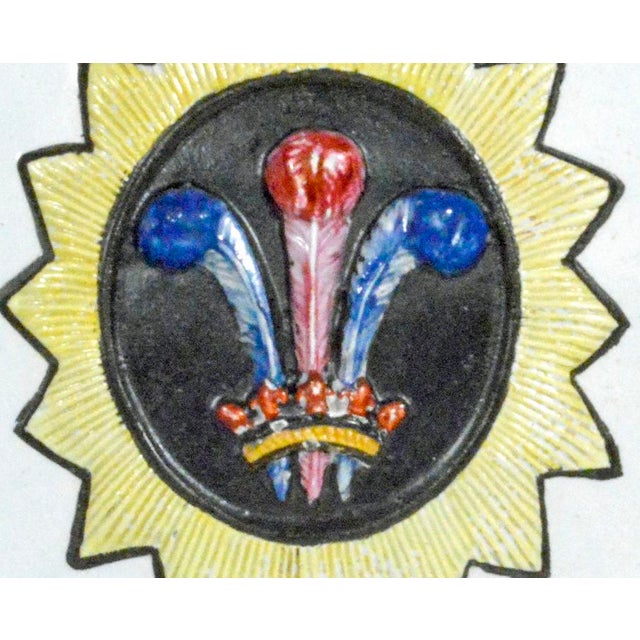
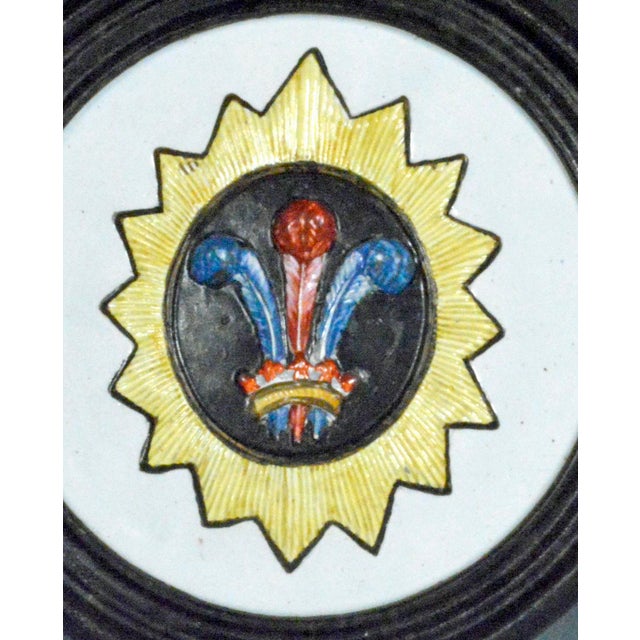
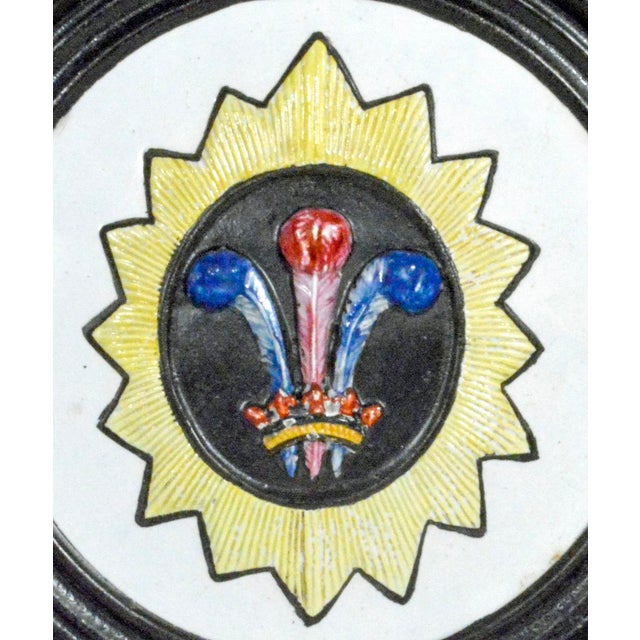
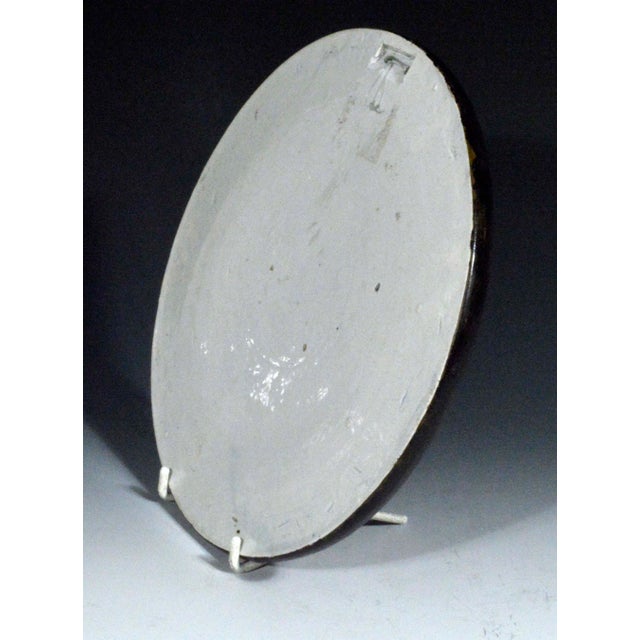
Made in Staffordshire in the years when the future George IV was Prince of Wales and then Prince Regent, this pair of Prattware wall plaques wears his badge with real swagger. Each is molded in relief with the three ostrich plumes rising from a coronet, hand-painted in the bright underglaze colors that make Prattware so collectible: a pair of cobalt-blue plumes flanking a russet-red one, a yellow coronet touched with red, all set on a black oval at the heart of a sixteen-pointed ochre-yellow star. The star sits on a clean white ground inside a black reeded frame that is part of the pottery itself, so the plaques arrive ready to hang, with a molded lug on the glazed reverse for a hook. The colors were brushed on freehand, and the two plaques differ just enough in the shading of the plumes and the strokes of the star to make plain that each was painted by hand.
Hang them as a pair either side of a mirror or a doorway in an entrance hall, stack them one above the other in a narrow wall space beside a chimneypiece, or set them into a bookcase between the shelves where the blue, red, yellow and black read strongly against the spines. They are just as at home against mahogany and brass in a traditional room as against a deep painted wall in a modern one, and they make a spirited talking point in a study or a dining room. We have not traced another example of this model, so this is a rare pair.
Dimensions (each)
Diameter: 8¾ inches (22.2 cm)
Depth: ½ inch (1.3 cm)
Chairish format: 8.75″ W × 0.5″ D × 8.75″ H
Marks
Unmarked, as is usual for Prattware; attributed to Staffordshire on the strength of the modeling and the palette.
Provenance
Earle D. Vandekar of Knightsbridge
Condition
Excellent.
Historical Context
The ostrich feathers, first borne by Edward the Black Prince in the fourteenth century and later combined with a coronet and the motto Ich Dien, form the badge of the heir apparent to the throne. From 1762 to 1820 the badge belonged to George, Prince of Wales, the future George IV, who acted as Regent for his father from 1811, and a plaque of this kind is a modest domestic version of the badge, made for a far wider public than ever wore it.
The composition of the plaques, with the plumes set on a dark oval at the center of a rayed star, is that of the shoulder-belt and shako plates of the period, and the badge was the device of several regiments in these years: the 3rd (Prince of Wales’s) Dragoon Guards, the 10th (Prince of Wales’s Own) Light Dragoons, of which the Prince was Colonel, the 12th (Prince of Wales’s) Light Dragoons, the 82nd (Prince of Wales’s Volunteers) and 87th (Prince of Wales’s Irish) Regiments of Foot and the 23rd Royal Welsh Fusiliers, as well as a number of the volunteer corps raised against invasion between 1794 and 1808, for which the Staffordshire and Yorkshire potters made souvenir jugs and figures. The plumes had a second currency in the same years as the device of the Prince as Grand Master of the premier Grand Lodge of English Freemasons, an office he held from 1790 until 1813, when he resigned it on becoming Regent; a Prince of Wales’s Lodge had been founded for him in 1787. Regimental plates, however, carry a number, a title or the motto, and none appears here, so while the plaques may well have been made for a regimental or masonic buyer, no particular unit or lodge can be named.
Prattware takes its name from the Pratt family of Lane Delph, Fenton, but relief-molded earthenware painted in this palette of underglaze metallic oxides, cobalt blue, ochre-yellow, green, brown and an iron-based orange-red, the colors able to withstand the temperature of the glaze firing, was made by many potteries in Staffordshire, Yorkshire, Tyneside, Liverpool and Scotland between about 1780 and 1840, and relief-molded wall plaques, some with integral molded frames, were among its recognized products
See less
- Dimensions
- 8.75ʺW × 0.5ʺD × 8.75ʺH
- Period
- Early 19th Century
- Country of Origin
- United Kingdom
- Item Type
- Vintage, Antique or Pre-owned
- Materials
- Pottery
- Condition
- Good Condition, Original Condition Unaltered, Some Imperfections
- Color
- Royal Blue
- Condition Notes
- Good condition Good condition less
Questions about the item?
Returns & Cancellations
Return Policy - All sales are final 48 hours after delivery, unless otherwise specified in the description of the product.
Cancellation Policy - Prior to shipping or local pickup, buyers may cancel an order for up to 48 hours, unless otherwise specified.
Related Collections
- Helmut Friedrich Schäffenacker Sculptural Wall Objects
- Medium-Density Fibreboard Sculptural Wall Objects
- Ralph Lauren Sculptural Wall Objects
- Maison Jansen Sculptural Wall Objects
- Dada Sculptural Wall Objects
- Antique Copper Finish Sculptural Wall Objects
- Asian Sculptural Wall Objects
- Greg Copeland Sculptural Wall Objects
- Mid-Century Modern Sculptural Wall Objects
- Curtis Jere Sculptural Wall Objects
- Plaster Sculptural Wall Objects
- Brutalist Sculptural Wall Objects
- Japanese Sculptural Wall Objects
- Sarreid Ltd. Sculptural Wall Objects
- Wenge Sculptural Wall Objects
- Silverplate Sculptural Wall Objects
- Platinum Sculptural Wall Objects
- The American School Sculptural Wall Objects
- Stainless Steel Sculptural Wall Objects
- Arteriors Home Sculptural Wall Objects