


Details
Description
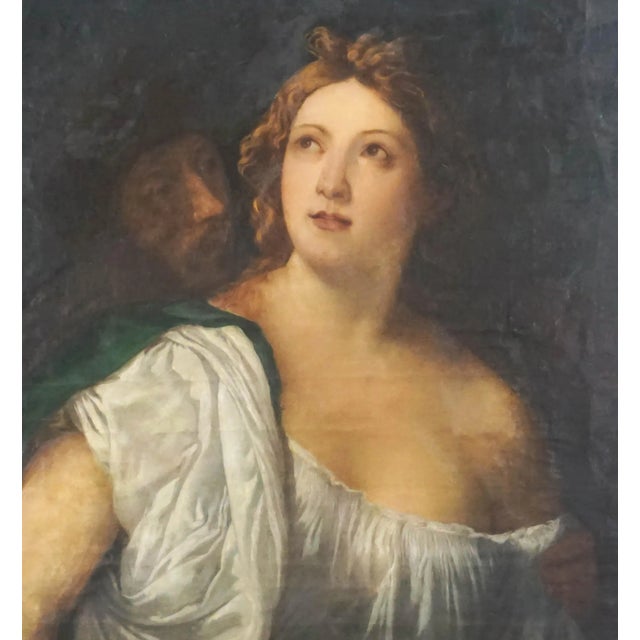
Copy after Titian's Renaissance Painting "Lucretia and Her Husband Lucius Tarquinius Collatinus"
Robert Azensky Fine art is pleased to offer …
Read more
Copy after Titian's Renaissance Painting "Lucretia and Her Husband Lucius Tarquinius Collatinus"
Robert Azensky Fine art is pleased to offer this copy after Titian's Renaissance masterpiece titled "Lucretia and Her Husband Lucius Tarquinius Collatinus." The picture depicts Lucretia about to kill herself so that she can preserve her honor after revealing Sextus Tarquinius raped her the previous night, which makes her the Roman female virtue model. Her face is looking up to the divine light coming from above, which gives her the strength of committing the act. The tension surrounding the awful moment poignantly seizes the moral dilemma of a lady who is forced to choose between honor and life. There are sensual elements in other treatments of this subject, such as the falling robe of Lucretia and the almost-bared breast. Also, the green color of the robe is particularly bright, which is witness to the very good quality of pigments that are available Venice. Lucretia poised with a knife, about to kill herself was a common subject in art, but the addition of the male figure behind her is unique. This figure is now referred to as Lucius Tarquinius Collatinus (the husband of Lucretia), originally painted in painted between 1514-1515 and the original is now in the Museum of Fine Arts, also called Kunsthistorisches Museum in Vienna.
Medium: Oil paint on on stretched linen.
Copy after Titian unsigned
Date: Early 19th Century
Condition: Good; professionally relined on Belgium linen, new stretcher bars, tears and missing paint restored and inpainted. New UV-resistant, non-yellowing varnish applied.
Image size: 33"H x 27"W
Frame size: 39"H x 33"W x 2.25"
Noteworthy is there is an early copy of this painting, which is in the British Royal Family art collection (Royal Collection), known as the world's largest private art collection, identifies the man figure as her rapist, known as Tarquin (Sextus Tarquinius), as do many sources. According to many of the varying Roman accounts of this story, the husband of Lucretia was present when she died, and Tarquin wasn't. If the man figure is meant to be Tarquin, then the setting should be the night before her death, with Lucretia possibly making her plan. Lucretia tragic story occurred in Rome in the 6th century BC during Tarquinius Superbus reign.
Tiziano (Vecelli/Vecellio) Titian was one greatest of Venetian painters, born at Pieve di Cadore (Fruili); died at Vencie, August 27, 1577. It has always been believed that at the time of his death he was a centenarian, and he himself wrote to Philip II in 1571 that he was more than ninety-five, which would make 1477 the year of his birth. But there are good reasons for believing that he made himself out to be older than he was and that he was born about 1487, that is ten years later than the generally accepted date.
Vasari makes him seventy-seven in 1566. Titian would therefore have died when he was between 85 and 90 years old, which would render more credible the marvelous freshness of his later works (cf.Herbert Cook, in the "Nineteenth Century", Jan., 1902, and "Repertorium für Kunstwissenschaft", XXV). The vigorous health which the artist inherited from his mountain race together with a habit of order, balance, and labour determined the predominant characteristic of his art. No painter better expressed, if not the highest beauty, at least that kind of beauty which springs from the deep joy of life, adorning it with an impression of calm, harmony, and serenity.
The first Venetian School had already proved itself capable of expressing these sentiments. Titian was to give them a still freer and fuller expression with an external charm and a magic of coloring which has sometimes raised the question whether he is not the greatest and most complete of all painters.
At the age of ten Titian was brought to Venice and placed by his brother with the celebrated mosaicist, Sebastian Zuccato, but at the end of four or five years he entered the studio of the aged painter Giovanni Bellini, at that time the most noted artist in the city. There he found a group of young men about his own age, among them Giovanni Palma da Serinalta, Lorenzo Lotto, and Sebastiano Luciani, who were all to become renowned.
See less
- Dimensions
- 33ʺW × 2.25ʺD × 39ʺH
- Styles
- Italian
- Art Subjects
- Portrait
- Frame Type
- Framed
- Period
- Early 19th Century
- Country of Origin
- Italy
- Item Type
- Vintage, Antique or Pre-owned
- Materials
- Linen
- Oil Paint
- Condition
- Good Condition, Restored, Some Imperfections
- Color
- Brown
- Condition Notes
- Professionally relined and stretched. All minor tears and missing paint restored and inpainted. New UV-resistant, non-yellowing varnish applied (see images). … moreProfessionally relined and stretched. All minor tears and missing paint restored and inpainted. New UV-resistant, non-yellowing varnish applied (see images). Frame is vintage gilt-toned wood frame (included as is). less
Questions about the item?
Returns & Cancellations
Return Policy - All sales are final 48 hours after delivery, unless otherwise specified in the description of the product.
Cancellation Policy - Prior to shipping or local pickup, buyers may cancel an order for up to 48 hours, unless otherwise specified.
Related Collections
- Lee Krasner Paintings
- Steve Kaufman Paintings
- Richard Anuszkiewicz Paintings
- Limoges, France Paintings
- Paintings in Panama City, FL
- Laminate Paintings
- Margaret Kennedy Paintings
- Keith Haring Paintings
- Jacobean Paintings
- Joseph Solman Paintings
- Louis Wolchonok Paintings
- Mark Lewis Art Paintings
- Mark Lewis Paintings
- Nikolaos Schizas Paintings
- Ralph Lauren Paintings
- Damien Hirst Paintings
- Sol LeWitt Paintings
- Donald Judd Paintings
- BandB Italia Paintings
- Michelle Arnold Paine Paintings
- Vienna Secession Paintings
- Camille Pissarro Paintings
- Paul Jenkins Paintings
- Lee Reynolds Paintings
- Mid-Century Modern Paintings