



Details
Description
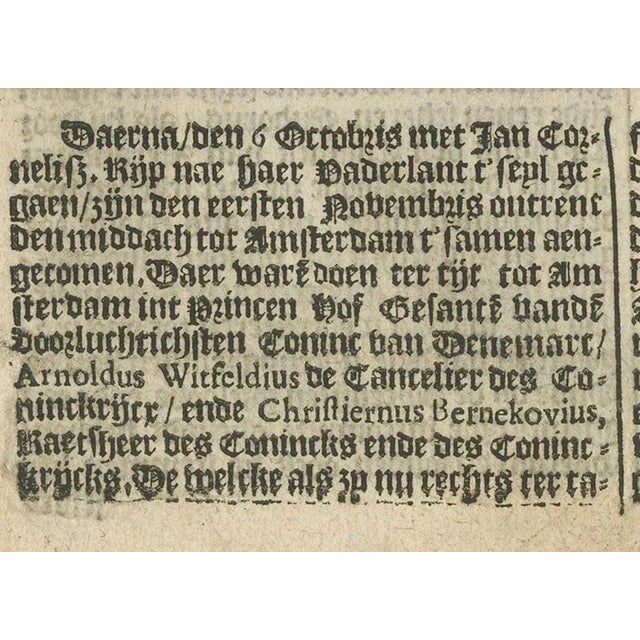
Title: Arrival of Dutch Voyagers in Amsterdam, from Pontanus’ Rerum et urbis Amstelodamensium historia, 1611 This fine early 17th-century engraving … Read more Title: Arrival of Dutch Voyagers in Amsterdam, from Pontanus’ Rerum et urbis Amstelodamensium historia, 1611 This fine early 17th-century engraving depicts the triumphant return of Dutch explorers to Amsterdam, a symbolic celebration of the city’s growing maritime power during the Dutch Golden Age. The scene shows richly dressed merchants, navigators, and civic leaders gathered in a courtyard to welcome home the sailors who had returned from the East Indies. The atmosphere conveys the pride and prosperity of Amsterdam at the height of its expansion as a world trading port. In the composition, a group of men shake hands in greeting, others stand in conversation, and attendants prepare refreshments at a long table beneath the arcade. The architecture, with its orderly facades and arcaded gallery, likely represents the Oost-Indisch Huis — the Dutch East India Company’s headquarters — or a similar civic setting associated with trade and exploration. Every gesture and expression celebrates success, enterprise, and the pioneering spirit of the Dutch nation. This print was published in Johannes Isacius Pontanus’ Rerum et urbis Amstelodamensium historia (History of Amsterdam), printed in Amsterdam in 1611. Pontanus, a Dutch-Danish historian and royal historiographer, compiled one of the earliest comprehensive histories of Amsterdam, richly illustrated with engravings showing the city’s architecture, industry, and overseas ventures. Many of these images were derived from or inspired by the earlier works of Jan Huygen van Linschoten and Cornelis Claesz, chronicling the voyages that opened the sea routes to Asia and laid the foundations for the Dutch East India Company (VOC). The engraving vividly captures the optimism of an era when Amsterdam was emerging as Europe’s leading maritime power. It stands as a remarkable visual document of early 17th-century Dutch life and the civic pride that accompanied the city’s transformation into a global center of commerce and navigation. Condition: Fair to good for its age, with minor toning, faint foxing, and small edge tears not affecting the image. Strong impression with visible plate mark and clean margins. Framing tips: A dark walnut or black ebonized frame with a light ivory or cream mat will enhance the engraving’s contrast and historical depth. A subtle gilt inner edge can further emphasize the composition’s warmth and period character. Technique: Engraving Maker: Anonymous engraver after designs for Johannes Isacius Pontanus, Amsterdam, 1611 See less
- Dimensions
- 7.09ʺW × 9.45ʺH
- Art Subjects
- Figure
- Country of Origin
- Netherlands
- Item Type
- Vintage, Antique or Pre-owned
- Materials
- Paper
- Condition
- Unknown, Some Imperfections
- Color
- Black
- Condition Notes
- Good — This vintage item remains fully functional, but it shows sign of age through scuffs, dings, faded finishes, minimal … moreGood — This vintage item remains fully functional, but it shows sign of age through scuffs, dings, faded finishes, minimal upholstery defects, or visible repairs\. Condition: Fair to good for its age, with minor toning, faint foxing, and small edge tears not affecting the image. Strong impression with visible plate mark and clean margins. less
Returns & Cancellations
Return Policy - All sales are final 48 hours after delivery, unless otherwise specified in the description of the product.
Cancellation Policy - Prior to shipping or local pickup, buyers may cancel an order for up to 48 hours, unless otherwise specified.