




Details
Description
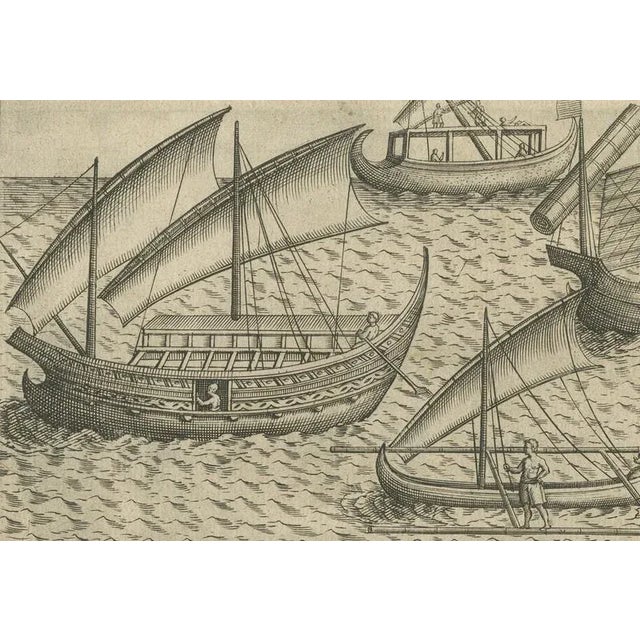
Javanese and Malay Ships near Bantam, from Pontanus’ Amsterdam History, 1611 Plus extra image on the reverse of an elephant, … Read more Javanese and Malay Ships near Bantam, from Pontanus’ Amsterdam History, 1611 Plus extra image on the reverse of an elephant, salamandar, turgle and rhino. This finely detailed early 17th-century engraving depicts a fleet of Southeast Asian vessels—likely Javanese and Malay trading ships—encountered by the Dutch near the port of Bantam (modern-day Banten, Indonesia). The image originates from Johannes Isacius Pontanus’ Rerum et urbis Amstelodamensium historia (History of Amsterdam), published in 1611, which chronicled the city’s rise as a maritime center and celebrated its role in Dutch exploration and global commerce. The engraving shows four distinctive vessels with high sterns and prows, triangular lateen sails, and open decks, closely resembling the *jong*, *lancaran*, and *prau* types used throughout the Indonesian archipelago. These ships were admired by early Dutch explorers for their speed, craftsmanship, and maneuverability in tropical waters. The Dutch, arriving in Java during their first voyages to the East Indies at the close of the 16th century, encountered such vessels at Bantam—then one of the busiest spice ports in Asia. Pontanus’ engravings are among the earliest printed European depictions of Southeast Asian maritime technology. The artist rendered the vessels with careful attention to their characteristic rigging and curved hulls, emphasizing both the exotic novelty and seafaring expertise of the Javanese and Malay peoples. In contrast to the rigid, towering European ships seen in other plates from the same series, these agile local craft appear ideally suited to the shallow coastal waters and monsoon winds of the region. This print forms part of a sequence in Pontanus’ Historia illustrating Dutch maritime encounters from the Arctic to the East Indies, drawing on reports from explorers such as Cornelis de Houtman and Jacob van Neck. It offers not only artistic appeal but also ethnographic and nautical insight into early contact between Europe and the Indonesian world. Condition: Good for its age, with some marginal toning and light wear along the edges. Strong plate impression and clearly legible text. Framing tips: Display in a warm-toned wood frame with a soft ivory mat to enhance the engraving’s maritime character. A black inner line helps accentuate the fine detail of the sails and rigging. Technique: Engraving Maker: Anonymous engraver after designs for Johannes Isacius Pontanus, Amsterdam, 1611 See less
- Dimensions
- 7.09ʺW × 9.45ʺH
- Art Subjects
- Figure
- Country of Origin
- Netherlands
- Item Type
- Vintage, Antique or Pre-owned
- Materials
- Paper
- Condition
- Unknown, Some Imperfections
- Color
- Black
- Condition Notes
- Very Good — This vintage item has no defects, but it may show slight traces of use\. Condition: Good for … moreVery Good — This vintage item has no defects, but it may show slight traces of use\. Condition: Good for its age, with some marginal toning and light wear along the edges. Strong plate impression and clearly legible text. less
Returns & Cancellations
Return Policy - All sales are final 48 hours after delivery, unless otherwise specified in the description of the product.
Cancellation Policy - Prior to shipping or local pickup, buyers may cancel an order for up to 48 hours, unless otherwise specified.